
合规治理

Search documents
腾讯自主构建并落地合规体系获ISO国际双认证
Yang Guang Wang· 2026-02-14 07:55
据了解,ISO 37001与ISO 37301是合规领域的核心国际标准,为组织系统化建立反贿赂及合规管理 体系提供框架。腾讯通过双认证,进一步增强了全球客户与合作伙伴的信任基础,为行业可持续发展树 立新标杆。 (注:此文属于央广网登载的商业信息,文章内容不代表本网观点,仅供参考。) 近日,腾讯宣布获得ISO 37001:2025反贿赂管理体系及GB/T 35770-2022/ISO 37301:2021合规管理体 系两项国际认证,成为互联网行业率先实现广泛业务覆盖的"双认证"企业之一。相关认证由国际公认的 认证机构SGS颁发,标志着腾讯在合规治理与反贿赂管理领域达到国际标准。 在颁证仪式上,SGS亚太区首席运营官杜佳斌指出,腾讯的认证过程未依赖外部咨询机构,完全由 内部团队自主完成体系搭建与落地实施,这是最为值得称道的。"从风险识别到持续改进,腾讯在各环 节均体现严谨性,高层决心与全员配合到位,双认证成果在业内具标杆意义。"杜佳斌表示。 香港廉政公署防止贪污处处长李景文对腾讯取得双认证表示祝贺,并指出腾讯积极参与合规防贪管 理,将诚信透明理念深度融入企业经营管理,与廉署推动防贪倡廉的方向高度一致。李景文表示, ...

平台经济反垄断迈入系统化、精细化 治理新阶段
Zhong Guo Jing Ji Wang· 2026-02-13 12:08
第二,《指引》的核心亮点之一在于其提供详实的法律条文解释,经由风险示例展现出更强的实践 指导性。不同于传统法律文本的抽象表述,《指引》将反垄断法上的一系列核心条款转化为具体可识别 的行为边界,将《中华人民共和国反垄断法》相对抽象的"标准"尽可能的明确化、具体化。特别是具 体、生动的风险示例,使平台经营者能够清晰识别监管红线,避免"踩线",降低合规成本,提高效率, 为平台经济健康有序发展提供更为明确的具体指引。 《互联网平台反垄断合规指引》(以下简称《指引》)的正式出台,标志着中国在平台经济反垄断 领域迈入了系统化、精细化治理的新阶段。尤其是自2020年《关于平台经济领域的反垄断指南》发布征 求意见稿、并于2021年正式出台以来,中国在平台经济反垄断领域又走过五年有余的发展历程。这不仅 是中国数字经济高速扩张的阶段,更是反垄断法治体系在执法与司法维度上不断成熟、深化和建构自主 知识体系的重要时期。本次《指引》的出台,是近五年内中国平台经济发展自主知识体系的系统凝练, 其既总结了过去的中国治理经验和治理智慧,又立足长远,为后续进一步建构良性竞争的市场秩序提供 方向。《指引》不仅填补了平台经济反垄断合规领域的潜在规 ...
沃华医药年报双增背后:销售费用高企、治理隐忧浮现
Xin Lang Cai Jing· 2026-02-06 08:17
Core Viewpoint - In 2025, Shandong Wohua Pharmaceutical reported a revenue of 817 million yuan, a year-on-year increase of 6.96%, and a net profit of 96 million yuan, a staggering increase of 162.93%. However, the annual report reveals several risk signals, including high sales expenses, unusual inter-subsidiary fund transfers, and governance challenges due to the company's "no actual controller" status [1][7]. Group 1: High Sales Expenses and Fund Transfers - Wohua Pharmaceutical maintained a gross margin of 75.38% in 2025, with its core cardiovascular drugs achieving a gross margin of 83.43%, highlighting the competitiveness of its "exclusive + medical insurance" product matrix [2][8]. - The company incurred sales expenses of approximately 407 million yuan, accounting for nearly 50% of its revenue, raising concerns about compliance risks amid heightened regulatory scrutiny on marketing expenses [2][8]. - The company provided 247 million yuan in loans to its loss-making subsidiary, Liaoning Wohua Kangchen, while its profitable subsidiary, Jiangxi Wohua Jishun, earned 18.54 million yuan, questioning the commercial rationale and safety of such financial support [2][8]. Group 2: Governance Risks from "No Actual Controller" Status - In November 2025, Wohua Pharmaceutical entered a "no actual controller" status due to a court ruling, significantly impacting its governance and decision-making mechanisms [3][10]. - The annual report's disclosure regarding this change was minimal, with critical information placed in less prominent sections, increasing the difficulty for investors to access and understand key governance risks [3][10]. - Compliance experts noted that the reasons and implications of the "no actual controller" status should have been clearly stated in the relevant sections of the report, as this situation could lead to decision-making deadlocks [3][10]. Group 3: Environmental and Climate Disclosure Issues - Wohua Pharmaceutical's environmental performance, particularly regarding wastewater and air emissions, was inadequately reported, with key data not directly listed but linked to external platforms, complicating information access for investors [4][11]. - The company failed to provide any climate-related disclosures, such as risk identification or carbon emission accounting, reflecting a lack of maturity in ESG data management among traditional pharmaceutical companies [5][11]. - The reliance on "link-based disclosure" was criticized as merely meeting formal compliance requirements without providing substantial transparency [4][11]. Conclusion - Wohua Pharmaceutical's 2025 annual report presents a picture of impressive performance but raises concerns regarding governance, compliance, and transparency. As regulatory scrutiny intensifies, the company must address these issues to enhance its governance and disclosure practices [6][12].

阳光人寿屡触监管红线,2025年罚金与罚单量创五年新高!
Xin Lang Cai Jing· 2026-01-23 09:40
Core Viewpoint - Sunshine Life Insurance is experiencing steady growth in business scale, with insurance revenue projected to increase from 60.827 billion yuan in 2021 to 92.127 billion yuan in 2025, reflecting an average annual compound growth rate of approximately 10.9% while maintaining a market share of around 2.0% in the life insurance sector [1][4][33]. Group 1: Business Performance - The net profit of Sunshine Life has shown volatility, with a decrease to 4.847 billion yuan in 2025 from 5.713 billion yuan in 2024, indicating a decline of approximately 15% despite continued revenue growth [6][35]. - The contribution from the investment sector has deepened, with significant reliance on investment income due to a recovering equity market, while the growth rate of insurance service revenue remains relatively slow [7][37]. - The concentration of surrender indicators has increased, with some products showing abnormally high values, indicating potential issues in customer retention [8][40]. Group 2: Regulatory Compliance - Sunshine Life faced a significant increase in regulatory penalties in 2025, with 71 penalties totaling 6.843 million yuan, marking a 478% increase compared to 1.184 million yuan in 2024, indicating rising compliance pressures [16][43]. - The company's penalty amount as a percentage of industry total reached 4.19% in 2025, which is more than double its market share of 2.0%, highlighting a disconnect between scale and compliance [46]. - Violations related to sales and marketing accounted for 72 instances over five years, with 33 occurring in 2025 alone, reflecting a direct correlation with performance pressures [48][51]. Group 3: Risk Indicators - The third-quarter solvency report for 2025 indicated a dual characteristic of surrender risk, with a concentration of surrender amounts and abnormal rates for specific products, suggesting a need for careful monitoring of business sustainability [11][40]. - The frequent occurrence of penalties for financial data inaccuracies raises concerns about the reliability of financial information used for decision-making, potentially impacting strategic assessments [54][58]. - The interplay between sales violations and abnormal surrender rates suggests that misleading sales practices may be a significant factor driving customer withdrawals, necessitating a reevaluation of sales strategies [51][54].

审计咨询“向前走” 筑牢合规治理“第一道防线”
Xin Lang Cai Jing· 2026-01-20 08:37
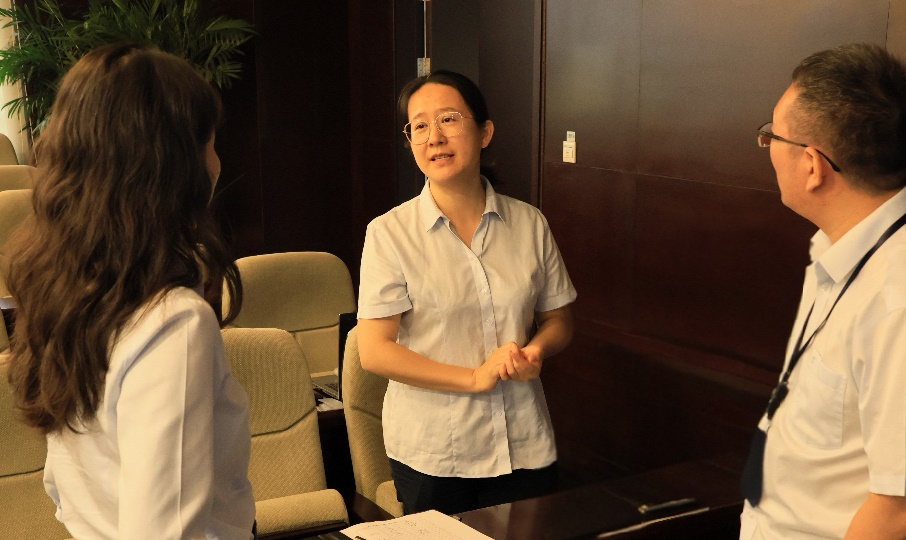
这背后,是浙江中烟打破审计"事后算账"传统模式,统筹监督与服务双重职能,推动审计工作向"事前预防、事中管控"全链条延 伸的积极探索。针对业务推进中的痛点难点,主动迭代审计服务模式,创新构建线上线下联动、分级审核闭环的审计咨询机制, 将专业审计判断精准嵌入业务关键节点,为企业高质量发展筑牢合规"防火墙"。 转自:新华财经 "采购项目启动前,部分业务部门开始尝试通过审计咨询系统寻求风险把关,在不确定事项上提前获得专业意见。"这一"风险前 置、咨询先行"的模式,如今已在浙江中烟落地生根。2025年,浙江中烟聚焦审计职能转型,推动审计咨询机制向业务前端深度 渗透,全年高效处置多项采购领域咨询事项,成功构建起协同高效的合规治理生态,为企业规范运营注入新活力。 编辑:赵鼎 图为审计部在做限价宣讲时提供审计咨询服务 (李庆宇 摄) 制度先行划边界,筑牢服务根基。制定相关管理办法,明确咨询范围、办理流程、权责划分与时限标准,将制度建设、采购事项 等重要领域纳入规范咨询范畴;搭建起"有章可循、有规可依"的工作体系。同时,紧盯业务实操反馈动态优化完善工作机制,确 保服务供给精准对接业务需求,为审计咨询工作高效开展提供坚实制度支撑 ...
715万重罚考问民泰银行合规治理
Bei Jing Shang Bao· 2026-01-13 15:42
Core Viewpoint - Zhejiang Mintai Commercial Bank faces significant compliance issues highlighted by a recent fine of 7.15 million yuan due to ten violations across core business areas, raising concerns about its internal control systems and overall governance [1][2][3] Compliance Issues - The recent fine from the Shanghai Financial Regulatory Bureau points to serious compliance failures, including improper deposit collection through third parties and inadequate loan management practices [2] - Historical data shows repeated violations in loan classification, employee conduct, and credit management across various branches, indicating systemic issues within the bank's operations [2][3] Financial Performance - Despite maintaining revenue growth, with operating income increasing from 62.23 billion yuan in 2022 to 72.12 billion yuan in 2024, the bank's net profit has declined, with a year-on-year drop of over 14% expected in 2024 [1][7] - The bank's net profit figures were 12.3 billion yuan in 2022, 13.39 billion yuan in 2023, and 11.47 billion yuan in 2024, reflecting a concerning trend amidst increasing market pressures [7] Capital and Governance Changes - The introduction of state-owned capital is seen as a potential remedy for the bank's governance issues, with recent capital increases from local state-owned enterprises aimed at enhancing capital adequacy and governance structures [4][5] - Since 2025, the bank's registered capital has increased from 46.07 billion yuan to 56.97 billion yuan, with significant stakes held by local state-owned entities, which may strengthen oversight and compliance [4][5] Industry Context - The banking sector is experiencing a "Matthew Effect," where larger banks continue to thrive while smaller regional banks face significant operational challenges due to limited capital and technological capabilities [8] - Small and medium-sized banks are urged to leverage local economic characteristics and government support to enhance service capabilities and develop unique growth paths [8]
从持牌到持久:香港德辅投资有限公司进入国际监管体系的深层意义
Sou Hu Cai Jing· 2026-01-12 04:10
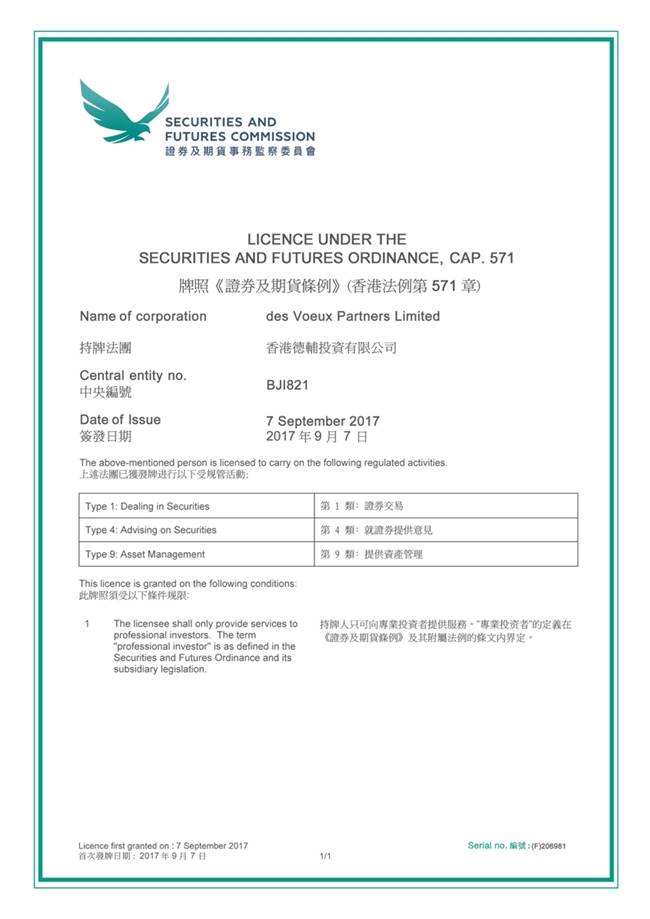
Core Viewpoint - Des Voeux Partners Limited has been officially included in the SFC licensed corporation list, marking a significant transition towards compliance with international asset management standards [1][10]. Group 1: Regulatory Framework - The SFC licensing process is characterized by ongoing supervision rather than a one-time approval, requiring licensed entities to maintain capital adequacy, personnel qualifications, internal controls, compliance reviews, and risk management [2][9]. - The inclusion of Des Voeux Partners in this regulatory framework indicates alignment with international asset management compliance standards, emphasizing that the license represents a long-term commitment rather than a mere promotional tool [2][10]. Group 2: License Structure and Market Positioning - Des Voeux Partners' licensed activities focus on securities dealing (Type 1), advising on securities (Type 4), and asset management (Type 9), which reflects a professional route centered on research capabilities and long-term capital allocation [5][6]. - The regulatory requirements dictate that Des Voeux Partners primarily serves professional investors, leading to a business model focused on limited clients, in-depth service, and long-term partnerships rather than mass-market expansion [7][12]. Group 3: Industry Context and Competitive Landscape - The asset management industry's competitive dynamics are shifting from performance and scale to compliance, risk control, and governance structures, making institutional credibility an essential asset in mature regulatory markets like Hong Kong [9][10]. - Des Voeux Partners' entry into the highly regulated sector exemplifies this trend, highlighting the importance of institutions that can operate sustainably within stringent regulatory environments [10][14]. Group 4: Future Outlook - The company views the licensing approval not as a signal for expansion but as an opportunity to enhance its research systems, risk management mechanisms, and service capabilities within a compliant framework [11][14]. - This restrained approach aligns with the development logic of leading international asset management firms, emphasizing longevity over speed in the current financial landscape [13][14].
全球产业链供应链重塑期的中国企业:能力提升!| 跨越山海
Di Yi Cai Jing· 2025-12-31 05:09
Core Insights - The article discusses the evolving landscape of globalization in 2025, highlighting the rise of trade protectionism and the emphasis on national economic policies, which create uncertainties for Chinese enterprises in their global expansion efforts [2][4]. Group 1: Globalization Trends - The global trade environment is increasingly characterized by protectionism, with countries favoring regional trade agreements over multilateral cooperation, leading to a fragmented trade landscape [6]. - Major economies are tightening foreign economic policies under the guise of national security, particularly the U.S. and EU, which are implementing measures aimed at reducing reliance on Chinese technology and supply chains [6][7]. - The EU is establishing new compliance barriers through regulations that impose environmental and labor standards, creating additional challenges for Chinese products entering the European market [7][11]. Group 2: Market-Specific Challenges - In the U.S. market, Chinese companies face stringent export controls and investment scrutiny, particularly in high-tech sectors, which complicates their operational landscape [9][10]. - The EU has introduced a unified foreign direct investment review mechanism, increasing barriers for Chinese investments in critical sectors, alongside new environmental regulations that impose additional costs on Chinese exports [11][12]. - India has adopted a cautious approach towards Chinese enterprises, implementing strict market entry barriers and local compliance requirements, which complicates the operational environment for Chinese firms [14][15]. Group 3: Regional Dynamics - The RCEP agreement offers both opportunities and challenges for Chinese companies, facilitating trade with ASEAN nations while also intensifying competition from regional players [17][18]. - In Latin America, political changes and regional trade agreements introduce uncertainties for Chinese investments, necessitating a flexible approach to navigate the evolving landscape [19][20]. - The Middle East presents a mixed opportunity for Chinese enterprises, with potential for collaboration in infrastructure and technology, but also challenges related to geopolitical tensions and compliance with local regulations [21][22]. Group 4: Case Studies - DHgate has successfully navigated the U.S. market by leveraging a flexible supply chain and innovative marketing strategies, despite facing significant regulatory challenges [28][29]. - Xiaohongshu has capitalized on the migration of users from TikTok, rapidly expanding its user base internationally, but must address content regulation and data security concerns [34][35]. - BYD has adopted a localization strategy in Europe to mitigate the impact of anti-subsidy investigations, while facing significant barriers in the U.S. market due to high tariffs and restrictive policies [39][40][42].


强化主动合规、突出源头预防 农业银行持续加强全链条合规治理
Zhong Guo Xin Wen Wang· 2025-12-30 07:04
Group 1 - The core viewpoint of the articles emphasizes the commitment of Agricultural Bank to enhance its compliance management system and risk prevention mechanisms to support high-quality development [1][3] - Agricultural Bank is actively implementing regulatory requirements by revising its compliance management basic system and optimizing its compliance management processes, aiming to establish a clear and effective compliance governance structure [1][2] - The bank is focusing on cultivating a strong compliance culture through a series of initiatives, including education and the promotion of compliance best practices, to foster a legal and disciplined environment [2] Group 2 - Agricultural Bank is prioritizing proactive compliance management by establishing differentiated internal control standards and enhancing its internal control prevention system to address key risk points [2] - The bank is committed to integrating compliance into all decision-making and operational processes, aligning with the directives from the 20th Central Committee and the Central Economic Work Conference [3]

强化主动合规 突出源头预防 农业银行持续加强全链条合规治理
Xin Hua Wang· 2025-12-30 05:10
Core Viewpoint - Agricultural Bank is committed to enhancing its compliance management system and risk prevention mechanisms to support high-quality development and ensure safety in operations [1][3]. Group 1: Compliance Governance - The bank is actively implementing regulatory requirements by revising its compliance management basic system and optimizing its organizational structure and operational processes [1]. - A comprehensive compliance governance mechanism has been established, focusing on cultural leadership, institutional norms, compliance review, dynamic assessment, and root cause management [1]. Group 2: Compliance Culture - Agricultural Bank emphasizes a proactive compliance culture through a series of activities that promote the "Five Musts and Five Must Nots" of Chinese financial culture [2]. - The bank is advancing compliance quality by recognizing benchmark units and sharing best practices to foster a strong legal compliance atmosphere [2]. Group 3: Risk Management - The bank has introduced differentiated internal control standards for its five-level institutions to enhance internal control construction [2]. - A closed-loop deterrent mechanism, rigid constraint mechanism, and intrinsic motivation mechanism have been established to address key risk points and improve compliance risk management levels [2].