
新文科建设

Search documents
南开大学:推动文科教育“脱虚向实”
Ke Ji Ri Bao· 2026-02-12 02:31
Core Viewpoint - Nankai University is advancing its "New Liberal Arts" initiative to integrate humanities and social sciences with technology and engineering, aiming to cultivate innovative, interdisciplinary talent that meets the demands of the digital age [2][6][8]. Group 1: Educational Reform and Talent Development - Nankai University has implemented a comprehensive upgrade to its liberal arts education system, focusing on a model that combines major and minor studies to enhance students' interdisciplinary skills [3][5]. - The university emphasizes the importance of practical experience and global competencies, integrating international resources into the curriculum to better prepare students for diverse career paths [3][5]. - The FSE and FAS programs are designed to attract high-quality students with strong foundations in both liberal arts and sciences, significantly expanding their opportunities for employment and further education [5][6]. Group 2: Curriculum Structure and Interdisciplinary Approach - The curriculum is restructured into three main modules: ideological foundation, liberal arts foundation, and digital intelligence foundation, ensuring a solid methodological base for students [3][9]. - Nankai University is expanding its interdisciplinary offerings, including new programs that combine language studies with fields like intelligent medical engineering and cryptography [4][9]. - The university's approach aims to create a stable and clear structure of interdisciplinary knowledge, fostering collaboration between humanities, social sciences, and STEM disciplines [4][5]. Group 3: Research and Knowledge System Development - Nankai University is focusing on building a unique Chinese knowledge system in social sciences, with initiatives like the introduction of a textbook on "Socialism with Chinese Characteristics" to be used in over 80 universities [7][9]. - The university is committed to enhancing original textbook development that integrates practical and theoretical innovations from Chinese socialism, positioning itself as a leader in this educational reform [7][9]. - The aim is to cultivate high-quality talent equipped with modern economic knowledge and a global perspective, contributing to both national and global development [7][9]. Group 4: Response to Societal Needs - Nankai University’s reforms are driven by the need to respond to national strategic demands and societal concerns, ensuring that its educational offerings remain relevant in the face of rapid technological and industrial changes [8][9]. - The university's mission emphasizes the importance of nurturing talent that possesses both humanistic qualities and practical skills, addressing the perceived limitations of liberal arts graduates in the job market [6][8]. - The ongoing reforms are part of a broader strategy to enhance the university's role in serving China's modernization efforts, ensuring that graduates are well-prepared to tackle complex societal issues [8][9].

新文科建设视域下的思政实践教学创新
Xin Lang Cai Jing· 2026-01-28 22:02
Core Viewpoint - The construction of the new liberal arts is expanding the space for innovation in ideological and political education while playing a leading role in revitalizing the humanities and serving the goal of building a strong educational nation [1] Group 1: Top-Level Design - The core essence of new liberal arts construction is to break down barriers between traditional disciplines, promoting resource integration and complementary advantages [1] - Universities should incorporate ideological and political practice into the overall planning of new liberal arts construction, establishing an integrated working mechanism led by the Party Committee [1] - A collaborative educational framework should be created, integrating quality teaching resources from various humanities disciplines and linking them with practical platforms such as local red education bases and rural revitalization [1] Group 2: Innovative Teaching Models - Universities are encouraged to utilize advanced technologies like artificial intelligence and big data to create a smart ideological and political practice platform [2] - Virtual simulation teaching scenarios should be developed to enhance students' understanding and recognition of the Party's innovative theories and the path of socialism with Chinese characteristics [2] - The design of practice projects should align with the characteristics of various humanities disciplines and societal needs, facilitating seamless connections between "small ideological classrooms" and "large social classrooms" [2] Group 3: Strengthening Faculty Foundation - The construction of the ideological and political education faculty should be integrated into the new liberal arts talent cultivation system, establishing a regular and systematic training mechanism [3] - Cross-disciplinary teaching research salons should be organized to enhance teachers' abilities in interdisciplinary teaching design and practical guidance [3] - Support for teachers to participate in significant practical projects is essential to transform real-life stories and industry dynamics into engaging ideological and political teaching resources [3]
复旦大学启动《中国历史地图集》修订工作
Ren Min Ri Bao· 2026-01-22 02:22
Core Viewpoint - The revision of the "China Historical Atlas," initiated under the leadership of the late historian Tan Qixian, aims to update this essential scholarly resource, reflecting advancements in historical geography, archaeology, and related fields since its first publication in 1982 [1]. Group 1: Project Overview - The revision work of the "China Historical Atlas" has been launched in Shanghai and is expected to take ten years to complete [1]. - The project will utilize the latest national basic geographic information data as a base map for rigorous verification and supplementation [1]. Group 2: Content Enhancements - The updated atlas will include new content related to the origins of early Chinese civilization and a volume on the "Republic of China period" [1]. - The project aims to create an intelligent platform to offer an online version of the atlas [1]. Group 3: Academic and Educational Goals - Fudan University will treat this revision as a leading project to strengthen the construction of new liberal arts, aiming to produce high-quality academic and educational outcomes [1]. - The initiative emphasizes a rigorous academic attitude and innovative spirit to create a work that honors the past, the present, and the nation [1].
汉语言文学“微专业”:小专业如何做好育人“大文章”
Xin Lang Cai Jing· 2026-01-06 19:29
Core Insights - The transformation of Chinese language and literature education is accelerating due to the dual drivers of new liberal arts construction and national strategic talent needs [1] - Micro-specialties are emerging as a key solution to bridge the gap between traditional education models and the demand for interdisciplinary, innovative talent [2] Group 1: Educational Paradigm Shift - The rise of micro-specialties represents a strategic response to the structural contradictions between educational supply and societal demands, emphasizing cross-disciplinary integration [2][3] - Micro-specialties empower cultural confidence and adaptability, aligning with the changing media environment and fostering new cultural narratives through courses like "Digital Humanities" and "Creative Writing" [2] Group 2: Economic Response - Micro-specialties address the structural mismatch in talent supply and demand, shifting from generalist to specialized and integrated skill sets in response to the deep integration of cultural creative industries and the digital economy [3] - The modular course design of micro-specialties facilitates the translation of humanistic knowledge into practical problem-solving skills in real-world contexts [3] Group 3: Innovative Talent Development - The construction of micro-specialties must transcend superficial course offerings, focusing on systematic innovation across objectives, curriculum, and teaching methods to cultivate T-shaped talents [4][5] - A three-tiered curriculum structure comprising core, directional, and practical modules is proposed to ensure a balance between foundational knowledge and innovative application [5] Group 4: Sustainable Development Framework - To avoid fragmentation and short-termism, a collaborative approach involving policy guidance and mechanism construction is essential for the sustainable development of micro-specialties [6] - Establishing an "industry-education integration" ecosystem is crucial for aligning talent cultivation with industrial upgrades, promoting partnerships between universities and leading enterprises [6] - The development of a credit bank and micro-certification system is necessary to enhance the social credibility and recognition of micro-specialties, ensuring their value in the job market [6]
南京工业大学:三维驱动 四位一体 创新数字贸易人才培养模式
Xin Lang Cai Jing· 2025-12-30 20:11
Core Viewpoint - Nanjing University of Technology is actively reforming its digital trade curriculum to align with the digital economy development strategy and educational digital transformation requirements, focusing on industry needs and technological empowerment in teaching [3][7]. Curriculum Structure - The university has developed a "three-dimensional driving, four-in-one" framework for digital trade education, which includes a curriculum system, teaching scenarios, faculty team, and evaluation system, driven by technology and industry-education integration [4]. - The curriculum is structured in a "layered progression, cross-disciplinary integration" manner, featuring a three-tier course chain: foundational courses like Digital Economics and Digital Trade, core courses such as Cross-border E-commerce Operations and Management, and cutting-edge courses including Digital Trade Practicum and Machine Learning [4]. - A cross-disciplinary module "Trade + Digital + X" is established to meet the needs for composite talent, integrating computer applications, data analysis, and multilingual communication [4]. Teaching Scenarios - The university is creating a "virtual-real integration, practical-oriented" teaching environment, with a dual-track practical teaching platform that includes an on-campus virtual simulation lab and off-campus practical bases [5]. - The on-campus lab simulates the entire cross-border e-commerce process, while off-campus collaborations with industry leaders enhance practical training [5]. - The teaching model incorporates cross-cultural communication elements to improve students' international adaptability [5]. Faculty Development - A "dual-teacher, dual-competence, cross-disciplinary collaboration" faculty team is being established, combining professional teachers, AI engineers, and industry experts [5]. - Internal training programs are enhancing teachers' digital teaching capabilities, while external experts are brought in to participate in course design and practical teaching [5]. Evaluation System - A "data-driven, multi-dimensional" evaluation system is being implemented, utilizing AI and big data technologies to create a three-in-one intelligent evaluation framework [6]. - The evaluation includes process evaluation, practical evaluation based on enterprise standards, and ideological evaluation focusing on digital trade regulations and data security [6]. Value Creation - The digital trade teaching model is enhancing talent quality, upgrading academic disciplines, and empowering industry-education collaboration, effectively supporting the development of the digital economy [7]. - Students participating in the reformed curriculum show significant improvements in digital skills and are well-recognized by digital trade enterprises in the Jiangbei New Area and the Yangtze River Delta [7]. - The model promotes the digital and intelligent transformation of traditional disciplines, contributing to the "New Liberal Arts" initiative by integrating information technology with humanities [7]. Regional Economic Development - The teaching model is aligned with regional industry needs, fostering a collaborative education system involving government, schools, industries, and enterprises [8]. - The university provides digital trade skills training and policy consulting services to small and medium-sized enterprises in the Jiangbei New Area, supporting high-quality development in the regional digital trade industry [8]. - The internationalized teaching approach enhances both international students' understanding of China's digital trade model and local students' cross-cultural communication skills [8].

吉林师范大学新闻与传播学院:创新“融通用”人才培养模式
Xin Lang Cai Jing· 2025-12-29 20:21
Core Viewpoint - The article emphasizes the need for a systematic transformation in mainstream media and the cultivation of high-level news communication talents to adapt to the demands of an all-media communication system, as exemplified by the "融通用" talent training model developed by Jilin Normal University over the past decade [1][6]. Group 1: Challenges in Talent Development - Current challenges in news communication talent cultivation include difficulties in implementing training goals, inefficiencies in teaching contexts, and a disconnect between theory and practice, which affects the effectiveness of talent development [2]. - The college aims to cultivate high-level news communication talents with a Marxist perspective, focusing on a systematic approach that includes specifications, pathways, and operational guarantees [2]. Group 2: Innovative Talent Training Scheme - The "五用" framework defines talent specifications, emphasizing the unity of political, public, and professional credibility, the integration of theory and practice, and the development of practical problem-solving skills [3]. - The framework also aims to prepare students for versatile roles in an all-media environment and enhance their professional content production capabilities [3]. Group 3: Deep Learning Pathways - The "五融" approach creates a deep learning environment by integrating ideological education with professional training, optimizing the curriculum, and enhancing students' digital skills and critical thinking [4]. - The college promotes a dual-track system that combines classroom learning with practical experiences, fostering a comprehensive learning ecosystem [4]. Group 4: Operational Mechanism for Training - The "五通" strategy ensures effective operation of the training mechanism by integrating resources from various stakeholders, aligning curriculum with practical job experiences, and promoting collaborative research and teaching [5]. - The college implements innovative evaluation methods and hosts various academic and community engagement activities to enhance the educational experience [5]. Group 5: Practical Contributions and Achievements - The "融通用" model showcases innovative value and offers a replicable framework for similar educational institutions, addressing fragmented ideological education and enhancing deep learning [6]. - The model has led to significant achievements, including the establishment of a provincial-level interdisciplinary platform and numerous awards for students in national and provincial competitions, demonstrating its effectiveness in talent cultivation [7].
探索AI时代行政管理教育新路径
Xin Lang Cai Jing· 2025-12-21 22:46
Core Insights - The modernization of governance systems and capabilities is being driven by the integration of new liberal arts education and advancements in artificial intelligence technology, creating a dual push for reform in administrative management education [1] - The core value of administrative management lies in responding to social needs and optimizing governance efficiency, with AI technology reshaping public governance logic and service forms [1] Group 1: Educational Reform - The need for breaking down barriers in administrative management education is emphasized, as traditional knowledge is increasingly disconnected from frontline governance needs [1] - A three-dimensional curriculum structure is proposed, consisting of foundational, core, and interdisciplinary layers to meet the demands of AI-era governance [1] - The curriculum will include core subjects like political science and public management, alongside new courses on intelligent governance to enhance students' governance thinking and technical knowledge [1] Group 2: Innovative Teaching Methods - The teaching model aims to bridge the gap between classroom learning and practical governance, utilizing smart teaching platforms and AI simulation technologies [2] - A project-driven approach is adopted, encouraging students to engage in real-world projects, enhancing their ability to translate theory into practice [2] - A collaborative platform involving government, academia, and enterprises is established to provide students with hands-on experience in administrative management [2] Group 3: Skills and Competency Development - The integration of vocational qualification standards and smart governance skills competitions into the practical teaching evaluation system is highlighted [3] - A dual-mentor system is implemented, pairing academic mentors with practical mentors to enhance students' theoretical and practical skills [3] - Faculty development initiatives are introduced to cultivate a cross-disciplinary teaching team capable of guiding students in both theory and practice [3] Group 4: Future Vision - The transformation in administrative management education is fundamentally about upgrading talent cultivation concepts and teaching models, aiming for resonance between education and governance [4] - The goal is to produce professionals who possess solid public governance theory, technical application skills, cross-disciplinary collaboration abilities, and innovative thinking [5] - The institution is committed to continuously optimizing its educational framework and teaching methods to meet the demands of the intelligent era and contribute to national governance modernization [5]
我们为什么还需要文科
Zhong Guo Qing Nian Bao· 2025-12-15 00:12
Core Viewpoint - The new liberal arts education is evolving from a concept to a practical implementation phase, aiming to cultivate interdisciplinary talents that meet societal and technological demands, particularly in the context of AI and other emerging technologies [1][10]. Group 1: New Liberal Arts Competitions and Initiatives - Various new liberal arts competitions are being held across China, such as the Guangdong and Chongqing competitions, serving as a window to observe the effectiveness of new liberal arts education [1]. - The Ministry of Education emphasizes the integration of new liberal arts with other fields, promoting interdisciplinary collaboration in higher education [10]. Group 2: Interdisciplinary Approach and Challenges - Experts highlight the importance of interdisciplinary collaboration in education, particularly in fields like journalism and communication, to adapt to rapid technological changes [2][3]. - There is a concern that the focus on technology may lead to a "toolism" mindset, where human creativity is overshadowed by technological capabilities [3][4]. Group 3: Humanistic Values in Education - The core mission of liberal arts education is to cultivate critical thinking and value judgment abilities, which are increasingly important in a rapidly changing technological landscape [8][12]. - The integration of humanistic values with scientific principles is seen as essential for the new liberal arts 2.0, ensuring that technology enhances rather than replaces human capabilities [4][8]. Group 4: Data and Technology in Liberal Arts - The application of data-driven approaches in fields like archaeology and comparative literature is expanding, but the fundamental goal remains to deepen the understanding of human and societal contexts [5][6]. - The new liberal arts must not only adapt to technological advancements but also maintain a focus on classic works that provide deep humanistic insights [12][11]. Group 5: Educational Reform and Future Directions - The ongoing optimization and adjustment of liberal arts programs reflect a significant transformation in the educational landscape, with a notable increase in new liberal arts programs [11]. - The future of liberal arts education should embrace challenges while remaining grounded in humanistic principles, ensuring that students are equipped to navigate the complexities of modern society [13][12].
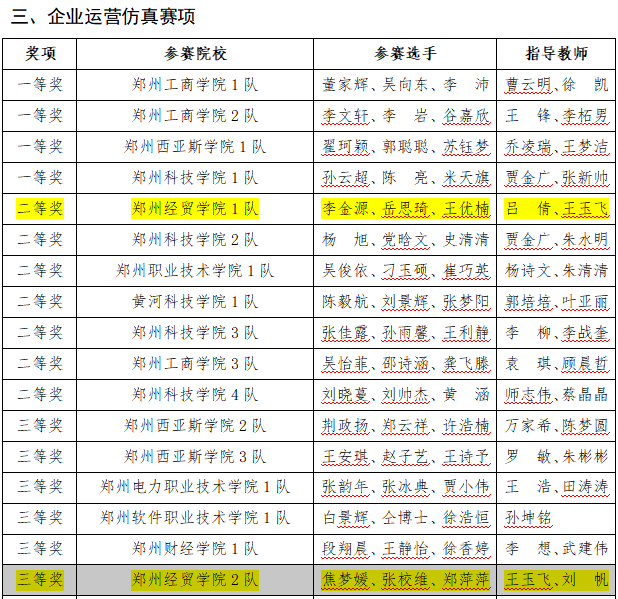
郑州经贸学院:学子在第九届郑州地方高校职业技能竞赛企业运营仿真赛荣获佳绩
Sou Hu Cai Jing· 2025-12-13 05:19
Core Insights - The 9th Zhengzhou Local University Vocational Skills Competition in Enterprise Operation Simulation concluded successfully, showcasing the strong professional skills and innovative capabilities of students from Zhengzhou University of Economics and Trade [1][5] - A total of 19 teams participated in the competition, with 4 first prizes, 7 second prizes, and 10 third prizes awarded [1][3] Awards Summary - First Prize Winners: Zhengzhou Business College (2 teams), Zhengzhou Sias University (1 team), Zhengzhou Technology College (1 team) [2] - Second Prize Winners: Zhengzhou University of Economics and Trade (1 team), Zhengzhou Technology College (2 teams), Zhengzhou Vocational Technical College (1 team), Huanghe Science and Technology College (1 team), Zhengzhou Sias University (1 team), Zhengzhou Business College (2 teams), Zhengzhou Technology College (1 team) [2] - Third Prize Winners: Zhengzhou Sias University (2 teams), Zhengzhou Electric Power Vocational Technical College (1 team), Zhengzhou Software Vocational Technical College (1 team), Zhengzhou Finance College (1 team), Zhengzhou University of Economics and Trade (1 team) [2] Competition Focus - The competition emphasized the integration of multiple disciplines and collaborative innovation, aiming to enhance digital operation levels and strengthen sustainable development awareness [3] - Students engaged in practical operations that involved reshaping business processes using enterprise data resources and digital tools, thereby deepening their understanding of professional knowledge and improving practical skills [3]
数智技术赋能新文科建设
Xin Hua Ri Bao· 2025-12-04 23:33
Core Insights - The rapid development of digital intelligence technology necessitates breaking down disciplinary barriers, innovating teaching models, and reshaping talent qualities to inject new momentum into the construction of new liberal arts education [1] Group 1: Reshaping the Academic Ecosystem - The core value of digital intelligence technology lies in breaking traditional boundaries within the liberal arts, creating a new academic ecosystem that integrates "liberal arts core + digital intelligence support + industry linkage" [2] - Universities can utilize big data technology to establish interdisciplinary demand platforms that capture real-time needs in areas such as social governance and cultural heritage [2] - Algorithms can be employed to match cultural digitalization challenges with relevant liberal arts curricula, generating meaningful interdisciplinary research topics [2] Group 2: Innovating Teaching Paradigms - Digital intelligence technology can optimize the interaction between teaching and learning, leading to profound changes in new liberal arts teaching models [3] - Schools should implement dynamic learning situation diagnosis systems to help teachers efficiently understand students' grasp of theoretical knowledge and practical skills [3] - Virtual teaching laboratories can create immersive learning environments, such as simulating English usage scenarios to enhance practical abilities [3] Group 3: Enhancing Talent Capabilities - The core competitiveness of new liberal arts talents in the digital age lies in their combination of humanistic thinking and digital intelligence application skills [4] - Universities should revise and improve talent cultivation plans based on the progress and needs of new liberal arts education [4] - Mandatory courses on digital literacy can be introduced to help students develop skills in data authenticity assessment and AI tool usage, preventing them from being overwhelmed by data [4] - Customized digital skills training courses can be designed for different majors, focusing on relevant competencies needed for future employment [4] - The goal is to deepen the integration of "value guidance" and "digital intelligence drive" to build a new educational ecosystem that meets both Chinese characteristics and global perspectives [4]