消费贷贴息

Search documents
A股市场大势研判:三大指数集体收涨
Dongguan Securities· 2026-01-25 23:34
Market Overview - The three major indices collectively rose, with the Shanghai Composite Index closing at 4136.16, up 0.33% [2] - The Shenzhen Component Index increased by 0.79% to 14439.66, while the CSI 300 fell by 0.45% to 4702.50 [2] - The ChiNext Index rose by 0.63% to 3349.50, and the STAR 50 Index increased by 0.78% to 1553.71 [2] Sector Performance - The top-performing sectors included Electric Equipment (3.50%), Nonferrous Metals (2.73%), and Defense Industry (2.65%) [3] - The sectors with the poorest performance were Communication (-1.52%), Banking (-0.90%), and Coal (-0.76%) [3] - Concept indices such as BC Battery (8.56%) and Perovskite Battery (8.24%) showed strong gains, while Corn (-0.14%) and Soybeans (-0.10%) lagged [3] Future Outlook - The market is expected to continue its upward trend, supported by multiple favorable factors, including the central bank's commitment to maintaining a moderately loose monetary policy [4][6] - The recent decrease in the re-lending and re-discount rates indicates potential for further cuts in reserve requirements and interest rates this year [6] - The improvement in macroeconomic conditions and corporate earnings recovery are seen as core drivers for the market's mid-term upward movement [6] - Recommended sectors for investment include Oil and Petrochemicals, Construction Decoration, Nonferrous Metals, TMT, and Coal [6]
陆家嘴财经早餐2026年1月23日星期五
Wind万得· 2026-01-23 00:13
Monetary Policy and Economic Measures - The central bank governor Pan Gongsheng stated that a moderately loose monetary policy will continue in 2026, with room for further cuts in reserve requirement ratios and interest rates to maintain ample liquidity [3] - The first batch of 936 billion yuan of ultra-long special government bonds has been allocated to support approximately 4,500 projects in various sectors, expected to drive total investment exceeding 460 billion yuan [4] - The People's Bank of China will conduct a 900 billion yuan MLF operation on January 23, net injecting 700 billion yuan into the market, marking the 11th consecutive month of increased operations [4] Consumer and Investment Trends - State-owned banks collectively announced the implementation of personal consumption loan interest subsidy policies, allowing some high-quality clients to enjoy effective interest rates in the "2%" range, lower than current housing loan rates [3] - Public funds have focused their fourth-quarter 2025 positions on core sectors such as electronics and power equipment, with Zhongji Xuchuang becoming the largest holding stock [3] Market Performance - The A-share market saw a slight increase, with the Shanghai Composite Index rising 0.14% to 4122.58 points, and the Shenzhen Component Index increasing by 0.5% [6] - The Hong Kong stock market also experienced minor fluctuations, with the Hang Seng Index rising 0.17% to 26629.96 points, and net inflows from southbound funds amounting to 5.166 billion HKD [6] Corporate Developments - Alibaba Group has decided to support its chip company "Pingtouge" for independent listing, with plans for restructuring to a mixed-ownership enterprise [7] - Xiaomi Group has initiated a stock repurchase plan of up to 2.5 billion HKD [9] - Nanjing Bank reported a net profit growth of 8.08% year-on-year for 2025 [9] Regulatory and Policy Updates - The State Administration for Market Regulation has issued a red card for the first time in the public utility sector, prohibiting a merger between two gas companies [10] - Nine departments jointly issued opinions to promote high-quality development in the pharmaceutical retail industry, encouraging mergers and acquisitions among retail pharmacies [10] Economic Indicators - The unemployment rate for urban labor aged 16-24 was reported at 16.5% in December 2025, while the rate for those aged 25-29 was 6.9% [5] - The National Bureau of Statistics reported a 28.1% year-on-year increase in sales revenue for the smart device manufacturing industry in 2025 [10]







多家银行公布 消费贷“国补”升级方案
Zhong Guo Zheng Quan Bao· 2026-01-21 21:42
Core Viewpoint - The Ministry of Finance has announced an optimization of the personal consumption loan interest subsidy policy, which includes expanding the scope of eligible loans and extending the policy period until the end of 2026, allowing each borrower to receive a maximum subsidy of 3,000 yuan [1][2]. Group 1: Policy Changes - The subsidy policy now includes credit card installment payments and removes previous restrictions on certain consumption areas, allowing all types of consumption loans to qualify for subsidies [1][2]. - The maximum subsidy limit of 500 yuan per single transaction and the previous cap of 1,000 yuan for loans under 50,000 yuan have been eliminated, enabling borrowers to receive a total of 3,000 yuan in subsidies annually [2]. Group 2: Implementation and Participation - Major banks such as Agricultural Bank of China, Bank of China, and others have already begun implementing the new subsidy measures, with over 500 financial institutions now eligible to process these loans [1][2]. - The policy aims to enhance accessibility for consumers in urban and rural areas by including city commercial banks, rural commercial banks, foreign banks, and consumer finance companies [2]. Group 3: Credit Card Installment Subsidy - The credit card installment subsidy policy will be effective throughout 2026, and customers can apply for retroactive subsidies for installments made between January 1, 2026, and the policy announcement date [3][4]. - Banks require customers to sign a supplementary agreement to benefit from the subsidy on credit card installments, ensuring compliance with the policy [3][4]. Group 4: Consumer Protection and Compliance - Banks emphasize that no fees will be charged for processing personal consumption loans and credit card installment subsidies, and they will not engage third-party intermediaries [5][6]. - Strict measures are in place to prevent fraudulent activities related to loan applications, and any violations will be recorded in the borrower's credit history [5][6].





消费贷贴息升级!多巨头火速行动,加码补贴到免息
Bei Jing Shang Bao· 2026-01-21 13:00
Core Viewpoint - The new policy on personal consumption loan interest subsidies aims to stimulate consumer spending by extending the implementation period and expanding the support scope, including credit card installment payments, with a maximum subsidy of 3,000 yuan per transaction [1][3][7]. Policy Implementation - The implementation period for the personal consumption loan interest subsidy policy has been extended to December 31, 2026, with the new effective period from September 1, 2025, to December 31, 2026 [3][5]. - The policy now includes credit card bill installment services with a 1% annual interest subsidy rate, addressing previous gaps in the credit card consumption credit policy [3][4]. Market Response - Multiple financial companies and e-commerce platforms, including Ant Group, JD.com, and Du Xiaoman, have quickly adapted to the new policy by enhancing their financial products and services [1][3][5]. - Ant Group has increased credit issuance and optimized financial products by offering interest subsidies through its Huabei installment service, combining national subsidies with additional merchant discounts [3][4]. Consumer Benefits - The policy allows consumers to enjoy a wide range of subsidized products, with some merchants already offering interest-free installment options prior to the policy's announcement [4][5]. - JD.com has removed previous limits on subsidy amounts and has implemented a system that automatically calculates and applies subsidies at checkout, enhancing consumer convenience [6][7]. Financial Impact - The estimated total scale of the interest subsidy policy is projected to reach around 200 billion yuan by 2026, with a potential coverage of over 200 million individuals [7][8]. - The policy is expected to significantly boost consumer spending, particularly in high-frequency consumption areas such as home appliances and home improvement [10][11]. Risk Management - Financial institutions are advised to implement strict verification processes to prevent misuse of funds and ensure that loans are used for legitimate consumer spending [10][11]. - The focus on risk management includes tracking the flow of funds and verifying the authenticity of consumer behavior to mitigate potential risks associated with the subsidy program [11].
个人消费贷贴息政策“延期扩围”,大行股份行快速跟进,新入围地方银行:客户流失担忧消除
Xin Lang Cai Jing· 2026-01-21 02:48
Core Viewpoint - The newly revised consumer loan interest subsidy policy is expected to stimulate domestic consumption recovery by encouraging banks to increase consumer loan issuance [1][7]. Group 1: Policy Implementation - Major state-owned banks and joint-stock banks, including Agricultural Bank of China, Bank of China, and Postal Savings Bank, have promptly responded to the new consumer loan interest subsidy policy [1][7]. - Postal Savings Bank announced that from September 1, 2025, to December 31, 2026, personal consumption loans used for actual consumption will be eligible for interest subsidies, with credit card bill installments also included in the subsidy scope [2][8]. - The policy removes the previous restriction on single transactions of 50,000 yuan or more for eligible consumption transactions [2][8]. Group 2: Operational Procedures - China Merchants Bank outlined that customers must follow specific procedures to apply for the consumer loan interest subsidy, including signing a supplementary agreement during or after the loan issuance [3][9]. - The bank will calculate the subsidy amount based on the agreed-upon subsidy ratio and cap, directly deducting the subsidy from the interest charged to customers [3][9]. Group 3: Inclusion of More Financial Institutions - The latest policy expansion includes city commercial banks, foreign banks, and consumer finance institutions, which were previously excluded from the interest subsidy program [4][10]. - This expansion aims to enhance fairness and inclusivity in the financial system, encouraging local banks to actively participate in consumer loan issuance [4][10]. - Industry insiders expressed optimism about the inclusion of more consumer finance companies, indicating readiness to implement the policy effectively [5][11].
楼市再添“猛料”!事关买房人的钱袋子!真能落地吗?
Sou Hu Cai Jing· 2025-12-30 03:17
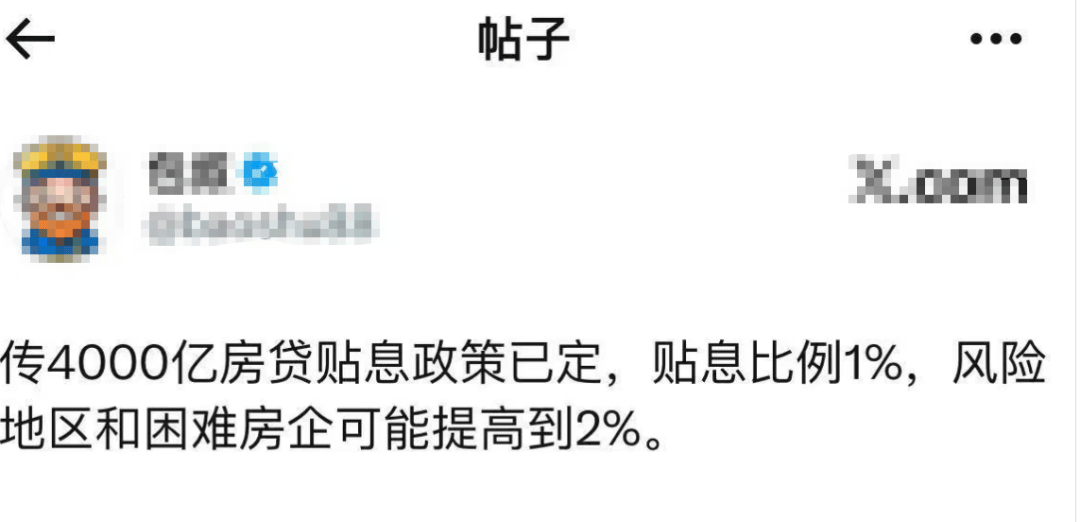
Core Viewpoint - The discussion around "mortgage interest subsidies" has intensified online, with rumors suggesting that the government may implement a 1% subsidy on mortgage interest for homebuyers to address the current downturn in the real estate market. However, this information has not been officially confirmed yet [1]. Group 1: Mortgage Interest Subsidy Details - There are various interpretations of the rumored subsidy, with some suggesting it may apply only to new mortgages, while others propose it could also benefit high-risk areas or struggling real estate companies [3]. - The concept of mortgage interest subsidies can be understood as a government supplement to the existing mortgage interest rates. For instance, a 1% subsidy would reduce the current first mortgage rate of 3.05% (LPR minus 45 basis points) to approximately 2.05%, significantly lowering costs for homebuyers [3]. - An example illustrates that for a property priced at 3 million, a 1% reduction in interest rates could save around 500,000 over 30 years, which could encourage hesitant buyers to enter the market and stimulate domestic consumption [3]. Group 2: Previous Implementations and Variations - The concept of mortgage interest subsidies is not new, as cities like Hangzhou, Nanjing, and Wuhan have previously implemented similar measures. For example, in December 2023, Hangzhou's Linping District announced a policy providing 1-3% interest subsidies for eligible loans on new residential properties for a period of 36 months [4]. - These differentiated subsidy policies, targeting specific regions and properties, differ from a unified national or local government subsidy approach [5]. Group 3: Broader Economic Context - The Loan Prime Rate (LPR), closely related to mortgages, has remained unchanged for seven months, with only a single reduction of 0.1% in May 2023. The current LPR for five years and above stands at 3.5%, with market speculation suggesting a potential reduction in the first quarter of 2026 [5]. - The anticipation of mortgage interest subsidies reflects a broader hope for new policies to stimulate the struggling real estate market, which is seen as a crucial pillar of the national economy [8]. - In contrast to mortgage interest subsidies, a consumption loan subsidy policy has already been initiated, aiming to lower consumer credit costs and stimulate spending across various sectors, including automotive and education [7].
地方消费贷“红包”能申领了
Xin Lang Cai Jing· 2025-12-29 19:18
Group 1 - The core point of the article is the introduction of a local consumer loan subsidy policy in Sichuan Province, allowing citizens to apply for a "new year red envelope" in the form of interest subsidies on personal consumer loans [1] - The policy execution period is from October 1, 2025, to March 31, 2026, during which eligible personal consumer loans can apply for interest subsidies [1] - Eligible personal consumer loans can enjoy an interest subsidy of 1 percentage point per annum, with a maximum not exceeding 50% of the loan contract interest rate [1] Group 2 - There is a cumulative subsidy cap mechanism in place, where individual borrowers can receive a maximum subsidy of 500 yuan for loans below 50,000 yuan, corresponding to a maximum cumulative loan amount of 100,000 yuan [1] - The overall cumulative subsidy limit is set at 1,500 yuan, applicable to a maximum cumulative loan amount of 300,000 yuan [1] - Citizens can apply for the subsidy through the mobile banking app by selecting the "subsidy application" option and uploading consumption vouchers or invoices as required [2]

消费贷贴息百日,更多地方性银行加入“地补”
Di Yi Cai Jing Zi Xun· 2025-12-14 15:06
Group 1 - The core viewpoint of the article highlights the implementation of the consumer loan interest subsidy policy, referred to as "financial national subsidy," which has been in effect for over a hundred days, showing increased bank lending but limited recovery in consumer credit demand [2][6] - Major state-owned and joint-stock banks have significantly increased their personal consumption loan issuance since September, with China Bank issuing 47.4 billion yuan in September alone, marking a 26.11% increase year-to-date [3][4] - Regional banks are also joining the initiative, raising loan limits to 500,000 to 1 million yuan, with some small banks offering up to 2 million yuan, promoting loans for various consumer purposes [4][5] Group 2 - Despite the increased loan limits, many banks maintain strict customer screening, with loans over 300,000 yuan primarily available to stable income groups, limiting the impact on broader consumer segments [5] - The overall demand for consumer loans remains weak, with a net decrease of 206 billion yuan in household loans in November, indicating a sluggish recovery in consumer credit [5][6] - The shift from "national subsidy" to "local subsidy" is evident as local governments begin to implement their own consumer loan interest subsidy policies, aiming to stimulate local consumption and activate regional markets [6][7]

消费贷贴息“版图”扩大!多家中小银行接棒送福利 消费者怎么享优惠?
Bei Jing Shang Bao· 2025-12-14 13:32
Core Insights - The policy to promote consumption is intensifying, with interest subsidy policies for consumer loans extending from national commercial banks to local regional banks [1][2] - Regions like Sichuan, Chongqing, and Guizhou have introduced supporting policies to include regional small and medium-sized banks in the consumer loan interest subsidy program, targeting rural and county markets [1][2] Policy Expansion - Since December, several regions have rapidly implemented policies to expand the scope of consumer loan interest subsidies, with a focus on local banks [2][3] - The initial policy framework was established in August, with the Ministry of Finance, the People's Bank of China, and the financial regulatory authority outlining the core institutions for the subsidy program [2][3] Implementation Details - Specific policies have been launched in various regions, such as Sichuan and Chongqing, which include interest subsidies for personal consumer loans effective from 2025 to 2026 [3][5] - The subsidy rate is set at 1% per annum, with specific limits on the total subsidy amount based on the loan amount and duration [5][6] Regional Variations - Different regions exhibit varying levels of subsidy intensity, influenced by local economic conditions and the operational strategies of banks [7] - The application processes and subsidy limits differ among banks, reflecting a tailored approach to local market conditions [6][7] Future Outlook - The model of expanding consumer loan interest subsidies to local banks is expected to be promoted nationwide, aligning with national policies encouraging local financial support [8] - Simplifying application processes and enhancing service experiences are critical for effectively reaching underserved markets [8]
从“国补”到“地补” 消费贷贴息迎来新军
Zhong Guo Zheng Quan Bao· 2025-12-10 22:31
Core Viewpoint - Regional banks in China are leveraging local fiscal support to introduce consumer loan subsidy programs, aiming to reduce the cost of consumer credit and stimulate consumer spending potential [1][2]. Group 1: Introduction of Consumer Loan Subsidies - Since December, banks such as Guizhou Bank and Guiyang Bank have announced personal consumer loan interest subsidy programs to lower residents' credit costs [2]. - The subsidy program is based on guidelines from multiple departments, effective from December 1, targeting eligible consumer loan clients [2]. Group 2: Details of Subsidy Programs - Guizhou Bank and Guiyang Bank's subsidies apply to loans for comprehensive consumption and service industry loans, with specific eligibility criteria tied to the borrower's registered business location [2]. - Chengdu Bank and Chengdu Rural Commercial Bank have also released their subsidy details, with the subsidy period set from October 1, 2025, to March 31, 2026 [2]. Group 3: Subsidy Limits and Application Process - The maximum subsidy for each borrower at Guizhou Bank and Guiyang Bank is capped at 3,000 yuan, with specific limits for smaller loans [3]. - The application process is voluntary and operates on a first-come, first-served basis, with a clear requirement for supporting documentation [3]. Group 4: Benefits for Local Economies - The subsidy initiative is viewed as a "triple win" for local economies, effectively utilizing fiscal resources to stimulate consumer spending while allowing banks to expand their customer base [4][5]. - Industry experts anticipate that more regions will adopt similar consumer loan subsidy policies tailored to their fiscal conditions and market characteristics [5].