
LPR调整

Search documents
2026楼市观察:合肥房贷利率已至历史低位,后续仍有下行空间
Sou Hu Cai Jing· 2026-02-27 06:59
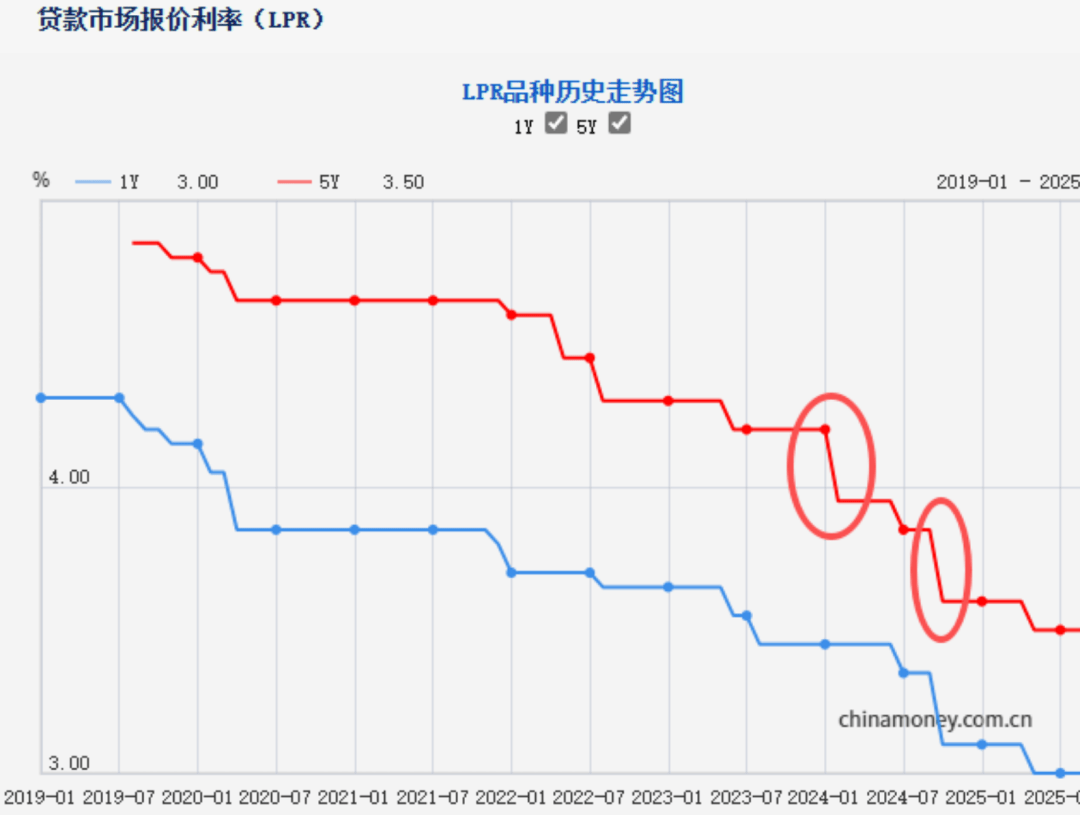
Core Viewpoint - The latest Loan Prime Rate (LPR) remains stable, with the 1-year LPR at 3.0% and the 5-year LPR at 3.5%, indicating a continued low interest rate environment for new commercial loans in Hefei [1] Group 1: Interest Rate Trends - The LPR has remained unchanged for six consecutive months, reflecting a stable monetary policy stance [1] - The Federal Reserve has initiated a rate-cutting cycle since the second half of 2025, with a total reduction of 75 basis points across three cuts [4][5][6] - Despite external easing signals from the U.S., domestic interest rates in China have not followed suit, showcasing a strong strategic determination from the central bank [6] Group 2: Monetary Policy Signals - Recent high-level meetings and policy statements indicate a commitment to maintaining a supportive monetary policy [7][8][9] - The central bank's reports emphasize the implementation of a moderately loose monetary policy, with a focus on maintaining financial stability and reasonable growth in financial aggregates [9][11] - The central bank has already lowered the rates of various structural monetary policy tools, indicating a proactive approach to support the economy [15] Group 3: Future Expectations - Market consensus suggests a strong likelihood of further monetary easing in 2026, with predictions of two rate cuts totaling 20-30 basis points [16] - Major international investment banks forecast a combination of a 50 basis point reserve requirement cut and a 10 basis point interest rate cut, potentially lowering the 5-year LPR to around 3.4% [17] - The external environment, including the Fed's rate cuts, and the need for stable financial support for economic recovery, create a conducive atmosphere for domestic rate cuts [18] Group 4: Inflation and Banking Considerations - A low inflation environment provides a realistic basis for potential rate cuts, with room for actual rates to decline further [19] - However, banks' net interest margins are at historically low levels, and exchange rate stability remains a critical consideration, suggesting that any rate cuts may be gradual rather than abrupt [19]

降息预期落空,房贷下调的下一轮周期在3、4月,内行人已开始准备这3件事,利率下调的路径已清晰,就看你怎么接
Sou Hu Cai Jing· 2026-01-20 17:13
Core Viewpoint - The People's Bank of China (PBOC) maintained the Loan Prime Rate (LPR) at 3.0% for 1-year and 3.5% for 5-year loans, disappointing expectations for a rate cut at the beginning of 2026 [1][3] Group 1: Interest Rate and Banking Sector - The average net interest margin for commercial banks in 2025 was only 1.42%, indicating a significant reduction in profit margins for banks [3] - The PBOC's decision to keep the LPR unchanged reflects the need to balance internal pressures and external constraints, particularly in light of the U.S. Federal Reserve's interest rate policies [4][13] - A structural interest rate cut was implemented, lowering the rates for specific loans to support targeted sectors like first-time homebuyers and small businesses, rather than a broad market approach [5][6] Group 2: Market Dynamics and Housing Sector - In 2025, the sales area of commercial residential properties decreased by 8.7%, indicating significant pressure on the housing market [8] - The first-time homebuyer loan rates have already been reduced to 2.6%, suggesting a clear policy path where public housing loans lead the way for commercial loans [8] - The anticipated effects of the structural rate cut are expected to manifest in the LPR adjustments around the second quarter of 2026, creating conditions for potential rate reductions [6][9] Group 3: Future Outlook and Policy Implications - The spring of 2026 is seen as a critical observation window for potential LPR adjustments, with expectations that any rate cuts could coincide with local government incentives [11][13] - The market may experience differentiated responses, with core cities likely to stabilize faster than lower-tier cities, which face additional challenges such as population decline and high inventory levels [13] - The PBOC's approach emphasizes targeted measures rather than broad monetary easing, indicating that future adjustments may be small and specific to certain regions or borrower categories [13]

银行视角看货币政策:如何理解结构性货币政策工具利率下调?
Guolian Minsheng Securities· 2026-01-17 14:51
Investment Rating - The report maintains a "Recommendation" rating for the banking industry [5] Core Insights - The People's Bank of China announced a 0.25 percentage point reduction in various structural monetary policy tool rates, with the one-year re-lending rate decreasing from 1.5% to 1.25% [7] - The reduction in re-lending rates is not considered a direct interest rate cut but is expected to lower banks' interest expenses by approximately 13 billion yuan annually, contributing to a 0.3 basis point improvement in bank margins [7] - The report anticipates that the Loan Prime Rate (LPR) is unlikely to be adjusted this month, as historical trends show LPR adjustments typically align with Open Market Operation (OMO) policy rate changes [7] - Looking ahead to 2026, the report suggests that if the actual GDP growth target is revised downwards, the first quarter's economic growth is not expected to fall below the target [7] Summary by Sections Monetary Policy Analysis - The report discusses the implications of the recent reduction in re-lending rates, indicating it serves as a signal for monetary policy at the start of the year and encourages banks to increase credit issuance [7] - The structural monetary policy tools currently account for approximately 13% of the base currency, amounting to about 5.2 trillion yuan [7] Economic Outlook - The report highlights that the monetary policy will focus on cross-cycle adjustments, maintaining a neutral stance while allowing for responsive measures based on economic performance [7] - The next potential window for further reductions in reserve requirements or interest rates is projected to be around the second or third quarter of 2026, contingent on economic conditions [7]
楼市再添“猛料”!事关买房人的钱袋子!真能落地吗?
Sou Hu Cai Jing· 2025-12-30 03:17
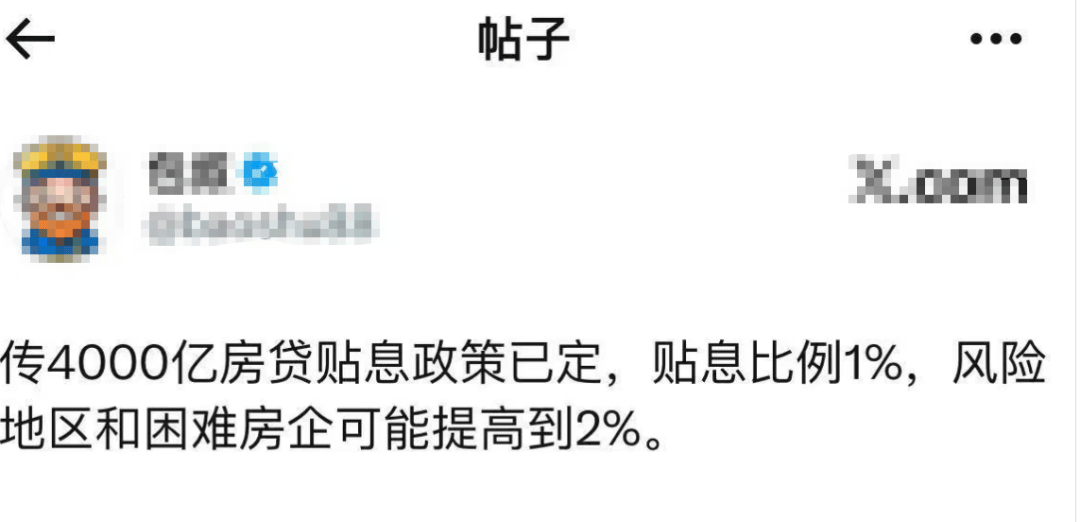
Core Viewpoint - The discussion around "mortgage interest subsidies" has intensified online, with rumors suggesting that the government may implement a 1% subsidy on mortgage interest for homebuyers to address the current downturn in the real estate market. However, this information has not been officially confirmed yet [1]. Group 1: Mortgage Interest Subsidy Details - There are various interpretations of the rumored subsidy, with some suggesting it may apply only to new mortgages, while others propose it could also benefit high-risk areas or struggling real estate companies [3]. - The concept of mortgage interest subsidies can be understood as a government supplement to the existing mortgage interest rates. For instance, a 1% subsidy would reduce the current first mortgage rate of 3.05% (LPR minus 45 basis points) to approximately 2.05%, significantly lowering costs for homebuyers [3]. - An example illustrates that for a property priced at 3 million, a 1% reduction in interest rates could save around 500,000 over 30 years, which could encourage hesitant buyers to enter the market and stimulate domestic consumption [3]. Group 2: Previous Implementations and Variations - The concept of mortgage interest subsidies is not new, as cities like Hangzhou, Nanjing, and Wuhan have previously implemented similar measures. For example, in December 2023, Hangzhou's Linping District announced a policy providing 1-3% interest subsidies for eligible loans on new residential properties for a period of 36 months [4]. - These differentiated subsidy policies, targeting specific regions and properties, differ from a unified national or local government subsidy approach [5]. Group 3: Broader Economic Context - The Loan Prime Rate (LPR), closely related to mortgages, has remained unchanged for seven months, with only a single reduction of 0.1% in May 2023. The current LPR for five years and above stands at 3.5%, with market speculation suggesting a potential reduction in the first quarter of 2026 [5]. - The anticipation of mortgage interest subsidies reflects a broader hope for new policies to stimulate the struggling real estate market, which is seen as a crucial pillar of the national economy [8]. - In contrast to mortgage interest subsidies, a consumption loan subsidy policy has already been initiated, aiming to lower consumer credit costs and stimulate spending across various sectors, including automotive and education [7].
刚刚,LPR公布!今年不会下调了?
Sou Hu Cai Jing· 2025-11-20 03:00
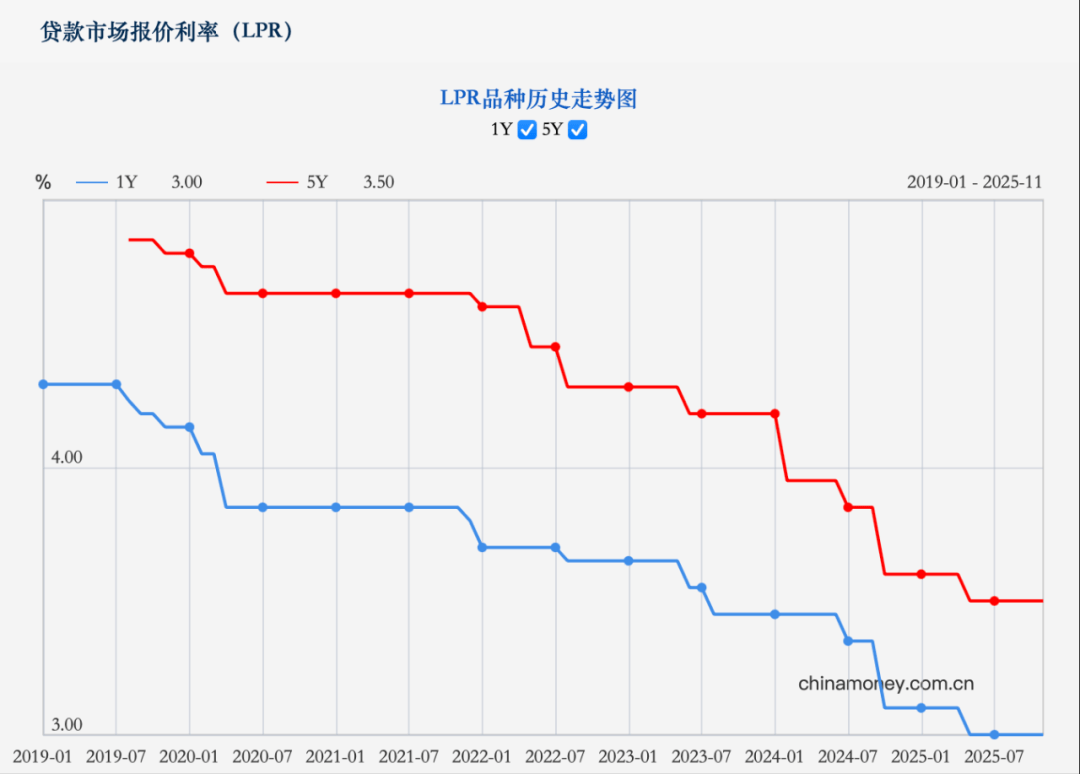
Group 1 - The core point of the article is that the Loan Prime Rate (LPR) for both 1-year and 5-year terms remains unchanged at 3.0% and 3.5% respectively as of November 20, 2025, indicating stable mortgage rates [1] - Many homeowners had high expectations for a decrease in LPR in November, as the LPR trend directly affects their monthly mortgage payments [3] - In 2024, the cumulative reduction in the 5-year LPR reached 60 basis points over three rounds of interest rate cuts [4] Group 2 - The frequency and magnitude of LPR cuts this year have been notably low, with only a 10 basis point reduction in May and no further changes since then [5] - The probability of a rate cut in December has significantly decreased, as consumer prices appear to have exited the deflationary zone, with October's CPI and PPI both showing increases [6] - The central bank is becoming more cautious about monetary easing, with plans to refine the interest rate adjustment framework and enhance the transmission mechanism of market-based interest rates [7]
郑眼看盘丨经济指标温和,A股微升
Mei Ri Jing Ji Xin Wen· 2025-05-19 10:42
Market Overview - A-shares experienced weak fluctuations in the morning but showed slight improvement in the afternoon, closing with minor gains. The Shanghai Composite Index rose by 0.12 points to 3367.58 points, while the total trading volume in the A-share market was 1.1189 trillion yuan, slightly down from 1.1241 trillion yuan on the previous Friday [1] Sector Performance - The shipping, chemical fiber, paper, real estate, and environmental protection sectors showed relatively strong performance, while the liquor, mineral products, engineering machinery, insurance, and banking sectors performed weaker [1] Regulatory Impact - Liquor stocks opened lower following the release of revised regulations that prohibit high-end dishes, cigarettes, and alcohol at official work meals, which may impact the liquor industry negatively [1] Economic Indicators - China's industrial added value for April grew by 6.1% year-on-year, exceeding the expected growth of 5.5%. Retail sales of consumer goods increased by 5.1%, and urban fixed asset investment rose by 4.0% in the first four months of the year [2] Market Sentiment - Despite the positive economic indicators, the market sentiment remains cautious due to the ongoing U.S.-China trade tensions, which have reduced expectations for immediate stimulus policies. This has contributed to the recent weaker performance of A-shares [2] Interest Rate Outlook - The People's Bank of China is expected to maintain the Loan Prime Rate (LPR) unchanged in May, with potential adjustments anticipated in the following months as the trade tensions ease and economic data stabilizes [2] Investment Strategy - A-shares are likely to continue in a fluctuating pattern in the short term, with investors adopting a conservative and watchful approach until further clarity on U.S.-China negotiations is achieved [2]