SOFR

Search documents
Eagle Point Income Co Inc.(EIC) - 2025 Q4 - Earnings Call Transcript
2026-02-26 17:32
Eagle Point Income Company (NYSE:EIC) Q4 2025 Earnings call February 26, 2026 11:30 AM ET Company ParticipantsChristopher Nolan - SVP for Equity ResearchDaniel Ko - Senior Principal and Portfolio ManagerDarren Daugherty - Investor Relations RepresentativeLena Umnova - Chief Accounting OfficerTom Majewski - Chairman and CEOConference Call ParticipantsErik Zwick - Managing Director and Equity Research AnalystOperatorGreetings. Welcome to the Eagle Point Income Company fourth quarter 2025 financial results con ...

Eagle Point Income Co Inc.(EIC) - 2025 Q4 - Earnings Call Transcript
2026-02-26 17:30
Financial Data and Key Metrics Changes - In 2025, the company generated a GAAP return on equity of negative 0.7% and a total return on common stock of negative 15.2%, assuming reinvestment of distributions [5] - The company paid $1.98 per share in cash distributions, representing 15% of the average stock price during the year [5] - The net investment income for the fourth quarter was $0.35 per share, down from $0.39 per share in the prior quarter [7] - The GAAP net loss for the fourth quarter was $15 million or $0.60 per share, compared to a GAAP net income of $0.43 per share in the third quarter [18] Business Line Data and Key Metrics Changes - Paydowns within the CLO debt portfolio totaled $147 million during 2025, contributing to early repayments [5] - The company participated in 10 resets and 6 refinancings across its CLO equity portfolio, resulting in average CLO debt cost savings of 46 basis points [6] - Recurring cash flows for the fourth quarter totaled $19 million or $0.79 per share, an 18% increase quarter-over-quarter [8] Market Data and Key Metrics Changes - The trailing twelve-month default rate decreased from 1.5% at the end of September to 1.2% as of December 31st, below the long-term average of 2.6% [14] - CLO new issuance rose to $55 billion in the fourth quarter, totaling $209 billion for 2025, surpassing the previous year's record [15] - The S&P UBS Leveraged Loan Index posted a 1.2% return for the fourth quarter and a 5.9% return for the entirety of 2025 [13] Company Strategy and Development Direction - The company actively managed its portfolio, seeking opportunities across CLO debt and equity, as well as other asset classes beyond CLOs [4] - The company plans to continue its share repurchase program, viewing its stock as undervalued and an attractive use of capital [11] - The management believes the current market environment represents a compelling opportunity for patient, well-capitalized investors [24] Management's Comments on Operating Environment and Future Outlook - Management noted that the CLO market faced challenging conditions, with reduced SOFR levels impacting CLO debt investment income and ongoing loan spread compression affecting CLO equity [4] - The company remains constructive on CLO market fundamentals, with a robust pipeline of refinancings and resets expected to lower liability costs [24] - Management emphasized the importance of active portfolio management amid dynamic market conditions, focusing on relative value and disciplined capital allocation [22] Other Important Information - The company's NAV decreased to $13.31 per share as of December 31st, down from $14.21 per share at the end of September [8] - The company completed the full redemption of its 7.75% Series B Term Preferred Stock and announced plans to redeem the 8% Series C Term Preferred Stock [10] Q&A Session Summary Question: Follow-up on realized losses due to underperforming managers - Management indicated that underperforming collateral managers faced credit issues and loan spread compression, leading to a rotation into better-performing CLOs and other asset classes [26][28] Question: Source of funds for redeeming Series C Term Preferred Stock - Management confirmed that the redemption would be funded through a combination of cash on hand and the new revolving credit facility [29] Question: Non-recurring items in earnings - Management stated there were no non-recurring items in the earnings for the quarter [35] Question: Expectation of balance sheet investment portfolio shrinkage - Management clarified that while redeeming preferred stock, they have been opportunistically buying back stock and do not expect a significant shrinkage in the investment portfolio [36] Question: Focus on alternative credit assets - Management explained that investments in alternative credit assets are made across the Eagle Point platform, with dedicated teams focusing on these opportunities [37][39]
美股资产大幅缩水后的反思:本轮大崩盘的真凶不是 AI?
Sou Hu Cai Jing· 2026-02-07 12:53
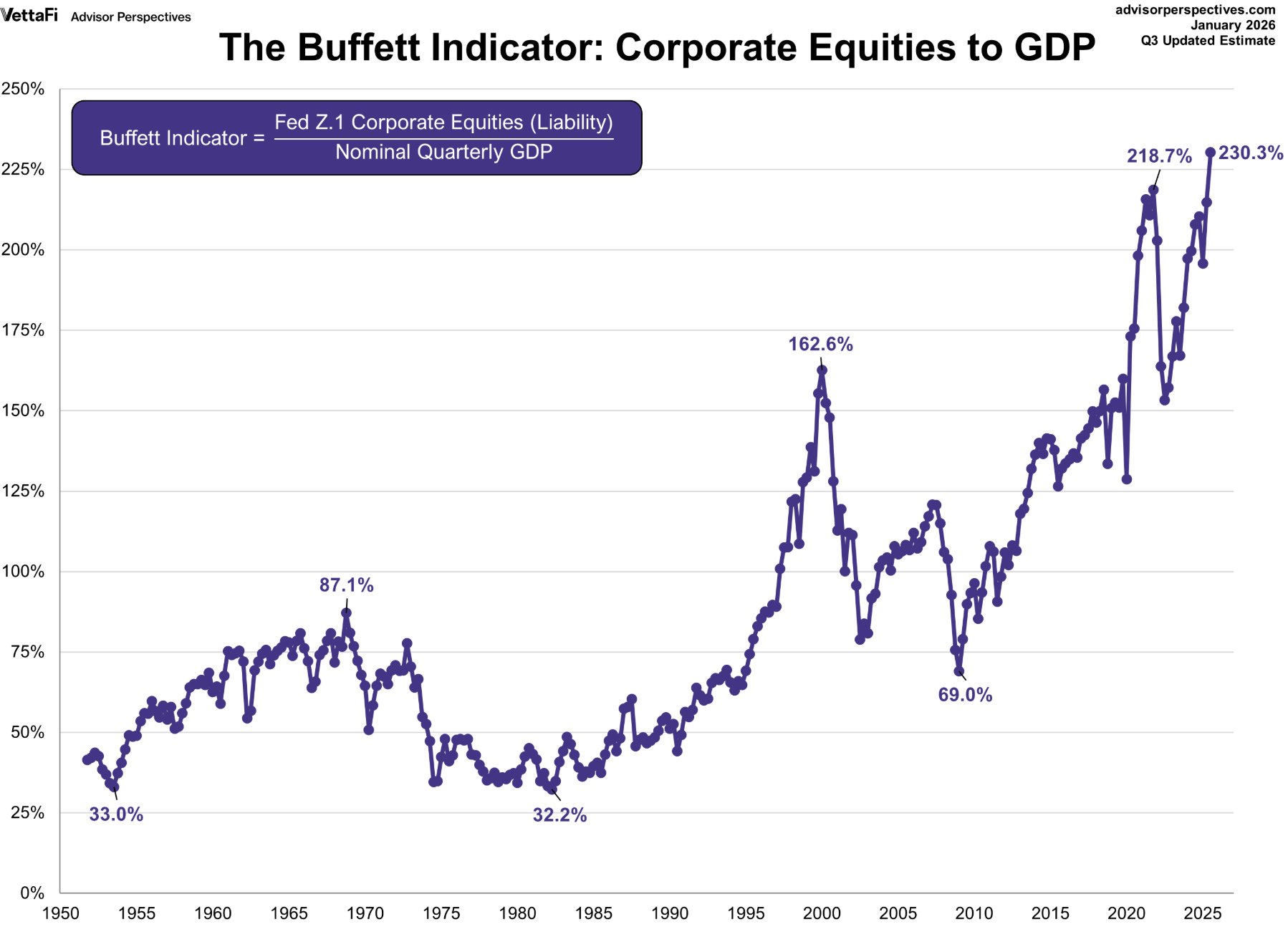
Market Overview - The recent market downturn has seen significant declines in various asset classes, including gold, silver, cryptocurrencies, and major stock indices like the US and Hong Kong markets, with some stocks like Figma and Xpeng dropping over 70% [1][2][3] Market Analysis - Analysts are attributing the market decline to several factors, including the perceived strength of Anthropic's legal AI, Google's higher-than-expected capital expenditure guidance, and the hawkish stance of incoming Federal Reserve Chair Warsh [2][4] - However, these explanations are deemed superficial, as the real drivers of the market volatility are liquidity tightening and high valuations [4][5] Valuation Metrics - The current market valuation, as indicated by the Buffett Indicator (total market capitalization to GDP ratio), stands at 230%, significantly above the 120% threshold that suggests severe overvaluation [5][6] - The S&P 500 Forward P/E ratio is at 22.0x, compared to a 30-year average of 17.1x, indicating a significant premium and suggesting that the market is in a "significantly overvalued" zone [7] Liquidity Concerns - Liquidity tightening is primarily driven by rising Japanese government bond yields, which are reducing global market liquidity due to the unwinding of yen carry trades [10][13] - The U.S. Treasury General Account (TGA) is also a critical factor, with a high balance of approximately $893.2 billion as of early February, and plans for significant debt issuance, further constraining market liquidity [14][15] Market Dynamics - The Chicago Mercantile Exchange (CME) has raised margin requirements for precious metals, which has historically led to forced deleveraging in the market, contributing to the recent volatility [17][19] - Key liquidity indicators to monitor include net liquidity, short-term funding prices (SOFR), interest rate volatility (MOVE), and credit spreads (HY OAS), as these factors will influence market stability and risk asset performance [20][21]

渣打:料美联储年内不再减息 预计香港3个月HIBOR将在3%附近波动
Zhi Tong Cai Jing· 2026-01-07 11:25
Group 1 - Standard Chartered's economist for Greater China, Chen Guanlin, expects HIBOR to closely reflect the trends of SOFR, with a forecast of 3-month HIBOR fluctuating around 3% in 2026, down from a previous estimate of 3.5% [1] - The bank anticipates that the U.S. economy will see accelerated growth due to AI-related investments, which may lead to an increase in inflation, thereby limiting the Federal Reserve's capacity for rate cuts in 2026 [1] - The Hong Kong Monetary Authority (HKMA) has intervened in the currency market by buying HKD and selling USD, resulting in a reduction of the banking system's aggregate balance from HKD 173.4 billion at the end of May to HKD 54.1 billion by the end of August [1] Group 2 - Standard Chartered indicates that due to a slowdown in capital inflows to the stock market and the ongoing recovery of the Hong Kong real estate market, there is limited room for further depreciation of the USD/HKD exchange rate in early 2026 [2] - The bank notes that seasonal factors towards the end of the year and index adjustments may lead to a slight tightening of HKD liquidity [2] - Ongoing debt swap activities may exert further appreciation pressure on HKD cross-currency swaps [2]
SOFR利差失控引全球资产暴跌,美财政成导火索,华尔街风暴将重演
Sou Hu Cai Jing· 2025-12-07 08:52
Group 1 - The core issue highlighted is the significant widening of the SOFR spread, reaching 32 basis points, indicating a tightening liquidity situation in the market [1][3] - SOFR, which represents the borrowing rate between financial institutions, has seen a divergence from the Federal Reserve's interest rates, signaling that banks are reluctant to lend, leading to a liquidity crunch [3][5] - The liquidity crisis has forced leveraged players, such as hedge funds and brokers, to sell off assets rapidly to raise cash, resulting in a sharp decline in various financial assets, including stocks and cryptocurrencies [5][12] Group 2 - The liquidity issues were exacerbated by the U.S. government shutdown, which caused funds that should have flowed into the market to be locked in the Treasury's accounts, further tightening liquidity [8][12] - SOFR has replaced LIBOR as the primary interest rate benchmark, being based on actual transactions, making it a more reliable indicator of market conditions [10] - Following the resolution of the government budget crisis, there was a temporary recovery in the stock market as funds began to flow back into the market, but concerns remain about potential future liquidity crises [12][14]

美元流动性的三维度观测
Sou Hu Cai Jing· 2025-11-09 08:35
Core Insights - The report by Industrial and Commercial Bank of China (Asia) establishes a "3×3 USD Liquidity Analysis Matrix" to systematically monitor changes in USD liquidity through three core markets: the federal funds market, the repo market, and the offshore USD market, using indicators of scale, price, and policy [1][2][3]. Federal Funds Market - The federal funds market is the cornerstone of USD liquidity, with total reserves reflecting the banking system's foundational liquidity. As of September 2025, total reserves are projected to be $3.2 trillion, accounting for 12.9% of total bank assets, indicating a still ample liquidity environment [1][3][13]. - The Federal Reserve's balance sheet reduction (QT) continues, but the Reverse Repo Program (RRP) serves as a buffer, keeping the federal funds rate stable within the policy range [1][3][13]. - The discount window is used cautiously due to the "stigma effect," typically only utilized during crises [1][17]. Repo Market - The repo market is a crucial liquidity hub, with attention on the Secured Overnight Financing Rate (SOFR) and the capacity of primary dealers. As of September 2025, the SOFR-ON RRP spread has widened to 16 basis points, indicating tightening liquidity conditions [2][20]. - The ratio of primary dealer reverse repos to reserves has risen to 0.88, reflecting accumulated pressure, though it remains below crisis levels [2][20]. - The Standing Repo Facility (SRF) usage reached a historical high in June 2025, highlighting the market's vulnerability to liquidity pressures [2][21]. Offshore USD Market - The offshore USD market is characterized by "bondification" and "derivatization," with cross-currency swap (CCS) basis as a key indicator. A narrowing CCS basis trend in 2025 suggests ample offshore liquidity [2][26][27]. - The use of central bank currency swaps and the FIMA repo facility are critical tools for maintaining global USD liquidity stability, with significant usage during systemic liquidity crises [2][35][38]. - The offshore market's liquidity is difficult to monitor through quantity indicators alone, as it relies heavily on cross-border borrowing and derivatives [2][29][31].


Arthur Hayes 博文:SRF 的启用与隐性量化宽松
Sou Hu Cai Jing· 2025-11-05 04:25
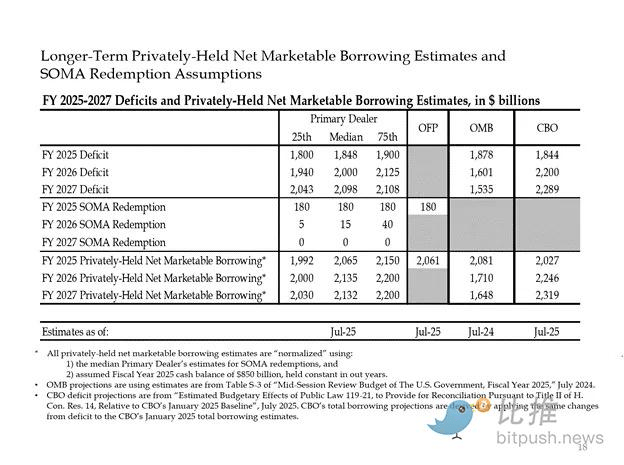
Group 1 - The article discusses the inevitability of government debt and the political incentives behind it, emphasizing that governments prefer to issue debt rather than raise taxes to fund expenditures [2][3] - It highlights the relationship between government borrowing and the Federal Reserve's balance sheet, suggesting that an increase in government debt will lead to an increase in the money supply, benefiting the liquidity of the dollar and potentially driving up the prices of Bitcoin and other cryptocurrencies [3][32] - The article outlines the projected federal deficits, estimating around $2 trillion annually, and discusses the implications for U.S. Treasury bond issuance and financing [6][7] Group 2 - The article identifies the primary buyers of U.S. debt, including foreign central banks, the private sector, and commercial banks, concluding that the marginal buyers are RV hedge funds, particularly those based in the Cayman Islands [9][14][12] - It explains the trading strategies of RV funds, which involve buying U.S. Treasury bonds and financing these purchases through repurchase agreements (repos) [19][21] - The article discusses the role of the Federal Reserve in managing short-term interest rates and how it influences the liquidity in the market, particularly through tools like the Standing Repo Facility (SRF) [22][28] Group 3 - The article warns of a potential liquidity crisis if RV funds cannot secure financing at favorable rates, which would hinder their ability to purchase U.S. debt and impact government financing [27][26] - It introduces the concept of "stealth quantitative easing," suggesting that the SRF will become a primary channel for injecting liquidity into the financial system without being labeled as traditional quantitative easing [32][31] - The article concludes that the current market stagnation presents opportunities, particularly as the government prepares to release additional liquidity once operations resume, which could reignite interest in cryptocurrencies [33]
X @Arthur Hayes
Arthur Hayes· 2025-11-02 08:51
Monetary Policy - The Federal Reserve's Standing Repo Facility (SRF) is characterized as a new "stealth money printing vehicle" [1] - When money market conditions tighten (SOFR exceeds the Fed Funds rate), the Fed increases liquidity by lending through the SRF [1]
SEVEN HILLS REAL(SEVN) - 2025 Q3 - Earnings Call Transcript
2025-10-28 16:02
Financial Data and Key Metrics Changes - Distributable earnings for Q3 2025 were $4.2 million or $0.29 per share, at the high end of guidance [4][12] - A regular quarterly dividend of $0.28 per share was declared, equating to an annualized yield of 11% [4] - The company ended the quarter with $77 million in cash and $310 million in capacity on secured financing facilities [14][15] Business Line Data and Key Metrics Changes - The portfolio consisted of $642 million in floating-rate first mortgage commitments across 22 loans, with a weighted average all-in yield of 8.2% and a weighted average loan-to-value of 67% [5] - The weighted average risk rating at quarter end was 2.9, with all loans current on debt service and no non-accrual balances [6][15] Market Data and Key Metrics Changes - Market sentiment improved following the Federal Reserve's rate cut in September, driving new financing activity [9] - Demand for floating-rate bridge financing remains strong, particularly due to 2021 and 2022 vintage floating-rate multifamily loan maturities [9][10] - The company is currently evaluating over $1 billion of loan opportunities, with a shift towards a higher proportion of acquisition financing [11] Company Strategy and Development Direction - The company aims to deploy capital into opportunities that offer the best relative value in the current environment, focusing on disciplined capital deployment [8] - The strategy includes maintaining strong sponsor relationships and leveraging underwriting and asset management expertise to generate attractive risk-adjusted returns [8] Management's Comments on Operating Environment and Future Outlook - Management noted that competition remains elevated, but they continue to find compelling opportunities that meet return thresholds [8] - Expectations of further rate cuts before year-end are anticipated to enhance borrower engagement and transaction volume [7][9] - The company expects fourth-quarter distributable earnings to be in the range of $0.29-$0.31 per share [13] Other Important Information - The company reported full repayment of two loans totaling $53.8 million during the quarter, with expectations for additional repayments in 2026 [7] - The CECL reserve remains modest at 150 basis points of total loan commitments, unchanged from the previous quarter [15] Q&A Session Summary Question: Expected repayments for the remainder of the year - Management confirmed that the only expected repayment before year-end is $15.3 million, with the majority of repayments scheduled for 2026 [17] Question: Sourcing of new loans and competition - Management indicated that most transactions come from traditional channels like mortgage banking, with a solid reputation helping to win loans [19] Question: Impact of lower SOFR on CECL reserve - Management explained that while lower SOFR could impact the CECL reserve, many factors influence it, and they maintain a conservative approach [23][24] Question: Demand for multifamily equity - Management noted that there is always demand for equity capital, especially with many loan maturities requiring additional equity [25][26] Question: Activity of banks in multifamily debt markets - Management observed that larger banks are active in the multifamily space, while smaller regional banks are more selective [28] Question: Cash balance increase - Management attributed the increase in cash balance to timing of repayments and the expectation of new loan originations [31] Question: NIM compression outlook - Management believes they are at the trough of NIM compression and expects to identify appropriate transactions for better returns [35]

A proxy for jobless claims data: Here's what to know
CNBC Television· 2025-10-17 13:17
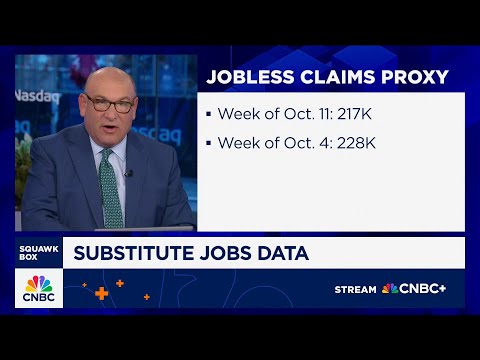
Labor Market Analysis - Haver Analytics estimates weekly jobless claims at 217,000 for the week of October 11th, compared to the government's 228,000 [1] - Continuing claims are estimated to be up at 1.942 million versus 1.92 million [2] - The economy is characterized as a relatively low fire, low hire environment, with no significant changes since the government stopped publishing data [4] - Goldman Sachs reports similar jobless claim numbers [5] Financial Market Conditions - Secured Overnight Funding Rate (SOFR) is at one-month highs, indicating a clamor for high-quality collateral and tightness in the financial market [11][12] - The rise in SOFR is reversing the effect of the Fed's rate cut on September 17th [13] - The fiscal year ended with 1.22 trillion to service the debt [16] Monetary Policy and Market Outlook - There's a divergence between jobless claims data and the Fed's concerns about the labor market [8] - The relationship between stocks and treasury yields is influenced by a "flight to good collateral" [9] - The current situation is not comparable to the great credit crisis [10] - Chairman Powell mentioned the possibility of ending quantitative tightening in the coming months due to some tightening in financial markets [17]