数字主权

Search documents
民调显示德国科技初创企业对美合作意愿下降
news flash· 2025-07-04 13:17
Group 1 - A recent survey indicates that German tech startups are becoming more cautious about collaboration with the U.S. due to changes in the American political landscape [1] - 70% of the surveyed companies believe that a potential re-election of Trump poses risks to the German economy [1] - 87% of the startups advocate for Germany to enhance its digital sovereignty and reduce dependence on the U.S. [1] Group 2 - 35% of the startups are taking a wait-and-see approach regarding partnerships with American companies or projects [1] - 31% of the companies are reassessing whether to accept funding from American investors [1]
欧盟酝酿量子计算新战略:弥补资金缺口,减少对美资依赖
Hua Er Jie Jian Wen· 2025-07-01 09:01
Core Viewpoint - The European Commission is set to unveil an ambitious plan to establish a competitive quantum computing ecosystem in Europe, addressing funding and expertise challenges in the sector [1][2]. Group 1: Funding and Investment Challenges - The lack of funding opportunities, particularly in venture capital, is forcing many European quantum startups to relocate to the United States for business expansion [1][2]. - Despite having strong scientific capabilities and promising startups, Europe faces a dual challenge of funding and talent loss in the quantum technology sector [2]. Group 2: Strategic Measures for Quantum Ecosystem - The upcoming strategy aims to consolidate expertise, resources, and knowledge to build a quantum ecosystem within the EU, addressing the productivity gap with the US [3]. - The EU's flagship research funding program, Horizon Europe, will continue to support quantum research, and a Scale-Up Europe Fund is being prepared to assist tech companies in scaling [3]. Group 3: Digital Sovereignty Agenda - The quantum strategy is part of a broader digital sovereignty agenda aimed at reducing reliance on large US tech companies, with investments in AI, quantum computing, and semiconductors deemed crucial for technological sovereignty [4]. - The EU's recent initiative to establish five AI gigafactories has attracted 76 responses, with potential investments reaching €230 billion, significantly enhancing capabilities in AI development [4].
欧盟云计算市场2/3份额被美企垄断 数字主权危机倒逼3000亿欧元本土化突围
智通财经网· 2025-06-27 10:49
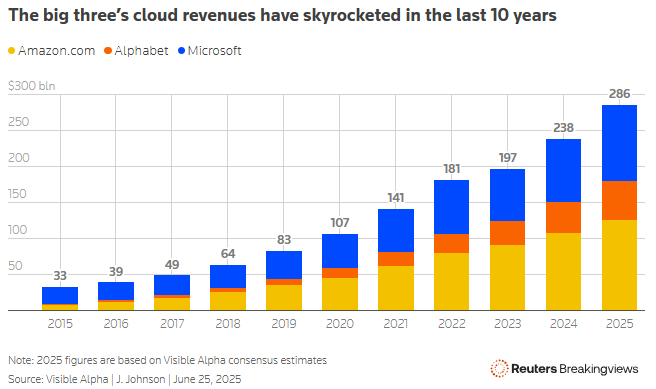
Core Insights - European companies are increasingly dependent on American cloud computing giants like Amazon, Microsoft, and Google, which control approximately two-thirds of the EU cloud market [1][6] - This dependency poses risks, as U.S. laws allow the government to access data stored by these cloud providers, raising concerns among European CEOs and governments [4][11] - The geopolitical climate has intensified these concerns, prompting European companies to consider alternatives to reduce reliance on U.S. cloud services [5][6] Market Dynamics - The dominance of U.S. cloud providers is attributed to their ability to invest heavily in data centers, offering reliable and cost-effective services [1] - The potential cost of building a fully localized European cloud ecosystem is estimated at €5 trillion, with EuroStack suggesting an investment of €300 billion over the next decade [6][6] - European companies face significant challenges in transitioning to local alternatives, including high costs and lengthy processes [6][7] Strategic Responses - Major cloud providers have begun to address these concerns by offering "sovereign solutions" that claim to give EU customers more control over their data [7] - However, skepticism remains regarding the effectiveness of these solutions in truly safeguarding European data from U.S. government access [7][11] - Some companies are exploring hybrid models, such as the "walled garden" approach, which allows for local data management while utilizing U.S. cloud technology [7][8] Customer Behavior - Many European clients are locked into long-term contracts with U.S. cloud providers, making immediate transitions to local alternatives challenging [8] - The EU Commission has expressed dissatisfaction with the lack of local solutions to reduce reliance on Microsoft 365, indicating a broader concern within the region [11]

荷兰云服务严重依赖美国 加剧数字主权忧虑
Xin Hua Wang· 2025-06-03 13:58
Core Viewpoint - The heavy reliance of the Netherlands on American cloud services raises significant concerns about digital sovereignty and national security, especially in light of recent political tensions and incidents involving U.S. sanctions [1][2][3] Group 1: Dependence on American Cloud Services - A recent survey revealed that a vast number of Dutch public institutions, including government agencies and critical infrastructure operators, outsource their email and cloud services to American companies, with Microsoft holding a 60% market share in email services [1] - 63% of large Dutch enterprises and 60% of critical infrastructure companies, such as banks and water supply firms, depend on American cloud platforms like Microsoft and Google [1][2] - The Dutch government and various ministries are significantly reliant on Microsoft services, with 9 out of 15 ministries using its cloud solutions [1] Group 2: Risks and Security Concerns - Experts warn that key Dutch websites, including those of the Ministry of Foreign Affairs and the Central Bank, could theoretically be shut down or altered by U.S. entities due to this dependence [2] - The U.S. government's ability to access Dutch data, even stored within the EU, poses a substantial risk to national security, especially in times of political conflict [2] - A report from a Dutch think tank emphasizes the need for the Netherlands to accelerate the development of local or European cloud service alternatives to mitigate systemic reliance on U.S. technology [2] Group 3: Academic and Political Response - The Dutch academic community is actively addressing the risks associated with U.S. digital storage, launching initiatives to back up critical research data stored on American servers [3] - The Dutch Parliament has passed several motions urging the government to reduce dependence on U.S. cloud services and to promote the development of domestic or European alternatives [3] - There is increasing pressure from lawmakers for the Dutch government to present actionable plans to enhance digital infrastructure resilience [3]

综述|微软封锁电邮事件凸显欧洲数字主权困境
Xin Hua She· 2025-05-25 05:37
Group 1 - The incident of Microsoft blocking the email account of the International Criminal Court's chief prosecutor has raised significant concerns regarding Europe's digital sovereignty [1] - The Netherlands has initiated a comprehensive review of its digital infrastructure in response to the incident, highlighting the risks associated with reliance on American tech companies [1][2] - A report from the Dutch Court of Audit indicated that over half of the Dutch government services operate on cloud systems controlled by U.S. companies, posing serious risks to service continuity [1] Group 2 - The European Union has been proactive in addressing these risks by introducing regulations like the Digital Markets Act to reduce dependence on foreign platforms and promote internal technological competition [2] - Despite ambitious plans, Europe faces significant challenges in achieving digital sovereignty due to deep-rooted reliance on U.S. cloud technologies, with migration to local systems taking considerable time [2] - The EU has opted for regulatory measures to limit the influence of U.S. tech giants, as evidenced by recent fines imposed on Apple and Meta for violations of the Digital Markets Act [2] Group 3 - In light of increasing pressure, U.S. tech companies are reassessing their strategies, with Microsoft committing to respect European laws and planning to increase data center capacity in Europe by 40% [3] - The email blocking incident has highlighted a critical gap in Europe's digital infrastructure, where data may be stored in EU data centers but is still controlled by U.S. companies, thus remaining subject to U.S. jurisdiction [3] - A mixed model is likely to be the short-term reality for European digital sovereignty, with public systems gradually transitioning to EU-controlled infrastructure while non-critical services continue to operate under stricter regulations on U.S. platforms [3]
《坦克世界》现在是俄罗斯国营游戏了
3 6 Ke· 2025-05-23 11:26
Core Points - The Russian Federal Court has ruled that Lesta Games committed "treason" and engaged in extremist activities, leading to the nationalization of its popular military games like "World of Tanks" and "World of Warships" [1][4] - Lesta Games, originally established in 1991 and later acquired by Wargaming, became independent after Wargaming exited the Russian and Belarusian markets due to the Ukraine conflict [2][4] - The company reported a revenue of 35 billion rubles (approximately 3.17 billion RMB) and a net profit of 16 billion rubles (approximately 1.45 billion RMB) for 2024, with a monthly active user base of 6.5 million [2] Legal and Political Context - The Russian government has tightened laws regarding treason and extremism since the escalation of the Ukraine conflict, with a significant increase in treason convictions [4][5] - Lesta's founder is accused of forming an organization that engaged in extremist activities, with claims that Lesta indirectly funded the Ukrainian military through charitable activities [4][5] - The court proceedings were expedited, with asset freezes occurring before a public trial, indicating a lack of transparency in the legal process [5] Industry Implications - The nationalization of Lesta Games is seen as a strong signal of the Russian government's increasing control over gaming content and infrastructure, aligning with its "digital sovereignty" agenda [7] - Industry associations have expressed concerns that the forced nationalization could undermine confidence in the gaming sector and lead to a significant outflow of entrepreneurs and capital [7] - The distinction between Russian and international versions of games is expected to widen, especially as multinational companies have already begun to withdraw from the Russian market [8]

综述丨电邮封锁事件引担忧 荷兰讨论摆脱对美技术依赖
Xin Hua She· 2025-05-21 07:41
Group 1 - The email account of Karim Khan, the chief prosecutor of the International Criminal Court in The Hague, was blocked by Microsoft, raising concerns about the monopoly of American tech companies in the Netherlands [1] - The incident has prompted discussions in the Netherlands about reducing reliance on American technology, leading to a movement towards "de-Microsoftization" [1] - At least 10 key public institutions in the Netherlands have approached local cloud service provider Intermax Group to seek alternatives to American cloud services [1] Group 2 - Transitioning away from Microsoft is challenging due to deep integration of its systems within many government departments, which have developed a "path dependency" on Microsoft technologies [2] - The Dutch Ministry of the Interior is reassessing its reliance on Microsoft and exploring alternative technologies from France and Germany, although current projects still depend on Microsoft software [2] - Local companies are assisting hospitals and government agencies in storing email copies locally to mitigate risks associated with potential service interruptions from Microsoft [2] Group 3 - The Dutch Central Bank has raised alarms about the national security risks posed by the heavy reliance on American tech companies, particularly in the financial sector [3] - The online payment system iDEAL, while appearing to be Dutch, relies on key technologies controlled by two American companies that dominate over 60% of the European market [3] - There is significant dependence on American companies like Amazon, Google, and Microsoft for storing and managing sensitive data across Dutch banks, businesses, and government institutions [3]
RISC-V十五年,势不可挡
半导体行业观察· 2025-05-21 01:37
Core Insights - RISC-V has emerged as a significant open-source instruction set architecture (ISA) that has gained traction in both academic and commercial sectors, driven by its flexibility and openness [2][4][9]. Group 1: Development and Adoption - The initial discussions among the team at UC Berkeley led to the acceptance of the risks associated with developing a new RISC architecture, which ultimately resulted in the creation of RISC-V [2][4]. - RISC-V's success is attributed not only to its technical advantages but also to its innovative business model that emphasizes openness and accessibility [5][7]. - The first version of the RISC-V instruction manual was released in May 2011, and the architecture quickly gained attention beyond academia, leading to its adoption in various commercial applications [5][10]. Group 2: Industry Engagement - The RISC-V community saw significant industry interest, with numerous companies participating in workshops and expressing a desire for open ISAs, highlighting the demand for flexibility in commercial ISAs [7][10]. - Major companies like NVIDIA announced plans to adopt RISC-V for critical internal functions, marking a pivotal moment for the architecture's acceptance in the semiconductor industry [9][10]. - The establishment of the RISC-V Foundation in 2015 aimed to promote the ISA's openness and prevent fragmentation, ensuring its sustainability and growth in the industry [15][16]. Group 3: Academic Integration - Academic institutions began to embrace RISC-V as a teaching architecture, with many universities converting their course materials to incorporate RISC-V [12][13]. - The collaboration between ETH Zurich and the University of Bologna on the PULP project exemplifies the academic interest in RISC-V, leading to the migration of cores to RISC-V for enhanced community engagement [13][14]. Group 4: Global Expansion - RISC-V has gained international traction, with countries like Brazil and India adopting it as a core computing architecture, reflecting its significance in national computing strategies [23][25]. - The RISC-V International Association was established to facilitate global collaboration and promote the architecture as a neutral platform for open computing [21][23]. Group 5: Future Directions - RISC-V is positioned to play a crucial role in various sectors, including automotive and aerospace, due to its modular and customizable design, which allows manufacturers to adapt quickly to changing needs [39][41]. - The architecture's potential in high-performance computing (HPC) is being explored, with ongoing projects demonstrating its capabilities in this domain [36][41]. - The focus on artificial intelligence (AI) and machine learning (ML) is expected to drive further adoption of RISC-V, as it allows for tailored designs that meet specific computational demands [30][34].

宝洁、可口可乐,遭欧盟突击检查
凤凰网财经· 2025-04-10 13:55
据财联社报道,宝洁被欧盟反垄断监管机构调查,与可口可乐同时遭到突击检查。 当地时间周三(3月19日),欧盟委员会宣布对谷歌母公司Alphabet提起反垄断指控,并责令苹果公司采取措施遵守欧盟新出台的《数字市场法》。 一年之后,调查有了初步结果。根据此前发布的公告,欧委会指控谷歌有两项行为违反了DMA,首先是谷歌的搜索引擎优先显示指向Alphabet自家服务, 而非竞争对手的搜索结果,违反了以"透明、公平和非歧视"方式对待第三方服务的要求。同时,应用商店Google Play阻止开发者引导用户在其他渠道下载 应用软件,这就导致开发者也要像支付"苹果税"一样给谷歌支付高额佣金。 此外,欧盟委员会还"敲打"了苹果,要求其继续"拆围栏", 遵循DMA的互操作性义务。简单而言,就是要求苹果硬件生态开源,一直以来,用户能在苹 果手机、电脑、手表、耳机等不同设备间切换,前提是都要有个"苹果全家桶",但现在欧盟则要求苹果开放系统工具和访问权限,允许第三方的智能手 表、耳机和VR设备可以更顺畅地和IOS系统连接,比如更简便的设备配对、更互通的消息推送、更快的数据传输等。 不过,欧盟的调查公告发出后,两家公司的回应也并不服软。 ...


宝洁、可口可乐,遭欧盟突击检查!
21世纪经济报道· 2025-04-10 11:00
Core Viewpoint - The article discusses the ongoing antitrust investigations by the European Union (EU) against major tech companies, particularly Google and Apple, under the newly enacted Digital Markets Act (DMA), highlighting the implications for these companies and the broader tech landscape in Europe [1][3][4]. Group 1: Antitrust Investigations - The EU has initiated antitrust investigations against Google and Apple, with both companies facing scrutiny for potentially violating the DMA [1][4]. - Google is accused of favoring its own services in search results and restricting developers from directing users to alternative app download channels, which could lead to significant fines [4][5]. - Apple is being pressured to open its ecosystem to third-party devices, which could enhance interoperability but also raises concerns about user privacy and innovation [4][6]. Group 2: Regulatory Context - The DMA, effective since March 2022, aims to regulate "gatekeeper" companies, primarily targeting large US tech firms, with potential fines reaching up to 10% of global annual revenue for violations [3][4]. - The EU's actions against US tech giants are seen as a response to the lack of local internet champions in Europe, as the market is dominated by American companies [9][10]. Group 3: Market Implications - The dominance of US companies in the European digital market is significant, with Google holding nearly 90% market share in search engines and major players like Amazon and Microsoft controlling over two-thirds of the AI and cloud computing markets [10]. - The EU's push for digital sovereignty includes a €200 billion investment plan for AI, indicating a strategic move to reduce reliance on US technology and foster local competition [10].