
新型工业化

Search documents
国家统计局:2025年全年工业企业利润实现增长,扭转了连续三年下降态势
Guo Jia Tong Ji Ju· 2026-01-27 02:01
Group 1: Overall Industrial Performance - In 2025, the profits of industrial enterprises in China increased by 0.6% compared to the previous year, reversing a three-year decline [1] - The manufacturing sector saw a significant growth of 5.0%, an increase of 8.9 percentage points from 2024 [1] - The electricity, heat, gas, and water production and supply sector grew by 9.4%, while the mining sector experienced a decline of 26.2% [1] - In December, profits of industrial enterprises turned from a decline of 13.1% in November to a growth of 5.3%, marking an 18.4 percentage point recovery [1] Group 2: Equipment Manufacturing Sector - In 2025, profits in the equipment manufacturing sector increased by 7.7%, contributing 2.8 percentage points to the overall profit growth of industrial enterprises [2] - The equipment manufacturing sector accounted for 39.8% of total industrial profits, an increase of 2.6 percentage points from the previous year [2] - Seven out of eight major categories within the equipment manufacturing sector reported profit growth, with railways, shipping, aerospace, and electronics industries showing double-digit growth rates of 31.2% and 19.5% respectively [2] Group 3: High-Tech Manufacturing Sector - The high-tech manufacturing sector's profits rose by 13.3%, surpassing the overall industrial profit growth by 12.7 percentage points [3] - The smart consumer electronics sector drove significant profit increases, with smart unmanned aerial vehicle manufacturing and smart vehicle equipment manufacturing seeing profits grow by 102.0% and 88.8% respectively [3] - The semiconductor industry experienced substantial profit growth, with integrated circuit manufacturing and semiconductor device manufacturing increasing by 172.6% and 128.0% respectively [3] Group 4: Traditional Industries and Other Sectors - Traditional industries showed significant improvements, with profits in the biochemical pesticide and cultural information chemical manufacturing sectors growing by 20.7% and 15.2%, respectively, exceeding the average for the chemical industry [4] - In the chemical fiber and power sectors, profits from bio-based chemical fiber manufacturing and biomass energy generation increased by 88.6% and 47.9%, respectively, significantly above their industry averages [4] - Profits for small and medium-sized enterprises, as well as foreign and Hong Kong, Macao, and Taiwan-invested enterprises, turned positive, growing by 1.4% and 4.2% respectively [4]
国家统计局:2025年全国规模以上工业企业利润增0.6% 新动能支撑带动作用明显
Guo Jia Tong Ji Ju· 2026-01-27 01:46
2025年全国规模以上工业企业利润增长0.6% 国家统计局数据显示,2025年,全国规模以上工业企业实现利润总额73982.0亿元,比上年增长0.6%。2025年,规模以上工业企业中,国有控股企业实现利 润总额20561.0亿元,比上年下降3.9%;股份制企业实现利润总额55408.3亿元,下降0.1%;外商及港澳台投资企业实现利润总额17447.4亿元,增长4.2%;私 营企业实现利润总额22810.6亿元,与上年持平。 国家统计局工业司首席统计师于卫宁解读2025年工业企业利润数据。 2025年,全国规模以上工业企业实现利润总额73982.0亿元,比上年增长0.6%(按可比口径计算,详见附注二)。 2025年,规模以上工业企业中,国有控股企业实现利润总额20561.0亿元,比上年下降3.9%;股份制企业实现利润总额55408.3亿元,下降0.1%;外商及港澳 台投资企业实现利润总额17447.4亿元,增长4.2%;私营企业实现利润总额22810.6亿元,与上年持平。 2025年,采矿业实现利润总额8345.1亿元,比上年下降26.2%;制造业实现利润总额56915.7亿元,增长5.0%;电力、热力、燃气及 ...

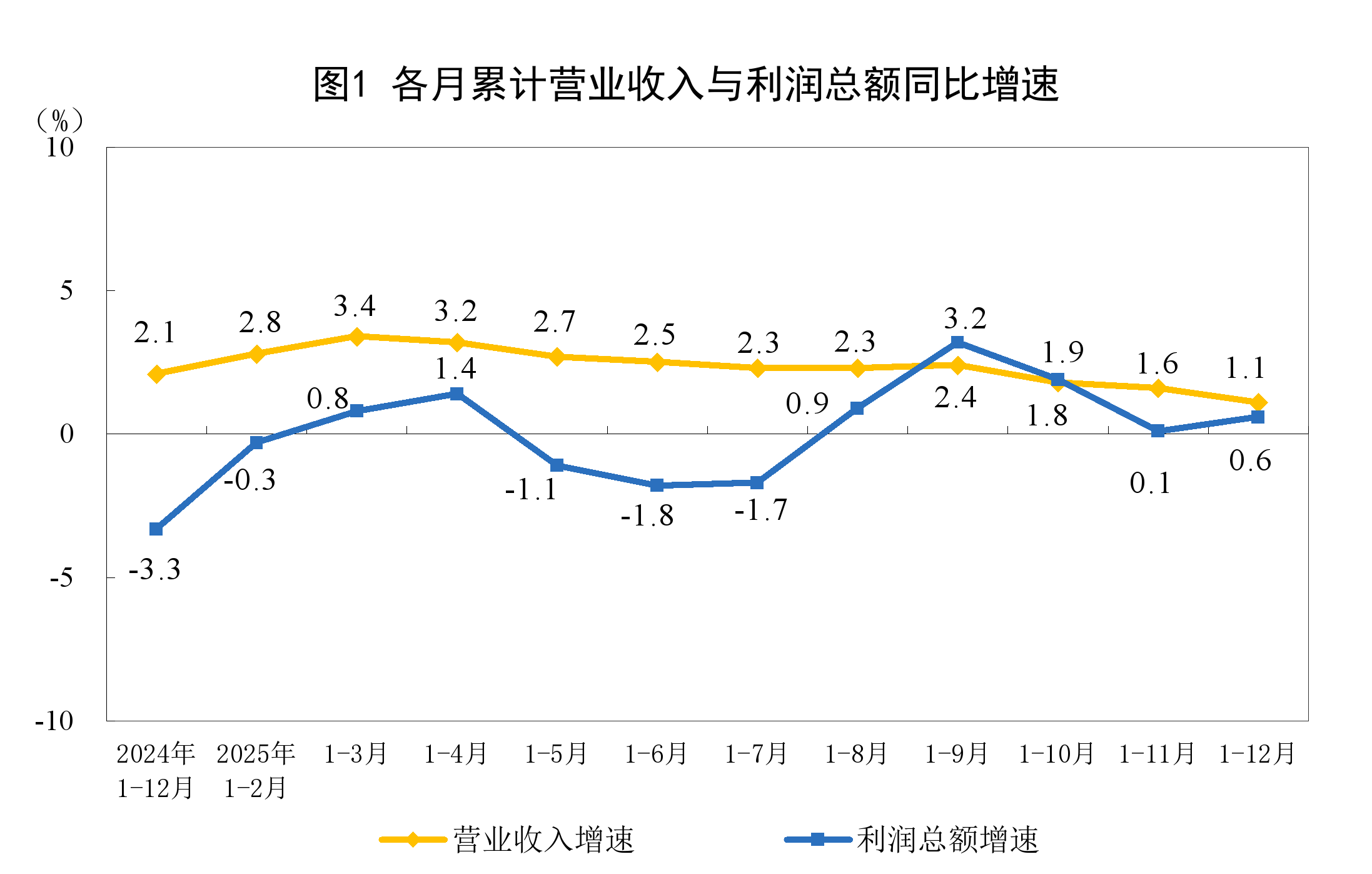
国家统计局解读:2025年规模以上工业企业利润实现增长 新动能支撑带动作用明显
智通财经网· 2026-01-27 01:44
2025年,各地区各部门加紧实施更加积极有为的宏观政策,加快推进新型工业化,推动工业经济稳定向 好运行。全年工业企业利润实现增长,扭转了连续三年下降态势,其中装备制造业、高技术制造业等新 动能支撑作用明显,传统产业利润结构持续优化,工业经济发展质效不断提升。 工业企业利润实现增长。2025年,全国规模以上工业企业利润较上年增长0.6%。从三大门类看,制造 业增长5.0%,增速较2024年大幅回升8.9个百分点;电力、热力、燃气及水生产和供应业增长9.4%;采 矿业下降26.2%。12月份,规模以上工业企业当月利润由11月份下降13.1%转为增长5.3%,回升18.4个百 分点。 装备制造业为工业向优升级提供坚实支撑。2025年,规模以上装备制造业利润较上年增长7.7%,拉动 全部规模以上工业企业利润增长2.8个百分点,是对规模以上工业企业利润增长拉动作用最强的板块。 规模以上装备制造业利润占全部工业企业利润的比重达39.8%,较上年提高2.6个百分点,工业企业利润 结构进一步优化。从行业看,装备制造业的8个大类行业中有7个行业利润较上年增长,其中,铁路船舶 航空航天、电子行业利润两位数增长,增速分别达31.2 ...
江西省委常委、赣州市委书记黄喜忠:扬长补短,固本兴新,奋力走好革命老区新型工业化路子
Xin Lang Cai Jing· 2026-01-27 01:32
Core Viewpoint - Ganzhou is focusing on industrial development as a key task for high-quality growth, leveraging its historical significance and resources to build a modern industrial system [1][2]. Group 1: Industrial Development Strategy - Ganzhou aims to enhance its industrial base, with industrial contribution to GDP reaching 49.3%, and has established four trillion-yuan industrial clusters in non-ferrous metals, new materials, electronic information, and modern home furnishings [2]. - The city is committed to transforming traditional industries and developing strategic emerging industries, with a goal of achieving an annual growth rate of approximately 10% in industrial revenue [3][6]. Group 2: Resource Utilization and Innovation - Ganzhou is enhancing the functionality of strategic resources like rare earths and tungsten, aiming to create a globally influential rare earth and rare metal industry cluster [5]. - The city is focusing on technological innovation, establishing high-level innovation platforms, and supporting the development of new drugs and advanced materials [12][13]. Group 3: Digital Transformation and Sustainability - The city has implemented policies to support digital transformation in manufacturing, with significant investments leading to improvements in productivity and reductions in energy consumption [8]. - Ganzhou is promoting green industrial practices, with multiple national and provincial-level green industrial parks and factories established [8]. Group 4: Ecosystem and Policy Support - The local government is enhancing the business environment through targeted policies and financial support, including a 530 billion yuan government industry fund [16][19]. - Reform initiatives in development zones are aimed at improving administrative efficiency and fostering a collaborative ecosystem between government and businesses [18][20].
驻港公司和初创企业数目再创新高 团结香港基金:建议港府引进国际加速器 在新田打造加速器集群
Zhi Tong Cai Jing· 2026-01-26 08:18
港府公布的"2025年有香港境外母公司的驻港公司按年统计调查"和"2025年初创企业统计调查"结果显 示,去年母公司在内地及海外的驻港公司数目增加至11070间;香港的初创企业数目则增至5221间,均 再创新高。团结香港基金副研究总监郭凯杰表示感到鼓舞,认为在地缘政治及环球经贸格局转变下仍录 得增长,印证香港内联外通、法治及国际化营商环境依然具吸引力,亦反映海内外企业对香港前景的信 心。他建议,港府积极引进国际加速器,并在新田打造加速器集群。 郭凯杰指出,在驻港公司及招商引资数字上升之际,更重要的是把落户转化为对本地生产总值及就业的 实质贡献。他建议港府引导新增企业投向可配合香港上游研发优势、并与新型工业化发展方向一致的策 略性产业,如生物科技、生命健康及先进制造,避免企业过度集中于以金融服务等为主的轻资产模式难 以带动对实体产业;同时鼓励企业在港建立更完整的研发—中试—量产链条,包括设立具实际产出的生 产线或智能微工厂,带动本地制造生态与供应链,为青年提供更多入行机会与清晰的职业阶梯,推动经 济多元化及整体GDP增长。 他亦表示,2025年香港初创企业数目较2021年大幅增加39%至5221间,展示近年创业 ...
零碳工厂:工业领域落实“双碳”目标的关键抓手
中国能源报· 2026-01-26 04:24
Core Viewpoint - The article discusses the issuance of the "Guiding Opinions on the Construction of Zero Carbon Factories" by five departments including the Ministry of Industry and Information Technology, marking a significant step in promoting zero carbon factory construction as a national strategic action aimed at achieving carbon neutrality in the industrial sector [1][3]. Summary by Sections Zero Carbon Factory Definition and Goals - A zero carbon factory prioritizes the use of green electricity and energy-saving modifications to reduce carbon emissions, aiming for net-zero emissions through carbon offsetting via green trading [1]. - The construction of zero carbon factories is set to be included in government work reports by 2025, indicating its elevation from industry exploration to a national strategy [1]. Key Tasks and Industry Focus - The "Guiding Opinions" outline three clear aspects: construction objects, goals, and pathways, focusing on key industries such as automotive, lithium batteries, photovoltaics, steel, non-ferrous metals, and petrochemicals, which together account for over 65% of the industrial added value and approximately 50% of total carbon emissions in China [3][4]. Development Goals and Phased Approach - The document sets clear, phased development goals, emphasizing the need to establish low-carbon competitive advantages in sensitive international trade sectors by 2027, particularly in automotive and electronics [4]. - By 2030, the focus will shift to consolidating low-carbon achievements in foundational materials and consumer goods, promoting collaborative carbon reduction across supply chains [4]. Construction Pathways and Mechanisms - The "Guiding Opinions" propose a comprehensive lifecycle approach to carbon reduction, including scientific carbon accounting, source reduction, process reduction, consumption carbon fixation, intelligent carbon control, and efficient carbon management [5]. - It emphasizes the need for differentiated deployment of tasks among various stakeholders, including local authorities, enterprises, industry associations, and research institutions, to create a multi-faceted governance structure for zero carbon factory construction [5]. Four Guiding Principles - The article outlines four guiding principles for zero carbon factory construction: 1. **Prudent Development**: Tailoring strategies to industry characteristics and ensuring steady carbon reduction without compromising economic growth [7]. 2. **Systematic Advancement**: Integrating energy optimization, resource recycling, and supply chain collaboration into a comprehensive carbon reduction strategy [8]. 3. **Soft and Hard Integration**: Combining physical measures with robust carbon management systems to enhance overall carbon management capabilities [9]. 4. **International Leadership**: Establishing standards and databases that reflect China's characteristics and actively participating in international standard-setting [9]. Recommendations for Stakeholders - Local authorities are advised to implement science-based policies that consider regional industrial characteristics and avoid sacrificing normal operations for short-term emission reductions [12]. - Enterprises should focus on enhancing their green competitiveness by aligning with ESG disclosure requirements and establishing effective carbon management systems [12]. - Research institutions are encouraged to innovate standards and frameworks that support zero carbon factory construction, ensuring alignment with international practices [13]. Conclusion - The "Guiding Opinions" serve as a clear action guide and institutional framework, marking a solid step towards zero carbon development in China's industry, with the potential to set a global benchmark for industrial green transformation [13].

营商广西·桂在便利丨柳州市柳东新区优服务强保障精准服务纾企困 汽车产业加速跑
Guang Xi Ri Bao· 2026-01-26 02:23
1月25日,在柳州市柳东新区工业园的广西思必驰科技有限公司生产区内,3条生产线满负荷运转。 作为国内专业的对话式人工智能平台公司,思必驰自去年与雅迪智能合作后,今年迎来交付量产期,预 计一季度产能同比增加40%。据悉,为应对产能需求的暴增,企业新增40名员工,春节前还将新开4条 生产线。 瑞浦赛克制造中心总监熊小强表示,柳州汽车产业链较完备,瑞浦赛克除了对上汽通用五菱提供动 力产品保供业务外,也在积极推进其他车企的供应业务。 "企业的发展,得益于柳州和柳东新区政府对汽车产业的大力扶持,这里产业生态协同高效,技术 人才资源丰富,降低了企业的用工与生产成本。"思必驰总经理施宋磊感慨道。 据了解,为帮助汽车企业提升发展空间,今年,柳东新区将建立"企业吹哨、专员报到"快速响应机 制。柳东新区工信局负责人曾玲表示,未来将针对企业诉求主动作为,提供政银企联动、支持企业参与 展销会、打造帮办代办品牌等服务,以更优服务助企纾困,让企业在新区安心发展、放心经营。(黎 静) 近年来,柳东新区全面贯彻落实柳州市关于推进新型工业化、建设现代制造城的决策部署,做强做 优汽车产业,从多维度延链、补链、强链,构建一个完整、高效且富有竞争力 ...
新华社:透视“十四五”收官之年工业和信息化发展成效
Xin Hua She· 2026-01-26 01:14
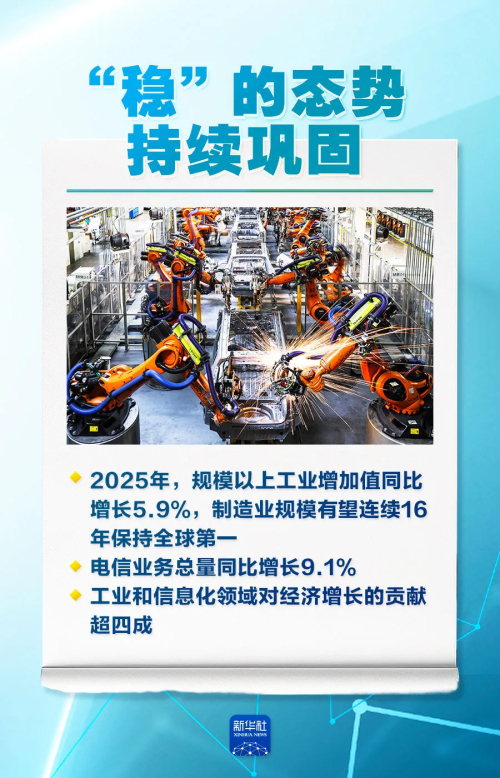
Core Insights - The industrial economy in China is showing steady growth, with a year-on-year increase of 5.9% in industrial added value for large-scale enterprises, and the manufacturing sector maintaining its position as the world's largest for 16 consecutive years [2][8] - The contribution of the industrial and information technology sectors to economic growth exceeds 40%, indicating their critical role in the national economy [2][7] Group 1: Industrial Growth and Achievements - The added value of equipment manufacturing and high-tech manufacturing increased by 9.2% and 9.4% year-on-year, respectively [9] - Over 35,000 basic-level, 8,200 advanced-level, 500 excellent-level, and 15 leading-level smart factories have been established [9] - More than 8,000 national green factories have been cultivated, contributing to energy and water consumption reduction in large-scale industrial units [9] Group 2: Innovation and New Technologies - Significant advancements in technology include over 300 key technology reserves from the first phase of 6G trials, and a year-on-year increase of 26.7% and 23.9% in the added value of integrated circuits and electronic materials, respectively [10] - The production of industrial robots increased by 28%, and new energy vehicle sales reached 16.49 million units, marking a year-on-year growth of 28.2% [10] - The application of artificial intelligence in manufacturing has expanded significantly, with the scale of intelligent computing power reaching 1590 EFLOPS [4] Group 3: Support for Small and Medium Enterprises - A total of 17,600 specialized and innovative "little giant" enterprises and over 140,000 specialized and innovative small and medium enterprises have been cultivated [3][13] - The added value of specialized and innovative "little giant" enterprises in large-scale industries is expected to grow by 6.9% year-on-year [3] Group 4: Future Directions and Policies - The focus for the upcoming year includes stabilizing growth, enhancing innovation, promoting integration, optimizing governance, and preventing risks, with a strong push for new industrialization [6] - The industrial and information technology sectors will continue to support the transformation and upgrading of traditional industries through initiatives like "5G + industrial internet" [5]
我省首批县(市)获扩权赋能,冲刺千亿目标 点将二十九“头雁”,领飞县域新雁阵
Si Chuan Ri Bao· 2026-01-26 00:27
Core Viewpoint - The Sichuan provincial government is implementing a "strong county empowerment reform" to enhance the economic strength of its counties, aiming to create a group of economically robust counties that can lead the province's high-quality economic development [1][2]. Group 1: Reform Objectives and Implementation - The first batch of counties selected for the reform includes 29 counties and cities, which are expected to lead the development of strong counties with economic outputs exceeding 1 billion, 800 million, and 500 million yuan [1][2]. - The reform aims to address the issue of "strong counties not being strong" by concentrating resources on counties with strong development foundations and potential [2][3]. - The average GDP of 183 counties in Sichuan is projected to reach 35.37 billion yuan in 2024, an increase of 8.81 billion yuan from 2020, with 27 counties exceeding 60 billion yuan in economic output [2]. Group 2: Selection Criteria and Distribution - The selection of the 29 pilot counties was based on a comprehensive assessment of their economic total, population size, market potential, and industrial foundation, while considering local intentions and debt risk [3]. - The distribution of the selected counties includes two each from major cities like Chengdu, Luzhou, Deyang, and others, with these counties contributing to over 19% of the province's GDP in 2024 [4]. Group 3: Industrial Development Focus - The reform emphasizes the development of leading industries, with pilot counties expected to achieve an industrial added value of 363.8 billion yuan in 2024, averaging 12.5 billion yuan per county [5]. - The strategy includes fostering new industrialization and leveraging local resource advantages to create significant industrial clusters [6]. Group 4: Urbanization and Population Integration - The pilot counties have a total population of nearly 19 million, representing over 20% of the province's population, but their urbanization rate is below provincial and national averages [7]. - Accelerating new urbanization and facilitating the integration of agricultural transfer populations into urban areas are key tasks for these counties [7]. Group 5: Monitoring and Accountability - A reform work promotion mechanism has been established to oversee the implementation of the reform, including monitoring and evaluation systems to ensure accountability [8]. - Counties that fail to meet performance indicators may face warnings and potential removal from the reform pilot program [8]. Group 6: Ambitious Goals and Action Plans - Specific counties, such as Jianyang and Xichang, have set ambitious goals to become the first "billion-dollar counties" by 2026, focusing on developing key industries [9][10]. - Various counties are implementing action plans to enhance economic development, with mechanisms for regular assessment and accountability [10].
淮安用五年“再造一个淮安工业”
Xin Lang Cai Jing· 2026-01-25 20:20
Core Insights - The city of Huai'an has focused on new industrialization over the past five years, successfully establishing 54 industrial projects with investments exceeding 3 billion yuan, of which 26 have been completed and put into operation, creating one national-level advanced manufacturing cluster and two trillion-yuan industrial clusters [1] - Huai'an has achieved top rankings in the provincial high-quality development comprehensive assessment for 2023 and 2024, indicating significant progress in economic development and public welfare [1] - The local government has implemented measures to enhance employment, entrepreneurship, and social security, leading to a notable increase in residents' income, which ranks among the highest in the province [1] Economic Strategy - Moving forward, Huai'an aims to focus on economic construction, emphasizing industrial growth and accelerating high-quality economic development despite adverse conditions [2] - The city plans to build a modern industrial system centered around the "353" strategic emerging industry integration cluster and implement the "151" reform initiative [2] - Development projects such as the Salt River industrial belt and the Huai River waterway industrial belt are being prioritized to enhance transportation and economic hubs, supporting regional development and domestic demand [2] Social Development - The government is committed to improving public welfare by enhancing education, healthcare, culture, and social security, ensuring that the benefits of economic growth reach all citizens [2] - There is a focus on addressing historical issues affecting the community and mitigating risks across various sectors to promote overall social stability and prosperity [2]