新能源发展

Search documents
20cm速递|新能源板块大爆发,创业板新能源ETF华夏(159368)上涨3.63%
Mei Ri Jing Ji Xin Wen· 2025-09-04 10:30
Group 1 - The A-share market showed mixed performance on September 4, with over 3,300 stocks rising, while sectors like banking and telecommunications lagged behind. The new energy sector experienced significant growth, with the Huaxia New Energy ETF (159368) rising by 3.63%, and stocks like Yiwei Lithium Energy and Zhongwei Shares increasing by over 10% and 8% respectively [1] - In the past month, the upstream prices of the new energy industry chain have shown a marginal recovery, driven by a rebound in lithium carbonate prices, which has increased lithium ore procurement demand. Limited supply from overseas mines and strong pricing sentiment among traders have contributed to the sustained strength of lithium ore prices [1] - The expectation of "anti-involution" policies and positive sentiment in the futures market have led to a significant rebound in the prices of lithium carbonate and lithium hydroxide, which has helped restore valuations across the entire new energy vehicle industry chain [1] Group 2 - According to Caitong Securities, domestic lithium battery production is expected to increase by 7.5% year-on-year by September 2025, with continued recovery in demand for power batteries. Breakthroughs in solid-state battery technology are anticipated, with several automakers planning to adopt solid-state batteries around 2027, accelerating the industrialization process [1] - The launch of pilot production lines and the restart of lithium battery expansion cycles are expected to improve the fundamentals of equipment companies, with a positive outlook on the advancement of solid-state battery industrialization [1] - The Huaxia New Energy ETF (159368) is the first ETF in the market tracking the entrepreneurial board new energy index, covering various sectors such as batteries, photovoltaics, and semiconductors, which aligns well with the "anti-involution" policy [2]

锡华科技:业绩高增在手订单充裕 IPO加码风电装备布局
Zheng Quan Shi Bao Wang· 2025-09-04 07:00
Company Overview - Jiangsu Xihua New Energy Technology Co., Ltd. (referred to as "Xihua Technology") is preparing for its IPO review on September 5, 2025, focusing on the R&D, manufacturing, and sales of specialized components for large high-end equipment, primarily wind turbine gearboxes and injection molding machines [1] - The company aims to become a leading global manufacturer of specialized components in the wind energy sector, aligning with national policies promoting renewable energy development [1] Financial Performance - Xihua Technology has shown steady growth, with annual revenues exceeding 900 million yuan from 2022 to 2024. In the first half of 2025, revenue reached 580.44 million yuan, a year-on-year increase of 36.67%, while the net profit grew to 94.29 million yuan, up 55.67% year-on-year [1] - The company reported a net profit growth of 57.07% in the second quarter of 2025, indicating continuous improvement in profitability [1] Order and Revenue Forecast - As of late July 2025, Xihua Technology has approximately 32,378.12 tons of orders on hand, with an average monthly tonnage of 12,951.25 tons, representing a 70.04% increase compared to the average monthly sales of 7,616.44 tons in 2024 [2] - The company anticipates revenue for the first three quarters of 2025 to be between 859 million and 869 million yuan, reflecting a year-on-year increase of 29.04% to 30.54%, with net profit expected to be between 150 million and 157 million yuan, a year-on-year increase of 44.03% to 50.52% [2] Industry Context - The Chinese wind power industry is experiencing robust demand, supported by favorable government policies, including the "2025 Energy Work Guidance Opinion" which promotes offshore wind power project development [2] - In 2024, the bidding volume for wind turbine manufacturers in China reached 220.64 GW, a year-on-year increase of 89.41%, indicating strong market growth [2] Fundraising and Future Prospects - Xihua Technology plans to raise 1.498 billion yuan through its IPO to fund the industrialization of core wind power equipment and the establishment of a research and development center, aimed at enhancing its core competitiveness [3] - Experts suggest that as the fundraising projects progress and production capacity is released, Xihua Technology is expected to make significant contributions to the national energy transition and the global wind power industry [3]
煤价、电价双降拖累 “煤炭一哥”中国神华上半年盈利再下滑
Di Yi Cai Jing· 2025-08-30 12:11
Core Viewpoint - China Shenhua's latest semi-annual report reveals a significant decline in revenue and net profit, marking the third consecutive year of profit decrease, primarily due to adverse coal market conditions [1][2]. Financial Performance - The company's revenue for the first half of the year decreased by 18.3% year-on-year to 138.11 billion yuan, while net profit attributable to shareholders fell by 12% to 24.641 billion yuan [1]. - Coal sales volume dropped by 10.9% to 205 million tons, and the average selling price decreased by 12.9% to 493 yuan per ton, leading to a decline in coal sales revenue [2]. - The power generation segment saw a 7.4% decrease in electricity generation to 98.78 billion kWh, with total electricity sales down 7.3% to 92.91 billion kWh [3]. Business Segments - The coal, railway, and power generation segments are the primary profit sources, contributing nearly 96% of total operating profit, with coal alone accounting for over 60% [1]. - The railway segment increased non-coal cargo handling by 7.4% to 13.1 million tons, while the port segment handled 7.2 million tons of non-coal goods, up 5.9% [3]. Market Conditions - The domestic coal market is described as weak, with a slight increase in overall coal consumption of 0.4%, but a 1.8% decline in the power generation sector's coal consumption [2]. - The average utilization hours for coal-fired power generation decreased by 147 hours year-on-year to 2056 hours, reflecting the impact of rapid development in renewable energy [2]. Future Outlook - The company maintains an optimistic outlook for the second half of the year, anticipating policy-driven energy demand growth and potential recovery in coal consumption and prices [3].

中国工程院院士黄震:储能是能源绿色转型和新能源发展不可或缺要素
Di Yi Cai Jing· 2025-08-29 11:34
Core Insights - The development of renewable energy in China has entered a new phase, with a focus on integrating energy storage solutions to support a new power system dominated by renewable sources [2][5] - The rapid growth of wind and solar energy has led to significant reductions in renewable energy generation costs, with solar power prices dropping from 4 yuan per kWh in 2008 to approximately 0.4 yuan per kWh currently [2] - The increasing share of renewable energy in the power mix has created challenges in energy consumption and stability, necessitating advancements in energy storage technologies [3][4] Energy Storage Technologies - Energy storage is categorized into three main types: source-side storage, grid-side storage, and load-side storage, each playing a crucial role in enhancing renewable energy consumption [5] - Long-duration energy storage technologies, such as pumped hydro storage, flow batteries, and fuel storage, are highlighted as essential for addressing the challenges posed by the variability of renewable energy sources [5][6] - Pumped hydro storage capacity in China has reached 60 million kW, with projections to double by 2030, although its widespread implementation is limited by geographical constraints [5] Green Fuel Initiatives - The development of green fuel technologies, including green hydrogen production from renewable energy sources, is gaining traction, with pilot projects focusing on green ethanol, green methanol, and green ammonia [7] - These initiatives aim to utilize excess renewable energy for fuel production, thereby reducing reliance on imported fossil fuels and enhancing energy security [6][7] Market Dynamics - The transition to renewable energy is marked by a shift in market dynamics, where new wind and solar projects must not only generate green electricity but also achieve favorable pricing [7] - The integration of energy storage solutions is deemed indispensable for the successful transition to a green energy system and the realization of carbon neutrality goals [5][7]
港股异动 | 大唐发电(00991)绩后涨超6% 上半年归母净利同比增超五成 传统产业升级取得积极成效
智通财经网· 2025-08-29 01:47
Core Viewpoint - Datang Power's stock rose over 6% following the release of its interim results, indicating positive market sentiment towards the company's performance and future prospects [1] Financial Performance - For the six months ending June 30, 2025, Datang Power reported operating revenue of RMB 57.193 billion, a decrease of 1.9% year-on-year [1] - The net profit attributable to equity holders increased by 50.3% to approximately RMB 4.874 billion [1] - Earnings per share were reported at RMB 0.2215, with an interim dividend proposed at RMB 0.055 per share [1] - The total pre-tax profit reached approximately RMB 7.671 billion, reflecting a year-on-year growth of about 37.92%, marking a historical high for the company during this period [1] Strategic Development - The company is actively implementing a new development philosophy, focusing on the accelerated growth of strategic emerging industries centered around renewable energy [1] - Traditional industries are undergoing upgrades, yielding positive results [1] - As of the first half of 2025, the company had approved a total of 66 projects with a capacity of 4,562.823 megawatts [1] - The total capacity under construction is 9,195 megawatts, with newly added installed capacity of 1,777.45 megawatts, of which 1,117.45 megawatts are from clean energy sources [1] - The proportion of low-carbon clean energy installed capacity has increased to 40.87%, up 0.5 percentage points from the end of 2024 [1]

中国神华20250827
2025-08-27 15:19
Summary of China Shenhua Conference Call Company Overview - **Company**: China Shenhua Energy Company Limited - **Industry**: Coal Industry Key Points and Arguments Stock Performance and Market Dynamics - China Shenhua's stock price has significantly increased since 2020, reflecting a shift in investment logic within the coal industry [2][3] - The stock price remained stagnant for 17 years before reaching a historical high in 2024, indicating evolving investor perceptions [3] Competitive Advantages - China Shenhua possesses high production efficiency and an integrated operational model, featuring world-class mechanized mining and free rail lines, which effectively reduce costs and enhance operational efficiency [2][6] - The company has a strong market position, with coal sales volume increasing from less than 130 million tons in 2005 to approximately 280 million tons by 2011, alongside a steady rise in return on equity to 21% [8] Historical Development Stages - The company's development can be divided into five key stages, from its establishment in 1995 to its IPO in 2005, and subsequent growth phases influenced by national policies and market conditions [4][7] Financial Performance - Despite a downturn in coal prices affecting profit expectations, China Shenhua maintains a solid bottom line of 50 billion yuan, with potential for upward adjustments in future performance [2][22] - The company achieved a record profit of 70 billion yuan in 2022, demonstrating its resilience and ability to capitalize on market conditions [16][22] Supply-Side Reform Impact - Supply-side reforms have led to the elimination of outdated production capacity, increasing industry concentration and benefiting leading companies like China Shenhua [12][11] - The company has successfully integrated operations with China Guodian Group, enhancing its market position and investor confidence [11] Market Trends and Future Outlook - The coal industry has shown cyclical resilience from 2020 to 2023, with improved supply-demand dynamics leading to rising coal prices [16] - Future economic conditions may lead to a gradual decline in coal prices, but demand is expected to stabilize, particularly in the context of increasing electricity consumption from the third sector and urban residents [19] Dividend Policy and Asset Acquisition - China Shenhua's dividend policy remains robust, with a commitment to high payout ratios despite concerns over recent asset acquisitions [23] - The company announced a mid-year dividend with a payout ratio of 75%, signaling strong cash flow management and commitment to shareholder returns [23] Challenges and Opportunities - The coal industry faces challenges from supply constraints and potential declines in production capacity by 2030, but China Shenhua is well-positioned to navigate these changes due to its stable earnings and high dividend profile [24] - The ongoing emphasis on energy security and the role of coal as a primary energy source in China will support the company's growth trajectory [24] Additional Important Insights - The coal industry's market concentration has increased, with the top five companies' market share rising from 40% to 46% since 2016 [13] - China Shenhua's operational efficiency and strategic resource integration have allowed it to maintain profitability even during industry downturns [10][12]
锐财经|供应更足 韧性更强
Ren Min Ri Bao Hai Wai Ban· 2025-08-27 06:11
Core Insights - During the "14th Five-Year Plan" period, China has established the world's largest and fastest-growing renewable energy system, with the share of renewable energy generation capacity increasing from 40% to approximately 60% [1] Energy Supply and Self-Sufficiency - China's energy self-sufficiency rate has consistently remained above 80% during the "14th Five-Year Plan" period, demonstrating strong energy supply capabilities and resilience [2] - In July, China's monthly electricity consumption exceeded 1 trillion kilowatt-hours for the first time, equivalent to Japan's total annual electricity consumption [2] - Domestic energy production has accelerated, with over 90% of the increase in energy consumption being self-supplied, highlighting the significant role of renewable energy [2] Investment Trends - Energy industry investment has shown robust growth, with an annual average growth rate exceeding 16%, particularly in electricity and heat production, which has seen investment growth rates surpassing 20% [4][5] - The total investment in the energy sector has consistently broken through significant thresholds, with cumulative investments accounting for nearly 10% of total fixed asset investments in society [4] - Renewable energy investments are projected to account for over 80% of power investment by 2024, indicating a strong shift towards green energy [4] New Energy Development - China's wind and solar power generation capacity has increased from 530 million kilowatts in 2020 to 1.68 billion kilowatts by July 2023, with an annual growth rate of 28% [6][7] - Wind and solar power now account for 18.6% of total electricity consumption, up from 9.7% in 2020, with significant contributions to overall energy supply [7] - China continues to lead globally in wind and solar power installations, with 47% of the world's total capacity and 63% of new installations in 2024 [7]
我国已建成全球门类最全规模最大的能源体系——供应更足 韧性更强
Ren Min Ri Bao Hai Wai Ban· 2025-08-27 00:33
Core Insights - During the "14th Five-Year Plan" period, China has established the world's largest and fastest-growing renewable energy system, with the share of renewable energy generation capacity increasing from 40% to approximately 60% [1] Group 1: Energy Supply and Self-Sufficiency - China's energy self-sufficiency rate has remained above 80% throughout the "14th Five-Year Plan" period, demonstrating strong energy supply capabilities [2] - In July, China's monthly electricity consumption exceeded 1 trillion kilowatt-hours for the first time, equivalent to Japan's total annual electricity consumption [2] - Domestic energy production has accelerated, with over 90% of the increase in consumption being self-supplied, highlighting the significant role of renewable energy [2] Group 2: Energy Investment Trends - Energy industrial investment has shown an annual growth rate exceeding 16%, with total investments surpassing 4 trillion, 5 trillion, and 6 trillion yuan in consecutive years [4] - Renewable energy investments have become the dominant force in power investments, expected to account for over 80% of power investment in 2024 [4] - Private enterprises have maintained double-digit growth in energy project investments, with over 85% of power facility construction being undertaken by private companies [5] Group 3: Renewable Energy Development - China's wind and solar power installed capacity increased from 530 million kilowatts in 2020 to 1.68 billion kilowatts by July 2023, with an annual growth rate of 28% [6] - The share of wind and solar power generation in total electricity consumption rose from 9.7% in 2020 to 18.6% in 2024, with a significant increase in the first half of this year [7] - China continues to lead globally in wind and solar power installations, with 47% of the world's total wind and solar capacity and 63% of new installations in 2024 [7]
新华社权威速览·非凡“十四五”|更快·更高·更优·更大!新能源发展实现高质量跃升
Xin Hua She· 2025-08-26 10:53
Core Insights - The rapid development of renewable energy in China since the "14th Five-Year Plan" has led to significant improvements in quality and scale, characterized by faster, higher, better, and larger growth [1] Group 1: Renewable Energy Growth - The share of wind and solar power generation in China's total electricity consumption increased from 9.7% in 2020 to 18.6% in 2024, with an average annual increase of over 2 percentage points [6] - In the first half of this year, wind and solar power generation reached 1.15 trillion kilowatt-hours, accounting for nearly one-fourth of the total electricity consumption [7] Group 2: Capacity Expansion - The newly installed capacity of renewable energy exceeded 350 million kilowatts, with distributed solar power becoming a significant contributor [8] - Among the new installations, household solar power accounted for 160 million kilowatts, with over 7 million households in China becoming "solar landlords" [8]


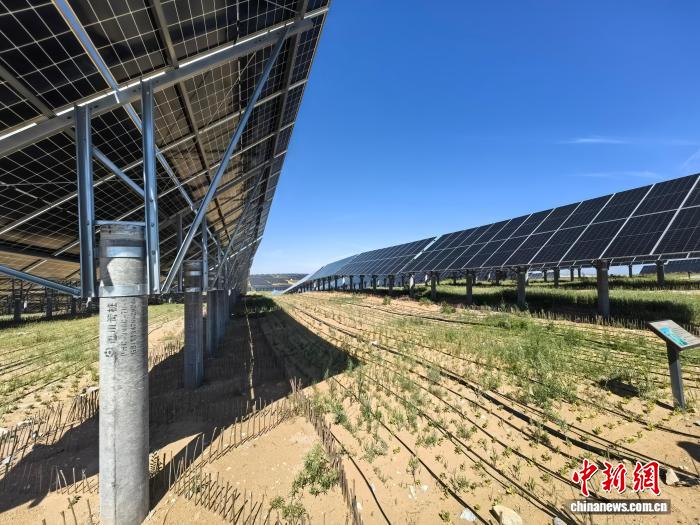
(活力中国调研行)“绿”与“电”绣出鄂尔多斯新图景
Zhong Guo Xin Wen Wang· 2025-08-26 06:41
Core Insights - The article highlights the transformation of Ordos City in Inner Mongolia from a resource-based economy to a renewable energy hub, utilizing solar power and ecological restoration methods to achieve economic and environmental benefits [1][5]. Group 1: Renewable Energy Development - The "Juma" solar power station, the world's largest solar panel-shaped power station, symbolizes Ordos's commitment to renewable energy development [1]. - The solar power initiatives in the Dala'tai region include a 400-kilometer "Solar Great Wall" and a 544-kilometer sand control road, which together form a protective barrier against desertification [2][3]. Group 2: Ecological Restoration - The combination of engineering and vegetation ("engineering sand fixation + tree and shrub planting") has significantly improved soil and water conservation rates, with the water and soil conservation rate in the "Ten Kongdui" area expected to reach 59.39% by 2025 [4]. - The ecological restoration project in the Ulanmulun Town mining subsidence area has transformed 42,000 acres of damaged land into a "sunshine bank," providing job opportunities and additional income for local herders [4][6]. Group 3: Economic Impact - The solar projects not only contribute to environmental sustainability but also enhance local economic conditions, with an estimated annual income increase of approximately 1,000 yuan per person for around 1,200 local herders from land leasing fees [4].