算力芯片

Search documents
大涨,突破27000点
Zhong Guo Ji Jin Bao· 2025-10-02 10:59
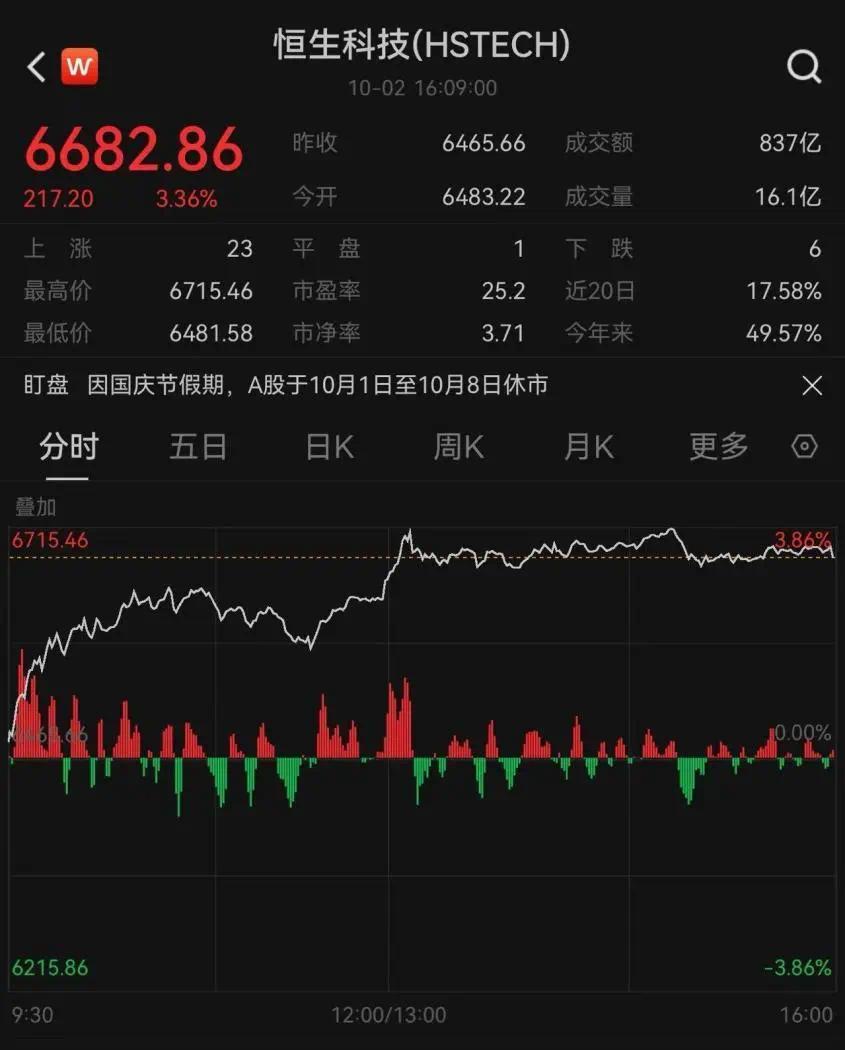
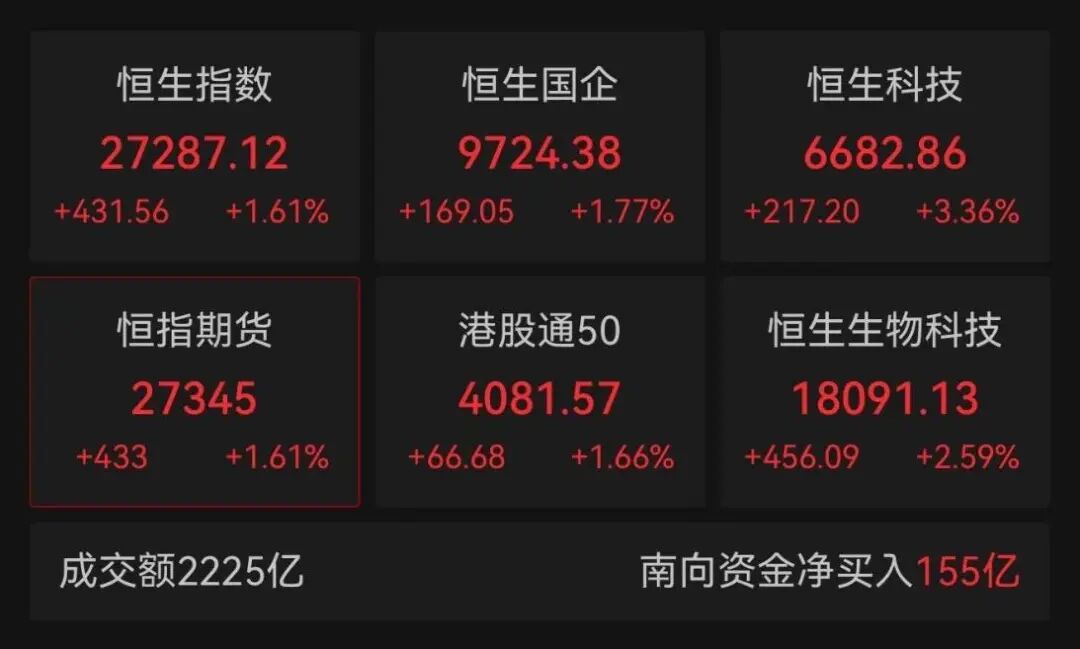
Market Overview - On the first trading day of the fourth quarter, Hong Kong stocks opened high and continued to rise, with the Hang Seng Index up by 1.61% to close at 28,287.12 points, the Hang Seng Tech Index up by 3.36% to 6,682.86 points, and the Hang Seng China Enterprises Index up by 1.77% [2][5] - Southbound funds saw a net inflow of 15.5 billion HKD, with total market turnover reaching 222.5 billion HKD [2] Technology Sector Performance - Major tech stocks performed strongly, with Kuaishou rising by 8.57%, Alibaba and Tencent seeing transaction volumes of approximately 17.6 billion and 11.6 billion HKD, respectively, and their stock prices increasing by 3.45% and 2.04% [5][6] - The valuation of Hong Kong's internet giants is rapidly converging with their overseas counterparts, with Tencent and Alibaba's valuations aligning closely with Meta and Google [5] Semiconductor Sector Highlights - Semiconductor stocks experienced significant gains, with SMIC rising over 12% and achieving a transaction volume of 5.8 billion HKD [8][9] - The launch of OpenAI's video generation model Sora 2 has spurred demand for computing chips, indicating a potential breakthrough in the video generation field [8] Gold Sector Insights - Gold stocks were boosted by rising gold prices, with international gold prices reaching approximately 3,922 USD per ounce [10] - Notable gains were seen in gold-related stocks, with China Silver Group rising over 30%, and Tongguan Gold and Zijin Mining increasing by 15.13% and 14.01%, respectively [10][11] IPO and Index Inclusion - Zijin Mining International has been rapidly included in the Hang Seng Composite Index, effective from October 16, 2025, following a successful IPO that raised approximately 24.98 billion HKD [13] - The IPO was highly oversubscribed, with over 190 times subscription and frozen funds exceeding 480 billion HKD [13]

大涨!突破27000点
Zhong Guo Ji Jin Bao· 2025-10-02 10:58
Market Overview - On the first trading day of the fourth quarter, the Hang Seng Technology Index surged by 3.36%, while the Hang Seng Index broke through the 27,000-point mark, indicating a strong market opening [1][2]. Stock Performance - The Hang Seng Index closed up 1.61% at 28,287.12 points, the Hang Seng Technology Index rose 3.36% to 6,682.86 points, and the Hang Seng China Enterprises Index increased by 1.77% [2]. - Notable stocks included Kuaishou, which rose by 8.57%, and Alibaba and Tencent, with trading volumes of approximately 17.6 billion and 11.6 billion HKD, respectively, increasing by 3.45% and 2.04% [4][5]. Technology Sector - The technology sector showed strong performance, with major players like Alibaba and Tencent seeing significant trading activity. The valuation of Hong Kong's internet giants is rapidly converging with their overseas counterparts [4]. - Semiconductor stocks experienced a rally, with SMIC rising over 12% and achieving a trading volume of 5.841 billion HKD [7][8]. Chip Sector - The "big three" in the chip sector, including SMIC, Huahong Semiconductor, and Shanghai Fudan, saw increases of 12.70%, 7.13%, and 4.70%, respectively [7][8]. - The launch of OpenAI's video generation model Sora 2 has spurred demand for computing chips, indicating a potential breakthrough in the video generation field [7]. Gold Sector - The gold sector benefited from rising gold prices due to increased demand for safe-haven assets amid U.S. government shutdown concerns and expectations of interest rate cuts by the Federal Reserve [9]. - International gold prices reached approximately 3,922 USD per ounce, with significant increases in gold-related stocks such as China Silver Group, which rose over 30% [9][10]. IPO Activity - Zijin Mining International was announced to be rapidly included in the Hang Seng Composite Index, following a successful IPO that raised 24.984 billion HKD, marking it as the second-largest IPO in Hong Kong for 2025 [11].
大涨!突破27000点
中国基金报· 2025-10-02 10:54
Market Overview - On the first trading day of Q4, the Hang Seng Technology Index surged by 3.36%, while the Hang Seng Index broke through 27,000 points, indicating a strong market opening [2][4]. Stock Performance - The Hang Seng Index closed up 1.61% at 28,287.12 points, the Hang Seng Technology Index rose 3.36% to 6,682.86 points, and the Hang Seng China Enterprises Index increased by 1.77% [4]. - Southbound capital saw a net inflow of 15.5 billion HKD, with total market turnover reaching 222.5 billion HKD [4]. Technology Stocks - Major technology stocks performed strongly, with Kuaishou rising by 8.57%, Alibaba and Tencent seeing transaction volumes of approximately 17.6 billion and 11.6 billion HKD, respectively, with increases of 3.45% and 2.04% [7][8]. - The valuation of Hong Kong's internet giants is rapidly converging with their overseas counterparts, with Tencent and Alibaba's valuations aligning closely with Meta and Google [7]. Semiconductor Sector - Semiconductor stocks experienced significant gains, with SMIC rising over 12% and achieving a transaction volume of 5.8 billion HKD [10][11]. - The launch of OpenAI's video generation model Sora 2 has spurred demand for computing chips, marking a potential breakthrough in the video generation field [10]. Gold Sector - Gold concept stocks benefited from rising gold prices, driven by increased demand for safe-haven assets amid U.S. government shutdown concerns and expectations of interest rate cuts by the Federal Reserve [12][13]. - International gold prices reached approximately 3,922 USD per ounce, with notable increases in stocks such as China Silver Group (up over 30%) and Zijin Mining (up 14.01%) [13][14]. IPO and Index Inclusion - Zijin Mining International is set to be quickly included in the Hang Seng Composite Index, effective from October 16, 2025, following its IPO which raised 24.984 billion HKD and saw a subscription rate exceeding 190 times [17][18].

AI、半导体:全球AI基础设施建设进入加速期
Huajin Securities· 2025-09-27 14:41
Investment Rating - The industry investment rating is "Outperform the Market" (maintained) [2][39] Core Views - The global AI infrastructure construction is entering an accelerated phase, with significant investments from major companies like NVIDIA and Alibaba [1][4] - The semiconductor sector is experiencing high growth, particularly in AI-related applications, with a focus on domestic chip supply chains [4][19] - The report highlights the importance of AI and semiconductor industries as transformative technologies for the next decade, predicting a tenfold increase in total computing power by 2035 [4][19] Summary by Sections Industry Performance - The electronic sector saw a weekly increase of 3.51% from September 22 to September 26, with the semiconductor equipment sector leading at 15.56% [7][8] - The Philadelphia Semiconductor Index experienced a slight decline but remains in a rebound channel since April 2025 [12][17] Key Company Updates - NVIDIA plans to invest up to $100 billion in AI infrastructure for OpenAI, with a deployment of at least 10 GW of systems expected by late 2026 [4] - Micron Technology reported Q4 FY2025 revenue of $11.32 billion, a 46% year-over-year increase, with DRAM revenue at $9 billion, up 69% year-over-year [4] - Alibaba is advancing its AI infrastructure with a planned investment of $380 billion, aiming for a tenfold increase in data center energy consumption by 2032 [4] Price Trends - DRAM prices are on the rise, with DDR5 prices increasing from $6.927 to $7.475 between September 22 and September 26 [23] - TV panel prices are expected to remain stable in September, with adjustments in production to balance supply and demand [19][20] Investment Recommendations - The report suggests focusing on the entire domestic chip supply chain, including companies like SMIC, Huahong, and Cambrian [4] - Continued attention is recommended for the AI PCB industry chain, with key companies including Shenghong Technology and Huadian Technology [4]
全是套路?英伟达、OpenAI、甲骨文的万亿“三角游戏”
Guan Cha Zhe Wang· 2025-09-23 07:40
Core Insights - Nvidia announced a strategic investment of up to $100 billion in OpenAI to build large-scale AI data centers and infrastructure [1] - Following the announcement, Nvidia's stock price surged over 4%, reaching a historical high with a market capitalization nearing $4.5 trillion [1] - The investment will be phased, with an initial $10 billion available upon signing the agreement, and further investments tied to the deployment of computing power [1][2] Group 1: Strategic Collaboration - The partnership forms a triad alliance with Oracle, referred to as "ONO," focusing on a capital chain around large models, cloud infrastructure, and computing chips [1][5] - OpenAI has signed a $300 billion cloud service contract with Oracle, set to last five years, with annual payments starting at $60 billion from 2027 [2] - OpenAI plans to utilize Nvidia's funding to establish and deploy at least 10 gigawatts (GW) of AI data centers, equivalent to 4 to 5 million GPUs [2] Group 2: Financial Dynamics - The collaboration creates a unique funding cycle: OpenAI purchases cloud services from Oracle, which in turn buys GPUs from Nvidia, and Nvidia reinvests part of its earnings back into OpenAI [5] - OpenAI, valued at $100 billion, is projected to incur losses exceeding $5 billion by 2025, with annual revenues of about $10 billion against $60 billion in cloud service expenses [5][6] - Oracle faces financial challenges, with capital expenditures for AI exceeding cash flow, leading to a significantly higher debt-to-equity ratio compared to competitors like Microsoft and Amazon [5][6] Group 3: Market Implications - The "ONO" alliance represents a high-risk financial gamble, where any issues faced by one party could trigger a chain reaction affecting all [6] - Concerns exist regarding the potential for market bubbles in the AI sector, reminiscent of the internet bubble in the past [6] - Despite the strong resource integration demonstrated by the alliance, the long-term prospects of this multi-billion dollar AI infrastructure race remain uncertain [7]



资金动向 | 北水抢筹港股127.36亿港元,连续22日买入阿里巴巴
Ge Long Hui· 2025-09-22 12:14
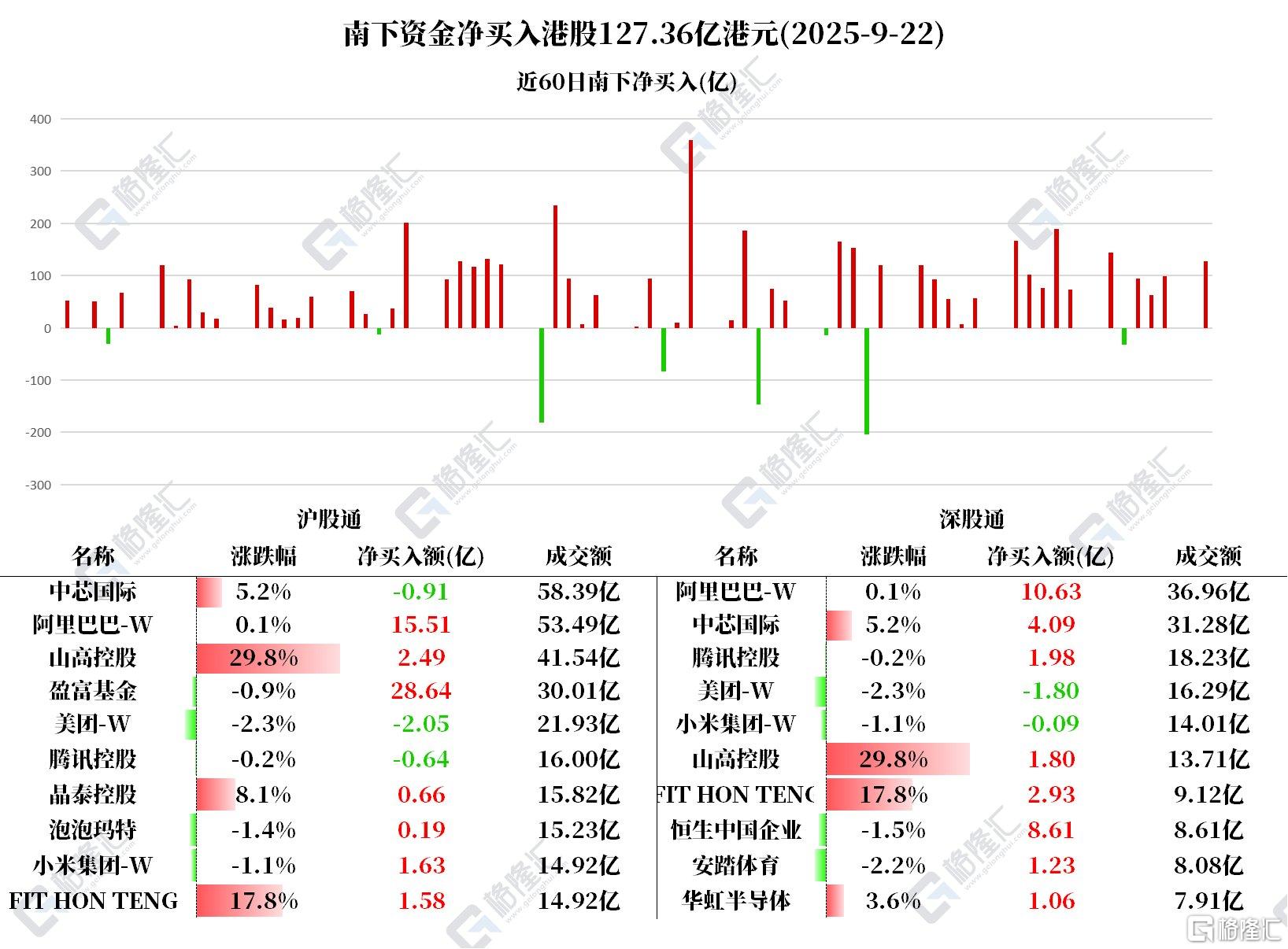
Group 1: Investment Trends - Significant net purchases were observed in various stocks, with the highest being the盈富基金 at 28.64 billion, followed by 阿里巴巴-W at 26.14 billion and 恒生中国企业 at 8.6 billion [1] - Southbound funds have continuously net purchased 阿里巴巴 for 22 days, totaling 604.4189 billion HKD [4] Group 2: Company Developments - 阿里巴巴 is set to hold its cloud conference on September 24, 2025, and has completed the issuance of 3.2 billion USD in zero-coupon convertible senior notes, with 80% allocated for cloud infrastructure [5] - 鸿腾精密 has seen increased demand for iPhone 17, with Apple requesting a 40% increase in daily production from its main supplier [5] - 小米集团 will launch its 17 series on September 25, featuring three models, and will hold its sixth annual speech focusing on innovation [6] - 晶泰控股 has been included in the FTSE China Small Cap Index, indicating increased capital attention and liquidity premium [6] - 中芯国际 is optimistic about future orders in the semiconductor sector, with several local tech giants entering chip development [6]

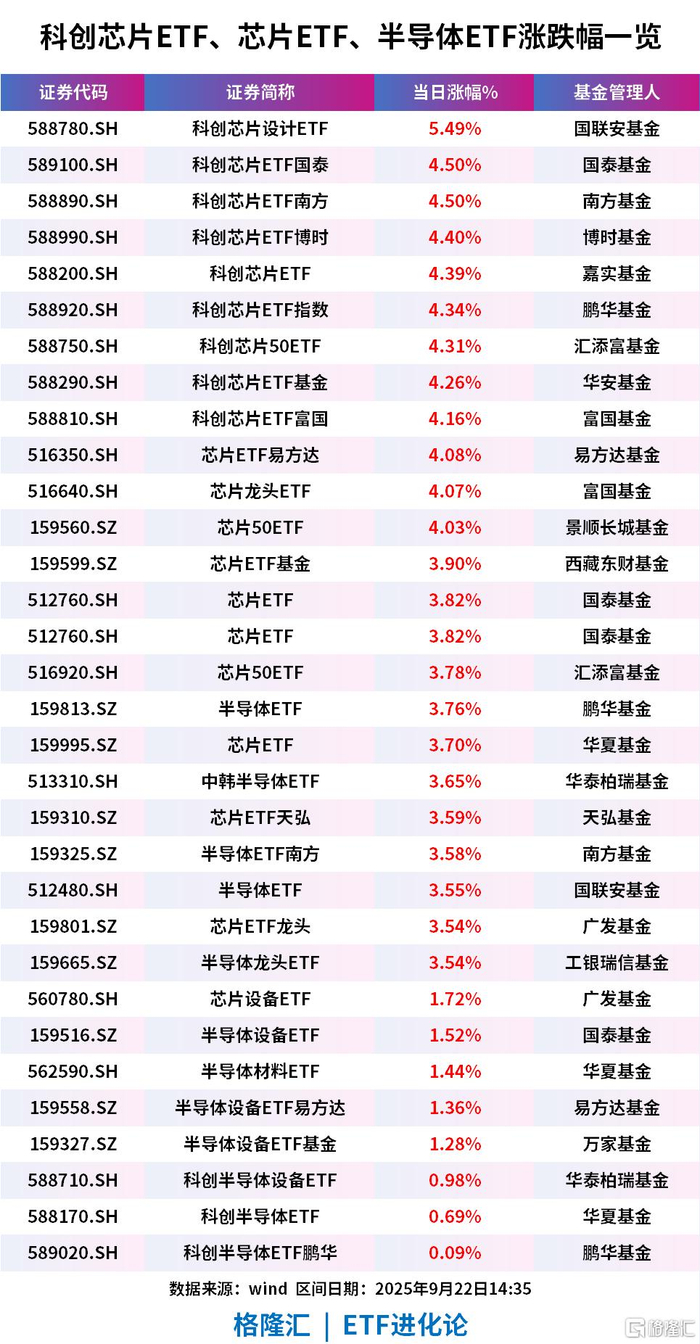
芯片股上涨,科创芯片设计ETF涨超5%,科创芯片ETF、科创芯片ETF指数、科创芯片50ETF涨超4%
Ge Long Hui A P P· 2025-09-22 08:28
Core Viewpoint - The semiconductor sector is experiencing significant growth, with various chip stocks rising over 10%, leading to a surge in related ETFs by more than 4% to 5% [1][2]. Group 1: Stock Performance - Chip stocks such as Zhongke Lanyun, Chip Origin, Jucheng, Haiguang Information, and Diaomicro have seen increases exceeding 10% [1]. - The Sci-Tech Innovation Chip Design ETF rose by 5.49%, while other related ETFs also reported gains ranging from 3.54% to 4.50% [2][3]. Group 2: Industry Developments - The semiconductor industry is witnessing an influx of domestic tech giants entering chip R&D, with Huawei announcing the timeline for its Ascend chip iteration [5]. - Companies like SMIC and Huahong Semiconductor are optimistic about future orders and market conditions [5]. - The upcoming IPO of Moore Threads, a leading domestic GPU company, is expected to enhance the domestic GPU landscape [5]. Group 3: Market Trends - According to Huatai Securities, global semiconductor equipment revenue is projected to grow by 14% year-on-year in 2025, reaching $148 billion [6]. - The Chinese semiconductor equipment market is experiencing a slight decline, with a 1% decrease in the first half of 2025, while the domestic equipment localization rate has increased by 6 percentage points to 21% [6][7]. - The overseas semiconductor equipment market is driven by AI demand, with a 40% year-on-year growth in the second quarter of 2025 [7][8]. Group 4: Future Outlook - The global semiconductor equipment revenue is expected to grow by 8% in 2026, with the Chinese market projected to remain stable [8]. - The focus on AI-related investments and the expansion of advanced logic in China are seen as structural opportunities for growth [8].


算力芯片概念再度走强 中科曙光反包涨停
Mei Ri Jing Ji Xin Wen· 2025-09-22 05:25
Group 1 - The core viewpoint of the news highlights a resurgence in the computing chip sector, with several companies experiencing significant stock price increases [1] - Zhongke Shuguang reached a limit-up increase, indicating strong market interest and investor confidence [1] - Other companies such as Haiguang Information and Tianpu Co. also saw notable gains, with Haiguang Information rising over 10% [1] Group 2 - Tianpu Co. achieved a remarkable 13 consecutive trading days of price increases, showcasing its strong performance in the market [1] - Companies like Dongxin Co., Ruixin Micro, Longxin Technology, Yuntian Lefe, and Aojie Technology also participated in the upward trend, reflecting a broader positive sentiment in the computing chip industry [1]

午间涨跌停股分析:54只涨停股、4只跌停股,智能音箱概念活跃,国光电器涨停
Xin Lang Cai Jing· 2025-09-22 03:48
Group 1 - A-shares saw significant market activity with 54 stocks hitting the daily limit up and 4 stocks hitting the limit down on September 22 [1] - The smart speaker concept was notably active, with Guoguang Electric reaching the limit up [1] - The advanced packaging concept strengthened, exemplified by Shanzi Gaoke achieving 6 consecutive limit ups in 7 days [1] - The computing power chip concept experienced an increase, highlighted by Tianpu Co. achieving 14 consecutive limit ups, and Heertai achieving 2 limit ups in 3 days [1] - Among the stocks with consecutive limit ups, *ST Zhengping had 11 limit ups in 14 days, and *ST Yatai had 10 limit ups in 11 days [1] Group 2 - *ST Gaohong faced a continuous decline with 7 consecutive limit downs [2] - *ST Nanzhi and Jinyi Film also experienced declines, each with 2 consecutive limit downs [2]

多只半导体ETF周涨超7%丨ETF基金周报
2 1 Shi Ji Jing Ji Bao Dao· 2025-09-22 03:18
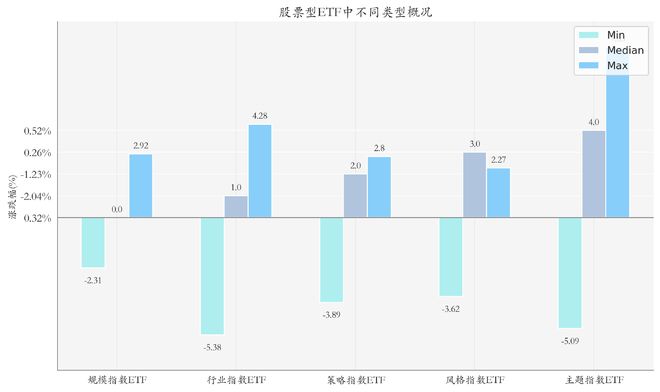
Market Overview - The Shanghai Composite Index fell by 1.3% to 3820.09 points, with a weekly high of 3899.96 points [1] - The Shenzhen Component Index rose by 1.14% to 13070.86 points, reaching a high of 13328.1 points [1] - The ChiNext Index increased by 2.34% to 3091.0 points, with a peak of 3168.68 points [1] - Global markets saw major indices rise, with the Nasdaq Composite up by 2.21%, the Dow Jones Industrial Average up by 1.05%, and the S&P 500 up by 1.22% [1] - In the Asia-Pacific region, the Hang Seng Index rose by 0.59% and the Nikkei 225 Index increased by 0.62% [1] ETF Market Performance - The median weekly return for stock ETFs was 0.08% [2] - The highest weekly return among scale index ETFs was 2.92% for the Jiashi ChiNext 50 ETF [2] - The highest weekly return among industry index ETFs was 4.28% for the China Tai Zhongzheng 800 Automotive and Parts ETF [2] - The highest weekly return among thematic index ETFs was 7.83% for the Huaxia Shanghai Stock Exchange Sci-Tech Innovation Board Semiconductor Materials Equipment Theme ETF [2] ETF Liquidity and Fund Flow - Average daily trading volume for stock ETFs increased by 26.0%, while average daily turnover remained unchanged [6] - The top five stock ETFs with the highest fund inflows included the Southern Zhongzheng 500 ETF with an inflow of 728 million yuan [8] - The top five stock ETFs with the highest fund outflows included the E Fund ChiNext ETF with an outflow of 658 million yuan [9] ETF Financing and Margin Trading - The financing balance for stock ETFs decreased from 45.329 billion yuan to 43.734 billion yuan [10] - The highest financing buy amount was 764 million yuan for the Huaxia Shanghai Stock Exchange ChiNext 50 Component ETF [10] ETF Market Size - The total market size for ETFs reached 5267.037 billion yuan, an increase of 23.954 billion yuan from the previous week [14] - Stock ETFs accounted for 66.9% of the total ETF market size, with a total size of 3526.187 billion yuan [16] New ETF Issuance - No new ETFs were issued last week, but 19 new ETFs were established, including various thematic and bond ETFs [17] Industry Insights - The advanced packaging industry is expected to see significant growth opportunities due to the slowdown of Moore's Law and limitations in advanced process technology [17] - The semiconductor industry is projected to experience a bottom reversal in its economic cycle, with Q2 2025 revenues reaching 1700.23 billion yuan, a year-on-year increase of 15.2% [19]