云基建

Search documents
甲骨文盘前涨超3%!开启250亿美元债发行,拟分八部分募资,全力冲刺云基建
Hua Er Jie Jian Wen· 2026-02-02 14:55
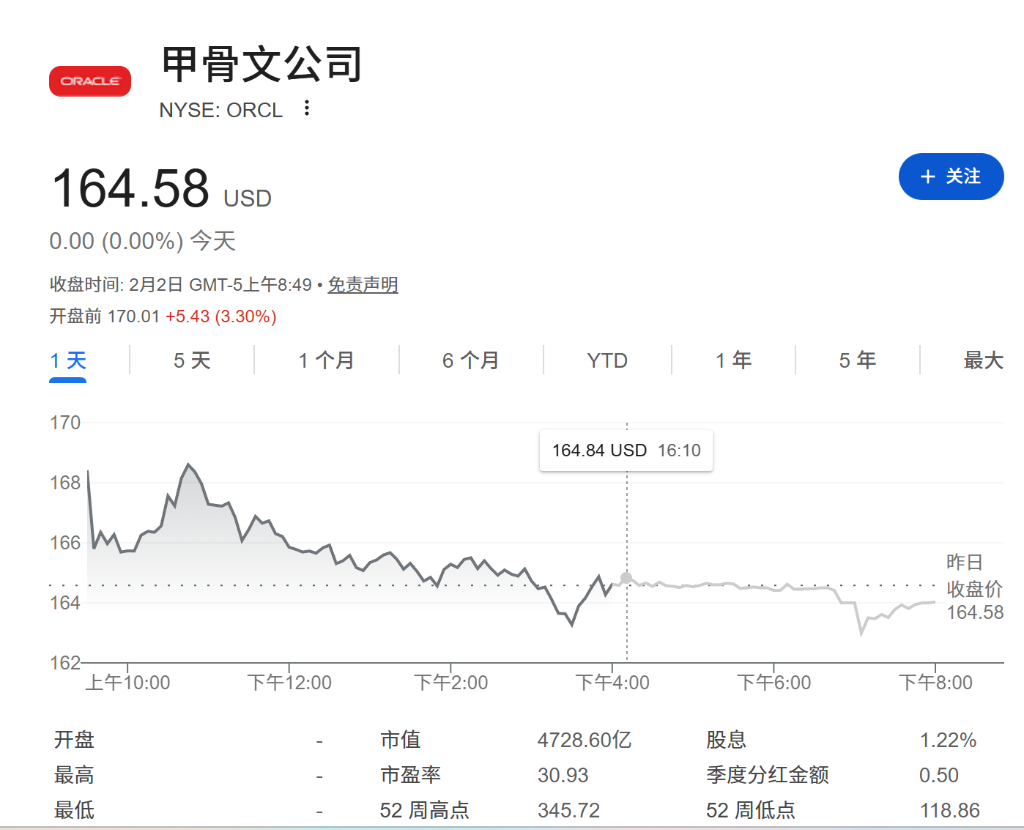
Core Viewpoint - Oracle has launched a significant financing plan to raise up to $50 billion through a combination of debt and equity to support its aggressive cloud infrastructure expansion strategy, driven by the surging demand for AI capabilities [1][5]. Group 1: Financing Details - Oracle plans to issue between $20 billion and $25 billion in dollar bonds, with the aim of covering half of its annual funding needs through this single bond issuance [3][4]. - The bond issuance will be divided into eight parts, with maturities ranging from 3 to 40 years, and the longest bonds expected to yield approximately 2.25 percentage points above U.S. Treasury rates [4]. - The remaining funding gap will be filled through equity-related instruments and common stock issuance, including a market equity plan of up to $20 billion [7]. Group 2: Business Strategy and Market Position - The core driver for this massive financing is the explosive growth in Oracle's cloud infrastructure business, as the company transitions from a traditional database software provider to a capital-intensive cloud infrastructure giant [5][6]. - The funds raised will specifically be used to build additional data center capacity to meet the substantial contract demands from key clients such as AMD, Meta Platforms, NVIDIA, OpenAI, TikTok, and xAI [5][6]. Group 3: Market Reactions and Concerns - Despite a temporary rise in stock price reflecting short-term optimism about the financing plan, concerns remain regarding Oracle's financial structure and cash flow pressures, especially given its existing debt of approximately $95 billion [3][8]. - Notable short-seller Michael Burry has criticized Oracle for unnecessary heavy asset expansion, highlighting the company's lack of a strong business moat compared to other tech giants and the potential risks if AI demand does not meet expectations [8]. - Analysts have pointed out that while the financing plan alleviates immediate liquidity concerns, Oracle's free cash flow has turned negative, raising questions about the long-term viability of contracts with unprofitable startup clients like OpenAI [8].


联想CEO杨元庆称不存在AI泡沫!计算机ETF(159998)昨日再获净申购近1700万份,芯片ETF天弘(159310)四连涨
2 1 Shi Ji Jing Ji Bao Dao· 2025-11-28 01:31
Group 1: Market Performance - A-shares showed mixed performance on November 27, with the ChiNext index closing in the red while leading CPO concept stocks like Xinyi and Zhongji experienced a pullback after initial gains [1] - The Computer ETF (159998) experienced fluctuations but still saw a net subscription of 16.8 million units, accumulating over 100 million yuan in net inflow over the past seven trading days [1] - The Chip ETF Tianhong (159310) achieved four consecutive days of gains, with a notable premium trading at the close, attracting a total of 12.07 million yuan in net inflow over the last ten days [1] Group 2: Industry Insights - The Computer ETF tracks the CSI Computer Theme Index, which encompasses both software and hardware sectors, reflecting the overall performance of the computer industry [1] - Key AI application areas include hardware for edge AI, software for C-end overseas markets, B-end enterprise services, and G-end private deployment of large models [1] - The Chip ETF tracks the CSI Chip Industry Index, with a projected 37.62% year-on-year growth in net profit for the first half of 2025, driven by policy support and surging demand [1] Group 3: Strategic Developments - Beijing's government plans to develop high-tech industries, focusing on new growth points such as sixth-generation mobile communication, quantum technology, and brain-computer interfaces [2] - Lenovo's chairman emphasized that AI is entering a phase of deep inclusivity, with significant infrastructure investments expected to spur the development of more terminal devices [2] - Northeast Securities noted a shift in the fundamentals of the computer sector, highlighting the prominence of cloud infrastructure, AI, and domestic innovation, with expectations for a revaluation of the industry by 2026 [2] - Huaxi Securities pointed out that the domestic chip localization process is a long-term trend, with the current period being optimal for the development of domestic chips, which is expected to enhance the overall domestic computing power share [2]


互联网行业AI商业化双主线:云基建护航场景应用共振
HTSC· 2025-10-19 07:03
Investment Rating - Maintain "Buy" rating for key companies in the AI and cloud infrastructure sectors [8] Core Insights - The report emphasizes two main investment lines: cloud infrastructure service providers benefiting from downstream demand and application scenario commercialization, particularly in advertising and vertical applications [17][19] - The rapid growth in token usage for AI models indicates a strong demand for AI applications, with significant increases in daily token calls for major platforms [18][26] - The report highlights the cost advantages of domestic AI models compared to international counterparts, with prices approximately 50% lower, facilitating broader market penetration [31][35] Summary by Sections Investment Rating - The report maintains a "Buy" rating for several key companies, including Alibaba, Baidu, Tencent, Kuaishou, and others, indicating strong growth potential in the AI and cloud sectors [11] Cloud Infrastructure - Cloud infrastructure is identified as the foundational layer for AI applications, with major players like Alibaba, Baidu, and Tencent developing comprehensive capabilities to support AI development [19][42] - The report notes that the cost of cloud computing is significantly lower than building in-house capabilities, enhancing the attractiveness of cloud services for AI development [19] AI Application Commercialization - The commercialization of AI in advertising is highlighted, with AI technologies improving efficiency and effectiveness in ad campaigns, leading to increased ROI for advertisers [20][21] - Vertical applications of AI are also expanding, with significant advancements in sectors such as video generation, recruitment, and office automation, showcasing the versatility and market potential of AI technologies [21][24] Market Dynamics - The report contrasts the focus on large model technology with the importance of application scenarios for AI commercialization, suggesting that companies with strong scene-based applications will have a competitive edge [22][25] - The increasing integration of AI into industry workflows is expected to drive demand for customized B-end services, which are seen as critical for differentiation in the market [23][24]
全是套路?英伟达、OpenAI、甲骨文的万亿“三角游戏”
Guan Cha Zhe Wang· 2025-09-23 07:40
Core Insights - Nvidia announced a strategic investment of up to $100 billion in OpenAI to build large-scale AI data centers and infrastructure [1] - Following the announcement, Nvidia's stock price surged over 4%, reaching a historical high with a market capitalization nearing $4.5 trillion [1] - The investment will be phased, with an initial $10 billion available upon signing the agreement, and further investments tied to the deployment of computing power [1][2] Group 1: Strategic Collaboration - The partnership forms a triad alliance with Oracle, referred to as "ONO," focusing on a capital chain around large models, cloud infrastructure, and computing chips [1][5] - OpenAI has signed a $300 billion cloud service contract with Oracle, set to last five years, with annual payments starting at $60 billion from 2027 [2] - OpenAI plans to utilize Nvidia's funding to establish and deploy at least 10 gigawatts (GW) of AI data centers, equivalent to 4 to 5 million GPUs [2] Group 2: Financial Dynamics - The collaboration creates a unique funding cycle: OpenAI purchases cloud services from Oracle, which in turn buys GPUs from Nvidia, and Nvidia reinvests part of its earnings back into OpenAI [5] - OpenAI, valued at $100 billion, is projected to incur losses exceeding $5 billion by 2025, with annual revenues of about $10 billion against $60 billion in cloud service expenses [5][6] - Oracle faces financial challenges, with capital expenditures for AI exceeding cash flow, leading to a significantly higher debt-to-equity ratio compared to competitors like Microsoft and Amazon [5][6] Group 3: Market Implications - The "ONO" alliance represents a high-risk financial gamble, where any issues faced by one party could trigger a chain reaction affecting all [6] - Concerns exist regarding the potential for market bubbles in the AI sector, reminiscent of the internet bubble in the past [6] - Despite the strong resource integration demonstrated by the alliance, the long-term prospects of this multi-billion dollar AI infrastructure race remain uncertain [7]


四巨头“烧钱凶猛”,非美和二线云厂被低估,GB200良率提升,大摩对AI服务器非常乐观
3 6 Ke· 2025-08-07 03:28
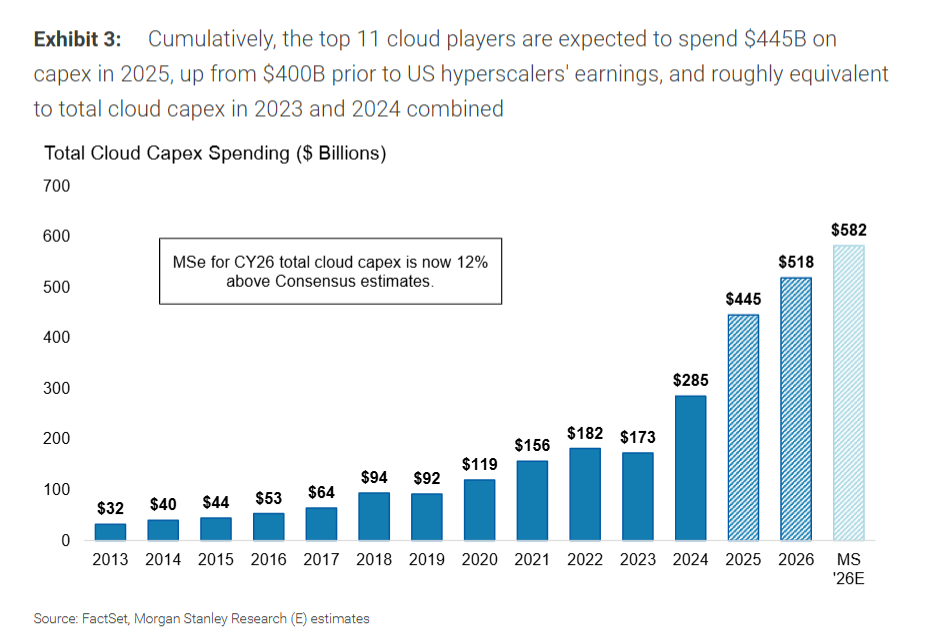
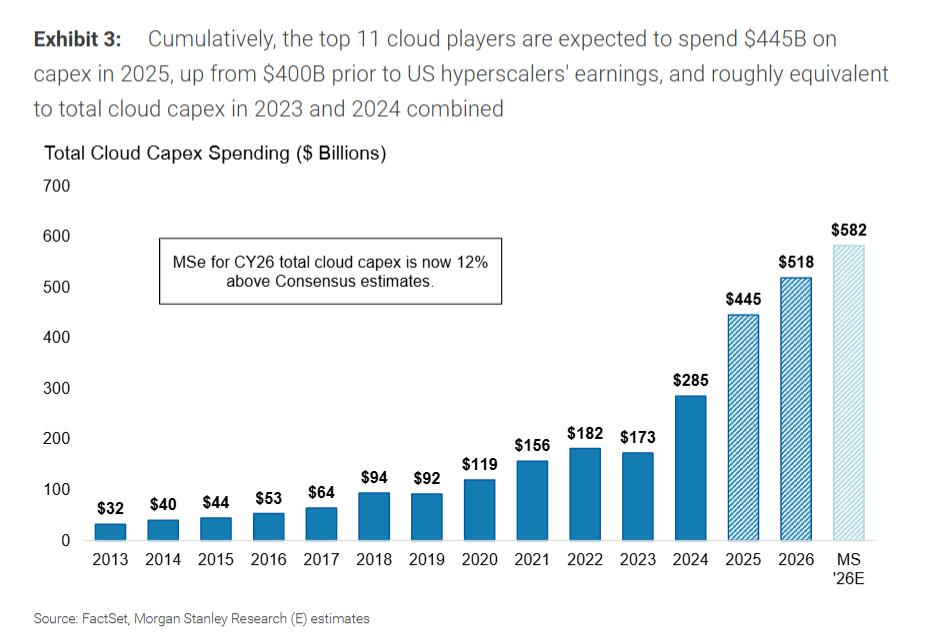
Core Insights - A global cloud infrastructure competition driven by AI is rapidly intensifying, with significant capital expenditure increases forecasted for major cloud service providers [1][2] Group 1: Capital Expenditure Forecasts - Morgan Stanley has raised its capital expenditure forecasts for the four major US cloud providers—Amazon, Google, Meta, and Microsoft—predicting a combined capital expenditure of $359 billion in 2025, a 57% year-over-year increase, and $454 billion in 2026, a 26% increase [1][2] - The total capital expenditure for the top 11 global cloud service providers is expected to reach $445 billion in 2025, significantly higher than the previous estimate of $400 billion [2] Group 2: Market Dynamics - The capital expenditure as a percentage of revenue for these companies is projected to exceed 20% by 2026, marking a historical high, with 18% expected in 2025 [4] - There is a growing demand from non-US regions and Tier 2 cloud service providers, which may have larger AI server reserves than leading players, indicating a broader market expansion [7] Group 3: Supply Chain Improvements - Supply chain issues are easing, with improvements in the assembly yield of Nvidia's next-generation GB200 chips, which is crucial for meeting the rising demand for AI servers [8] - Major projects like "Stargate," a collaboration involving OpenAI, SoftBank, and Oracle, are moving beyond planning stages and engaging with Asian supply chains for server cabinet procurement [8]




四巨头“烧钱凶猛”,非美和二线云厂被低估,GB200良率提升!大摩对AI服务器非常乐观
华尔街见闻· 2025-08-06 13:06
Core Viewpoint - A global cloud infrastructure competition driven by AI is rapidly intensifying, with significant capital expenditure increases expected from major cloud service providers [1][2][7]. Group 1: Capital Expenditure Projections - Morgan Stanley has significantly raised its capital expenditure forecasts for the four major U.S. cloud service providers—Amazon, Google, Meta, and Microsoft—projecting a combined capital expenditure of $359 billion in 2025, a 57% year-over-year increase, and $454 billion in 2026, a 26% increase [1][2]. - The total capital expenditure for the top 11 global cloud service providers is expected to reach $445 billion in 2025, surpassing previous estimates of $400 billion [2]. Group 2: Market Dynamics - The capital expenditure as a percentage of revenue for these companies is projected to exceed 20% by 2026, marking a historical high, with 18% expected in 2025 [3]. - There is a growing demand from non-U.S. regions and Tier 2 cloud service providers, which may have even larger AI server reserves than leading players, indicating a significant market expansion [5]. Group 3: Supply Chain Improvements - Supply chain issues are easing, with improvements in the assembly yield of NVIDIA's next-generation GB200 chips, which is crucial for meeting the rising demand for AI servers [6]. - Major projects like "Stargate," a collaboration involving OpenAI, SoftBank, and Oracle, are moving from concept to execution, indicating a shift from order-based to project-based demand [6]. Group 4: Industry Outlook - Morgan Stanley maintains a positive outlook on the cloud semiconductor industry, citing strong global demand, underestimated growth areas, and improving supply chains as foundational elements for sustained industry growth in the coming years [7].

四巨头“烧钱凶猛”,非美和二线云厂被低估,GB200良率提升!大摩对AI服务器非常乐观
Hua Er Jie Jian Wen· 2025-08-06 01:47
Group 1 - A global cloud infrastructure competition driven by AI is rapidly intensifying, with significant capital expenditure increases forecasted for major cloud service providers [1][2] - Morgan Stanley predicts that the combined capital expenditure of Amazon, Google, Meta, and Microsoft will reach $359 billion in 2025, a 57% year-over-year increase, and $454 billion in 2026, a 26% increase [2][5] - The report highlights that the demand from non-US regions and Tier 2 cloud service providers is likely underestimated, indicating a broader market potential [1][7] Group 2 - The capital expenditure growth for the four major US cloud providers is expected to accelerate, with a projected $100 billion in Q4 2025, a 39% year-over-year increase [2] - The total capital expenditure for the top 11 global cloud service providers is expected to reach $445 billion in 2025, significantly higher than previous forecasts [2] Group 3 - By 2026, capital expenditure as a percentage of revenue for these companies is expected to exceed 20%, setting a new historical high [5] - The demand for AI servers, particularly from Tier 2 cloud service providers, is anticipated to grow significantly, with potential capital expenditure increases starting in the second half of 2026 [7] Group 4 - Supply chain issues are easing, with improvements in the assembly yield of Nvidia's GB200 chips, which supports the growing demand for AI servers [8] - Major projects like "Stargate," involving OpenAI, SoftBank, and Oracle, are moving from planning to execution, indicating a shift from order-based to project-based demand [8]