
航天强国

Search documents
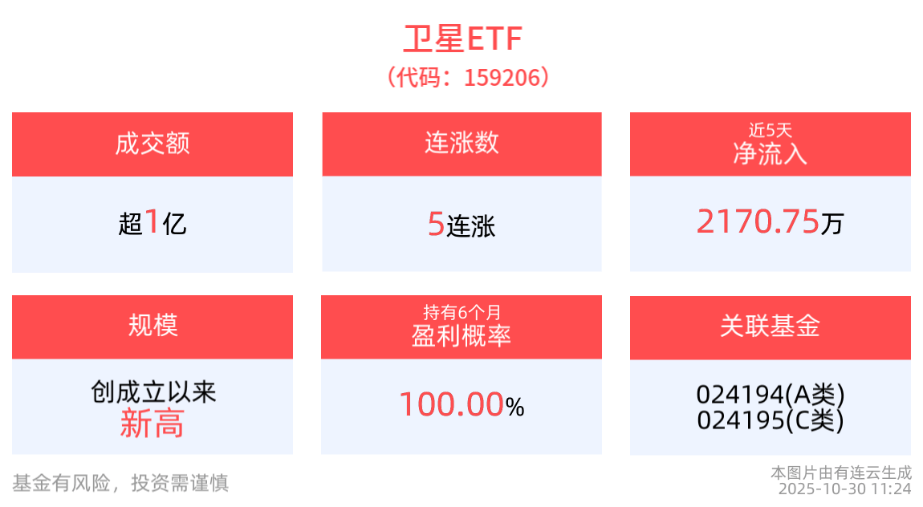
“航天强国”催化继续,卫星ETF(159206)盘中翻红,强势冲击五连涨,成分股国盾量子涨停
Sou Hu Cai Jing· 2025-10-30 03:43
Core Viewpoint - The satellite industry in China is experiencing rapid growth, driven by advancements in commercial space activities and government support, positioning it as a key area of international competition [5]. Group 1: Market Performance - As of 11:25, the Satellite ETF (159206) increased by 0.83%, with constituent stocks such as GuoDun Quantum reaching the daily limit up [3]. - Notable stock performances include: - GuoDun Quantum (688027) at 613.20, up 20.00% - Shaanxi Huada (301517) at 48.28, up 5.16% - China Satellite (600118) at 44.12, up 3.81% [4]. Group 2: Industry Developments - The Shenzhou 21 manned flight mission press conference highlighted the successful progress of various lunar mission components, including the Long March 10 rocket and the Dream Boat manned spacecraft [3]. - On October 16, a successful launch of 12 low-orbit satellite internet satellites was conducted using the Long March 8A rocket, marking a significant achievement in commercial space endeavors [3]. Group 3: Strategic Insights - Industry experts emphasize that the aerospace sector is a core frontier industry in the current international competitive landscape, with China's satellite industry rapidly advancing and benefiting related enterprises [5]. - The designation of "Aerospace Power" alongside "Manufacturing Power" indicates the strategic importance of the aerospace industry at the national level [5]. - The development of commercial space is essential for achieving the "Aerospace Power" goal, transitioning from "task-driven" to "demand-driven" activities, which will promote industry scale upgrades [5]. - The planning for satellite constellations during the 14th Five-Year Plan period anticipates a significant increase in rocket launches and satellite demand, presenting business opportunities in rocket and satellite manufacturing [5].



“制造强国”实干系列周报-20251029
Shenwan Hongyuan Securities· 2025-10-29 04:14
Group 1: Aerospace Industry - The "Aerospace Power" has been included in the 14th Five-Year Plan, indicating a potential rapid development phase over the next five years[10] - The deep space economy is expected to become a core engine for transforming China from a space power to a space superpower, with significant breakthroughs in key technologies like satellite internet and reusable rockets[10] - The aerospace industry value chain is structured like a pyramid, with high profit margins in the mid and downstream sectors, which include satellite services and ground equipment[12] Group 2: PCB Equipment - Demand for drilling equipment is increasing due to the rise in the number of holes required for high-speed materials, leading to a significant increase in the number of machines needed for PCB production[33] - The market for laser drilling equipment is experiencing both volume and price increases, driven by the growing complexity of PCB designs[33] - Major players in the PCB equipment market, such as Dazhu CNC and Dingtai High-Tech, are expected to see substantial revenue growth, with Dazhu reporting a 95.19% year-over-year increase in revenue for Q3 2023[35] Group 3: Automotive Industry - The automotive industry is expected to focus on "expanding domestic demand" and "high-quality development" during the 14th Five-Year Plan, emphasizing smart and green technologies[51] - The integration of AI and green technologies is projected to enhance the competitiveness of the automotive sector, with a focus on electric and hybrid vehicles[54] Group 4: AI Glasses - The market for AI glasses is rapidly expanding, with major players like Meta launching products that have received strong market responses, indicating a growing consumer interest[60] - AI glasses are expected to enhance user interaction through integrated functionalities, positioning them as a significant advancement in wearable technology[64] Group 5: Floor Cleaning Machines - The floor cleaning machine market has seen significant sales growth since Q4 2024, driven by government subsidies, with a projected increase in sales volume[89] - The market is currently dominated by a few key players, indicating a trend towards increased market concentration[89]


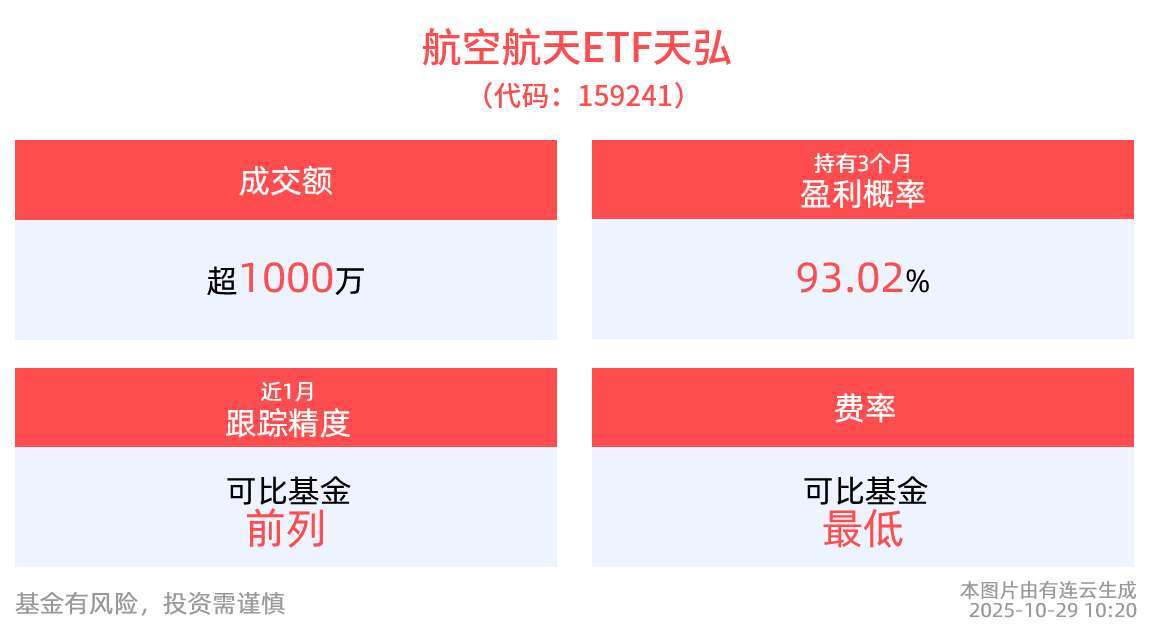
成飞、卫星Q3营收翻倍!含航量最高的航空航天ETF天弘(159241)助力把握板块机遇
Sou Hu Cai Jing· 2025-10-29 02:37
Core Viewpoint - The aerospace industry is experiencing significant growth, with a notable increase in revenue and net profit for key companies, indicating a favorable investment environment in the sector [4][5]. Group 1: Industry Performance - The aerospace ETF Tianhong (159241) is showing strong momentum, with a turnover of 4% and a transaction volume of 18.36 million yuan [3]. - The aerospace industry is expected to maintain high activity levels in the capital market, with explosive growth in revenue and net profit in the third quarter [4]. Group 2: Company Highlights - AVIC Chengfei reported a net profit of 1.256 billion yuan in the third quarter, a year-on-year increase of 170%, with revenue of 27.584 billion yuan, up 139.04% [4]. - China Satellite's third-quarter revenue reached 1.782 billion yuan, a year-on-year increase of 177.31%, with a net profit of 45.3029 million yuan, marking a turnaround from losses [5]. - The growth in China Satellite's performance is attributed to the completion of satellite system projects and increased orders in various business segments [5]. Group 3: Institutional Insights - Dongfang Securities highlighted the strong policy signal from the 20th Central Committee's Fourth Plenary Session to accelerate the construction of a strong aerospace nation [5]. - The successful static ignition test of the Zhuque-3 rocket is expected to lower launch costs and enhance the efficiency of low-orbit satellite networks, benefiting the commercial aerospace sector [5].

景气度高涨 航天产业公司业绩释放
Shang Hai Zheng Quan Bao· 2025-10-28 19:31
Core Viewpoint - The aerospace industry in China is experiencing a significant upturn, driven by increased satellite internet launches, the emergence of reusable rockets, and a surge in IPO activities among commercial rocket companies. The convergence of favorable policies, strong performance, and technological advancements is highlighting a turning point in the industry [1]. Group 1: Company Performance - *ST Chengchang has a first-mover advantage in the satellite communication sector, launching a complete set of satellite communication T/R chip solutions. The company reported a revenue of 306 million yuan and a net profit of 90.36 million yuan for the first three quarters, with Q3 revenue reaching 105 million yuan, a year-on-year increase of 266.57%, and a net profit of 33.73 million yuan, marking a return to profitability [2]. - Zhenray Technology is focusing on the commercial low-orbit satellite market, achieving a revenue of 302 million yuan, a year-on-year growth of 65.76%, and a net profit of 101 million yuan, with a staggering increase of 598.09%. In Q3, the company reported revenue of 97.51 million yuan, up 51.33%, and a net profit of 38.64 million yuan, up 337.49% [3]. - Aerospace Development reported Q3 revenue of 1.008 billion yuan, a year-on-year increase of 209.17%, leading to a total revenue of 1.697 billion yuan for the first three quarters, a growth of 42.59%. However, the company recorded a net loss of 110 million yuan in Q3, although this was an improvement compared to previous quarters [3]. Group 2: Industry Trends - The 20th Central Committee of the Communist Party of China emphasizes the importance of developing the real economy, with a focus on intelligent, green, and integrated directions, accelerating the construction of a strong manufacturing and aerospace nation. This aligns with the strategic development of emerging industries such as aerospace during the 14th Five-Year Plan [4]. - The aerospace industry is witnessing continuous growth, with successful launches of low-orbit satellites, including the "National Grid Constellation" and the "Qianfan Constellation," which set a record for the number of satellites launched in a single mission, surpassing 100 satellites in orbit [4]. - Multiple reusable rockets are expected to make their maiden flights within the year, with companies like Blue Arrow Aerospace, CAS Space, Tianbing Technology, Xinghe Power, and Interstellar Glory initiating their IPO processes [4]. Group 3: Future Outlook - Aerospace Zhizhuang is actively seizing opportunities in commercial aerospace, focusing on promoting ground simulation equipment, micro-systems, and microprocessor chips. The company aims to enhance its core competitiveness and expand its market presence to achieve strong operational performance [5]. - *ST Chengchang is expanding its product coverage in the satellite sector, particularly in low-orbit satellite applications, which will support its business development as the low-orbit satellite networking progresses [5].



AI终端、卫星通信、汽车电子驱动多元增长 信维通信第三季度扣非净利润增长22.06%
Quan Jing Wang· 2025-10-28 11:21
Core Viewpoint - The company has reported a steady growth in revenue and profit, indicating an improvement in profitability and a successful strategic transformation towards becoming a diversified technology solution provider [1] Group 1: Financial Performance - In Q3 2025, the company achieved a revenue of 2.759 billion yuan, a year-on-year increase of 4.20% [1] - The net profit attributable to the parent company, excluding non-recurring items, was 314 million yuan, reflecting a year-on-year growth of 22.06% [1] - The gross margin for the first three quarters was 21.53%, up by 0.73 percentage points compared to the same period last year, while the gross margin for Q3 alone was 25.45%, an increase of 1.69 percentage points year-on-year [1] Group 2: Strategic Transformation - The company is transitioning from a single RF leader to a diversified technology solution provider, focusing on new business areas such as AI terminal hardware, commercial satellites, smart vehicles, data centers, and robotics [1][2] - The company has established a comprehensive product matrix for AI glasses, which is a key area for growth, and has successfully entered the supply chains of well-known brands like Meta [2] Group 3: AI Terminal Business - The company is leveraging its first-mover advantage in AI terminal business to gain additional growth momentum during the recovery phase of consumer electronics [3] - The demand for AI end-side hardware is rapidly increasing, driven by the proliferation of smart devices, which presents significant growth opportunities for the company [2] Group 4: Satellite Communication - The company is positioned to benefit from favorable satellite policies and has developed a product matrix that includes connectors, antennas, and structural components, enhancing its competitive edge in the satellite communication industry [4] - The company has strengthened its leading position in the commercial satellite sector through deepened collaborations with key North American clients [4] Group 5: Automotive Electronics - The rapid penetration of smart connected vehicles has opened up growth opportunities in automotive electronics, with the company establishing a diverse product matrix in this sector [6][7] - The company is actively exploring commercial opportunities in digital keys, wireless communication, and perception technologies within the automotive sector [7] - The company's overseas manufacturing bases in Vietnam and Mexico enhance its global delivery capabilities and cost control, supporting stable supply chains [7] Group 6: Overall Business Outlook - The company's diversified business layout, including consumer electronics, satellite communication, and smart vehicles, is showing initial success, positioning it for sustained growth [7] - Continuous breakthroughs in new industries, clients, technologies, and products are expected to enhance the company's growth certainty as it evolves from a "RF leader" to a "diversified technology solution provider" [7]

十五五规划建议:加快建设制造强国、质量强国、航天强国、交通强国、网络强国 保持制造业合理比重
财联社· 2025-10-28 09:14
Core Viewpoint - The article emphasizes the importance of building a modern industrial system as the material and technological foundation for Chinese-style modernization, focusing on strengthening the real economy [1] Group 1: Modern Industrial System - The modern industrial system is identified as a key component of Chinese-style modernization, highlighting the need for a robust material and technological base [1] - The focus is on maintaining a reasonable proportion of manufacturing while constructing a modern industrial system centered around advanced manufacturing [1] Group 2: Economic Development Focus - The development of the economy should prioritize the real economy, with an emphasis on intelligent, green, and integrated directions [1] - There is a call to accelerate the construction of a manufacturing powerhouse, quality powerhouse, aerospace powerhouse, transportation powerhouse, and cyber powerhouse [1]

十五五规划建议:加快建设制造强国、质量强国、航天强国、交通强国、网络强国 保持制造业合理比重
Ge Long Hui· 2025-10-28 09:03
Core Points - The article discusses the release of the "Suggestions on Formulating the 15th Five-Year Plan for National Economic and Social Development" by the Central Committee of the Communist Party of China, emphasizing the importance of building a modern industrial system and strengthening the foundation of the real economy [1] Group 1 - The modern industrial system is identified as the material and technological foundation for Chinese-style modernization [1] - The focus of economic development is to be placed on the real economy, with an emphasis on intelligent, green, and integrated directions [1] - The plan aims to accelerate the construction of a manufacturing powerhouse, quality powerhouse, aerospace powerhouse, transportation powerhouse, and cyber powerhouse, while maintaining a reasonable proportion of manufacturing [1] - The goal is to establish a modern industrial system with advanced manufacturing as its backbone [1]
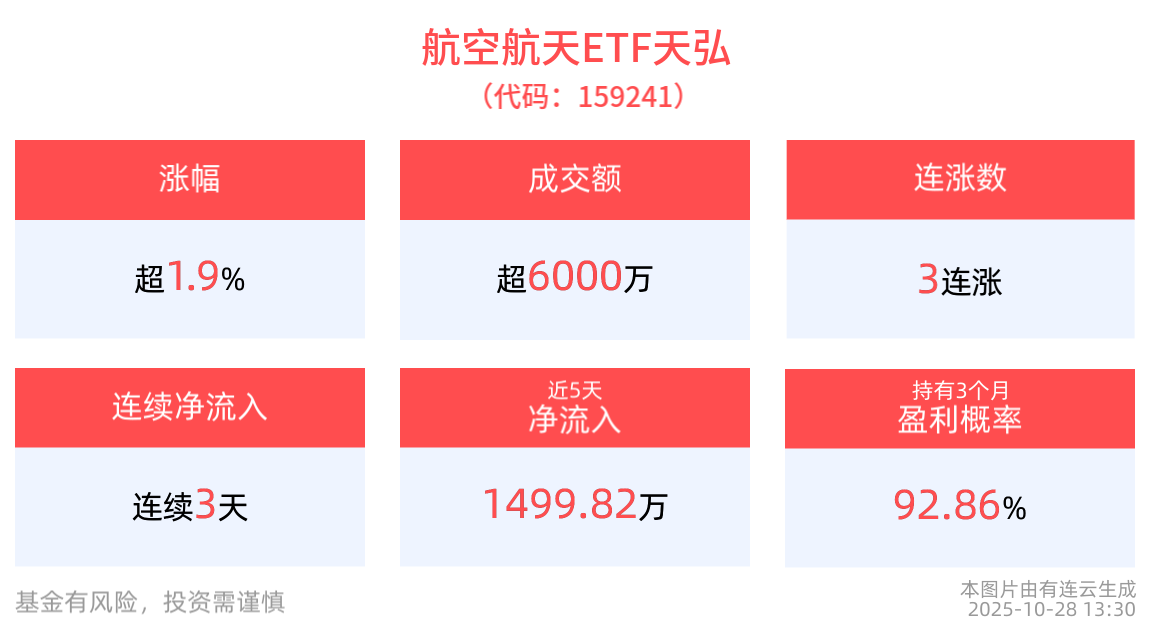
从未缺席大牛市!含航量最高的航空航天ETF天弘(159241)逆势上涨近2%,连续3日“吸金”
Xin Lang Cai Jing· 2025-10-28 05:42
Core Viewpoint - The aerospace ETF Tianhong (159241) has shown a significant upward trend, indicating strong market interest and potential investment opportunities in the aerospace sector [3][4]. Group 1: Market Performance - As of October 28, 2025, the aerospace ETF Tianhong (159241) increased by 1.96%, marking a three-day consecutive rise with a trading volume of 61.21 million yuan and a turnover rate of 13.04% [3]. - Key component stocks such as Great Wall Military Industry (601606) rose by 10.00%, Aerospace Development (000547) by 9.95%, and Construction Industry (002265) by 7.41% [3]. - The aerospace ETF Tianhong (159241) has attracted a total net inflow of 10.376 million yuan over the past three days [3]. Group 2: Product Highlights - The aerospace ETF Tianhong (159241) tracks the National Aerospace Index, which is highly concentrated in the defense and aerospace sectors, with a weight of 98.2% in the primary industry classification [4]. - The index is well-aligned with emerging themes such as low-altitude economy, satellite internet, and commercial aerospace, with over 68% weight in "Aerospace Equipment + Aerospace Equipment" and 76.55% in military-civilian integration [4]. Group 3: Historical Context - The Shanghai Composite Index has crossed the 4000-point mark, with the National Aerospace Index historically performing well during such bullish phases, showing increases of 38.08% in 2007 and 66.26% in 2015 [5]. Group 4: Institutional Insights - Citic Construction Investment Securities emphasizes the importance of developing the real economy, particularly highlighting the goal of becoming a strong aerospace nation, and the need for high-level technological self-reliance [6]. - The focus is on enhancing traditional industries while fostering new and future industries, promoting high-quality development in the service sector, and building a modern infrastructure system [6].


CATA航空大会闭幕!含航量最高的航空航天ETF天弘(159241)抢先布局航空产业链,民航“十五五”提质信号释放
Xin Lang Cai Jing· 2025-10-28 01:45
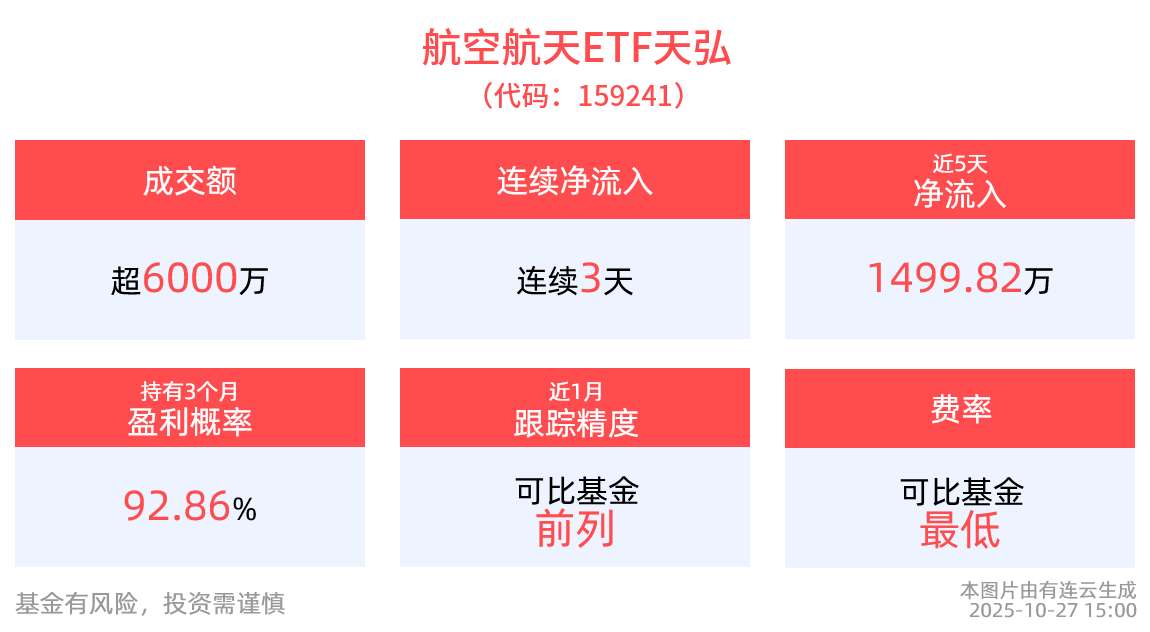
Core Insights - The Aerospace ETF Tianhong (159241) has shown a 0.77% increase as of October 27, 2025, with a trading volume of 64.86 million yuan, indicating active market participation [3] - The ETF closely tracks the Guozheng Aerospace Index, with a high concentration of 98.2% in the military industry, covering key sectors such as aerospace equipment, satellite navigation, and new materials [3] - Recent developments include the third CATA Aviation Conference held in Beijing, focusing on the integration of transport and general aviation, and the launch of a national low-altitude economy skills competition [3][4] Product Highlights - The Aerospace ETF Tianhong (159241) is recognized for its high purity in military exposure, featuring leading companies in the aerospace sector, including those involved in large aircraft development and commercial space [3] - The ETF has seen a net inflow of 10.38 million yuan over the last three days, reflecting investor confidence [3] Industry Trends - The Civil Aviation Administration of China indicated a shift in the aviation sector towards optimizing existing resources while enhancing quality and efficiency during the 14th Five-Year Plan [4] - CICC highlighted the strategic importance of the aerospace industry, noting its elevated status following the Fourth Plenary Session, which emphasizes the development of a modern industrial system [5] - The commercial aerospace sector, including satellite internet and BeiDou navigation, is expected to accelerate during the 14th Five-Year Plan, driven by international competition [5]
光大证券晨会速递-20251028
EBSCN· 2025-10-28 00:59
Group 1: Macro Insights - In September, industrial enterprise profits continued to expand year-on-year, primarily driven by low base effects, with characteristics of rising volume and price, improved profit margins, and proactive inventory replenishment [2] - The profit growth in raw materials and equipment manufacturing sectors has accelerated, with profit distribution increasingly favoring midstream and upstream industries [2] - Looking ahead, profits are expected to maintain high growth rates in October and November due to low base support, but weak terminal demand and diminishing effects of "anti-involution" may temper the recovery process [2] Group 2: Fund Market Insights - Domestic equity market indices rose, with the ChiNext Index leading the gains, while gold prices experienced a pullback [3] - TMT-themed funds outperformed again, while there was significant net outflow from domestic stock ETFs, particularly from large-cap and TMT-themed ETFs [3] - Notably, there was significant inflow into commodity ETFs, particularly gold ETFs, indicating a shift in investor sentiment [3] Group 3: Automotive Industry - The automotive industry is undergoing rapid restructuring due to technological changes, particularly in intelligent driving and humanoid robotics, aligning with policies aimed at boosting domestic demand and economic growth [4] - Investment opportunities are recommended in the robot and intelligent driving themes, particularly focusing on strong model cycles in the second half of 2025 [4] Group 4: Steel Industry - Steel futures profits have dropped to their lowest levels since 2015, but there is potential for recovery to historical average levels due to government policies aimed at phasing out outdated capacity [5] - The steel sector's price fluctuations should be monitored closely as they pose risks to profitability [5] Group 5: Building Materials - The commercial aerospace industry is expected to accelerate following the introduction of the "strong aerospace nation" initiative, with Shanghai's action plan promoting high-quality development in the construction industry [6] - Recommendations include focusing on new materials and construction-related companies, such as China Jushi and Guoen Co., which are positioned in high-growth segments [6] Group 6: Company-Specific Insights - Chuanfa Longmang reported significant revenue and profit growth in Q3, driven by the integration of Tianbao Company, with forecasts for net profits of 657 million, 817 million, and 964 million yuan from 2025 to 2027 [8] - CNOOC Engineering's revenue for the first three quarters of 2025 was 17.7 billion yuan, with a net profit of 1.6 billion yuan, and forecasts suggest continued growth in net profits over the next three years [9] - Luoyang Molybdenum's Q3 performance exceeded expectations, with a net profit of 14.28 billion yuan, and projections for net profits of 19 billion, 20.1 billion, and 21.6 billion yuan from 2025 to 2027 [10] - Western Mining's net profit for the first three quarters was 2.95 billion yuan, with a significant acquisition expected to enhance resource holdings and future profitability [11] - North New Building Materials reported a decline in revenue and net profit, prompting a downward revision of profit forecasts for the next three years, but maintains a stable outlook for its gypsum board business [12] - China National Materials reported stable performance with improved cash flow and a significant increase in new contracts, particularly from overseas markets [13] - Fuanna's revenue declined significantly in Q3, leading to a downward revision of profit forecasts, reflecting challenges in retail and business adjustments [14] - Sanofi's net profit was below expectations due to one-time expenses, but the company remains a leader in blood glucose monitoring with potential for overseas expansion [15] - Ziyan Food's revenue decreased in the first three quarters, but Q3 showed signs of recovery, with forecasts for future earnings remaining positive [16] - Zhongju Gaoxin's revenue and net profit declined in the first three quarters, leading to revised forecasts, but the company continues to focus on channel development and new product performance [17] - Jinzhai Food reported modest revenue growth but faced profit declines, with future earnings projections indicating potential for recovery [18] - Dongpeng Beverage's revenue and net profit showed significant growth in the first three quarters, with upward revisions to future profit forecasts reflecting strong performance [19]