
跨境资金流动

Search documents
跨境资金“高速路” 海南EF账户结算超千亿|活力中国调研行
2 1 Shi Ji Jing Ji Bao Dao· 2025-09-23 15:54
Core Viewpoint - The establishment of the multi-functional EF account in Hainan Free Trade Port is a significant step towards facilitating cross-border capital flow and enhancing the operational efficiency of multinational enterprises [1][3]. Group 1: EF Account Overview - The EF account is a unified onshore and offshore currency account system designed to streamline cross-border fund transfers for various entities, including domestic institutions, foreign institutions, foreign individuals, and financial institutions [1][3]. - The EF account allows for efficient fund transfers between domestic and foreign accounts, significantly improving the ease of cross-border trade and investment for enterprises [1][3]. Group 2: Applications and Benefits - The EF account supports a wide range of applications, including cross-border trade settlement, foreign exchange transactions, loans, trade financing, and foreign investment, thereby expanding its utility in international markets [3][4]. - Enterprises can choose between onshore and offshore exchange rates for transactions, which helps in managing exchange rate risks and reducing financial costs [3][5]. Group 3: Impact on Enterprises - Companies have reported a significant increase in the efficiency of cross-border transactions, with processing times reduced from 1-2 days to just 2-3 hours [4]. - The volume of cross-border settlement business for some companies has doubled year-on-year, with specific transactions reaching up to 820 million USD [5]. Group 4: Future Prospects - The EF account is expected to provide robust financial support for the higher level of openness in Hainan Free Trade Port post-closure, with ongoing adjustments to policies and rules to meet the diverse financial needs of enterprises [5].

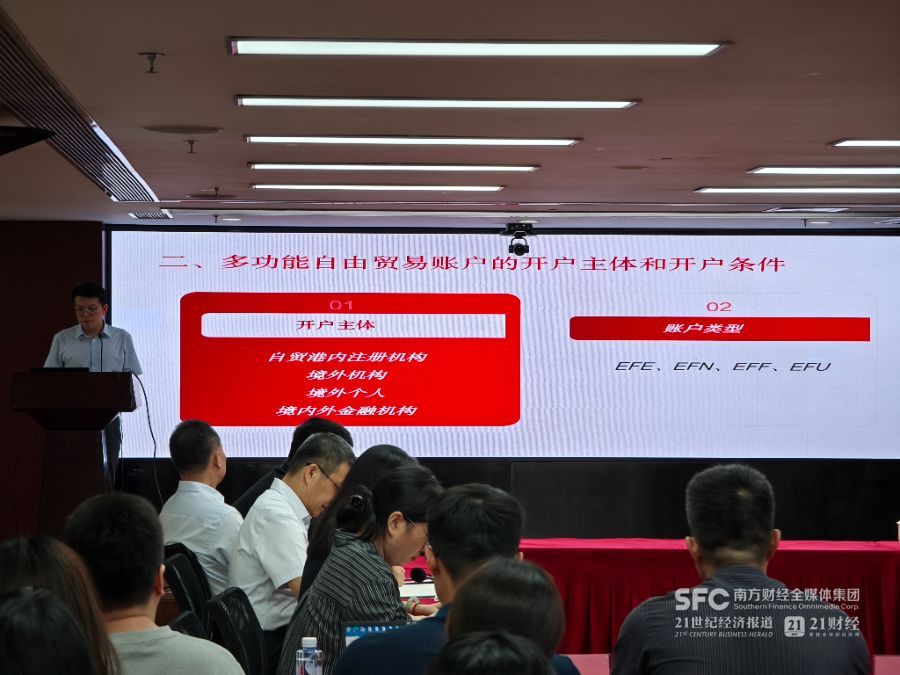
跨境资金“高速路”,海南EF账户结算超千亿
2 1 Shi Ji Jing Ji Bao Dao· 2025-09-23 14:02
Core Viewpoint - The establishment of the EF account system in Hainan Free Trade Port facilitates cross-border capital flow, enhancing the efficiency and convenience for enterprises in international trade and investment [1][2]. Group 1: EF Account Overview - The EF account is a unified foreign and domestic currency account system established by banks in Hainan Free Trade Port, designed to streamline cross-border capital transactions [1]. - There are four types of EF accounts based on the account holder: EFE accounts for domestic institutions, EFN accounts for overseas institutions, EFF accounts for overseas individuals, and EFU accounts for domestic and foreign financial institutions [1]. Group 2: Benefits for Enterprises - Enterprises can complete cross-border fund transfers with just a payment instruction, eliminating the need for extensive documentation and approval processes, thus lowering operational costs [2]. - The EF account supports multiple currencies, including USD, EUR, and JPY, allowing enterprises to choose between onshore and offshore exchange rates for better financial management [2]. Group 3: Efficiency and Growth - The EF account has significantly improved the efficiency of cross-border transactions, reducing processing time from 1-2 days to 2-3 hours [3]. - As of August 2025, the number of cross-border settlement transactions has doubled compared to the previous year, with a notable increase in offshore trading activities [3]. Group 4: Future Prospects - The EF account will continue to provide robust financial support for higher levels of openness in Hainan Free Trade Port, adapting policies to meet the diverse financial needs of enterprises engaged in international trade [4].

存款搬家走到哪了?
2025-09-23 02:34
Summary of Conference Call Records Industry Overview - The records focus on the banking and financial industry, particularly the trends in deposit migration and its implications for the capital market. Key Points and Arguments 1. **Deposit Migration Trends** - As of August, M1 growth increased by 0.4 percentage points to 6%, while M2 growth remained stable, indicating a continued trend towards liquidity in deposits. Corporate demand for current deposits rose to 6.7%, while household current deposit growth slightly decreased to 6.3% [2][3][4] 2. **Potential for Capital Market Inflows** - The potential scale for household deposits migrating to equity markets is estimated at 5 to 7 trillion RMB. However, the process is complex and not straightforward, influenced by various factors including liquidity in the financial system [2][3][12] 3. **Impact of Monetary Policy** - The central bank's liquidity provision remains ample, with an increase of 0.4 trillion RMB in August. Interbank market rates are maintained at around 1.4% to 1.5%, indicating a loose monetary environment. However, a net decrease of 110 billion RMB in the central bank's debt to other financial companies may signal regulatory shifts [4][11] 4. **Cross-Border Capital Flows** - The RMB exchange rate remained strong, with a shift from capital outflows to inflows in the A-share market. This change is attributed to improved foreign capital conditions and a reversal of previous outflow trends [5][9] 5. **Non-Bank Deposit Increases** - Non-bank deposits increased by 550 billion RMB year-on-year in August, primarily from funds entering brokerage margin accounts and fixed-income product accounts. This indicates a shift in investment preferences towards non-bank financial products [6][7] 6. **Investor Risk Appetite** - There is a notable increase in residents' risk appetite, with a shift from fixed-term to current and equity assets. The ratio of household savings to stock market capitalization has decreased from 210% to 157%, suggesting room for further capital market inflows [8][12] 7. **Market Dynamics and Investor Sentiment** - Despite the potential for deposit migration, the pace has slowed due to factors such as preemptive fiscal and credit policies, increased investor divergence post-stock market rises, and a slowdown in export growth affecting capital flows [3][10][11] 8. **Future Outlook on Deposit Migration** - While the current pace of deposit migration is slowing, the potential remains significant. The estimated 5 to 7 trillion RMB potential for migration is expected to continue, albeit with fluctuations influenced by fiscal policies, market performance, and export dynamics [12] Other Important Insights - The trend of passive equity fund growth indicates a shift in investor behavior, with passive funds or ETFs becoming the primary choice for market entry [7] - The overall liquidity environment and regulatory changes will play crucial roles in shaping future capital market dynamics and deposit migration trends [4][11]
外汇市场活力和韧性增强 应对外部风险挑战底气更足
Sou Hu Cai Jing· 2025-09-22 22:20
Core Insights - The People's Bank of China and the State Administration of Foreign Exchange reported that China's cross-border capital flows have remained generally balanced despite high volatility in international markets, with the RMB exchange rate performing steadily against major currencies [1][2] - The cross-border receipts and payments scale is projected to reach $14 trillion in 2024, a 64% increase from 2020, with an average annual growth rate during the 14th Five-Year Plan period being 8 percentage points higher than the previous period [1] - The ratio of enterprises using foreign exchange hedging has increased from 17% in 2020 to around 30%, and the RMB's share in cross-border trade has risen from 16% to nearly 30% [1] Market Resilience - The international balance of payments has remained fundamentally balanced during the 14th Five-Year Plan, with the current account surplus to GDP ratio staying within a reasonable range [2] - Foreign exchange reserves have consistently remained above $3 trillion, stabilizing at over $3.2 trillion in recent years, serving as a crucial stabilizer for the national economy and finance [2] - The State Administration of Foreign Exchange has facilitated nearly $4.6 trillion in trade-related foreign exchange receipts and payments since the beginning of the 14th Five-Year Plan [2] Policy Initiatives - The foreign exchange authority has implemented reforms to enhance the efficiency of trade foreign exchange receipts and payments, as well as to promote high-level openness in cross-border trade and investment [2] - Efforts to improve the convenience of cross-border investment and financing have led to nearly $300 billion in related transactions during the 14th Five-Year Plan [2] - The foreign exchange business reform has included over 23,000 quality clients from small and medium-sized enterprises, private enterprises, and foreign-funded enterprises, with cumulative transactions exceeding $500 billion [2]
中国人民银行副行长、国家外汇局局长朱鹤新: 外汇市场活力和韧性增强 应对外部风险挑战底气更足
Zheng Quan Shi Bao· 2025-09-22 18:03
Core Insights - The People's Bank of China and the State Administration of Foreign Exchange reported that China's cross-border capital flows have remained generally balanced despite high volatility in international markets, with the RMB exchange rate showing stability among major currencies [1][2] Group 1: Market Performance - In 2024, China's cross-border receipts and payments are projected to reach $14 trillion, a 64% increase from 2020, with an average annual growth rate during the 14th Five-Year Plan period being 8 percentage points higher than the previous period [1] - In the first eight months of this year, cross-border receipts and payments increased by 10% year-on-year, indicating sustained activity in cross-border trade and investment [1] - The ratio of enterprises using foreign exchange hedging has risen from 17% in 2020 to approximately 30%, while the RMB's share in cross-border trade has increased from 16% to nearly 30% [1] Group 2: Foreign Exchange Reserves and Stability - China's international balance of payments has remained fundamentally balanced during the 14th Five-Year Plan, with the current account surplus to GDP ratio staying within a reasonable range [2] - Foreign exchange reserves have consistently remained above $3 trillion, stabilizing above $3.2 trillion in recent years, serving as a crucial stabilizer for the national economy and finance [2] Group 3: Policy and Reform Initiatives - The State Administration of Foreign Exchange has implemented reforms to enhance the efficiency of trade foreign exchange receipts and payments, processing nearly $4.6 trillion in related business since the beginning of the 14th Five-Year Plan [2] - To improve cross-border investment and financing convenience, approximately $300 billion in related business has been processed during the same period [2] - The foreign exchange business reform has included over 23,000 quality clients from small and medium-sized enterprises, private enterprises, and foreign-funded enterprises, with cumulative business transactions exceeding $500 billion [2]
朱鹤新:近年来我国跨境资金流动总体均衡,人民币汇率在主要货币中表现比较稳定
Zheng Quan Shi Bao Wang· 2025-09-22 08:02
Core Viewpoint - The overall cross-border capital flow in China remains balanced despite high volatility in the international market, with the RMB exchange rate showing stability against major currencies [1] Group 1: Economic Outlook - The long-term fundamentals of China's economy are positive, supported by steady progress in high-level opening-up [1] - The improvements in the RMB exchange rate formation mechanism and effective macro-prudential management of the foreign exchange market enhance the ability to respond to external risks [1] Group 2: Future Development - The stable international balance of payments is expected to provide a solid foundation for the healthy development of China's foreign exchange market during the 14th Five-Year Plan period [1]
美元节节败退!人民币稳住阵脚,能否一举破7?
Sou Hu Cai Jing· 2025-09-20 08:33
Core Viewpoint - The Federal Reserve has lowered interest rates from 4.25%-4.50% to 4.00%-4.25%, which has led to a stable performance of the RMB, reflecting a complex interplay of various factors in the market [1][3]. Group 1: RMB Performance Overview - The RMB has shown a "reverse drama" this year, starting from a high of 7.3 and rebounding significantly, with a notable appreciation in late August [3]. - The recent strength of the RMB is attributed to a "triple gain" effect, including expectations of Fed rate cuts, a declining US dollar index, and supportive internal factors [3][5]. - In July, the foreign exchange settlement surplus reached 22.8 billion USD, indicating improved market sentiment and increased demand for RMB [5]. Group 2: Future Outlook for RMB - The external environment, characterized by the Fed's rate cut cycle, is expected to benefit emerging markets, with the RMB likely to remain stable and slightly strong [7]. - Internal conditions, such as narrowing interest rate differentials between China and the US, are expected to alleviate depreciation pressure on the RMB [7]. - For the RMB to break the 7.0 mark, stronger catalysts like sustained foreign capital inflows or better-than-expected economic data are needed [7][9].
国家外汇管理局:8月外资总体净买入境内股票和债券
Sou Hu Cai Jing· 2025-09-20 05:02
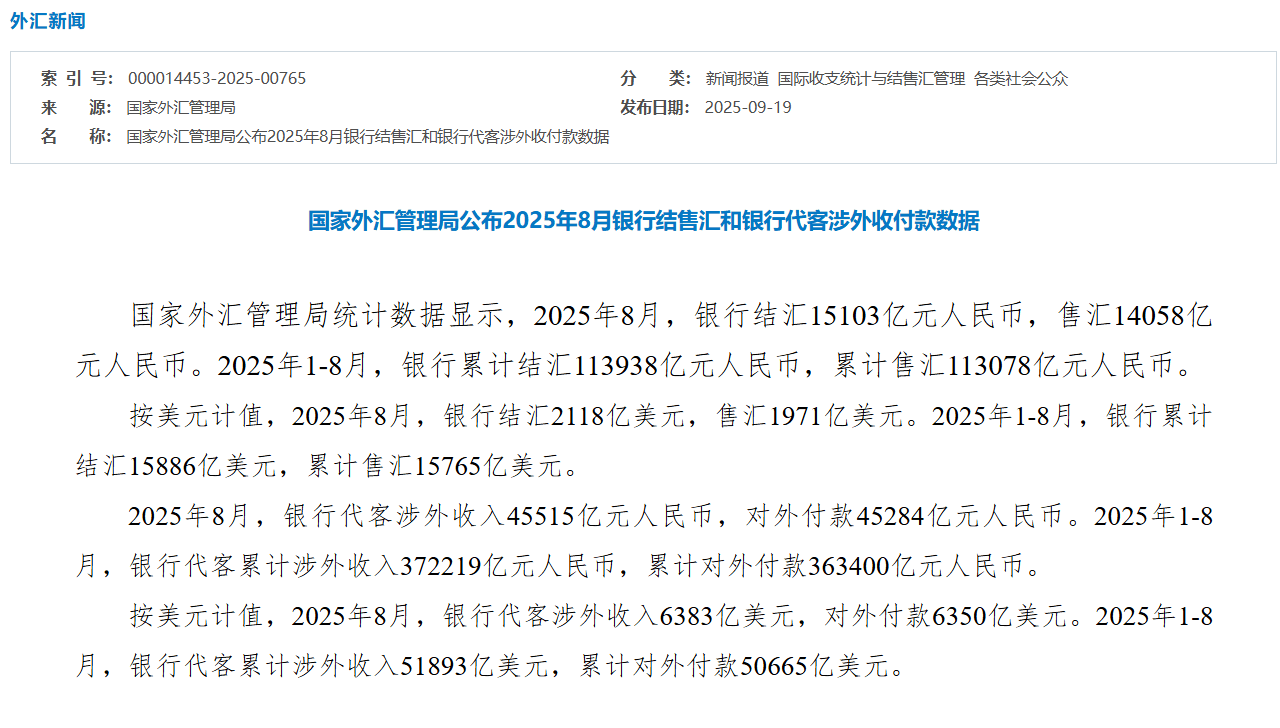
Group 1 - The core viewpoint of the article highlights the stable operation of China's foreign exchange market in August 2025, with active trading and a basic balance in supply and demand [4] - In August 2025, banks settled 15,103 billion RMB and sold 14,058 billion RMB, while the cumulative settlement from January to August reached 113,938 billion RMB and cumulative sales were 113,078 billion RMB [1][2] - The non-bank sector's cross-border receipts and payments reached 1.3 trillion USD in August, reflecting an 8% year-on-year growth, indicating steady development in cross-border trade and investment activities [4] Group 2 - In August, banks recorded a net inflow of cross-border funds amounting to 3.2 billion USD, with a surplus of 14.6 billion USD in bank settlement and sales [4] - The net inflow from goods trade remained stable, while foreign investment in domestic stocks and bonds showed a net inflow, and service trade and investment income saw a decrease from seasonal highs [4]
外资8月加仓中国股债跨境资金净流入32亿美元
Zheng Quan Shi Bao· 2025-09-19 22:13
Core Insights - The State Administration of Foreign Exchange reported a net inflow of $3.2 billion in cross-border funds and a surplus of $14.6 billion in bank settlement and sale of foreign exchange in August 2025, indicating a stable market expectation [1] - Foreign capital showed a net purchase of domestic stocks and bonds in August, reflecting positive sentiment towards the Chinese market [1] Summary by Categories Foreign Exchange Market - The foreign exchange market maintained overall balance in August, with bank settlements reaching $211.8 billion and sales at $197.1 billion, continuing the surplus trend [1] - The trading volume of bank customer foreign exchange receipts and payments reached $1.3 trillion, a year-on-year increase of 8%, indicating sustained high activity levels [1] Cross-Border Capital Flow - The net inflow from goods trade remained stable, while foreign capital net purchases of domestic stocks and bonds were noted [1] - In August, bank customer foreign exchange income was $638.3 billion and payments were $635 billion, resulting in a slight surplus and basic balance in receipts and payments [1] Economic Indicators - The decline in the US dollar index in August, influenced by monetary policy expectations and macroeconomic data, led to a general recovery of non-dollar currencies [1] - The capital and current account cross-border receipts both showed growth, with steady development in trade and investment financing [1]
8月外资总体净买入 境内股票和债券
Zhong Guo Zheng Quan Bao· 2025-09-19 20:28
● 本报记者彭扬 国家外汇管理局副局长、新闻发言人李斌表示,8月我国外汇市场平稳运行。一方面,外汇市场交易保 持活跃。8月,企业、个人等非银行部门跨境收支1.3万亿美元,同比增长8%。其中,经常项目和资本 项目跨境收支均有所增长,跨境贸易和投融资稳步发展。另一方面,外汇市场供求总体平衡。8月,跨 境资金净流入32亿美元,银行结售汇顺差146亿美元。分项目看,货物贸易资金净流入保持稳定,外资 总体净买入境内股票和债券,服务贸易和投资收益资金净流出由季节性高位回落。 9月19日,国家外汇管理局公布数据显示,2025年8月,银行结汇15103亿元人民币,售汇14058亿元人民 币。1-8月,银行累计结汇113938亿元人民币,累计售汇113078亿元人民币。 8月,银行代客涉外收入45515亿元人民币,对外付款45284亿元人民币。1-8月,银行代客累计涉外收入 372219亿元人民币,累计对外付款363400亿元人民币。 "总的来看,当前我国外汇市场交易活跃,外汇供求基本平衡,市场预期保持稳定。"李斌说。 ...