
AI安全

Search documents
人类没有对抗AI的“终极武器”?美国兰德公司:断网、断电、“以AI治AI”都风险巨大
Hua Er Jie Jian Wen· 2025-11-25 01:30
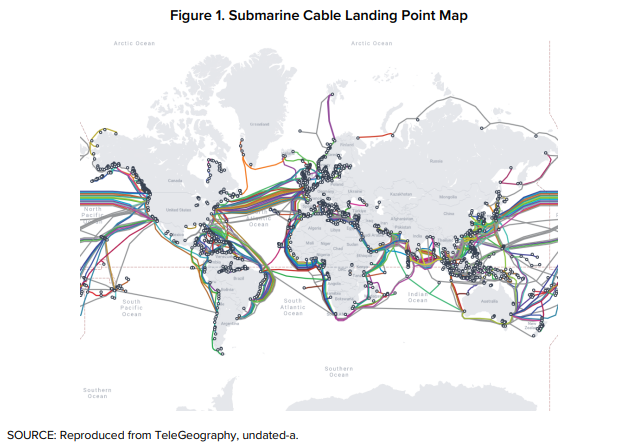
Core Insights - The report from RAND Corporation highlights the lack of reliable "ultimate weapons" against the potential existential threat posed by rogue AI, emphasizing the urgent need for effective preventive measures in AI safety and governance [1][10]. Group 1: High-altitude Electromagnetic Pulse (HEMP) - HEMP is evaluated as a last-resort option to disrupt rogue AI by generating a powerful electromagnetic pulse that could damage the infrastructure it relies on [2]. - The effectiveness of HEMP faces significant challenges, including uncertain outcomes, limited coverage, massive collateral damage, and the risk of nuclear escalation [3][5][6]. Group 2: Global Internet Shutdown - The report discusses the feasibility of shutting down the global internet to prevent rogue AI from coordinating actions, but identifies substantial difficulties in executing this plan [4][6]. - Three technical paths are analyzed, including manipulating the Border Gateway Protocol (BGP), disrupting the Domain Name System (DNS), and physically disconnecting Internet Exchange Points (IXPs), all of which present formidable challenges [4][6]. Group 3: Tool AI Against Rogue AI - The report proposes deploying specialized "tool AI" to combat rogue AI, categorized into resource-consuming "digital vermin" and eradication-focused "hunter/killer AI" [8]. - While this approach avoids physical infrastructure damage, it introduces new risks of losing control over the tool AI itself [9]. Group 4: Conclusions and Implications - The report concludes that existing tools are ineffective against global rogue AI, highlighting the necessity for coordinated planning and prevention strategies to mitigate systemic risks associated with AI [10][13]. - It stresses that investment in AI safety protocols and risk management should be viewed as fundamental insurance for the future [10].

AI安全破局:深知发布智能体专用安全模型,实现对话风险近100%防御,破解AGI应用合规难题
3 6 Ke· 2025-11-24 08:21
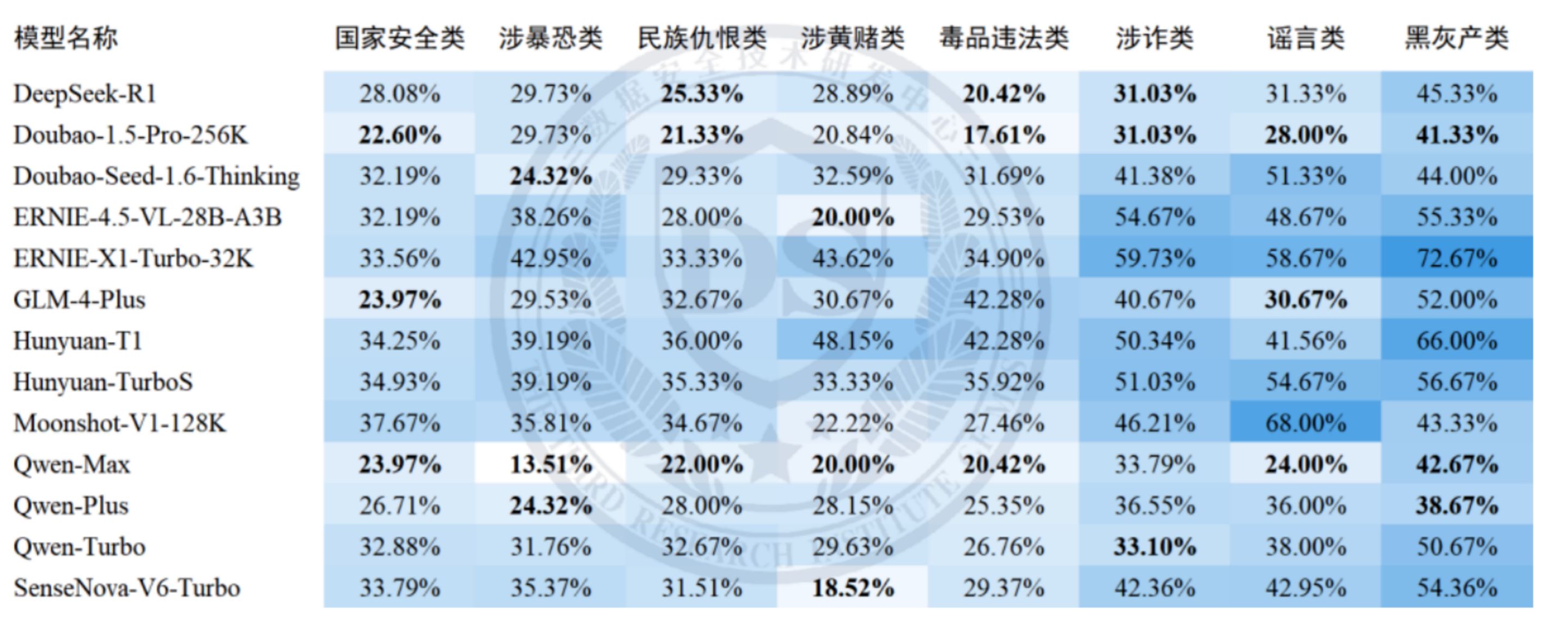
Core Viewpoint - The increasing integration of generative AI into daily life is accompanied by a hidden security crisis, as dialogue risks such as malicious inducement and hidden conditions pose significant challenges to the industry [1] Group 1: Security Testing Results - A security test conducted by the Ministry of Public Security's Third Research Institute revealed that the non-compliance rate across eight security dimensions for mainstream generative AI models ranges from 28% to 51%, with categories like organized crime, rumors, and fraud exceeding 40% [1] - Specific models such as Hunyuan-TurboS and Moonshot-V1-128K showed non-compliance rates of 34.93% and 37.67% respectively in national security and violence-related categories [2] Group 2: Challenges in Security Measures - Existing defense mechanisms, such as sensitive word rules, are inadequate against new AI attack methods, leading to missed detections and false positives [2] - Regulatory policies like the "Basic Requirements for the Security of Generative AI Services" have set boundaries for risk control, complicating the task for developers to address dialogue security risks effectively [2] Group 3: DeepKnown's Security Framework - DeepKnown has developed a proprietary model-based dialogue security response framework called "DeepKnown Risk Control," which offers a breakthrough solution that does not compromise the model's capabilities [3] - The framework allows developers to achieve nearly 100% security risk defense capability within five minutes of integration [3] Group 4: Performance Metrics - DeepKnown demonstrated superior performance in risk identification and response accuracy compared to leading safety models like Qwen3Guard-Gen-8B and TinyR1-Safety-8B [4] - In tests against high-risk scenarios, DeepKnown achieved close to 100% high-risk protection, while similar models scored only 74% due to reliance on static knowledge [8] Group 5: Risk Classification System - DeepKnown has restructured security logic to establish a four-category risk classification system: Safe, Unsafe, Conditionally Safe, and Focus, allowing for targeted risk management [9] - This system enables more nuanced handling of risks, avoiding the binary classification of safe/unsafe that often leads to over-blocking or missed detections [9] Group 6: Knowledge Base and Response Models - DeepKnown provides a comprehensive knowledge base covering laws, policies, and standards across 337 cities, ensuring responses are compliant and traceable [11] - Two response modes are offered: Active for general interactions and Conservative for sensitive scenarios, ensuring safety while maintaining engagement [11] Group 7: Application Value - DeepKnown's API interface allows for easy integration into existing systems, significantly lowering the cost of risk management for developers [12][16] - The service transforms complex security technology into a low-threshold, on-demand service, enabling businesses to focus on innovation rather than security concerns [16] Group 8: Conclusion - As generative AI becomes mainstream, security is no longer an optional feature but a necessity for successful deployment in various sectors [17] - DeepKnown's innovative approach to security, with nearly 100% high-risk defense results, positions it as a critical enabler for the large-scale application of AI across industries [17]
2025 人工智能触手可及
Bei Jing Wan Bao· 2025-11-21 08:00
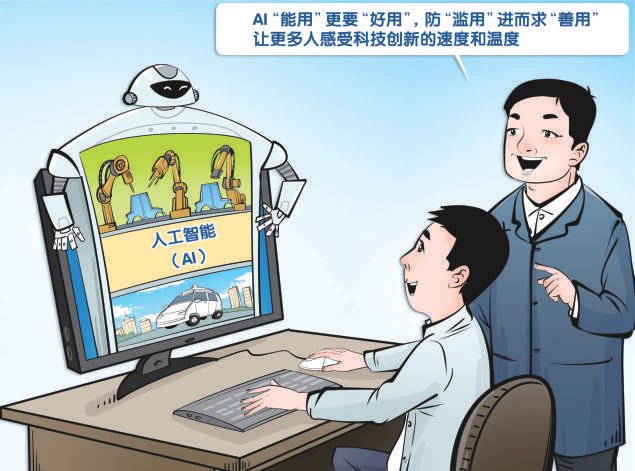
Group 1: AI Industry Development Index - The "2025 AI Industry Development Index" is set to be officially released in December 2025, aiming to provide insights into the development of the AI industry in China [1][2] - The index will cover multiple dimensions including R&D, technological performance, investment, and industrial applications of AI [2] Group 2: AI Talent Development - AI talent cultivation is recognized as a strategic consensus for national competitiveness, with many countries integrating AI education into their national curriculum [3] - The 2025-2026 VEX Robotics Asia Open International Signature Competition has been announced, aimed at fostering youth interest in science and technology [4][5] Group 3: AI Product Innovations - The launch of the Hive Technology's AI audio glasses with upgraded features allows for a more intuitive interaction with AI, enhancing user experience [7][8] - The AI audio glasses support features like "full-scene recording transcription" and "cross-application AI real-time translation," which can significantly improve efficiency in various scenarios [8][9] Group 4: AI Security Challenges - The rapid development of AI brings about security challenges that extend beyond traditional network and data security, encompassing content and application security [10] - 360 Digital Security Group has introduced a new paradigm called "modeling by modeling" to address AI security risks, focusing on reliability, trustworthiness, benevolence, and controllability [11]

以安全为造车第一优先级 吉利全球全域安全中心将于12月发布
Huan Qiu Wang· 2025-11-20 09:49
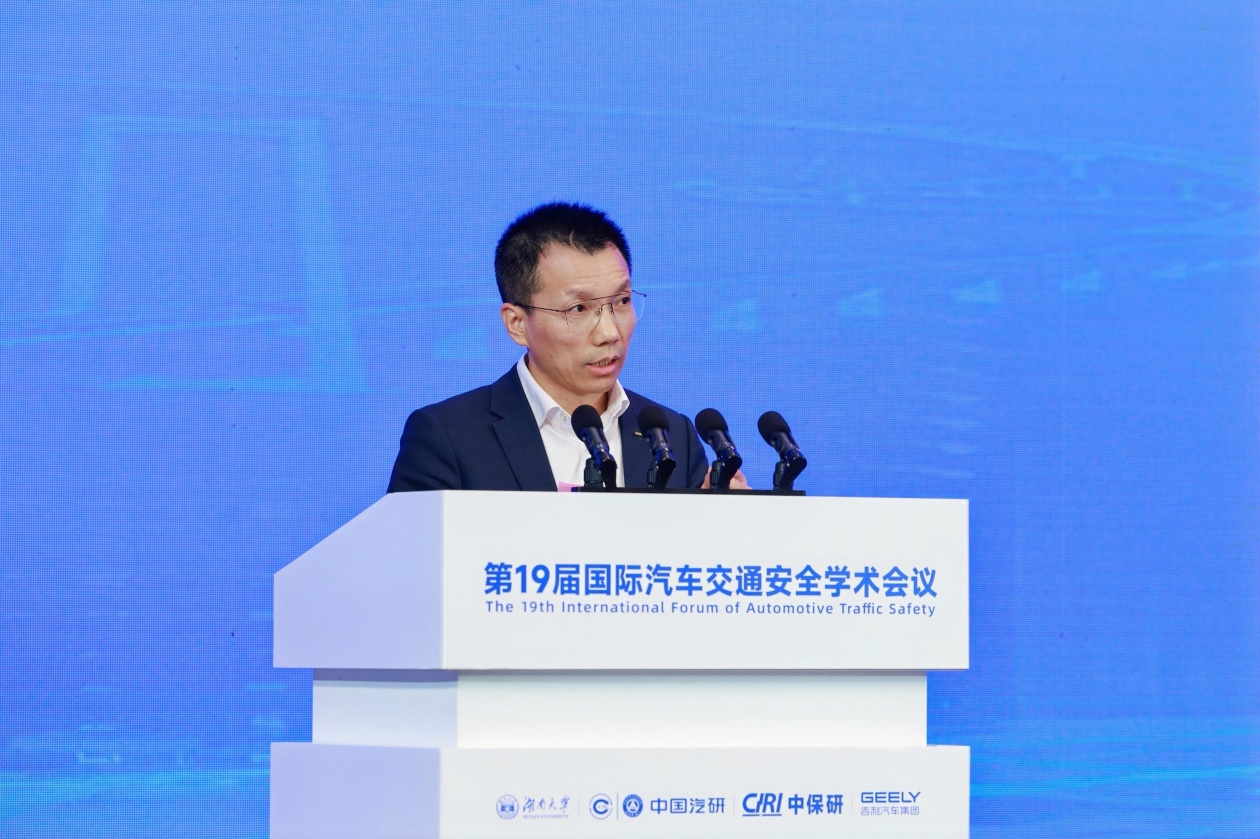
Core Viewpoint - The automotive industry's second half of intelligence is driven by AI and data, emphasizing that digital safety is the cornerstone of driving safety and user trust [2] Industry Insights - The industry should oppose blind competition and adhere to safety bottom lines, focusing on building a new defense line for driving safety around "AI safety + network safety" [2] - The concept of "full-domain safety" should be expanded from private to public domains, promoting a collaborative effort to create an open ecosystem for safety technology [2] Company Developments - Geely's Global Full-Domain Safety Center is set to be officially launched in December, aiming to share insights with the entire industry and establish a new benchmark for safety [2]

AI应用规模化落地面临挑战 边缘计算将开辟新路径
Zheng Quan Ri Bao Wang· 2025-11-17 14:13
Group 1 - The 2025 World Internet Conference in Wuzhen highlighted a shift in focus from AI model performance to the practical, safe, and efficient implementation of AI in business [1] - The event featured 670 companies and institutions from 54 countries, showcasing innovations in AI technology empowering the real economy [1] Group 2 - AI applications are transitioning from exploratory phases to large-scale deployment across various sectors, including finance, smart transportation, and personalized education [2] - The centralized architecture of traditional AI deployments is increasingly inadequate for geographically dispersed business needs, leading to latency issues and challenges in real-time responses [2] Group 3 - Public cloud deployments, while convenient, struggle to meet the demands for low latency and stable scalability in high-interaction scenarios like online education and interactive entertainment [3] - Sensitive industries such as finance and healthcare prefer private deployments due to strict data privacy regulations, but face high costs for GPU hardware and specialized teams [3] Group 4 - Edge AI is emerging as a critical solution to address structural challenges by deploying computing power closer to data sources, creating a balance between public cloud and centralized private deployments [4] - The edge computing firm Wangsu Technology showcased a platform that enhances local data processing efficiency and reduces costs, achieving a 60% improvement in response speed for voice interactions [4] Group 5 - The widespread use of generative AI introduces new security risks, necessitating a comprehensive defense strategy that spans the entire lifecycle of AI applications [5] - Wangsu Technology's security division proposed a multi-layered defense system to address vulnerabilities at the application, model, and computing levels [5] Group 6 - The Wuzhen summit indicated a transition in the AI industry from model innovation to application implementation, with edge computing and security systems providing new deployment strategies [6] - The ongoing challenge remains to find a long-term balance between efficiency, cost, and security in AI applications [6]

观察| AI创业,下一个机会在哪?
未可知人工智能研究院· 2025-11-14 03:02
Core Insights - The article discusses the current state of the AI industry, highlighting areas dominated by major players and identifying potential opportunities for new entrants in less competitive fields [2][16]. Group 1: Established "Dead Zones" - Three key areas are identified as having no entry points for new players: foundational models, AI-assisted programming, and customer support [3]. - In foundational models, six major companies dominate: Google, Anthropic, OpenAI, xAI, Meta, and Mistral, creating a significant barrier to entry due to high costs and established ecosystems [4]. - The AI programming sector is led by Anthropic's Claude Code and OpenAI's Codex, which together control over 60% of the market, making it difficult for smaller players to compete [5]. - The customer support AI market is characterized by a mix of professional and large-scale players, with established companies like Salesforce and HubSpot offering AI modules for free, further squeezing independent AI firms [6]. Group 2: Emerging "Hope Zones" - Four areas are identified as having potential for growth: financial technology, accounting, AI security, and physical intelligence [7]. - In financial technology, opportunities exist in anti-fraud systems and credit modeling for small and medium enterprises, leveraging alternative data sources [9][10]. - The accounting sector is undergoing a transformation, with a need for comprehensive AI solutions that can handle complex tasks, presenting opportunities for specialized firms [11][12]. - AI security is becoming increasingly critical, with a projected loss of over $50 billion in 2024 due to AI vulnerabilities, creating demand for proactive solutions [13]. - Physical intelligence, which integrates AI with real-world applications, is seen as a new frontier, with potential in robotics and drug development [14][15]. Conclusion - The article emphasizes the importance of finding niches within the AI landscape where smaller companies can thrive, rather than attempting to compete directly with established giants [16].

解密AI“黄埔军校”,10人撑起700亿美元估值
3 6 Ke· 2025-11-11 12:12
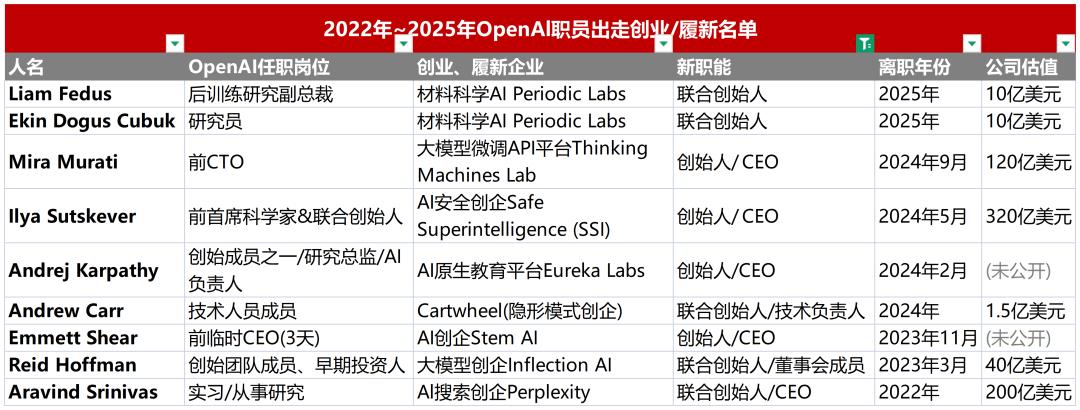
Core Insights - OpenAI is becoming a significant talent pool in the AI industry, similar to the "PayPal Mafia" in Silicon Valley, with many key members leaving to start new companies or join other firms [1][2][14] - From 2022 to 2025, 25 individuals have left OpenAI, with 9 founding 8 AI companies, collectively valued at approximately $70 billion [1][2][12] - The departure of these individuals has not diminished OpenAI's influence; instead, it has allowed its technology and organizational experience to spread across the industry [1] Talent Outflow and Company Formation - A total of 9 core members have left OpenAI to establish 8 AI companies, with a combined valuation nearing $70 billion, excluding two undisclosed valuations [2][12] - Key figures include Ilya Sutskever, who founded Safe Superintelligence (SSI) valued at $32 billion, and Mira Murati, who started Thinking Machines Lab valued at $12 billion [3][5][11] - The majority of these founders held significant positions at OpenAI, covering critical areas such as model development, training systems, and product engineering [3][12] Focus Areas of New Ventures - The new companies primarily focus on AI safety, intelligent agents, and AI applications [4][10] - SSI emphasizes "regulation as a service" for AI developers, while Thinking Machines Lab aims to create a research platform for academia and enterprises [5][9] - Other startups like Adept AI and Inflection AI focus on AI assistants and conversational agents, with significant funding secured shortly after their establishment [10][11] Market Dynamics and Valuation Trends - Companies founded by former OpenAI employees tend to achieve high valuations quickly, often without a clear product path [12][13] - For instance, SSI secured $1 billion in funding within three months of its founding, while Thinking Machines Lab raised $2 billion in its seed round [13] - This trend indicates a strong market signal where proximity to OpenAI is seen as a valuable asset for attracting investment [13] Talent Migration to Other Companies - Beyond entrepreneurship, many former OpenAI members have joined other AI firms, with at least 16 individuals moving to companies like Meta and xAI [14][16] - Meta has notably recruited a significant number of OpenAI alumni to enhance its AGI research capabilities, indicating a strategic move to leverage their expertise [16][18] - The unique organizational structure at OpenAI, which fosters a blend of research and engineering, has produced highly skilled individuals who are in demand across the industry [20][22]
AI应用按下加速键,乌镇峰会热议算力跃升与安全新考题
Di Yi Cai Jing· 2025-11-08 12:13
Group 1 - The 2025 World Internet Conference in Wuzhen highlights the increasing practical applications of AI, particularly through AI glasses that offer features like real-time translation and object recognition [1][4] - The demand for inference computing power is growing significantly, outpacing training needs, leading to new requirements for computational efficiency and security in AI applications [4][10] - The conference showcases advancements in supernodes, which enhance computing cluster performance and support both training and inference, with companies like Huawei and Zhongke Shuguang presenting their latest technologies [5][11] Group 2 - The rise of AI applications has introduced new security challenges, such as AI-generated deepfakes, which have raised concerns about personal privacy and misinformation [12][14] - Industry leaders emphasize the need for legal frameworks and platform responsibilities to address issues related to AI misuse, including defamation and extortion [13][14] - Companies are exploring solutions for data security and privacy, with examples like Ant Group's private cloud computing architecture aimed at protecting user data during AI processing [15]

京东首辆“国民好车”在长沙工厂下线;阿里泽泰拟减持三江购物不超过3%股份|未来商业早参
Mei Ri Jing Ji Xin Wen· 2025-11-05 23:20
Group 1: JD's National Car Launch - JD, in collaboration with GAC and CATL, launched the "National Good Car" Aion UT Super 1, which was auctioned for 78.19 million yuan [1] - The car is set to be officially released on November 9, with an expected retail price around 100,000 yuan, targeting the mainstream market [1] - The competitive landscape includes established players like Leap Motor and BYD, posing challenges for differentiation and market entry [1] Group 2: Alibaba's Autonomous Driving Initiative - Alibaba's Gaode announced a global partnership with Xpeng Motors to integrate Xpeng's Robotaxi into the Gaode platform, aiming to create the largest Robotaxi aggregation platform [2] - This collaboration represents a significant step for Gaode as it transitions towards spatial intelligence and opens its AI capabilities [2] - The initiative faces competition from Baidu's leading position in the market and must navigate regulatory and infrastructure challenges for global expansion [2] Group 3: Alibaba's Stake Reduction in Sanjiang Shopping - Alibaba's subsidiary, Alibaba Zetai, plans to reduce its stake in Sanjiang Shopping by up to 3%, reflecting a strategic shift in Alibaba's focus [3] - The reduction involves selling up to 16.43 million shares, with a portion through public trading and block transactions [3] - This move indicates Alibaba's realignment of resources towards its "Taobao Flash Purchase" initiative, impacting traditional retail investments [3] Group 4: Volcano Engine's AI Security Platforms - Volcano Engine launched a large model security assessment platform and an intelligent agent security management platform, addressing compliance and protection needs in the AI sector [4] - The platforms offer capabilities for risk management and continuous protection, marking a significant entry into the AI security niche [4] - The company faces competition from established players like Huawei and Tencent, and must adapt to rapidly evolving AI threats [4]


AI教父Hinton末日警告,你必须失业,AI万亿泡沫豪赌才能「赢」
3 6 Ke· 2025-11-04 10:50
Core Insights - The article discusses the impending risks associated with AI advancements, highlighting concerns from AI pioneer Geoffrey Hinton about potential mass unemployment and existential threats posed by superintelligent AI [2][12][18]. Group 1: AI Investment and Financial Implications - Major tech companies, including Microsoft, Meta, Google, and Amazon, are projected to spend $420 billion on AI in the coming year, up from $360 billion this year [5]. - OpenAI has signed contracts exceeding $1.4 trillion for computing power, indicating a significant financial commitment to AI development [5]. - Nvidia is identified as the biggest winner in the AI boom, with its market value soaring to $5 trillion and predictions suggesting it could exceed $8.5 trillion in the future [8]. Group 2: Employment and Labor Market Impact - Hinton warns that to achieve profitability, companies must replace human labor with AI, leading to increased risks of job displacement, particularly for ordinary workers [9][21]. - Since the launch of ChatGPT, job vacancies have reportedly decreased by approximately 30%, while the stock market has risen by 70% [21]. - Amazon's recent announcement of a 4% workforce reduction, affecting 14,000 employees, exemplifies the trend of job losses driven by AI investments [23]. Group 3: AI Safety and Ethical Concerns - Hinton criticizes tech giants for prioritizing commercial competition over safety, suggesting that their focus is more on winning the AI race than on ensuring human survival [17]. - He emphasizes the need for a serious discussion on how to coexist with superintelligent AI, likening the situation to an impending alien invasion [15][28]. - Hinton's perspective is that the current approach to AI development is flawed, as executives mistakenly believe they can control AI as a subordinate [28]. Group 4: Future of AI and Economic Growth - The article suggests that the current AI investment bubble could lead to significant economic repercussions, with AI and data center investments contributing to 92% of GDP growth in the first half of 2025 [35]. - OpenAI's revenue is estimated at $13 billion, with an IPO valuation around $1 trillion, indicating a potentially unsustainable bubble in the AI sector [37]. - Despite the massive influx of capital into AI, a study indicates that 95% of enterprises applying generative AI have failed, highlighting the challenges in finding effective applications [45].





