Scaling Law

Search documents
一文读懂谷歌最强大模型Gemini 3:下半年最大惊喜,谷歌王者回归
36氪· 2025-11-19 09:44
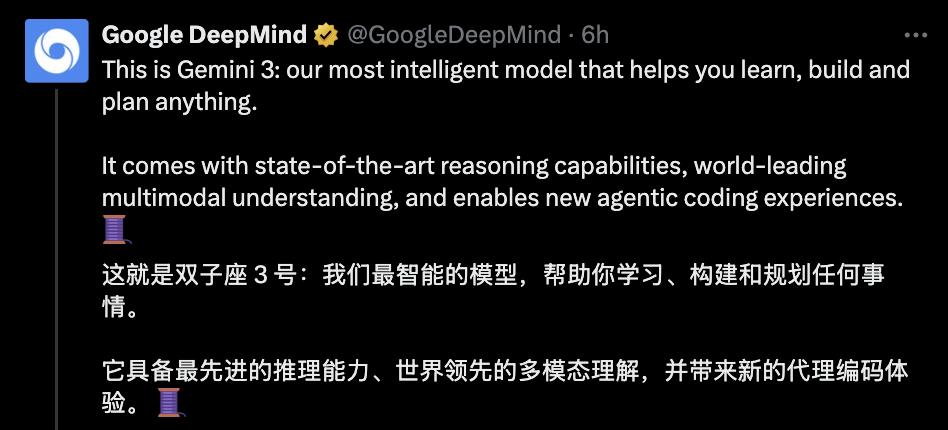
Core Insights - The article discusses the significant advancements made by Google's Gemini 3, which marks a notable leap in AI capabilities, particularly in comparison to its competitors like OpenAI's GPT-5 and Anthropic's Claude Sonnet [4][10][36]. Benchmark Performance - Gemini 3 has demonstrated exceptional performance across various benchmarks, achieving scores that significantly surpass its predecessors and competitors. For instance, it scored 37.5% in Humanity's Last Exam without tools, compared to Gemini 2.5 Pro's 21.6% and Claude Sonnet 4.5's 13.7% [16][17]. - In the ARC-AGI-2 test, Gemini 3 Pro scored 31.1%, while GPT-5.1 only managed 17.6%, indicating a closer approach to human-like fluid intelligence [17][19]. - The model also excelled in mathematical reasoning, achieving 95.0% in AIME 2025 without tools and 100% with code execution, showcasing its advanced capabilities in complex problem-solving [22]. Multimodal Understanding - Gemini 3's multimodal understanding is highlighted by its scores of 81.0% in MMMU-Pro and 72.7% in ScreenSpot-Pro, significantly outperforming competitors [21][22]. - The model's ability to understand and synthesize information from complex charts was evidenced by an 81.4% score in CharXiv Reasoning, further establishing its superiority in this domain [21]. Coding and Agent Capabilities - Although Gemini 3 scored 76.2% in SWE-Bench Verified, it still fell short of Claude Sonnet 4.5's 77.2%. However, it outperformed in other coding benchmarks, such as LiveCodeBench, where it scored significantly higher than its nearest competitor [24][25]. - The model's agentic capabilities were demonstrated in the Design Arena, where it ranked first overall and excelled in multiple coding categories, indicating a strong performance in real-world coding environments [28]. Long Context and Memory - Gemini 3 shows improved long-context capabilities, scoring 77.0% in MRCR v2 benchmark for 28k context, which is significantly higher than its competitors [31]. - The model's ability to recall factual information effectively was also noted, suggesting a robust memory system [32]. Generative UI and User Experience - The introduction of Generative UI allows Gemini 3 to create customized user interfaces based on user intent and context, marking a significant shift in human-computer interaction [41][42]. - This capability enables the model to adapt its design and interaction style based on the user's preferences, enhancing the overall user experience [45]. Scaling Law and Future Implications - Gemini 3's release challenges the notion that the Scaling Law has reached its limits, with Google asserting that significant improvements can still be made in AI training and architecture [55][58]. - The model's architecture, based on sparse mixture-of-experts, indicates a departure from previous versions, suggesting a new direction in AI development [58]. Conclusion - The launch of Gemini 3 signifies Google's return to a leadership position in AI, showcasing its potential to redefine front-end development and integrate agent capabilities into user interfaces [62][63].



一文读懂谷歌最强大模型Gemini 3:下半年最大惊喜,谷歌王朝回归
3 6 Ke· 2025-11-19 03:10
Core Insights - The release of Gemini 3 marks a significant breakthrough in the AI field, ending a period of stagnation and showcasing Google's ambition to redefine its ecosystem with AI capabilities [1][6][24]. Benchmark Performance - Gemini 3 demonstrates a substantial leap in benchmark scores, outperforming competitors like Claude Sonnet and GPT-5 across various tests, indicating a clear competitive edge [7][8][24]. - In the Humanity's Last Exam, Gemini 3 Pro scored 37.5% without tools and 45.8% with tools, significantly higher than its predecessors [8][9]. - The ARC-AGI-2 test results show Gemini 3 Pro achieving 31.1%, while GPT-5.1 only managed 17.6%, highlighting its advanced reasoning capabilities [9][11]. Multimodal and Coding Capabilities - Gemini 3 excels in multimodal understanding, scoring 81.0% in MMMU-Pro and 72.7% in ScreenSpot-Pro, showcasing its ability to comprehend and interact with visual data [13][15]. - In coding benchmarks, Gemini 3 achieved a score of 76.2% in SWE-Bench Verified, indicating a strong performance in software engineering tasks [15][18]. Long Context and Memory - The model shows improved long-context capabilities, scoring 77.0% in MRCR v2 benchmark for 28k context, demonstrating its ability to utilize information from lengthy documents effectively [21][22]. Agent Capabilities - Gemini 3 integrates general agent capabilities, allowing it to understand tasks, plan, and utilize tools effectively, marking a significant evolution in AI functionality [34][35]. User Experience and Customization - The introduction of Generative UI allows Gemini 3 to create customized user interfaces based on user intent and context, enhancing user interaction [29][30]. - The model's ability to adapt to user preferences over multiple interactions signifies a shift towards more personalized AI experiences [31]. Scaling Law and Future Potential - Gemini 3's development challenges the notion that scaling laws have reached a limit, with Google emphasizing ongoing improvements in pre-training and post-training processes [37][38]. - The model's architecture, utilizing sparse mixture-of-experts, indicates a departure from previous versions and suggests potential for further advancements [38][40]. Conclusion - The launch of Gemini 3 Pro signifies Google's return to leadership in AI, showcasing its capabilities to redefine front-end development and integrate agent functionalities, while also indicating a continued commitment to advancing AI technology [42][43].
首个完整开源的生成式推荐框架MiniOneRec,轻量复现工业级OneRec!
机器之心· 2025-11-17 09:00
Core Viewpoint - The article discusses the launch of MiniOneRec, the first complete end-to-end open-source framework for generative recommendation, which validates the generative recommendation Scaling Law and provides a comprehensive training and research platform for the community [2][4]. Group 1: Generative Recommendation Framework - MiniOneRec has gained significant attention in the recommendation community since its release on October 28, with all code, datasets, and model weights open-sourced, requiring only 4-8 A100 GPUs for easy reproduction [6]. - The framework offers a one-stop lightweight implementation and improvement for generative recommendation, including a rich toolbox for SID (Semantic ID) construction, integrating advanced quantization algorithms [9]. - The framework has demonstrated a significant advantage in parameter utilization efficiency, as shown by the training and evaluation loss decreasing with increasing model size from 0.5 billion to 7 billion parameters [8][10]. Group 2: Performance Validation - Researchers have validated the generative recommendation Scaling Law on public datasets, showcasing the model's efficiency in parameter utilization [7]. - MiniOneRec outperforms traditional and generative recommendation paradigms significantly, leading by approximately 30 percentage points over the TIGER model in metrics such as HitRate@K and NDCG@K [23]. Group 3: Innovations in Recommendation - The framework introduces a full-process SID alignment strategy, which significantly enhances the performance of generative recommendations by incorporating world knowledge from large models [13][15]. - MiniOneRec employs a novel reinforcement learning strategy tailored for recommendations, including a constrained decoding sampling strategy to improve the diversity of generated items and a ranking reward to enhance the distinction of sorting signals [17][21]. Group 4: Future Outlook - The article raises the question of whether generative recommendation will become the new paradigm for recommendation systems, highlighting two approaches: the reformist approach, which integrates generative architecture into existing systems, and the revolutionary approach, which aims to completely overhaul traditional models [25][26]. - Both approaches have demonstrated the practical value of the generative paradigm, with some major companies already realizing tangible benefits from its implementation [27].

中金:具身智能走向数据驱动 高价值信息量成具身智能竞争核心
智通财经网· 2025-11-17 01:37
Core Insights - The report from CICC highlights that the short-term layered architecture remains mainstream due to engineering controllability, while VLA shows potential in complex tasks and human-machine interaction. The world model is viewed as a long-term direction due to its cross-device transfer capability [1] Group 1: Embodied Intelligence Algorithms - Layered control serves as the foundational architecture paradigm, utilizing a two-tier structure for engineering [1] - The VLA paradigm, based on VLM, enhances generalization and interaction capabilities, representing an active research direction [1] - The world model provides physical constraints through environmental modeling and future predictions, currently in the research-led stage [1] Group 2: Embodied Intelligence Data - Robotic data encompasses multimodal sources, with industries seeking low-cost data acquisition and high-efficiency application paths [2] - Data acquisition methods include real machines, video (first-person/third-person), and simulation [2] - Data security is a critical baseline, with humanoid robot manufacturers facing challenges related to permission isolation, data encryption systems, and cross-border transmission policies [2] Group 3: Hot Topics in Embodied Intelligence - The Scaling Law for robots has not yet seen explosive breakthroughs, with limitations such as insufficient real data production capacity and Sim2Real transfer being key constraints [3] - Benchmarking is driving the standardization of evaluation processes, as embodied robots lack a recognized quantitative framework [3] - Physical AI, which integrates physical knowledge with AI models, has progressed to applications in robotic operations [3]
中国曾经也有一家“OpenAI”
虎嗅APP· 2025-11-16 09:08
Core Insights - The article discusses the evolution and strategic direction of Zhiyuan Research Institute, emphasizing its commitment to non-profit research in AI, contrasting with the commercialization seen in companies like OpenAI [5][8][14]. Group 1: Zhiyuan's Strategic Direction - Zhiyuan Research Institute initially considered establishing a commercial subsidiary similar to OpenAI but ultimately decided to remain a non-profit research organization [5]. - The institute has successfully incubated several startups, such as Zhipu AI and Moonlight, with valuations around 30 billion RMB each, showcasing its role as a supportive force in the AI ecosystem [5][8]. - The new research direction proposed by Wang Zhongyuan, "Wujie," focuses on multi-modal models, distinguishing it from the previous "Wudao" series, which centered on large language models [6][8]. Group 2: Multi-Modal Models and Scaling Law - The recent release of the EMU3.5 world model is seen as a significant step towards achieving a "Scaling Law" in multi-modal AI, although it is still considered a preliminary stage [7][25]. - EMU3.5's architecture allows for learning from multi-modal data, which has shown improved performance in tasks like image-text editing, indicating a potential path towards more human-like intelligence [23][24]. - The current model's parameters are around 300 billion, comparable to GPT-3.5, but achieving true "Scaling Law" will require significantly more data and computational resources [25][28]. Group 3: Research Philosophy and Talent Attraction - Zhiyuan's non-profit model has proven sustainable in China's AI landscape, attracting young researchers who prioritize long-term scientific value over immediate financial rewards [12][14]. - The institute encourages its researchers to pursue entrepreneurial ventures while providing academic and resource support, fostering a culture of innovation without direct commercialization [15][18]. - The emphasis on open-source research and collaboration is central to Zhiyuan's mission, aiming to lead in AI innovation while maintaining a commitment to societal benefits [18][19].

本体无关:Generalist 27万小时要掀真机采集场桌子
3 6 Ke· 2025-11-14 00:17
Core Insights - The key turning point in the data race is no longer a debate over data solutions but a return to the "first principles" of data collection, focusing on reusable, scalable, and evolvable data streams [1][24] - Generalist AI's announcement of its GEN-0 embodied foundation model, trained on 270,000 hours of human operation video data, marks a significant validation of the Scaling Law in the robotics field, akin to a "ChatGPT moment" for embodied intelligence [1][24] Data Collection Challenges - The traditional remote operation data collection model is facing insurmountable efficiency bottlenecks, as it relies on linear accumulation processes that cannot meet the exponential data demands outlined by the Scaling Law [3][4] - Real machine remote operation data collection is limited by physical world constraints, leading to a linear growth that is insufficient for the exponential needs of model performance improvement [3][4] - The complexity of deploying, debugging, and maintaining physical hardware creates a rigid and cumbersome data collection system, hindering rapid scalability [4][12] Embodied Robotics Value Proposition - The core value realization of embodied robots lies in their application in real-world scenarios that meet essential needs, sustainability, and economies of scale [5][6] - Current applications often represent superficial "scene slices" rather than comprehensive industrial solutions, emphasizing the need for robots to become collaborative partners in human labor [5][6] Precision Interaction Capabilities - Embodied robots must not only perform tasks but also understand the underlying logic of actions, requiring a deep comprehension of physical interactions and environmental variables [6][8] - The lack of suitable training data for various embodied forms presents a significant challenge in developing robots capable of nuanced physical interactions [8][9] Data Pyramid Structure - The industry recognizes a "data pyramid" structure, with the base consisting of vast amounts of internet data and human operation videos, the middle layer comprising synthetic data, and the apex being high-value real machine remote operation data [10][11] Generalist AI's Breakthrough - Generalist AI's use of 270,000 hours of human operation video data has validated the existence of the Scaling Law in robotics, demonstrating the potential for scalable data collection through its UMI (Universal Manipulation Interface) solution [12][24] - The UMI approach allows for flexible deployment of data collection devices across various environments, facilitating true scalability [12][24] Simulation Data Potential - Synthetic data shows promise in achieving scalability and economic efficiency, as it can quickly generate diverse training data in virtual environments without the need for physical setups [14][16] - The commercial value of synthetic data has been demonstrated through successful applications, indicating its potential to bridge the gap between virtual and real-world robotics applications [17][24] Industry Trends and Future Directions - The industry is at a critical stage of data development, emphasizing the need for efficient acquisition of high-quality training data to meet the demands of embodied robotics [18][24] - Companies that continue to focus on traditional data collection methods are likely to struggle in the competitive landscape defined by the Scaling Law [24][25]

2026年A股策略展望:“小登”月时代,牛途仍在
Guoxin Securities· 2025-11-13 12:03
Group 1 - The current bull market is in its second phase, transitioning from emotional drivers to fundamental factors, with a focus on technology as the main theme [1][11][19] - The bull market is characterized by a significant structural differentiation between "small-cap assets" and "large-cap assets," with "small-cap stocks" outperforming [30][21] - The technology sector is expected to lead the market, with specific attention on AI applications, robotics, smart driving, and AI programming [2][57][63] Group 2 - The report highlights that the bull market's main line is technology, with significant contributions from major tech companies, particularly in AI and related fields [2][57] - Historical bull markets have shown that the main line often correlates with industry cycles, where sectors with high revenue growth tend to outperform [58][60] - The report emphasizes the importance of fundamental recovery, with expectations of improved profitability and contract liabilities for listed companies [19][21] Group 3 - The report indicates that the market's valuation structure is healthy, with no signs of overheating, as evidenced by the current PB ratios being lower than in previous bull markets [21][25] - The differentiation in performance between "old economy stocks" and "new economy stocks" is notable, with "old economy stocks" lagging significantly behind [30][31] - The report suggests that the ongoing "deposit migration" trend may lead to increased investment in higher-yielding assets, further supporting market growth [35][39] Group 4 - The report outlines key policy directions for 2026, focusing on high-quality development, technological self-reliance, and comprehensive reform to support economic growth [17][18] - The anticipated political volatility in the U.S. and potential interest rate cuts by the Federal Reserve are expected to drive capital flows into emerging market assets, including Chinese stocks [46][47] - The report notes that the AI industry is expected to see substantial growth, with projections indicating a market size of over $2.6 trillion by 2030, driven by advancements in technology and increased investment [63][68]
2026年A股策略展望:“小登”时代,牛途仍在
Guoxin Securities· 2025-11-13 09:23
Group 1 - The current bull market is in its second phase, transitioning from emotional drivers to fundamental ones, with a focus on technology as the main theme [1][11][19] - The bull market is characterized by a significant structural differentiation between "small-cap" and "large-cap" assets, with "small-cap" stocks outperforming [30][21] - The technology sector is expected to lead the market, with specific attention on AI applications, robotics, smart driving, and AI in life sciences [2][57][68] Group 2 - The report highlights that the bull market's main line is technology, with significant contributions from major tech companies, particularly in AI and semiconductor sectors [2][63] - Historical bull markets have shown that the main line often correlates with industry cycles, where sectors with high revenue growth tend to outperform [58][60] - The report emphasizes the importance of understanding the differentiation between "old economy" and "new economy" stocks, with a recommendation to maintain exposure to dividend-paying assets amidst a backdrop of financial asset scarcity [2][30][10] Group 3 - The report discusses the impact of macroeconomic policies, including fiscal and monetary measures, on market performance, particularly in relation to the "14th Five-Year Plan" and its focus on high-quality development and technological self-reliance [17][18] - The analysis indicates that the market's valuation structure is healthier compared to previous bull markets, with a lower percentage of stocks trading at high price-to-book ratios [21][25] - The report notes that the trend of "deposit migration" is ongoing, with a shift in funds towards higher-yielding assets as traditional deposit rates decline [35][39]
宇宙尺度压缩:Scaling Law的边界,柏拉图表征收敛于物质和信息交汇,解决P与NP问题,Simulation假说……
AI科技大本营· 2025-11-13 05:59
Core Viewpoint - The article discusses the successful implementation of scientific multitask learning at a cosmic scale through the BigBang-Proton project, proposing the concept of Universe Compression, which aims to pre-train models using the entirety of the universe as a unified entity [1][7]. Group 1: Scientific Multitask Learning - Scientific multitask learning is essential for achieving Universe Compression, as it allows for the integration of highly heterogeneous datasets across various disciplines, which traditional models struggle to converge [2][4]. - The BigBang-Proton project demonstrates that with the right representation and architecture, diverse scientific data can converge, indicating the potential for transfer learning across scales and structures [2][4]. Group 2: Scaling Law and Platonic Representation - The Scaling Law observed in language models can extend beyond language to encompass physical realities, suggesting that the limits of these models may align with the fundamental laws of the universe [5][6]. - The Platonic Representation Hypothesis posits that AI models trained on diverse datasets tend to converge on a statistical representation of reality, which aligns with the findings from the BigBang-Proton project [6][7]. Group 3: Universe Compression Plan - The proposed Universe Compression plan involves creating a unified spacetime framework that integrates all scientific knowledge and experimental data across scales, structures, and disciplines [25][26]. - This approach aims to reveal the underlying homogeneity of structures in the universe, facilitating deep analogies across various scientific fields [26]. Group 4: Next Steps and Hypotheses - The company proposes a second hypothesis that suggests reconstructing any physical structure in the universe through next-word prediction, enhancing the model's ability to simulate complex physical systems [28]. - This hypothesis aims to integrate embodied intelligence capabilities, improving generalization in complex mechanical systems like aircraft and vehicles [28].

「紫荆智康」获近亿元天使轮融资,加速AI医院系统开发及落地 | 早起看早期
36氪· 2025-11-11 00:10
Core Insights - "Zijing Zhikang" has completed nearly 100 million yuan in angel round financing, led by Xinglian Capital, with the funds primarily allocated for the development and iteration of the Zijing AI Hospital system [2] - The company aims to leverage advanced large model AI technology to create a virtual medical world system, enhancing smart healthcare applications in the real world [2] - The Zijing AI Hospital's core logic involves simulating real hospital facilities and processes, particularly by creating highly human-like, diverse AI patients to meet initial training data needs [2] Data and Training Challenges - High-quality data and case studies are essential for training AI doctors, but challenges such as data silos and difficulty in data acquisition persist in the real medical world [3] - Zijing Zhikang's core technology team is addressing the cold start problem by synthesizing some case data using AI, creating "evolvable intelligent agents based on simulations" [3] - The AI hospital has constructed over 500,000 AI patients covering various countries, age groups, and disease types, serving as a significant supplement for training AI doctors [3] AI Doctor Evolution - The AI doctors are designed to possess self-evolution capabilities, with a specific memory and reflection algorithm to accumulate "experience" during consultations [5] - The evolution of AI doctors is expected to be faster than that of human doctors, with experimental results indicating that the AI's capability evolution curve aligns with Scaling Law [5] - Zijing Zhikang has developed 42 AI doctors that achieved over 96% accuracy on the MedQA dataset, surpassing the average level of human doctors [5] Product Development and Features - The AI system includes three interfaces: a patient app, a doctor workstation, and a hospital system, facilitating full-cycle health management [5] - Patients can register online, engage in intelligent pre-consultation, and generate structured medical records, while doctors can access these records to save time during consultations [5] - The system is designed to manage health data over time, providing health advice and allowing patients to utilize AI for health consultations and report interpretations [5] Future Plans and Regulatory Alignment - The Zijing AI Hospital system is set to launch publicly by the end of 2025, with initial internal testing already conducted in various departments at Tsinghua University Hospital [6] - The system's development aligns with recent government initiatives aimed at promoting and regulating the application of AI in healthcare, potentially enhancing service capabilities and efficiency in grassroots medical settings [6]