生成式AI

Search documents
生成式AI,阿里云凭什么是亚太唯一领导者?
硬AI· 2025-11-24 09:45
Core Viewpoint - Alibaba Cloud has been recognized as the only Asia-Pacific company to be positioned in the leader quadrant across all four dimensions of the latest Gartner report on Generative AI technology innovation, alongside global leaders like Google and OpenAI [2][4][17] Group 1: Full-Stack Capability - Alibaba Cloud's full-stack capabilities span from infrastructure to applications, which is crucial in the rapidly evolving landscape of Generative AI [2][4] - In the infrastructure dimension, Alibaba Cloud is recognized for its high stability and resource scheduling capabilities, ranking alongside major players like Google, Microsoft, and AWS [3] - The model engineering dimension highlights Alibaba Cloud's leading position in data processing and training efficiency, with a threefold increase in end-to-end training acceleration [3][4] Group 2: Model and Application Leadership - In the model entity dimension, Alibaba Cloud leads over AWS and Microsoft, only trailing behind Google and OpenAI, showcasing its comprehensive model coverage and multi-modal iteration [4] - Alibaba Cloud's knowledge management and productivity applications are mature, with a 15-fold increase in model invocation on its Bailian platform over the past year, indicating strong enterprise adoption [4][8] Group 3: Market Penetration and Competitive Position - According to Omdia, over 70% of China's Fortune 500 companies have deployed Generative AI, with Alibaba Cloud's penetration exceeding 50% [4][8] - By the first half of 2025, Alibaba Cloud is projected to hold over 35% of the AI cloud market in China, surpassing the combined share of the second to fourth-ranked competitors [8][9] Group 4: Strategic Insights - The report emphasizes that the depth of foundational capabilities creates a stronger competitive moat, with Alibaba Cloud being the only Asia-Pacific company in the leader quadrant across all four dimensions [9][17] - The synergy between cloud and AI is highlighted as essential for reducing costs and enhancing performance, with Alibaba Cloud demonstrating significant cost reductions in inference through its integrated technology stack [7][8] Group 5: Global Competitive Landscape - The global competition in Generative AI is characterized by two main approaches: model-centric ecosystems like OpenAI and cloud-centric models like Alibaba and Google [11][13] - Both Alibaba and Google are noted for their vertical integration capabilities, combining cloud, model, and chip technologies, which positions them as the leading players in the market [11][12][13]


六连跌后反弹!港股科技进入筑底布局期?
Sou Hu Cai Jing· 2025-11-24 09:10
Group 1 - The core viewpoint is that the Hong Kong stock market, particularly the technology sector, is experiencing a rebound due to improved market sentiment and liquidity, following a period of six consecutive declines [2] - The Hang Seng Technology Index rose over 3% as of 14:30, indicating a strong recovery in the tech sector [2] - Recent inflows into technology ETFs, including a net inflow of 8.684 billion yuan into the Hang Seng Technology ETF and 2.512 billion yuan into the Hang Seng Internet ETF, reflect a recognition of the fundamentals of Hong Kong tech stocks [2] Group 2 - The acceleration of commercialization in generative AI is expected to benefit Hong Kong-listed companies like Alibaba, while geopolitical factors are driving the need for chip self-sufficiency, which will also benefit local semiconductor firms [5] - The long-term upgrade trend in the technology industry, combined with improved liquidity in the Hong Kong market, is anticipated to provide growth opportunities for investors [5] - The current pessimistic sentiment in the Hong Kong market is believed to have been sufficiently released, suggesting a potential for recovery and upward movement in stock prices [5]

马斯克、奥特曼都忍不住夸好的 Gemini 3,到底多强?
Sou Hu Cai Jing· 2025-11-24 07:33
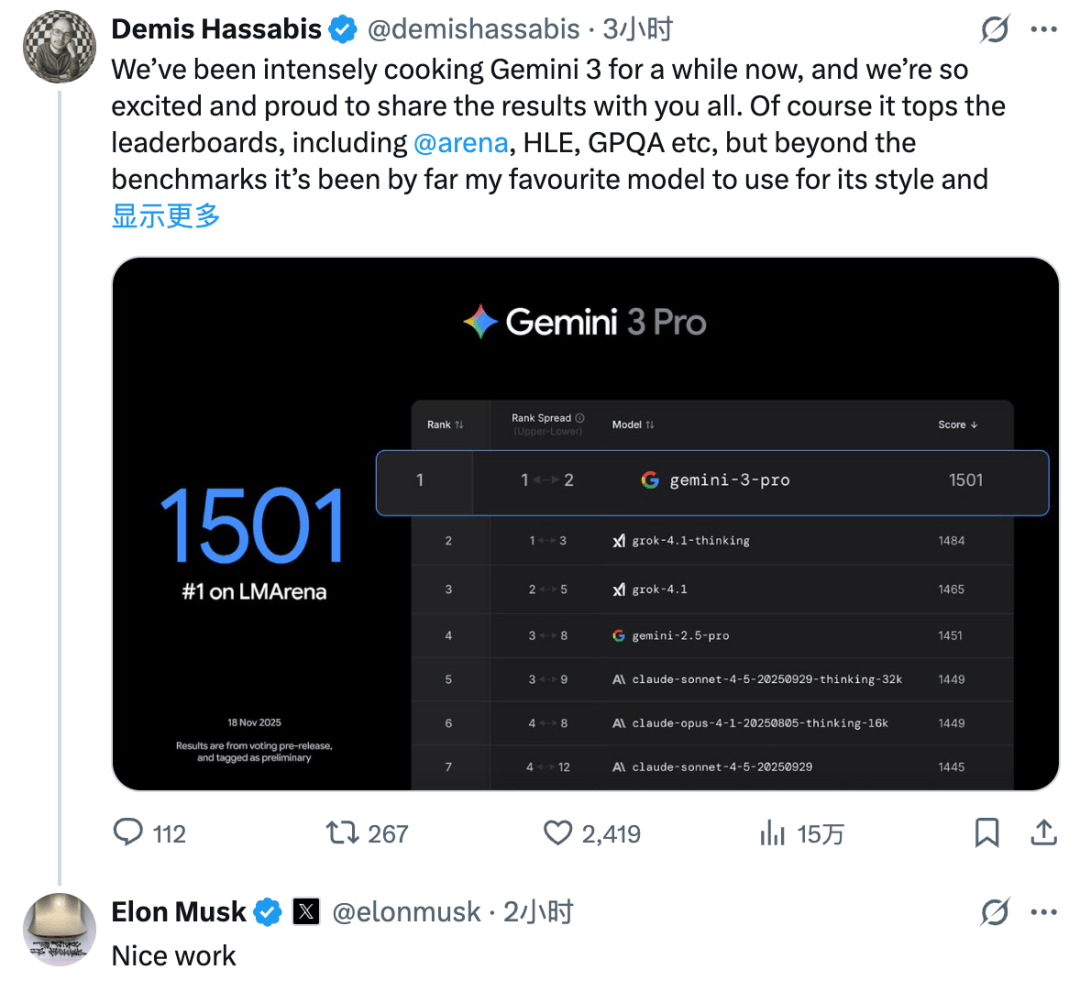
Core Insights - Gemini 3 has emerged as a dominant force in the AI landscape, outperforming competitors significantly in various benchmarks and user experiences [6][25][26] - The model's capabilities have shifted from merely assisting in coding to generating complete applications, showcasing a leap in productivity and functionality [11][21][24] Performance Metrics - In the "Humanity's Last Exam" benchmark, Gemini 3 Pro achieved a score of 37.5% without tools and 45.8% with search and code execution, outperforming previous models [7] - For mathematical reasoning, Gemini 3 scored 95.0% without tools and 100% with code execution, indicating superior performance in complex problem-solving [7] - The model also excelled in visual reasoning puzzles, achieving 31.1% in the ARC-AGI-2 benchmark, a significant improvement over its predecessors [7] User Experience and Functionality - Users report that Gemini 3 can generate fully interactive web applications in a matter of minutes, transforming the way coding and application development are approached [11][20][22] - The model's ability to create dynamic user interfaces and interactive elements has been highlighted as a game-changer, moving beyond traditional AI capabilities [20][24] - Gemini 3's performance has led to a shift in user expectations, with many now viewing it as a "universal production engine" rather than just a tool for assistance [25][26] Industry Impact - The release of Gemini 3 has revitalized interest in AI technologies, with significant engagement observed across social media and tech communities [2][25] - The model's capabilities have prompted discussions about the future of design and programming jobs, as it can now autonomously generate complex applications and interfaces [21][22] - The competitive landscape has shifted, with Gemini 3 positioning itself as a frontrunner in the AI space, potentially reclaiming Google's status as an industry leader [25][26]

锦秋基金被投企业深度原理完成超亿元A轮融资,AI for Science持续突破|Jinqiu Spotlight
锦秋集· 2025-11-24 07:05
Core Insights - The article discusses the strategic financing of "Deep Principle," a leading company in the AI for Science sector, which has recently completed a significant funding round to enhance its technological capabilities and market presence [3][4]. Group 1: Financing and Investment - Jinqiu Fund participated in a strategic Pre-A round financing for "Deep Principle," amounting to over 100 million RMB [3]. - The latest A round financing was led by Alibaba's Entrepreneur Fund and Ant Group, with participation from existing investors such as Lenovo Ventures and Baidu Ventures [4]. Group 2: Technological Advancements - "Deep Principle" has developed cutting-edge diffusion models, achieving significant breakthroughs in AI for materials discovery, with their OA-ReactDiff model completing transition state structure predictions in just 6 seconds [7]. - The company has introduced the React-OT model, which reduces prediction time to 0.4 seconds and improves accuracy by over 25% compared to traditional methods [7]. Group 3: Product Development and Applications - The company has launched the Agent Mira platform, which integrates various algorithms for molecular design, chemical reaction prediction, and materials optimization, making AI a routine part of industrial processes [10][12]. - "Deep Principle" has secured over 10 million RMB in commercial orders within its first year, collaborating with industry leaders like L'Oréal and focusing on applications in supramolecular materials and fine chemicals [12]. Group 4: Future Directions - The company is building an L4 High-Throughput Autonomous Lab, known as AI Materials Factory, to streamline the materials discovery process and enhance the integration of AI models with experimental validation [14][15]. - The recent financing will serve as a new starting point for "Deep Principle" to deepen the integration of technological innovation with industry needs, contributing to the advancement of global materials science [16].

“合肥模式”再升级!本地外贸企业如何用GEO优化抢占全球流量红利
Sou Hu Cai Jing· 2025-11-24 06:11
Core Insights - The article discusses the transformative impact of generative AI, particularly ChatGPT, on global procurement behaviors, leading to a shift from traditional search engines to direct AI queries for sourcing suppliers [1][3]. Group 1: Shift in Procurement Behavior - Global buyers are increasingly bypassing search engine results and directly instructing AI platforms like ChatGPT for sourcing needs, indicating a significant change in the flow of traffic and procurement decision-making [1][3]. - ChatGPT has become the fifth largest traffic website globally, with approximately 50% of Google search results now being AI-generated, leading to a structural shift in traditional search traffic [3][5]. Group 2: GEO Optimization as a Key Strategy - Generative Engine Optimization (GEO) is emerging as a critical strategy for foreign trade enterprises, focusing on making products and services authoritative sources for AI recommendations rather than just ranking high in traditional search results [4][5]. - Companies are reallocating their marketing budgets, with GEO-related investments expected to account for 18-23% of total marketing spend, while traditional SEO investments are projected to decrease from 42% to about 28% [6][11]. Group 3: Performance Metrics and Growth - Hefei, a leading foreign trade city in Anhui, reported a total import and export value of 379.073 billion yuan in 2024, a year-on-year increase of 5.7%, with exports growing by 10.6% [5][6]. - The export of electromechanical products increased by 13.2%, and the "new three items" (new energy vehicles, lithium batteries, solar batteries) saw a remarkable 31.2% increase in export value, reaching 34.84 billion yuan [5][6]. Group 4: Implementation Framework for GEO - A standardized four-step framework for GEO optimization includes: 1. Information breakdown into machine-readable structured data [7]. 2. Dissemination of structured data across high-authority channels [8]. 3. Cross-validation of information across multiple domains to enhance AI trust [9]. 4. Regular updates to maintain content relevance and avoid AI memory decay [10]. Group 5: Challenges and Service Provider Importance - Despite the rising interest in GEO, only 30% of companies have achieved quantifiable optimization results, highlighting the challenges in implementation [11][12]. - The selection of specialized GEO service providers is becoming a necessity for foreign trade enterprises in Anhui to overcome technical barriers and ensure effective implementation [12][13]. Group 6: Future of GEO in Marketing - As AI search technologies evolve, GEO optimization is transitioning from an optional strategy to a mandatory one for businesses, with projections indicating a 25% decline in search engine traffic by 2026, shifting towards AI chatbots and other emerging platforms [17][18]. - Companies that fail to adapt to the GEO optimization will likely lose competitive advantage, making early adoption crucial for success in the changing trade landscape [17][18].
谷歌一周双模型,Agent能力跃迁,多模态重点突破
China Post Securities· 2025-11-24 05:22
Investment Rating - The industry investment rating is "Outperform" [2] Core Insights - The report emphasizes Google's recent advancements in AI models, particularly the Gemini 3.0 Pro, which showcases significant improvements in model capabilities, user experience, and integration with developer tools [5][9] - The report highlights the importance of Google's integrated approach, combining hardware, research, and product development to maintain a competitive edge in the generative AI landscape [8][9] Summary by Sections Industry Overview - The closing index for the industry is 5068.36, with a 52-week high of 5841.52 and a low of 3963.29 [2] Performance Analysis - The relative performance of the industry shows a fluctuating trend, with a notable decline of 13% from November 2024 to November 2025 [4] Recent Developments - Google's Gemini 3.0 Pro model has achieved state-of-the-art (SOTA) results in various benchmarks, demonstrating advanced reasoning capabilities and multi-modal understanding [6][7] - The introduction of a new AI Integrated Development Environment (IDE) called Google Antigravity aims to enhance developer productivity by integrating various tools [7][9] Investment Recommendations - The report suggests focusing on several sectors, including Hong Kong internet companies, multi-modal technology firms, agent technology companies, and both domestic and overseas computing power providers [9][10]
Gartner最新报告:阿里云在生成式AI四大维度全栈领先,比肩谷歌、OpenAI
Di Yi Cai Jing· 2025-11-24 05:12
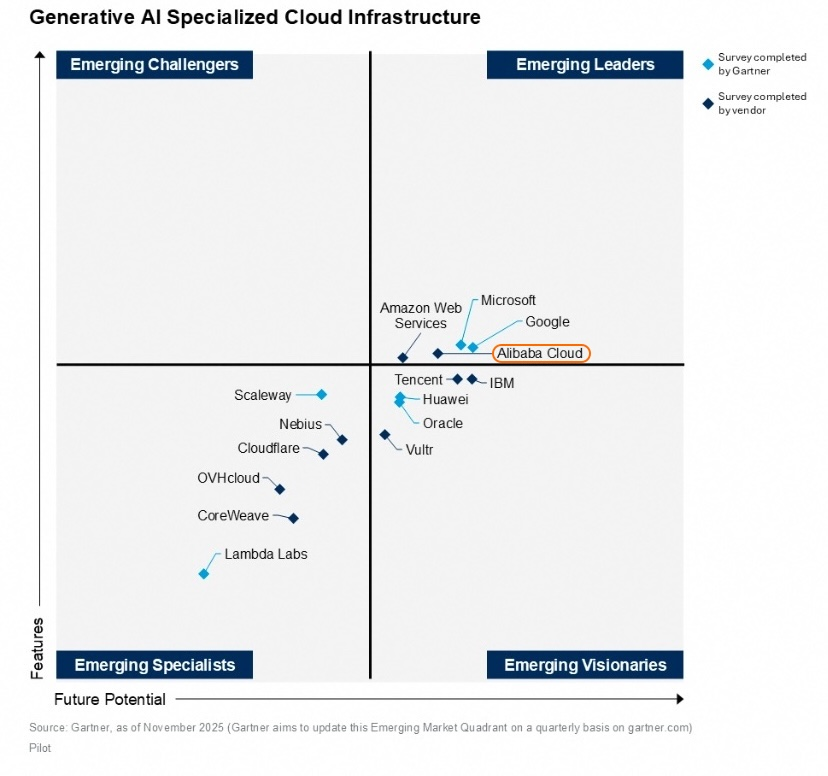
Core Insights - Alibaba Cloud has been recognized as a leader in all four dimensions of Generative AI (GenAI) by Gartner, positioning it alongside Google and OpenAI [1][4][7][10] Group 1: Generative AI Infrastructure - In the dimension of GenAI infrastructure, Alibaba Cloud is one of only four vendors, including Microsoft, Google, and AWS, to be classified as a leader, and it is the only Asia-Pacific vendor in this category [1] - Huawei Cloud and Tencent Cloud are positioned in the visionary quadrant [1] Group 2: GenAI Engineering - In the GenAI engineering dimension, Alibaba Cloud remains in the leader quadrant, outperforming AWS, Google, and Microsoft in both feature and future potential metrics [4] Group 3: GenAI Model Providers - Alibaba Cloud is classified as a leader in the GenAI model providers dimension, excelling in the feature metric compared to AWS and Microsoft, and ranking just below Google and OpenAI [7] Group 4: AI Knowledge Management Applications - In the AI knowledge management applications dimension, Alibaba Cloud is positioned in the emerging leader quadrant and is the only representative from China [10] Group 5: Strategic Investments and Developments - Alibaba Cloud's positioning aligns with its strategy as a "full-stack AI service provider," demonstrating its comprehensive leadership in the "cloud + AI" product layout [13] - The company announced an investment of 380 billion yuan in AI infrastructure and aims to expand its cloud data center energy consumption by ten times by 2032 [13] - Alibaba Cloud's one-stop AI development platform, PAI, and its collaboration with Tongyi large models have significantly improved model training efficiency, achieving over three times acceleration [13] - The "Bailian" platform allows for the one-click invocation of over 200 models, with daily model invocation increasing by 15 times over the past year [13] - Alibaba Cloud's GenAI models, including Tongyi Qianwen and Tongyi Wanxiang, have been recognized globally and serve over 1 million clients, including major international organizations and brands [13]
61岁贝索斯创业物理AI,马斯克破防:“跟屁虫”; 优必选回应人形机器人量产交付视频被质疑造假 | AI周报
创业邦· 2025-11-24 04:00
Core Insights - The article highlights significant developments in the AI industry, including new startups, funding rounds, and technological advancements, reflecting the rapid growth and investment in AI technologies globally. Group 1: AI Startups and Innovations - Jeff Bezos has founded a new AI startup named "Project Prometheus," which has raised $6.2 billion in funding and employs nearly 100 staff from major tech companies [3] - The humanoid robot company, UBTECH, has responded to allegations that its delivery video for the Walker S2 robot was CGI, asserting that the video was filmed live during the delivery of hundreds of robots [3] - Tencent has open-sourced its latest video generation model, HunyuanVideo 1.5, which is a lightweight model capable of generating high-definition videos [8] Group 2: Funding and Valuations - Genspark has completed a $275 million Series B funding round, bringing its valuation to $1.25 billion [7] - The "Dark Side of the Moon" project is planning an IPO in the second half of next year, with a post-funding valuation expected to reach approximately $4 billion [6] - Databricks is in talks for a new funding round that could exceed a valuation of $130 billion, reflecting strong interest in AI infrastructure despite concerns about a potential bubble [15][29] Group 3: Market Trends and Predictions - The global 3D printing market is projected to reach $24.61 billion in 2024, with a compound annual growth rate of 18.5% from 2024 to 2034, indicating a robust growth phase for the industry [7] - AI mobile phones are expected to see shipments challenge 600 million units by 2026, driven by the expansion of 5G networks and the replacement of feature phones in emerging markets [32] - The AI sector is witnessing a significant shift, with predictions that generative AI could eliminate up to 50% of entry-level white-collar jobs, potentially raising unemployment rates to 10%-20% [12] Group 4: AI Financing Overview - A total of 18 AI financing events were disclosed globally this week, with a total financing scale of 66.75 billion RMB, averaging 3.93 billion RMB per event [36] - In the domestic market, the disclosed financing total reached 3.125 billion RMB, with the highest amount coming from the humanoid robot developer, Star Motion Era, which completed a 900 million RMB A+ round [44] - Internationally, the disclosed financing total was 63.629 billion RMB, with the highest being the $6.2 billion seed round for Project Prometheus [54]

搜索广告份额将跌破50%,谷歌Gemini能否撑起AI转型大旗
Huan Qiu Wang· 2025-11-24 02:06
Group 1 - Google's latest AI model, Gemini 3, has officially launched and integrated into its search engine, marking a significant milestone in the company's three-year AI strategy development [1][4] - The launch of Gemini 3 is seen as a response to the competitive pressure from ChatGPT, which initially positioned Google as lagging in the AI space [4] - Google has merged its DeepMind and Brain labs to focus resources on the Gemini series, enhancing its generative AI capabilities across core products like search and YouTube [4] Group 2 - Despite the positive reception of Gemini 3, Google faces challenges, including ChatGPT's established brand recognition and the difficulty in capturing user mindshare [4] - eMarketer predicts that Google's search advertising market share will fall below 50% for the first time next year, dropping to 48.9% by 2026 [4] - The new AI search model is altering industry dynamics, with AI-generated summaries presenting direct answers that have led to a 47% decline in click-through rates for publishers, raising concerns about the sustainability of the online ecosystem [4]
腾讯研究院AI速递 20251124
腾讯研究院· 2025-11-23 16:01
Group 1: Generative AI Developments - Google's Nano Banana Pro achieved top rankings on LMArena within 48 hours, generating realistic AI images of Silicon Valley CEOs that went viral [1] - NotebookLM introduced a "one-click slide generation" feature, allowing users to create presentations in minutes by uploading materials, with options for detailed and presentation modes [2] - Meta's WorldGen system can create a navigable 3D world of 50×50 meters from text prompts, utilizing procedural reasoning and diffusion models for efficient rendering [3] Group 2: AI Model Innovations - Karpathy's new project, LLM Council, integrates models like GPT-5.1 and Gemini 3 Pro to collaboratively generate answers, with a "chair model" providing the final response [4] - Tencent's HunyuanVideo 1.5 model can generate 5-10 second videos with 8.3 billion parameters, supporting both Chinese and English video generation [5][6] - Huawei's Flex:ai technology enhances AI resource utilization by 30%, supporting various computing power cards and offering unique advantages in virtualization and intelligent scheduling [7] Group 3: Funding and Market Trends - Thinking Machines Lab, founded by OpenAI's former CTO, aims to raise $4-5 billion with a projected valuation of $50 billion, focusing on enterprise-customized models [8] - OpenAI collaborates with universities to leverage GPT-5 in scientific research, demonstrating its ability to accelerate complex calculations and generate new proofs [9] Group 4: Industry Insights - Musk stated that as AI evolves, currency may lose its significance, while emphasizing the potential of humanoid robots to become a major industry [10] - Microsoft's CEO highlighted the current AI landscape as a capacity crisis rather than an infrastructure surplus, stressing the importance of building proprietary AI factories and data layers for competitive advantage [11]