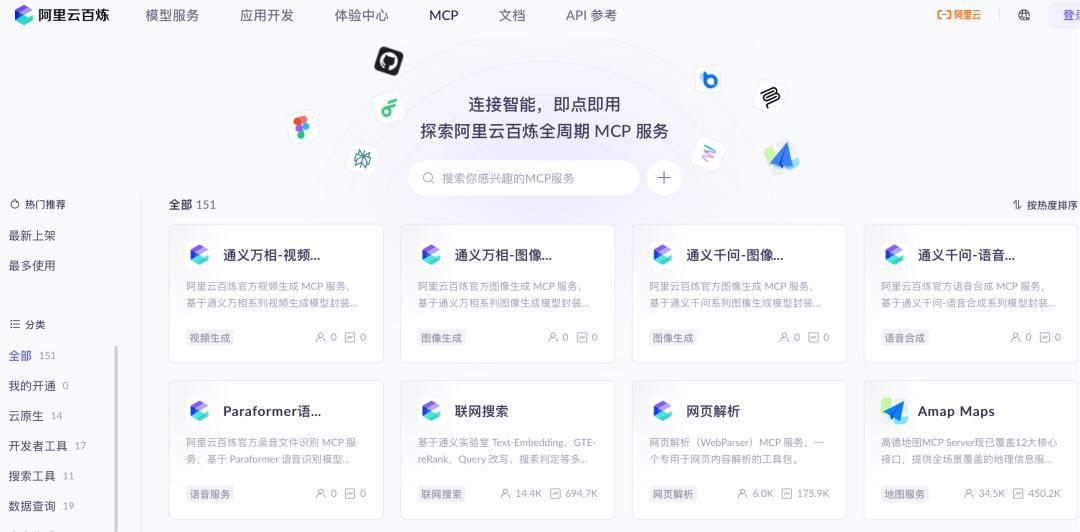
百炼平台

Search documents
国内大厂AI进展点评:阿里云收入加速,AI商业化进入兑现期
Guoxin Securities· 2026-03-24 02:58
Investment Rating - The investment rating for the industry is "Outperform the Market" (maintained) [1][7] Core Insights - Alibaba Cloud's revenue accelerated, with Q3 FY2026 revenue reaching 43.284 billion yuan, a year-on-year growth of 36%, and external commercialization revenue growing by 35% [2][3] - AI-related product revenue has achieved triple-digit growth for ten consecutive quarters, with a target set by management to exceed 100 billion USD in annual revenue from cloud and AI commercialization within the next five years [2] - The growth driver for Alibaba Cloud has shifted from internal support to a resonance of internal and external demand, confirming a structural upward trend driven by AI [2] - The daily token call volume has surged, indicating a transition from "experimental calls" to high-adhesion "productivity consumption," becoming a new anchor for commercialization [2][10] - The open-source ecosystem has effectively lowered the trial-and-error threshold for enterprises, facilitating a smooth flow to the Bailian platform, highlighting the revenue potential of high-margin PaaS/MaaS layers [2] Revenue Performance - Alibaba Cloud's Q3 FY2026 cloud revenue reached 43.284 billion yuan, marking a year-on-year increase of 36% and a quarter-on-quarter increase of 8.8% [3] - The EBITDA for FY2025 reached 10.56 billion yuan, with a profit margin rising to 9%, showing a consistent year-on-year increase in both EBITDA scale and profit margin [3] Capital Expenditure - Alibaba Cloud's capital expenditure for Q4 FY2025 was 29 billion yuan, with a total annual capital expenditure of 123.7 billion yuan, representing a year-on-year increase of approximately 44% [8] - The internal capital expenditure plan for 2026 is projected to reach 150 billion yuan, with over 100 billion yuan allocated for infrastructure investments [8] Token Usage and Ecosystem - The daily token call volume has increased significantly, with external customer daily calls rising from less than 1 trillion at the beginning of the year to nearly 5 trillion, while internal business calls reached 16-17 trillion [10] - As of Q3 FY2025, AI-related external revenue was approximately 6.3 billion yuan, with GPU-related revenue around 4.7 billion yuan and PaaS/MaaS-related revenue about 1.6 billion yuan [12] Market Competition and Pricing Strategy - The industry pricing anchor is shifting from "low-price volume grabbing" back to "value pricing," with Alibaba Cloud and Baidu announcing price increases for AI computing power and storage [16] - Alibaba Cloud's future competitive focus is on bundling models, GPUs, and toolchains into high ARPU full-stack contracts, contrasting with competitors focusing on low-cost MaaS [16] Industry Chain Overview - Alibaba Cloud's 2026 capital expenditure plan of approximately 150 billion yuan will drive expansion and iteration in the upstream hardware industry chain, including IDC, power supply, and liquid cooling [18] - The target for domestic chip procurement is set at 70%, which will accelerate the domestic core hardware localization process [18]
浙江将打造世界一流AI模型群,发力全域算力统筹
2 1 Shi Ji Jing Ji Bao Dao· 2026-02-04 09:08
Core Insights - Zhejiang aims to establish itself as a highland for artificial intelligence innovation, focusing on a multi-layered computing power service system and promoting the "AI+" initiative for comprehensive development in various sectors [1][2] Group 1: AI Development Plans - The "Fifteen Five" high-quality development plan emphasizes the creation of a world-class model group and an optimal open-source ecosystem [1] - The plan includes the establishment of AI application pilot bases, particularly in the healthcare sector, and the promotion of new healthcare service models integrating AI [1] - The province plans to enhance its AI capabilities by leveraging its unique county-level scenarios and deep participation from private manufacturing [1][2] Group 2: AI Industry Growth Targets - By 2027, Zhejiang aims for its AI terminal industry to achieve over 500 billion yuan in revenue, with significant advancements in key technologies and the cultivation of numerous high-growth enterprises [2] - The province will develop a comprehensive AI terminal industry system, focusing on consumer, industry, and future terminals, with a core cluster around Hangzhou and surrounding cities [2][3] Group 3: Key Technology Development - The plan highlights the importance of breaking through core technologies, including the development of intelligent operating systems, AI chip technologies, and critical components like sensors and actuators [3] - Emphasis is placed on advancing GPU, TPU, and RISC-V chips, as well as creating high-quality datasets for various industries [3]

阿里云营收大增34%创新高,吴泳铭如何讲好“越投越涨”的故事?
Tai Mei Ti A P P· 2025-11-26 04:09
Core Insights - Alibaba is focusing on increasing capital expenditure to enhance future earnings potential, particularly in its AI cloud business, which has shown significant growth despite short-term market concerns [1][6] - The latest quarterly report highlights a 34% year-on-year revenue growth for Alibaba Cloud, driven by strong AI demand and public cloud revenue [1][3] - The company’s capital expenditure surged by 80% year-on-year to 31.5 billion RMB, with a total of approximately 120 billion RMB invested in AI and cloud infrastructure over the past four quarters [1][7] Financial Performance - Alibaba Cloud's revenue reached 39.824 billion RMB, marking a record growth rate [1][3] - Adjusted net profit fell by 72% year-on-year to 10.35 billion RMB, and free cash flow turned into a net outflow of 21.84 billion RMB [1][3] - The total revenue growth for Alibaba Cloud and its non-consolidated businesses accelerated to 34% and 29% respectively for the quarter ending September 30, 2025 [3] AI Business Strategy - The company is prioritizing three key areas for AI development: enhancing core model training capabilities, improving the efficiency of the Bai Lian platform for inference services, and balancing internal AI needs with external customer demands [4][5] - There is a strong demand for AI products among enterprise clients, with significant growth potential in various applications, including product development and customer interactions [3][6] - CEO Wu Yongming expressed confidence in the absence of an "AI bubble" over the next three years, citing solid demand and reasonable return potential [6][7] Supply Chain and Investment Outlook - The global AI server supply chain is experiencing shortages, with demand outpacing supply, which is expected to continue for the next two to three years [7][8] - Alibaba's CFO indicated that the previously mentioned 380 billion RMB capital expenditure plan might be conservative, and further investments could be made to meet market demand [7][8] - The company is focusing on the quality and cost-effectiveness of its AI infrastructure, with various application models contributing to revenue generation [8]

全文|阿里巴巴业绩会实录:未来三年内不太可能出现人工智能泡沫
Xin Lang Ke Ji· 2025-11-25 15:00
Core Viewpoint - Alibaba reported its Q2 FY2026 earnings with revenue of 247.8 billion yuan, a 5% year-over-year increase, and a net profit of 20.6 billion yuan, down 53% year-over-year, primarily due to a decline in operating profit [1][2]. Financial Performance - Revenue for Q2 FY2026 was 247.8 billion yuan, with a 5% year-over-year growth. Excluding disposed businesses, the year-over-year growth would be 15% [1]. - Net profit was 20.6 billion yuan, reflecting a 53% decline year-over-year. Adjusted net profit was 10.4 billion yuan, down 72% year-over-year [1][2]. Cloud Business Outlook - The management expressed strong confidence in the growth potential of Alibaba Cloud, citing high demand for AI servers that exceeds supply. The backlog of orders continues to grow, indicating a sustained acceleration in future growth [3]. Instant Retail Business Developments - The company has focused on optimizing unit economics in its instant retail business, achieving significant progress. The average order value has increased, and logistics costs have decreased, leading to a reduction in losses per order by half compared to previous months [4][5]. - Instant retail has shown rapid growth, particularly in food and health categories, with a 30% increase in orders from brands like Hema and Cat Supermarket since August [5]. EBITDA and CMR Insights - The EBITDA for the September quarter is expected to be a peak due to prior investments. Future quarters may see reduced investments as operational efficiency improves [6]. - The core e-commerce business's customer management revenue (CMR) is influenced by payment fees and promotional costs, with expected slower growth in the next quarter due to the recent introduction of payment fees [6]. Capital Expenditure Plans - The company has a three-year capital expenditure plan of 380 billion yuan, with 120 billion yuan already invested in the past four quarters. Management may increase investments if demand continues to outpace supply [8][9]. - The return on investment for capital expenditures remains uncertain due to the evolving nature of the AI industry, but long-term demand growth is expected to support investment returns [9][11]. Strategic Focus Areas - Alibaba is prioritizing the enhancement of its AI infrastructure and model capabilities to meet customer demands. The focus includes improving the efficiency of AI resource utilization and expanding high-value application scenarios [10][11]. - The company is also exploring potential growth in other consumer sectors, including offline retail and travel services, while emphasizing the importance of business integration and collaboration [12].
生成式AI,阿里云凭什么是亚太唯一领导者?
硬AI· 2025-11-24 09:45
Core Viewpoint - Alibaba Cloud has been recognized as the only Asia-Pacific company to be positioned in the leader quadrant across all four dimensions of the latest Gartner report on Generative AI technology innovation, alongside global leaders like Google and OpenAI [2][4][17] Group 1: Full-Stack Capability - Alibaba Cloud's full-stack capabilities span from infrastructure to applications, which is crucial in the rapidly evolving landscape of Generative AI [2][4] - In the infrastructure dimension, Alibaba Cloud is recognized for its high stability and resource scheduling capabilities, ranking alongside major players like Google, Microsoft, and AWS [3] - The model engineering dimension highlights Alibaba Cloud's leading position in data processing and training efficiency, with a threefold increase in end-to-end training acceleration [3][4] Group 2: Model and Application Leadership - In the model entity dimension, Alibaba Cloud leads over AWS and Microsoft, only trailing behind Google and OpenAI, showcasing its comprehensive model coverage and multi-modal iteration [4] - Alibaba Cloud's knowledge management and productivity applications are mature, with a 15-fold increase in model invocation on its Bailian platform over the past year, indicating strong enterprise adoption [4][8] Group 3: Market Penetration and Competitive Position - According to Omdia, over 70% of China's Fortune 500 companies have deployed Generative AI, with Alibaba Cloud's penetration exceeding 50% [4][8] - By the first half of 2025, Alibaba Cloud is projected to hold over 35% of the AI cloud market in China, surpassing the combined share of the second to fourth-ranked competitors [8][9] Group 4: Strategic Insights - The report emphasizes that the depth of foundational capabilities creates a stronger competitive moat, with Alibaba Cloud being the only Asia-Pacific company in the leader quadrant across all four dimensions [9][17] - The synergy between cloud and AI is highlighted as essential for reducing costs and enhancing performance, with Alibaba Cloud demonstrating significant cost reductions in inference through its integrated technology stack [7][8] Group 5: Global Competitive Landscape - The global competition in Generative AI is characterized by two main approaches: model-centric ecosystems like OpenAI and cloud-centric models like Alibaba and Google [11][13] - Both Alibaba and Google are noted for their vertical integration capabilities, combining cloud, model, and chip technologies, which positions them as the leading players in the market [11][12][13]

Gartner最新报告:阿里云在生成式AI四大维度全栈领先,比肩谷歌、OpenAI
Di Yi Cai Jing· 2025-11-24 05:12
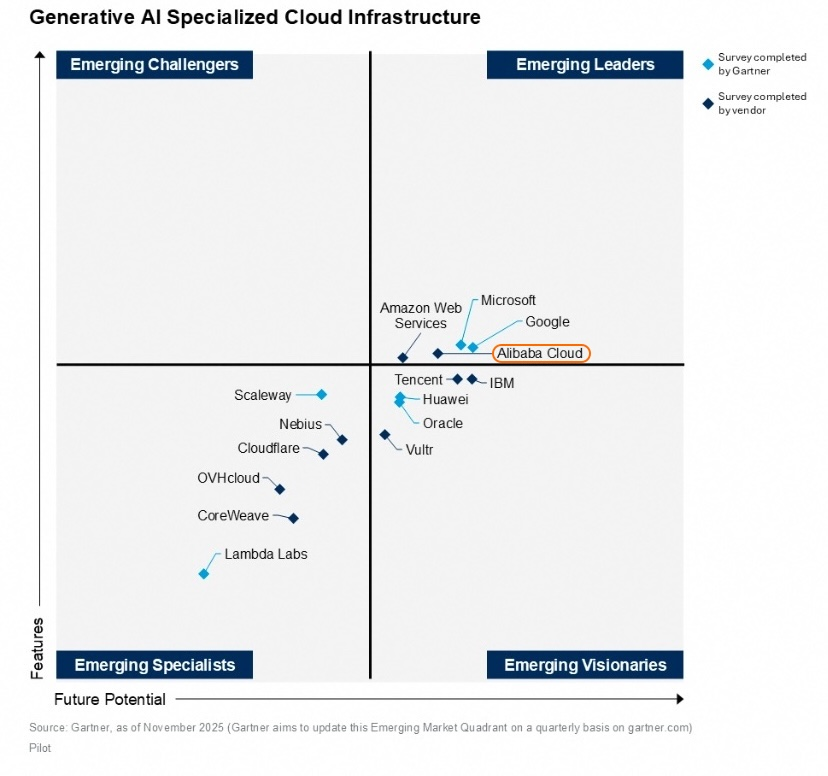
Core Insights - Alibaba Cloud has been recognized as a leader in all four dimensions of Generative AI (GenAI) by Gartner, positioning it alongside Google and OpenAI [1][4][7][10] Group 1: Generative AI Infrastructure - In the dimension of GenAI infrastructure, Alibaba Cloud is one of only four vendors, including Microsoft, Google, and AWS, to be classified as a leader, and it is the only Asia-Pacific vendor in this category [1] - Huawei Cloud and Tencent Cloud are positioned in the visionary quadrant [1] Group 2: GenAI Engineering - In the GenAI engineering dimension, Alibaba Cloud remains in the leader quadrant, outperforming AWS, Google, and Microsoft in both feature and future potential metrics [4] Group 3: GenAI Model Providers - Alibaba Cloud is classified as a leader in the GenAI model providers dimension, excelling in the feature metric compared to AWS and Microsoft, and ranking just below Google and OpenAI [7] Group 4: AI Knowledge Management Applications - In the AI knowledge management applications dimension, Alibaba Cloud is positioned in the emerging leader quadrant and is the only representative from China [10] Group 5: Strategic Investments and Developments - Alibaba Cloud's positioning aligns with its strategy as a "full-stack AI service provider," demonstrating its comprehensive leadership in the "cloud + AI" product layout [13] - The company announced an investment of 380 billion yuan in AI infrastructure and aims to expand its cloud data center energy consumption by ten times by 2032 [13] - Alibaba Cloud's one-stop AI development platform, PAI, and its collaboration with Tongyi large models have significantly improved model training efficiency, achieving over three times acceleration [13] - The "Bailian" platform allows for the one-click invocation of over 200 models, with daily model invocation increasing by 15 times over the past year [13] - Alibaba Cloud's GenAI models, including Tongyi Qianwen and Tongyi Wanxiang, have been recognized globally and serve over 1 million clients, including major international organizations and brands [13]
AI时代的双11:阿里云与伙伴的集体跃迁
36氪· 2025-11-12 13:35
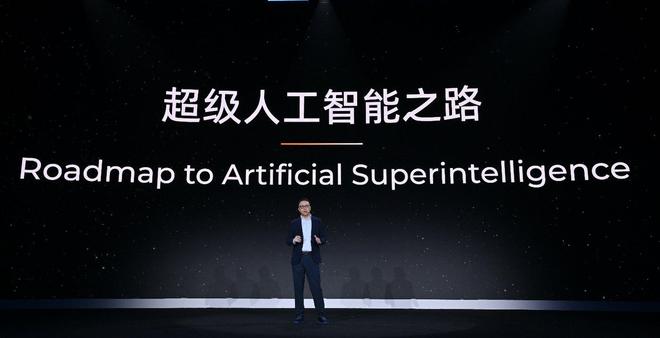
Core Viewpoint - The article discusses how Alibaba Cloud is leveraging the Double 11 shopping festival to showcase its AI capabilities and strengthen its ecosystem partnerships, marking a shift from consumer-focused promotions to B2B applications of AI technology [5][30][34]. Group 1: Alibaba Cloud's Strategy - Alibaba Cloud is positioning itself as a leader in AI by integrating its services with the Double 11 event, which has evolved from a consumer sales event to a platform for businesses to explore AI solutions [6][33]. - The company has defined three stages towards achieving Super AI (ASI): intelligent emergence, autonomous action, and self-iteration, indicating a long-term vision for AI development [5][6]. - The shift in cloud computing sales logic is highlighted, where the focus is moving from transactional partnerships to service-oriented partnerships that can provide comprehensive AI solutions [9][10]. Group 2: Market Response and Ecosystem Development - The first hour of Double 11 saw Alibaba Cloud's orders surpass "tens of millions," indicating a growing confidence in AI solutions among market participants [8][9]. - Alibaba Cloud is restructuring its partner ecosystem to prioritize service capabilities over mere transactional relationships, aiming to enhance the overall AI service delivery [10][11]. - The company is actively inviting AI-native partners who focus on specific industry applications, thereby expanding its ecosystem with both traditional and new partners [14][15]. Group 3: AI Applications and Industry Impact - Real-world applications of Alibaba Cloud's AI capabilities are demonstrated through partnerships in various sectors, such as satellite communication and education, showcasing the practical benefits of AI integration [20][22][23]. - The article emphasizes the importance of localized operations and the "last mile" in AI implementation, where partners play crucial roles in delivering tailored solutions to clients [27][28]. - The Double 11 event serves as a significant moment for businesses to engage with AI technologies, marking a collective movement towards AI adoption across various industries [32][33].

当前Agent赛道:热度之下隐现落地难题,如何破局?
雷峰网· 2025-10-22 00:51
Core Viewpoint - The article discusses the rapid development and challenges of the Agent application market, highlighting the divergence of leading players into two distinct paths: full-stack AI service providers and specialized players focusing on vertical markets [1][4][11]. Group 1: Market Overview - The Agent application market is predicted to reach $27 billion in China by 2028 according to IDC [3]. - The current landscape shows a surge in investment and competition among companies eager to adopt Agent technology [2]. Group 2: Player Strategies - Major players in the Agent space include AI giants and cloud service providers, who are lowering the barriers for enterprises to adopt Agent technology [6][7]. - AI giants like OpenAI leverage their foundational model capabilities to gain a first-mover advantage, while cloud providers like Google and AWS are focusing on comprehensive solutions for enterprise Agent development [8][9]. Group 3: Application Scenarios - The primary application scenarios for Agents in enterprises include processing complex multi-modal content, interactive scenarios like chatbots, and high-value intelligent inspection and risk control [15]. - The consumer electronics industry has been the first to adopt Agent technology, with traditional sectors like agriculture gradually following suit [15]. Group 4: Technical Challenges - There are significant technical challenges in the deployment of Agents, including issues with model hallucination, multi-modal integration, and memory management [16]. - The integration of Agents with existing enterprise systems like ERP and CRM is complex, and the need for multi-Agent collaboration is becoming increasingly important [17][18]. Group 5: Solutions for Implementation - To overcome the challenges of Agent deployment, continuous technological innovation is essential, focusing on enhancing model capabilities and system engineering [22]. - The industry is exploring new development paradigms to improve the breadth and depth of Agent tasks, with protocols like MCP and A2A being tested to facilitate communication between different Agents [23][24]. Group 6: Industry Collaboration - Collaboration between vendors and enterprises is crucial for successful Agent implementation, with a focus on aligning business needs with Agent technology [25]. - The sharing of experiences and best practices among developers is encouraged to address complex scenarios and improve Agent development [26].

阿里云AI成果入选顶会,可让GPU用量削减82%;优必选再爆亿元大单
Mei Ri Jing Ji Xin Wen· 2025-10-19 23:13
Group 1 - Alibaba Cloud's Aegaeon solution has been selected for the top academic conference SOSP2025, significantly reducing GPU usage by 82% and lowering hardware costs [1] - The Aegaeon technology has been applied to the Bailian platform, allowing single GPU services to support multiple models, thereby enhancing throughput [1] - The success of Aegaeon not only represents a technological breakthrough for Alibaba Cloud but also offers new hope and insights for the entire AI industry regarding efficient resource utilization [1] Group 2 - UBTECH has secured a major contract worth 126 million yuan for the procurement and installation of embodied intelligent data collection and testing center equipment, contributing to over 630 million yuan in total orders for the Walker series humanoid robots this year [1][2] - The humanoid robot market is experiencing rapid growth, with increasing demand reflected in UBTECH's rising order volumes across various application scenarios, including industrial production, service industries, education, and home entertainment [2] Group 3 - An semiconductor company in Dongguan plans to implement a "four days on, three days off" work schedule due to supply chain disruptions and product shortages following government intervention [3] - The company is facing pressure from product shortages and price increases, prompting its parent company to initiate measures to stabilize the domestic supply chain to meet customer demands [3] - The complexity of the semiconductor industry necessitates enhanced cooperation among upstream and downstream enterprises to build a more stable and diversified supply chain system to mitigate future risks [3]

大厂集体走进智能体“致富课”,转身重划一条起跑线
Sou Hu Cai Jing· 2025-10-01 14:37
Group 1 - The article highlights the growing trend of "intelligent agents" being marketed as a means for ordinary people to achieve financial success, with various eye-catching headlines suggesting significant earning potential [1][2] - Major companies are shifting their focus towards developing intelligent agents, moving from individual applications to multi-agent systems that enhance productivity and efficiency [3][5][9] Group 2 - The concept of "digital employees" is emphasized, where intelligent agents are seen as advanced tools capable of autonomous decision-making and task execution, surpassing traditional AI capabilities [11][13] - The commercial value of intelligent agents is projected to grow significantly, with estimates suggesting the enterprise AI agent market in China could exceed $27 billion by 2028, focusing on task outcomes rather than just technology [14][16] - The competition among major players is expected to intensify as the focus shifts from technological superiority to the ability to deliver practical, monetizable solutions that address real business challenges [16]