
人形机器人

Search documents
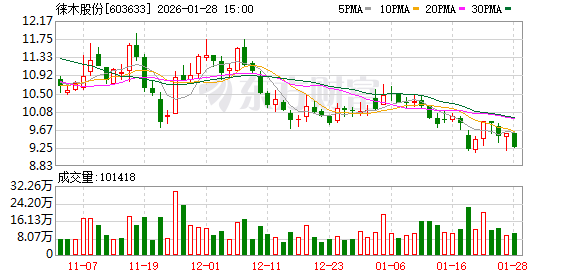
徕木股份:目前公司生产的连接器产品主要应用于汽车及通讯等领域
Mei Ri Jing Ji Xin Wen· 2026-01-28 09:16
Core Viewpoint - The company is currently focused on connector products primarily used in the automotive and communications sectors, with applications in the robotics field still in the research and validation stage, indicating that significant impacts on company performance are not expected in the short term [1]. Group 1 - The company has stated that its connector products are mainly applied in the automotive and communications industries [1]. - The application of connectors in the robotics sector is still undergoing research and validation, with small-scale supply currently [1]. - The company emphasizes that the ability to expand into the robotics market will depend on customer validation, and it will not have a major impact on performance in the short term [1]. Group 2 - An investor inquired about reports suggesting that the company has become a sole supplier of flexible hand joint connectors for leading firms in the humanoid robot sector, such as UBTECH and Yushun, leveraging its core technology [3]. - The reported value of a single connector for humanoid robots ranges from 500 to 800 yuan, indicating a potential new profit growth point as the robotics industry commercializes [3].


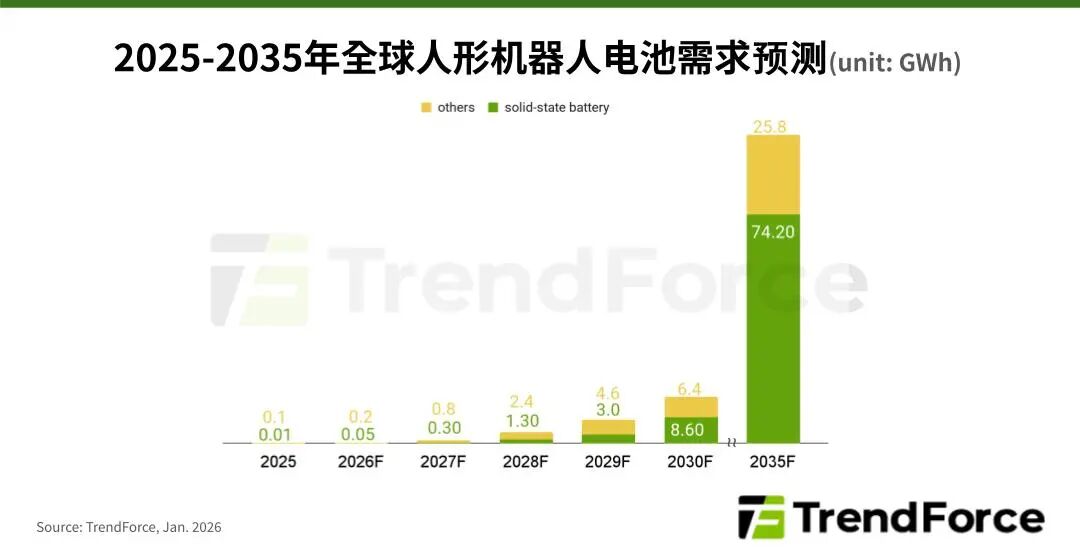
集邦咨询:预计人形机器人对固态电池的需求有望于2035年超74GWh
智通财经网· 2026-01-28 09:09
Core Insights - The development of humanoid robots is expected to reach a commercialization milestone by 2026, increasing the importance of batteries as an "energy supply" [1] - Solid-state lithium batteries are projected to become the mainstream solution due to their high energy density, with demand from humanoid robots expected to exceed 74 GWh by 2035, growing over a thousand times from 2026 [1] Group 1: Humanoid Robot Battery Market - Global humanoid robot shipments are forecasted to surpass 50,000 units in 2026, representing an annual growth of over 700% [4] - High-nickel ternary lithium batteries (NMC/NCA) are currently the mainstream choice for robot batteries due to their relatively high energy density, while lithium iron phosphate batteries (LFP) are used for lower endurance applications [4] - Most humanoid robots currently have a battery capacity below 2 kWh, with typical endurance ranging from 2 to 4 hours, such as Unitree's H1 with 0.864 kWh and Tesla's Optimus Gen2 with 2.3 kWh [4] Group 2: Challenges and Opportunities - The development of humanoid robot batteries faces two main challenges: the rapid iteration of core technologies affecting battery customization and the current focus on finding scalable commercial applications rather than improving endurance [5] - Despite these challenges, the demand for high energy density, high discharge rate, and high safety batteries in humanoid robots presents an opportunity for solid-state batteries to demonstrate their advantages [5] - Breakthroughs in solid-state battery technology and cost reductions are expected to help humanoid robots overcome power limitations [5]


盘点第一波人形机器人倒闭潮,谁能活过2026年
阿尔法工场研究院· 2026-01-28 09:07
Core Viewpoint - The humanoid robot industry in 2025 is experiencing a severe dichotomy, with significant funding and successful companies on one side, while many startups face collapse due to financial and operational challenges [4][5][9]. Industry Overview - In 2025, the humanoid robot sector saw 610 financing events, nearly tripling from the previous year, with total funding exceeding 57 billion yuan [15]. - Over 100 humanoid robot companies in China have differentiated significantly, with leading firms securing billion-level orders and preparing for IPOs, while others struggle to survive [4][5]. Company Failures - Notable failures include K-Scale Labs, which collapsed just before mass production due to cash flow issues, revealing the challenges faced by many startups lacking a complete local supply chain [5][6]. - Rethink Robotics, a pioneer in collaborative robots, faced its second closure in 2025 after failing to meet market expectations, highlighting the risks of rushed product launches [7][9]. - iRobot, the maker of Roomba, filed for bankruptcy in December 2025, attributed to prolonged financial struggles and competition from lower-priced Chinese products [8][9]. Market Dynamics - The industry is shifting from a focus on academic institutions to industrial enterprises, with increased orders from automotive manufacturers, indicating a demand for reliability and economic viability [15][16]. - The competition has intensified, with many companies producing similar products, leading to a "race to the bottom" in pricing and innovation [10][11]. Technological Challenges - The primary bottleneck in humanoid robots is the AI module, which is crucial for their functionality, yet many companies invest little in this area, relying on larger tech firms for support [11][12]. - The rapid pace of technological evolution means that today's leaders can quickly become laggards if they fail to innovate [12][13]. Survival Strategies - Companies must establish differentiation, create genuine commercial loops, maintain financing capabilities, and leverage data to enhance AI models [16]. - The industry is expected to see further consolidation and a clearer divide between successful firms and those unable to adapt to market demands [15][16].

研报掘金丨群益证券(香港):北特科技2025年净利润大幅增长,予“买进”建议
Ge Long Hui A P P· 2026-01-28 07:58
群益证券(香港)研报指出,北特科技2025年净利润大幅增长,看好丝杠成为公司增长新动能。2025年全 年预计实现归母净利润1.2-1.3亿元,同比增长61.0%-75.0%;4Q单季度预计实现归母净利润0.2-0.3亿 元,同比增长110.1%-204.2%,公司业绩符合预期。目前公司已实现行星滚柱丝杠产品的小批量交付并 获得客户的认可,正积极建设上海嘉定、江苏昆山、泰国工厂三座基地,其中:①上海嘉定基地已小规 模投产;②江苏昆山基地将于2026年正式投产,行星滚柱丝杠年产能达260万套;③泰国基地总投资3.5 亿元,规划产能80万套/年,泰国基地可以及时响应海外客户需求,融入重要客户的全球供应链体系。 整体看,公司正打造丝杠作为增长新曲线,推动主业向人形机器人、高端装备制造等新质生产力领域升 级。给予公司"买进"的投资建议。 ...

伯特利:L3元年EMB加速量产,人形机器人丝杠、电机打造第二增长曲-20260128
Tai Ping Yang Zheng Quan· 2026-01-28 07:25
Investment Rating - The report maintains a "Buy" rating for the company Berteli (603596) with a target price based on the last closing price of 54.85 [1][10]. Core Insights - The report highlights that 2026 will be the year of commercialization for L3 autonomous driving, with Berteli positioned as a core supplier through its "XYZ + Intelligent Driving Assistance" intelligent chassis solution [4][10]. - Berteli's human-shaped robot screw and motor business is expected to create a second growth curve, leveraging its expertise in electric drive and precision transmission technologies [6][10]. Summary by Sections Company Overview - Berteli focuses on its main business, integrating products such as electronic mechanical brakes (EMB), redundant line control braking systems (WCBS 2.0H), and electric power steering (DP-EPS) [5][10]. - The company has secured a second EMB project with a major domestic automaker, enhancing its position in the market [5][10]. Financial Projections - Revenue projections for 2025, 2026, and 2027 are estimated at 125 billion, 156 billion, and 201 billion respectively, with corresponding net profits of 14.5 billion, 18.9 billion, and 24.9 billion [10][11]. - The report anticipates a revenue growth rate of 32.95% in 2024, followed by 25.45% in 2025, and 25.39% in 2026 [11]. Market Position - Berteli is recognized as a leader in the intelligent chassis market, with significant market share in the auxiliary intelligent driving front-view integrated machine segment [5][10]. - The company has achieved over 20 million units in cumulative production for its electronic parking brake (EPB) system, solidifying its leadership in the domestic line control market [7][10]. Strategic Initiatives - Berteli is expanding its global production capacity, with projects in Mexico and Germany aimed at enhancing its market reach [9][10]. - The company is focusing on domestic substitution of core components, reducing reliance on foreign key chips [9][10].

香港汽车ETF(520720)涨超1.2%,政策与智能驾驶有望利好行业发展
Mei Ri Jing Ji Xin Wen· 2026-01-28 06:25
Core Viewpoint - The automotive sector is currently experiencing a weak performance during the off-season, but market pessimism regarding sales is gradually diminishing, indicating that negative expectations may have bottomed out [1] Group 1: Market Conditions - The automotive sector is in a weak performance phase due to the off-season, but there is a gradual reduction in pessimistic sales expectations [1] - Structural improvements are anticipated in the market, particularly with the expectation of reduced competition and enhanced overseas sales [1] Group 2: Policy and Technological Developments - The implementation of the 2026 vehicle trade-in policy is expected to support domestic demand, with commercial vehicles likely to benefit more [1] - The autonomous driving sector is projected to enter a commercialization breakthrough phase in 2026, supported by relaxed policy expectations [1] - The humanoid robot sector is entering a phase where fundamental developments are expected to materialize, with attention needed on upcoming mass production milestones [1] Group 3: Investment Opportunities - The commercial vehicle sector is expected to see continued support from domestic demand and increased exports, especially with the full extension of subsidy policies in 2026 [1] - The Hong Kong automotive ETF (520720) tracks the Hong Kong Stock Connect automotive index (931239), which selects listed companies involved in vehicle manufacturing, components, and intelligent driving, focusing on new energy and intelligent directions [1]
人形机器人“大脑”,迎来国产替代新方案
Guan Cha Zhe Wang· 2026-01-28 03:45
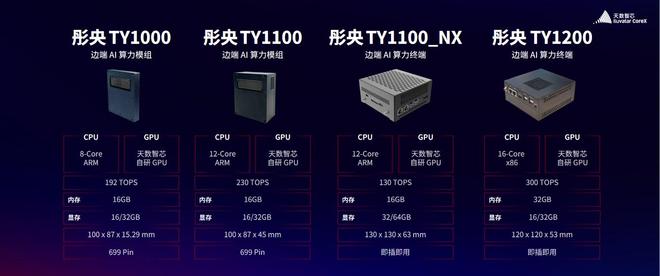
Core Insights - The article discusses the emergence of domestic alternatives to NVIDIA's dominance in humanoid robot "brain" chip modules, highlighting the launch of the "Tongyang" series by domestic GPU company TianShu ZhiXin [1][10]. Group 1: Product Features - The Tongyang series is compatible with the CUDA ecosystem, allowing seamless switching between TianShu ZhiXin's products and NVIDIA's Orin series, thus providing more options for industrial applications in embodied intelligence [3][10]. - The Tongyang series includes four products with distinct features: - Tongyang TY1000, a compact module with industry-level computing power [3]. - Tongyang TY1100, which integrates an ARM v9 12-core CPU and a self-developed GPU module [3]. - Tongyang TY1100_NX, known for its larger memory and cost-effectiveness [3]. - Tongyang TY1200, offering up to 300 TOPS performance, aimed at advanced applications like AIPC and embodied intelligence [4][6]. Group 2: Performance Comparison - The Tongyang series boasts measured dense computing power ranging from 100 TOPS to 300 TOPS, surpassing the capabilities of NVIDIA's Orin series [4][6]. - In practical tests across various scenarios, the performance of Tongyang TY1000 has been reported to exceed that of NVIDIA's AGX Orin [4][6]. Group 3: Market Context - The year 2025 is projected to be a pivotal year for humanoid robot mass production, with IDC estimating global shipments to reach approximately 18,000 units, over 60% of which will come from Chinese manufacturers [6]. - Despite advancements, there remains a significant gap in AI computing power for humanoid robots, with Intel and NVIDIA still holding a dominant position in the market [7][8]. Group 4: Competitive Landscape - The article notes that while domestic alternatives like the RK3588 chip from Rockchip have made progress in the "small brain" segment, they fall short in AI computing power, with a maximum of 6 TOPS [7][8]. - The article highlights the potential of the Diguo Robot's new generation chip, which can achieve 560 TOPS, indicating a move towards more competitive domestic solutions [8]. Group 5: Migration and Cost Considerations - TianShu ZhiXin's adherence to the GPGPU route and compatibility with the CUDA ecosystem positions its products as a more convenient option for migration compared to other domestic alternatives [10]. - The high migration costs associated with transitioning algorithms from NVIDIA's platform to other architectures could significantly impact the development speed of domestic companies [10].

世运电路20260127
2026-01-28 03:01
Summary of the Conference Call for Shiyun Circuit Company Overview - Shiyun Circuit holds over 20% market share in PCB procurement for Tesla, indicating its significant position in the electric vehicle supply chain [2][4] - The company is actively expanding into cutting-edge technology fields such as energy storage, commercial aerospace, brain-machine interfaces, and humanoid robots, which will drive demand for high-performance PCBs [2][4] Financial Projections - Projected revenues for Shiyun Circuit from 2025 to 2027 are expected to be 6.1 billion, 7.9 billion, and 11.3 billion respectively [2][4] - Projected net profits for the same period are expected to be 890 million, 1.17 billion, and 1.71 billion respectively, indicating a steady growth trajectory [2][4] Market Trends and Opportunities - SpaceX is expected to launch approximately 3,000 satellites in 2025 and increase to 4,000 in 2026, significantly boosting demand for PCBs [2][6] - The demand for high-reliability, high-performance PCBs is increasing in humanoid robots and AI computing chips, which will further benefit Shiyun Circuit [2][6] Competitive Advantages - Shiyun Circuit has established strong channel barriers with clients and possesses a deep technical foundation, positioning it well in emerging technology sectors [3][8] - The company is expected to solidify its market position through capacity expansion, potentially leading to a significant performance boost referred to as the "Musk Moment" [2][4][5] Applications of Technology - Shiyun Circuit's PCBs are widely used in various advanced technology fields, including: - Autonomous driving in electric vehicles, particularly in Tesla [7] - Energy storage systems supporting AI computing power management [7] - Commercial aerospace applications, including satellite launches and ground receiving terminals for SpaceX [7] - Brain-machine interfaces and humanoid robots, which require high-performance PCBs [7] Investment Considerations - Current market conditions present a significant opportunity for investors to consider Shiyun Circuit, given its strong technical foundation and growth potential in emerging technology sectors [8] - The company is viewed as a high-quality stock with substantial upside potential at its current market valuation [8]

亚普股份20260127
2026-01-28 03:01
Summary of the Conference Call for Yapu Co., Ltd. Industry and Company Overview - **Company**: Yapu Co., Ltd. (亚普股份) - **Industry**: Rotating Transformer (旋转变压器) and Robotics (人形机器人) - **Acquisition**: Yapu has acquired Silver Frost (银霜公司), which has replaced part of the market share previously held by Japan's Tokikawa in the domestic rotating transformer market and is expected to enter the North American market [2][4] Key Insights and Arguments - **Market Potential**: - The humanoid robot market is projected to sell 1-2 million units in the next five years, corresponding to a market space of approximately 3 billion RMB. If sales exceed 10 million units, the market size could expand several times [2][6] - The small satellite launch market is also growing, with each satellite requiring 6-8 rotating transformers, leading to a market size of about 1.8 billion RMB [2][6] - **Technological Advantages**: - Rotating transformers are preferred for humanoid robots due to their high reliability and longevity in complex environments compared to magnetic, inductive, and optical encoders [2][7] - The technology is increasingly being adopted in the electric vehicle sector, which is paving the way for its application in robotics [2][7] - **Market Dynamics**: - Each humanoid robot may require around 15 rotating transformers, which is about one-third of the total encoder count. The price per transformer is higher than that used in automobiles, estimated at 150-200 RMB, which is 1.5-2 times the cost of automotive transformers [2][10] - By 2030, the number of robots is expected to reach 2 million, leading to a market size of 6 billion RMB, with the North American market accounting for about 3 billion RMB [2][10] Financial Performance and Growth - **Silver Frost's Financials**: - Silver Frost's revenue has rapidly increased from 50 million RMB in 2020 to approximately 350 million RMB in 2022, with a net profit of 140 million RMB and a profit margin of 40% [4][13] - The company primarily serves clients in the electric vehicle sector, including BYD and China CRRC, and has a market share exceeding 50% in the domestic automotive sector [4][14] - **Future Growth**: - Silver Frost is expected to grow its revenue by 100 to 200 million RMB annually, which will positively impact Yapu's overall performance [20] Competitive Landscape - **Market Position**: - Silver Frost is a leading player in the domestic market, with significant competition from global leaders like Tokikawa and others [4][11] - The satellite selection market is projected to be lucrative, with a size of about 1.8 billion RMB and higher profit margins compared to standard robotics applications [12] - **Strategic Advantages**: - Silver Frost has demonstrated competitive performance against international leaders and is gaining traction with North American clients due to cost advantages [15][16] Investment Considerations - **Current Investment Opportunity**: - The growth in the robotics and aerospace sectors presents a catalyst for Yapu's performance, with a market capitalization of 13 billion RMB and a PE ratio of 20, indicating relatively low investment risk [22] - Successful expansion into North American markets or significant growth in aerospace projects could substantially enhance Yapu's valuation [22] Additional Insights - **Lack of Competitors**: - There are currently no other publicly listed companies in the A-share market that focus on rotating transformer technology at the same level as Silver Frost and Yapu [21]

津上机床20260127
2026-01-28 03:01
Summary of Jinshang Machine Tool Conference Call Company Overview - **Company**: Jinshang Machine Tool - **Industry**: Machine Tool Manufacturing Key Points Sales and Orders - In 2025, Jinshang Machine Tool achieved a sales revenue of **5.19 billion RMB**, marking a **38.6%** year-on-year increase, setting a historical record [2][3] - Total orders in 2025 were approximately **15,800 units**, with a total order value close to **5 billion RMB** [3] - The automotive sector accounted for **40.5%** of total orders, approximately **2 billion RMB**, while the 3C sector contributed **10.1%**, around **500 million RMB** [3] - As of January 2026, orders exceeded **1,000 units**, with significant demand from the automotive and 3C sectors [4][5] Product Performance - The AI liquid cooling segment is expected to see orders between **2,000 to 3,000 units** in 2026, with a total revenue close to **1 billion RMB** from humanoid robots [2][5] - The 3C business is stable, benefiting from large orders in the Apple supply chain, expected to continue into FY2027 with total orders potentially reaching **1,000 to 1,500 units** [2][6] - Different product lines exhibit significant gross margin variations, with grinding machines nearing **50%** gross margin, while automatic lathes have relatively high margins as well [8] Market Dynamics - The automotive sector remains the largest downstream segment, with growth slowing but still positive. Specialized teams have been established to address customer needs in niche areas like braking systems [9] - Over **90%** of components are sourced domestically or self-manufactured, with imports primarily for CNC systems from Japan [13] R&D and Future Outlook - R&D investment is expected to increase, focusing on application development for Chinese customers, with a current workforce of **200-300 R&D personnel** [15] - The company aims to expand its market share by lowering costs and competing more aggressively with domestic brands [20] - The industry cycle is projected to be around **4 years**, with expectations for continued growth in FY2026 and FY2027, potentially breaking traditional cyclical patterns [23] Risks and Challenges - Tensions in Sino-Japanese relations have posed some challenges, but the company has not yet seen significant impacts on sales or procurement [17][18] - The company has no current plans for refinancing, as it has sufficient funds to support future capital expenditures and new product development [25] Strategic Focus - Jinshang Machine Tool is focusing on expanding its presence in the automotive sector, particularly in braking systems, while also exploring opportunities in the Southeast Asian market [22][29] Additional Insights - The company has faced a decline in the Taiwanese market, primarily due to orders being sourced from mainland China [10][11] - There are ongoing efforts to improve competitiveness in the semiconductor equipment sector, although current offerings are considered weaker compared to competitors [12] This summary encapsulates the key insights from the conference call, highlighting the company's performance, market dynamics, and strategic direction.