
藏粮于地

Search documents
全力以赴夺取秋粮丰收 持续夯实粮食安全根基
Ren Min Ri Bao· 2025-09-11 22:02
Core Insights - The article emphasizes the importance of ensuring national food security through effective autumn grain production and agricultural disaster prevention measures [1][2]. Group 1: Agricultural Production - The focus is on achieving the annual grain production targets, particularly through the successful harvest of autumn crops [1]. - Key crops such as rice, corn, and soybeans are highlighted, with a call for targeted management practices based on crop type and region [1]. - The need for timely preparations for autumn grain harvesting and storage plans is stressed to ensure smooth sales and market stability [1]. Group 2: Agricultural Technology and Infrastructure - The article discusses the implementation of high-standard farmland construction and the protection of black soil, which are crucial for enhancing agricultural productivity [2]. - There is an emphasis on integrating and promoting advanced agricultural technologies to improve yield consistency and overall production capacity [2]. - The importance of developing and applying advanced agricultural machinery is highlighted to support agricultural modernization [2].
刘国中在黑龙江调研时强调 全力以赴夺取秋粮丰收 持续夯实粮食安全根基
Xin Hua Wang· 2025-09-11 11:32
Core Viewpoint - The Chinese government emphasizes the importance of ensuring national food security through effective autumn grain production and agricultural disaster prevention measures [1][2] Group 1: Agricultural Production - The focus is on achieving the annual grain production targets, particularly through the successful harvest of autumn crops [1] - Key crops such as rice, corn, and soybeans are highlighted, with specific management strategies recommended for different varieties and regions [1] - The government aims to enhance grain production efficiency and levels by leveraging various agricultural cooperative organizations [1] Group 2: Disaster Prevention and Agricultural Services - There is a strong emphasis on agricultural disaster prevention, including measures against pests and early frost [1] - The importance of preparing for the autumn harvest and ensuring smooth grain sales and market stability is stressed [1] - The promotion of agricultural social services is seen as crucial for improving production efficiency [1] Group 3: Agricultural Technology and Infrastructure - The government is committed to implementing strategies for land and technology conservation to enhance overall grain production capacity [2] - High-standard farmland construction and black soil protection are prioritized, with a focus on improving irrigation facilities [2] - The development and application of advanced agricultural machinery are essential for accelerating agricultural modernization [2]
总产、单产均创三年来新高! 茂名早稻迎来丰收
Nan Fang Nong Cun Bao· 2025-09-05 13:34
Core Insights - The early rice harvest in Maoming has achieved record high total production and yield in three years, with a total planting area exceeding 1.44 million acres and total output surpassing 620,000 tons [2][3]. Group 1: Production and Yield - The total production and yield of early rice in Maoming have increased by 0.4% and 0.9% year-on-year, respectively, marking a "double increase" [3]. - The average yield reached 431 kg per acre, with demonstration areas achieving theoretical yields exceeding 600 kg per acre [2][11]. Group 2: Agricultural Strategies - Maoming has implemented the national food security strategy, focusing on "storing grain in the land and technology," and promoting the integration of five key elements: good land, good seeds, good practices, good opportunities, and good systems [4][5]. - The city is actively promoting reasonable planting density for rice, with a demonstration area of 85,000 acres, increasing planting density to over 16,000 holes per acre, which is 15% higher than non-demonstration areas [9][10]. Group 3: Support and Services - The city is enhancing the production capacity of grain and oil by supporting large-scale planting entities and integrating high-yield technology models [12][14]. - Socialized agricultural service entities are providing comprehensive services, including machine tillage, harvesting, and pest control, covering over 500,000 acres and benefiting 120,000 small farmers [26][27]. Group 4: Pest Control and Loss Management - Maoming is conducting a "pest control for grain" initiative, ensuring a pest control response rate of 100% and controlling grain loss to below 5% [23][25].


呼伦贝尔260余万亩小麦喜迎丰收季
Nei Meng Gu Ri Bao· 2025-08-28 01:31
Core Insights - The wheat harvest in Hulunbuir is progressing well, with over 2.6 million acres of wheat entering the harvest period, showcasing a successful agricultural season [1][2] - The company has implemented advanced agricultural practices and machinery to enhance wheat quality and yield, with expectations of higher production compared to previous years [2] Group 1: Harvest Progress - The harvesting of wheat began on August 16, with the first 2,615 acres of Mongolian purple wheat being cut, marking the official start of the company's 96,000 acres wheat harvesting operation [1] - The company is utilizing 49 harvesting machines and 46 harvesting vehicles, achieving an average daily harvest of over 5,000 acres [2] - As of August 27, a total of 160,000 acres of wheat have been harvested [2] Group 2: Agricultural Practices - The company has adopted a segmented harvesting approach based on wheat maturity to optimize grain quality, ensuring the best moisture content before mechanical harvesting [1] - The implementation of precise water and fertilizer management, along with pest control measures, is expected to yield approximately 600 pounds per acre [2] - The company is following a "harvest as it matures" principle to ensure timely collection and safe storage of the wheat [2] Group 3: Environmental Conditions - Favorable soil moisture and timely sowing have contributed to the strong growth of wheat this year, with no significant rainfall during the maturity period, preventing sprouting issues [2] - The region's agricultural strategies, including the promotion of mechanized and protective tillage practices, have been applied to over 1 million acres annually, enhancing production potential [2]
从撂荒地到丰收田 从水稻示范田看如何端稳“中国饭碗”
Xin Hua Cai Jing· 2025-08-26 15:22
Core Viewpoint - The article emphasizes the importance of revitalizing abandoned land and improving agricultural resilience in Guangdong to ensure food security, highlighting innovative models like "insurance+" that support rural revitalization and agricultural productivity [1][2][3]. Group 1: Revitalization of Abandoned Land - The first water rice planting demonstration field in Jiangmen, Guangdong, transformed 180 acres of previously abandoned land into productive fields, achieving a yield of over 800 pounds per acre in its first year [2]. - The collaborative efforts of Jiangmen Insurance, local government, and agricultural cooperatives initiated the revival of abandoned land through infrastructure improvements and modern agricultural practices [2][3]. - The revival efforts led to an expected yield of over 1,000 pounds per acre this year, significantly improving local soil conditions and increasing farmers' income by 15,000 yuan per person [3]. Group 2: "Insurance+" Model and Technological Integration - The "insurance+" model in Guangdong integrates insurance with technology and agricultural services, enhancing risk management and productivity in agriculture [4][5]. - The establishment of a smart agricultural meteorological service project in Taishan allows real-time monitoring of various agricultural data, improving disaster response times by 70% [4]. - This model has shifted from post-disaster compensation to proactive risk prevention, effectively reducing systemic risks in food production [4][6]. Group 3: Financial Collaboration and Support - Guangdong has established the first agricultural insurance disaster reduction service center, which has been replicated across 60 centers statewide, covering various agricultural sectors [5][6]. - From 2023 to mid-2025, the "insurance+" model has allocated 195 million yuan for disaster reduction projects, benefiting over 3.6 million households and achieving a disaster reduction effect exceeding 770 million yuan [5][6]. - In the rice sector alone, 426.5 million yuan has been invested in disaster projects, benefiting over 1.1 million households and achieving a reduction in losses of 178 million yuan [6].

绘就乡村全面振兴新图景
Jing Ji Ri Bao· 2025-08-21 22:15
Group 1: Agricultural Development and Food Security - Food security is a primary task for rural revitalization, emphasizing the need for strong supply capabilities of grain and important agricultural products [1] - Jilin Province has maintained a stable grain output of over 800 billion jin for four consecutive years, with a target of reaching a historical high of 853.2 billion jin in 2024 [3] - The "Lishu Model" in Jilin County promotes protective farming practices, covering nearly 100 million acres of arable land, effectively reducing soil erosion and stabilizing grain production [2] Group 2: Specialty Crop Production and Processing - Qinghai Province is the largest northern canola planting area, with over 500,000 acres and an annual canola oil production exceeding 30,000 tons [4] - Jilin Province's Hongxiang Seed Industry Company invests over 40% of its net profit in R&D, achieving a seed germination rate of 97.75% [3] - The development of unique agricultural products, such as ginseng chocolate and blueberry juice, is driving economic growth in Jilin, with an expected industry chain output value exceeding 500 million yuan by 2025 [7] Group 3: Rural Tourism and Economic Diversification - The transformation of Bianmagou Village into a flower sea tourism destination has attracted over 2 million visitors, generating a total tourism income of 20 million yuan in 2024 [9] - The integration of agriculture and tourism in Guangdong Village has led to a tenfold increase in collective economic income since 2015, with significant improvements in local infrastructure [11] - The revival of historical villages like Diaoyuan Ancient Village has resulted in increased rental income for residents and job creation, with over 590,000 visitors in 2024 [13]
保护好利用好黑土地
Jing Ji Ri Bao· 2025-08-13 22:23
Group 1 - The core message emphasizes the importance of protecting and utilizing black soil, referred to as the "panda of arable land," to benefit the people sustainably [1] - The "Lishu model" of protective tillage, which includes minimal tillage and straw return, has been effectively implemented in Siping City, leading to reduced soil disturbance and improved soil fertility [1] - By 2024, Siping City plans to expand the area of protective tillage to 6.229 million acres, achieving full coverage of suitable plots [1] Group 2 - Siping City's comprehensive arable land quality rating is 3.76, which is one level higher than the national average and 0.7 levels higher than the provincial average [2] - In 2024, Siping City's grain output is projected to reach 9.802 billion pounds, marking a historical high and achieving 21 consecutive years of increased production [2] - The city is focusing on high-standard farmland construction to enhance black soil protection efforts, aiming to contribute significantly to national food security [2]
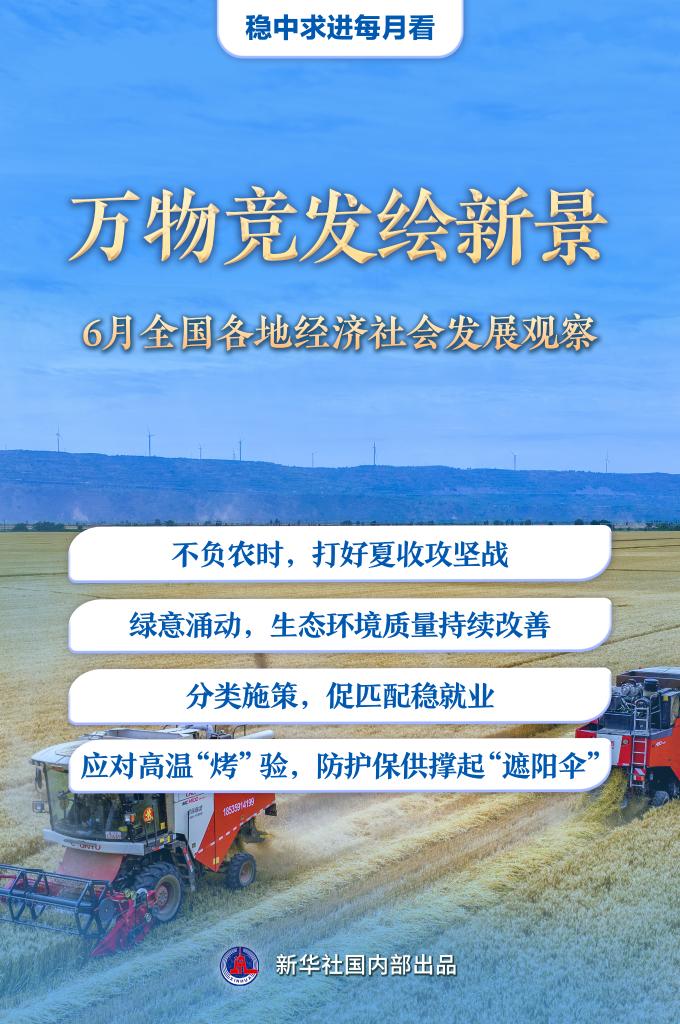
稳中求进每月看丨万物竞发绘新景——6月全国各地经济社会发展观察
Xin Hua Wang· 2025-08-12 05:49
Group 1: Agricultural Development - The summer grain harvest is crucial for the overall grain production, with over 90% of summer grain already harvested nationwide [7][6] - Advanced agricultural technologies, such as the use of GPS-assisted machinery, have significantly improved efficiency and reduced grain loss during harvesting [10][6] - The government is actively promoting the "store grain in technology" strategy, which emphasizes agricultural innovation and technology adoption [11][10] Group 2: Environmental Improvement - There has been a continuous improvement in ecological environment quality, with successful initiatives in wetland restoration and desertification control [12][12] - The area of desertified land has been reduced for four consecutive survey periods since 2000, showcasing effective environmental management [12][12] - The green development concept is increasingly embraced, with various regions implementing projects to enhance ecological balance and sustainability [15][17] Group 3: Employment Stability - Various local governments are implementing targeted measures to stabilize employment, particularly for vulnerable groups such as migrant workers and recent graduates [18][19] - Collaborative efforts between local governments and businesses are facilitating job placements and skills training to meet industry demands [18][19] - Employment services are being enhanced to ensure a seamless transition from education to employment for graduates [18][19] Group 4: Heatwave Response - In response to extreme heat conditions, construction sites are implementing measures to protect workers, including providing cooling stations and hydration supplies [25][26] - Local authorities are actively monitoring and managing urban services to ensure stability during high-temperature periods [26][26] - The focus is on both preventive measures and preparedness to safeguard public health and support agricultural production during heatwaves [28][30]
金融赋能 助力“湘米”更“香”
Jin Rong Shi Bao· 2025-08-08 08:02
Core Viewpoint - Hunan province plays a crucial role in ensuring national food security, with a stable grain planting area and production capacity, as emphasized by President Xi Jinping during his visit in March 2024 [1][2]. Financial Support for Food Security - The Hunan Financial Regulatory Bureau has implemented various measures to enhance financial support for food security, including increasing credit supply and insurance coverage for the entire grain production chain [2][3]. - As of the end of 2024, the loan balance for key grain sectors in Hunan reached 153.53 billion yuan, a year-on-year increase of 20.7% [2]. - The insurance amount for rice in Hunan was 46.01 billion yuan in 2024, ranking first in the country [2]. Focus on Agricultural Infrastructure - The financial support emphasizes the construction of high-standard farmland to strengthen the foundation of grain production, with loans for high-standard farmland construction reaching 41.36 billion yuan, an increase of 9.4 billion yuan year-on-year [3]. - Innovative financing models have been developed to address issues related to insufficient collateral for high-standard farmland projects [3]. Innovation in Financial Services - The Hunan Financial Regulatory Bureau has optimized agricultural insurance services by creating a risk map for major agricultural products and establishing a multi-dimensional information sharing mechanism [4]. - New insurance products have been introduced, including comprehensive cost insurance for rice and corn, as well as index-based insurance for weather-related risks [4]. Support for Seed Industry Development - Hunan is a significant player in the seed industry, and the financial regulatory body has introduced policies to support seed industry innovation, with loans to the seed sector totaling 12.43 billion yuan in 2024 [6]. - Banks are encouraged to prioritize credit resources for leading seed enterprises and provide comprehensive services to the entire supply chain [6]. Future Directions - The Hunan Financial Regulatory Bureau plans to continue enhancing financial services for food security by increasing resource allocation and innovating financial products tailored to agricultural needs [7]. - There will be a focus on collaboration with various departments to implement supportive policies effectively, ensuring that financial services contribute to rural revitalization [7].
高标准农田建好更要管好
Jing Ji Ri Bao· 2025-08-06 22:02
Core Viewpoint - The construction of high-standard farmland is a crucial measure to implement the strategies of storing grain in land and technology, with a focus on enhancing quality and management of farmland [1][2]. Group 1: Importance and Characteristics of High-Standard Farmland - High-standard farmland is characterized by its high quality, productivity, disaster resistance, and resource utilization efficiency [2]. - As of the end of 2024, the area of high-standard farmland in Henan and Jiangsu provinces has exceeded 80% of their permanent farmland area, with over 1 billion acres of high-standard farmland built nationwide [2]. Group 2: Construction and Management Standards - Emphasis on strict quality control in construction, with a focus on achieving high yield and stability in production [3]. - The implementation of a clear standard system that is adaptable to local conditions and addresses specific agricultural challenges such as drought and flooding [3]. Group 3: Post-Construction Management - Effective management of high-standard farmland is essential for the overall management of permanent basic farmland, with a clear responsibility chain established [4]. - The introduction of market mechanisms, such as commercial insurance for disaster damage, is encouraged to enhance management effectiveness [4]. Group 4: Utilization and Technological Integration - The efficient use of high-standard farmland involves promoting quality seeds, techniques, and practices to increase grain yield and quality [5]. - There is a push for integrating advanced technologies such as data monitoring, smart irrigation, and IoT in high-standard farmland projects to maximize land utilization efficiency [5].