
卫星互联网

Search documents
华为发布Flex:ai AI容器技术 实现单卡同时承载多个AI工作负载;谷歌计划每6个月将算力容量翻倍,谷歌供应链受关注——《投资早参》
Mei Ri Jing Ji Xin Wen· 2025-11-24 01:09
Important Market News - Multiple Sci-Tech Innovation Board ETFs and the first batch of AI ETFs have been approved, expected to attract more incremental funds into the market [1] - The approval of these products signals regulatory support for strategic emerging industries, providing efficient channels for investors to allocate funds in core areas like AI [1] Industry Insights - Huawei launched Flex:ai AI container software, which can split a single GPU/NPU card into multiple virtual computing units, improving resource utilization from an industry average of 30%-40% to 70% [2] - This technology aims to enhance the domestic AI computing industry and promote the integration of domestic computing resources, marking a shift in competition from hardware to system [2] - The "5G+" Industrial Internet Conference announced the launch of commercial trials for satellite IoT services, with a market size currently around 400-500 billion, expected to exceed 2000-4000 billion by 2030 [3] - Google's ambitious goal to double computing capacity every six months and achieve a 1000-fold increase in 4-5 years highlights the critical nature of AI infrastructure competition [4] - The AI infrastructure competition is reshaping the industry landscape, with significant implications for investment opportunities in the AI supply chain [4]
港股概念追踪 | 卫星物联网商用试验正式启动!千亿市场规模可期(附概念股)
智通财经网· 2025-11-23 23:23
Core Insights - The commercial trial of satellite IoT services in China has officially started, aiming to enhance the satellite communication market and support emerging industries like commercial space and low-altitude economy [1] - The satellite IoT business will create significant demand for satellite launches, driving growth in the satellite manufacturing and rocket launch sectors [1][2] - The satellite communication market in China is projected to exceed 80 billion yuan in 2023, with an expected annual growth rate of approximately 15% from 2024 to 2029, potentially reaching around 200 billion yuan by 2029 [2] Industry Developments - The satellite IoT trial is part of a broader strategy to optimize business access and promote the development of the satellite communication industry, aligning with technological innovation and industrial transformation [1] - The integration of satellite IoT is expected to revolutionize various sectors, including agriculture, energy, emergency communication, and low-altitude economy applications [2] - The satellite IoT will enable real-time tracking and data transmission for low-altitude vehicles, addressing communication gaps in the low-altitude economy [3] Company Activities - China Telecom is actively promoting satellite internet development and has achieved significant technological breakthroughs, enabling mobile devices to connect directly to satellites [4] - China Mobile has received a license to operate satellite mobile communication services, enhancing applications in emergency communication and remote area connectivity [5] - China Unicom has successfully launched low-orbit satellites that support narrowband IoT communication, marking a significant step in China's satellite IoT capabilities [5]



国家国防科工局成立商业航天司;中国半导体行业协会张立:半导体产业正迎来新一轮变革
Mei Ri Jing Ji Xin Wen· 2025-11-23 23:17
Group 1 - The establishment of the Commercial Space Administration by the National Defense Science and Technology Industry Bureau indicates a significant government focus on the regulated development of the commercial space industry, which is expected to enhance the efficiency of satellite industry development and key processes such as launch approvals and satellite operation licensing [1] - The integration of functions across multiple departments is anticipated to break down barriers and promote collaboration across the entire value chain, positioning China to gain a competitive edge in the global space arena, particularly with the rise of low Earth orbit satellite constellations and the space economy [1] - The move is seen as a strong boost for the industry, with future attention needed on the implementation of supporting regulations and their effectiveness [1] Group 2 - The semiconductor industry is undergoing a new wave of transformation driven by markets such as artificial intelligence, embodied intelligence, smart connected vehicles, and quantum computing, which demand higher performance, energy efficiency, and reliability from chips [2] - The Chinese semiconductor industry is encouraged to adopt a systematic approach to build an innovative ecosystem across the entire value chain, leveraging applications to seize opportunities presented by industry changes and expanding collaborative development spaces [2] - The emphasis on "open cooperation" reflects China's commitment to global development in the semiconductor sector amidst intensifying global technological competition, highlighting the importance for investors to focus on companies with technological accumulation in specific application scenarios [2] Group 3 - Unisoc has launched a new generation of eSIM chips, THC9E, which support satellite internet applications and provide a high-reliability connection capability that integrates operator eSIM, satellite communication eSIM, and Wi-Fi [3] - The trend towards "integrated space and ground" is becoming a direction for 6G evolution, with eSIM technology expected to accelerate the deployment of IoT and emergency communication scenarios, although the technology's iteration cycle should be approached with caution [3] - This technological advancement has the potential to address communication challenges in remote areas, but considerations regarding costs and pricing are necessary, alongside reflections on how Chinese companies can assert influence in satellite communication standard-setting [3]
国家国防科工局成立商业航天司;中国半导体行业协会张立:半导体产业正迎来新一轮变革|数智早参
Mei Ri Jing Ji Xin Wen· 2025-11-23 23:11
Group 1: Commercial Aerospace Development - The establishment of the Commercial Aerospace Department by the National Defense Science and Technology Industry Bureau indicates a significant government focus on the regulated development of the commercial aerospace industry [1] - This new department is expected to enhance the efficiency of key processes such as commercial launch approvals and satellite operation licensing through better integration of various departmental functions [1] - The move is seen as a strong boost for the industry, especially in the context of emerging trends like low Earth orbit satellite constellations and the space economy, which require breaking down departmental barriers for better collaboration [1] Group 2: Semiconductor Industry Transformation - The semiconductor industry in China is undergoing a new wave of transformation driven by markets such as artificial intelligence, intelligent connected vehicles, and quantum computing, which demand higher chip performance and energy efficiency [2] - There is a call for a systematic approach to build a full-chain innovation ecosystem, leveraging applications to seize opportunities presented by the industry transformation [2] - The emphasis on "open cooperation" reflects China's commitment to global development in the semiconductor sector amidst increasing global technological competition [2] Group 3: eSIM Technology and Satellite Internet - Unisoc has launched a new generation eSIM chip, THC9E, which supports satellite internet applications and offers a high-reliability connection capability integrating operator eSIM, satellite communication eSIM, and Wi-Fi [3] - The trend towards "integrated space and ground" is becoming a direction for 6G evolution, with eSIM technology playing a crucial role in accelerating the deployment of IoT and emergency communication scenarios [3] - This technological advancement has the potential to address communication challenges in remote areas, although considerations regarding costs and pricing remain important [3]

两年试验启动 卫星通信迈入“商用前夜”
Bei Jing Shang Bao· 2025-11-23 15:32
Core Viewpoint - The launch of the satellite IoT business commercial trial marks a significant step towards the commercialization of satellite communication in China, paving the way for the development of emerging industries such as commercial aerospace and low-altitude economy [1][2]. Commercial Trial Launch - The Ministry of Industry and Information Technology officially announced the start of a two-year commercial trial for satellite IoT services during the 2025 China 5G + Industrial Internet Conference [2]. - The trial aims to enrich the supply of satellite communication services, stimulate the vitality of business entities, enhance industry service capabilities, and establish a safety supervision system [2][3]. - Satellite IoT services will connect various IoT devices through satellite communication technology, providing wide-area connectivity for data collection terminals, wearable devices, and transportation tools [2]. Policy Implementation - The launch of the commercial trial is a concrete implementation of the earlier policy blueprint outlined in the "Guiding Opinions on Optimizing Business Access to Promote the Development of the Satellite Communication Industry" released in August [2][3]. - The guiding opinions set a target for 2030, aiming for improved satellite communication management systems, optimized industry development environments, and significant advancements in infrastructure and international cooperation [2][3]. Market Potential - The satellite internet market in China is projected to reach a scale of hundreds of billions in the coming years, with global satellite internet market size expected to reach trillions by 2040 [4]. - An expert calculated that with approximately 1 billion ground IoT connections in China, a 5% blind spot could generate an annual revenue of 5 billion yuan if satellite services are charged at 10 yuan per terminal [4]. - The key variable for achieving these market projections is reducing the constellation cost to below 1 USD per terminal per year [4]. Application Scenarios - The integration of satellite IoT is expected to transform four major application scenarios: smart agriculture, energy digitalization, emergency communication, and low-altitude economy [5][6]. - In agriculture, satellite IoT will connect drones and sensors in remote areas for precise irrigation and production management [6]. - In energy, satellite technology will enable real-time data transmission and remote monitoring of facilities like oil fields and wind farms, significantly reducing operational costs [6]. Challenges Ahead - Four main challenges have been identified: spectrum compatibility, terminal power consumption, data sovereignty, and rocket capacity [6]. - Addressing these challenges is crucial for transforming satellite internet into a profitable venture [6].
两年试验启动 卫星通信迈向“商用前夜”
Bei Jing Shang Bao· 2025-11-23 13:13
Core Viewpoint - The launch of the satellite IoT business commercial trial marks a significant step towards the commercialization of satellite communication in China, paving the way for the development of commercial aerospace and low-altitude economy sectors [1][2]. Group 1: Commercial Trial Launch - The Ministry of Industry and Information Technology has officially initiated a two-year commercial trial for satellite IoT services, aiming to enhance the supply in the satellite communication market and stimulate the vitality of business entities [2][3]. - The satellite IoT service connects various IoT devices through satellite communication technology, providing wide-area connectivity for data collection terminals, wearable devices, and transportation tools [2][3]. Group 2: Policy Framework - The commercial trial aligns with the earlier released "Guiding Opinions" aimed at optimizing business access and promoting the satellite communication industry, with a vision for significant improvements by 2030 [3]. - The "Guiding Opinions" detail 19 specific measures across six areas to support the healthy development of satellite IoT services [3]. Group 3: Market Potential - The satellite internet market in China is projected to reach a scale of hundreds of billions in the coming years, with global market estimates suggesting a potential of trillions by 2040 [4]. - The current landscape includes approximately 1 billion ground IoT connections, with 5% in blind spots, indicating a substantial revenue opportunity if satellite services are effectively integrated [4]. Group 4: Application Scenarios - Key application scenarios for satellite IoT include smart agriculture, energy digitalization, emergency communication, and low-altitude economic applications, which will benefit from reliable wide-area communication [5][6]. - The successful implementation of satellite IoT services could transform various industries by enabling efficient data transmission and management [5][6]. Group 5: Challenges Ahead - Four main challenges need to be addressed for successful implementation: spectrum compatibility, terminal power consumption, data sovereignty, and rocket launch capacity [6]. - Overcoming these challenges is crucial for transforming satellite internet capabilities into tangible economic benefits [6].
中国首个“天通+北斗”国产星基高精度定位服务试商用
Zhong Guo Xin Wen Wang· 2025-11-21 09:44
Core Points - The "Tiantong + Beidou" domestic satellite-based high-precision positioning service has officially launched for trial operation, supporting the large-scale application of Beidou and the autonomous construction of China's comprehensive PNT (Positioning, Navigation, Timing) system [1][2] - The Tiantong satellite system is China's first independently developed satellite mobile communication system, which provides real-time dynamic minute-level convergence and centimeter-level positioning services without relying on ground networks [1] - The satellite-based navigation enhancement system primarily targets remote areas, oceans, low-altitude, and low-orbit regions with weak or no network coverage, with applications in various fields such as surveying, agricultural machinery automation, intelligent navigation, marine positioning, and drone inspections [1] Industry Insights - The satellite internet, as a new type of information infrastructure, is crucial for achieving comprehensive connectivity across land, sea, air, and space, and for realizing the "Internet of Everything" [2] - Recent policies from the Chinese government aim to explore the application potential of high-orbit satellites like Tiantong, promoting direct satellite connections for mobile phones, cars, and airplanes to develop popular satellite communication applications [2] - The next-generation Tiantong satellite system is expected to be operational by 2029, which will expand new business opportunities and market scale [2]
2025中国航天第二次发射失利,损失3颗卫星,原因已确认
3 6 Ke· 2025-11-20 11:37
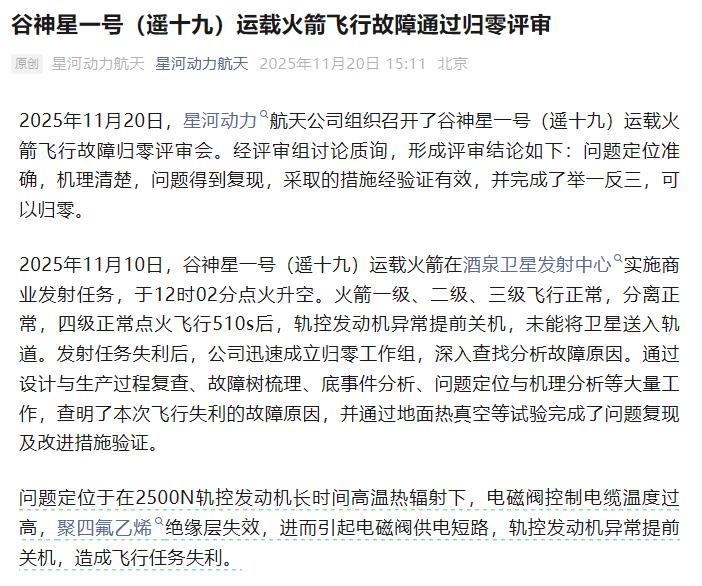
Core Viewpoint - The recent failure of the Ceres-1 rocket launch by Star River Dynamics highlights the challenges faced by private aerospace companies in China, particularly as the company approaches its IPO phase. Despite the setback, the overall growth trajectory of the private space sector remains strong, supported by government policies and a burgeoning market for satellite launches. Group 1: Launch Details - The Ceres-1 rocket was launched on November 10, 2023, from the Jiuquan Satellite Launch Center, with initial stages proceeding normally before an anomaly occurred during the fourth stage ignition [1][2] - The failure resulted in the inability to place three satellites into orbit, marking the second launch failure for the year in China's aerospace sector [2][5] - The Ceres-1 rocket is designed for low Earth orbit small satellite launches, featuring a configuration of three solid stages and one liquid stage, with a total launch capacity of 400 kg to low Earth orbit [5][8] Group 2: Investigation and Impact - An investigation revealed that the failure was caused by overheating of the electromagnetic valve control cable, leading to a short circuit and premature engine shutdown [3][10] - The financial impact of the failure is somewhat mitigated by insurance coverage, which can offset some of the economic losses incurred [9] - Star River Dynamics has previously achieved a success rate of 90.9% with 20 successful launches out of 22 attempts since its first successful launch in November 2020 [11] Group 3: Industry Context - The failure is viewed as a "growing pain" for China's private aerospace sector, which has rapidly developed since 2014 under supportive government policies [13] - The commercial space market in China is projected to exceed 300 billion yuan by 2025, with satellite launch demand accounting for 45% of this market [13] - Globally, launch failures are common in the aerospace industry, with a long-term success rate of around 90%, indicating that setbacks are part of the technological evolution and maturation of the industry [14]

通宇通讯(002792):全低轨星座布局,产业成长带来长期价值
Tebon Securities· 2025-11-20 06:07
Investment Rating - The report maintains a "Buy" rating for the company [2][8] Core Views - The company is positioned to benefit from the growth of the satellite internet industry, with significant investments and partnerships enhancing its capabilities [5][8] - The company has a strong foundation in traditional cellular network infrastructure and is now integrating into global satellite internet constellations, which may lead to substantial revenue growth [8] - The report highlights the company's involvement in multiple satellite internet initiatives and its compatibility with existing satellite systems, indicating a strategic advantage [5][6] Summary by Sections Market Performance - The company's stock has shown a relative performance against the CSI 300 index, with a noted decline of 34% over the specified period [3] Financial Data and Forecast - The company is projected to achieve revenues of 1,599 million, 1,968 million, and 2,326 million yuan for the years 2025, 2026, and 2027 respectively, with corresponding net profits of 121 million, 148 million, and 217 million yuan [7][9] - The earnings per share (EPS) are expected to rise from 0.23 yuan in 2025 to 0.41 yuan in 2027, reflecting a positive growth trajectory [8][9] - The gross margin is anticipated to improve from 22.2% in 2024 to 27.0% by 2027, indicating enhanced operational efficiency [9] Investment Insights - The company is actively participating in the development of low Earth orbit (LEO) satellite constellations, which is expected to drive long-term value creation [5][8] - The report emphasizes the potential for the company to capitalize on the increasing demand for satellite internet services, particularly as it aligns with major industry players and technological advancements [6][8]

这一产业火了,掀起资本热潮!
Zheng Quan Shi Bao Wang· 2025-11-20 03:00
Core Insights - The Chinese commercial aerospace industry is experiencing a surge in investment and financing, driven by national strategy and technological advancements, as it transitions from a technical breakthrough phase to a stage focused on industrial capacity building [1][2][3] Investment and Financing Trends - The commercial aerospace sector has maintained high levels of investment activity, with companies like Tianbing Technology, Infinite Aerospace, and others making significant financing progress across various sub-sectors such as rocket development and satellite manufacturing [1] - The China Securities Regulatory Commission has included commercial aerospace in the fifth set of standards for the Sci-Tech Innovation Board, facilitating capital access for unprofitable hard-tech companies [2][3] Industry Dynamics - There is a pressing demand for satellite launches in China, with over 30,000 low-orbit satellites submitted to the International Telecommunication Union, creating immense launch requirements [2] - The competition among commercial rocket companies is shifting from individual launch success to building a complete industrial chain that encompasses research, manufacturing, and launch services [2][3] Criteria for Industrialization Capability - Three key metrics define the industrialization capability of commercial aerospace companies: 1. **Full-chain Technical Autonomy**: Essential for cost reduction and technological iteration, requiring self-research across the entire rocket development process [4] 2. **Scale Manufacturing and Launch Service Capability**: The ability to provide stable and high-frequency launch services is crucial for achieving commercial aerospace value [5] 3. **Rapid Iteration and Learning Capability**: The industry must focus on quick learning and optimization rather than aiming for zero errors, emphasizing a cycle of systematic trial and error [5][6] Future Outlook - The ultimate competition in commercial aerospace will hinge on the integration of talent, technology, products, and market capabilities [6] - The next five years will be critical for China's positioning in the global space economy, with IPOs serving as a starting point for companies to demonstrate their comprehensive capabilities [6]