
战略性新兴产业

Search documents
中国机械工业联合会:上半年机械工业规模以上企业增加值同比增长9%
Zheng Quan Ri Bao· 2025-08-04 16:10
罗俊杰称,截至6月末,机械工业规模以上企业数量达13.6万家,较上年同期增加0.6万家,占全国工业 的26.2%,占比较上年同期提高0.4个百分点;资产总计达40.4万亿元,同比增长6.6%,占全国工业的 22.0%,占比较上年同期提高0.3个百分点。 从上半年机械工业行业发展亮点来看,除绿色转型步伐持续加快,外贸出口保持较快增长外,罗俊杰进 一步表示,战略性新兴产业对机械工业发展的带动作用继续增强。 数据显示,上半年,机械工业战略性新兴产业相关行业合计实现营业收入和利润总额增速分别比全部机 械工业高1.3个百分点和5.4个百分点,占机械工业的比重分别达82.8%和82.6%,占比较上年同期分别提 高1个百分点和3.9个百分点。其中,新能源装备、节能环保装备、高端装备制造等相关产业营业收入和 利润总额增速均明显高于机械工业总体水平。 展望下半年,罗俊杰表示,综合判断,预计下半年机械工业经济运行将延续稳中向好的总体态势,全年 主要经济指标增速在5.5%左右,对外贸易保持基本稳定。 8月4日,中国机械工业联合会发布数据显示,在存量政策与新一轮"两新"政策加力扩围叠加效应下,国 内市场需求改善,带动机械工业产销形势 ...
机械工业规上企业利润增长9.4% 战略性新兴产业贡献超八成
Zheng Quan Shi Bao Wang· 2025-08-04 09:16
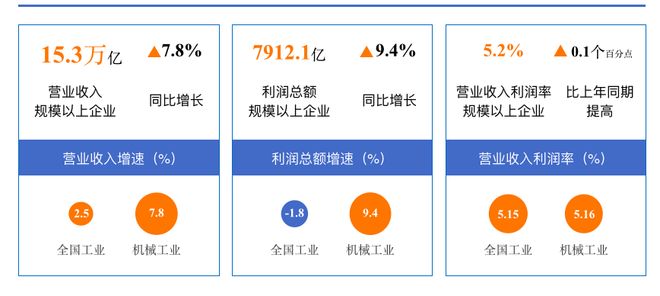
8月4日,中国机械工业联合会召开2025年上半年机械工业经济运行情况发布会。今年上半年,机械工业 规模以上企业增加值同比增长9.0%。实现营业收入15.3万亿元,同比增长7.8%;实现利润总额7912.1亿 元,同比增长9.4%,增速比全国工业高11.2个百分点。 中国机械工业联合会副会长、新闻发言人罗俊杰透露,工信部即将印发机械、汽车、电力装备等行业稳 增长工作方案,为机械工业发展注入强劲动力,推动其实现质的有效提升和量的合理增长,助力行业延 续稳中向好的发展态势。 机械工业规模以上企业利润增长9.4% 上半年,机械工业主要经济指标较快增长,为实现全年目标打下了良好基础。罗俊杰介绍,上半年,机 械工业规模以上企业增加值同比增长9.0%,增速高于全国工业和制造业2.6和2个百分点,为稳定经济大 盘、提振工业经济发挥积极作用。 机械工业主要涉及的五个国民经济行业大类增加值均实现同比增长。数据显示,汽车和电气机械行业实 现两位数增长,增速分别为11.3%和12.2%,引领机械工业的增长;通用设备、专用设备和仪器仪表行 业增速分别为8.3%、3.8%和7.6%。 在存量政策与新一轮"两新"政策加力扩围叠加效应下,国 ...
多领域上半年“成绩单”出炉 利好积聚经济“跃动”内生动力强劲
Yang Shi Wang· 2025-08-04 08:55
记者8月4日从中国机械工业联合会获悉,2025年上半年,我国机械工业经济运行稳中向好,产品产销平 稳增长,对外贸易展现韧性,创新活力加快释放,新质生产力积极发展,产业升级和高质量发展成效显 著。 2025年上半年,机械工业产业支柱地位稳固提升。截至6月末,机械工业规模以上企业数量达13.6万 家,较上年同期增加0.6万家,占全国工业的26.2%。 此外,上半年,机械工业规模以上企业增加值同比增长9.0%,增速高于全国工业和制造业2.6和2个百分 点,为稳定经济大盘、提振工业经济发挥积极作用。 不仅如此,机械工业主要涉及的5个国民经济行业大类增加值均实现同比增长。其中,汽车和电气机械 行业实现两位数增长,增速分别为11.3%和12.2%。通用设备、专用设备和仪器仪表行业增速分别为 8.3%、3.8%和7.6%。 罗俊杰表示,近期,工业和信息化部即将印发机械、汽车、电力装备等行业稳增长工作方案。着力提升 优质供给能力,优化行业发展环境,推动行业实现质的有效提升和量的合理增长。综合判断,预计下半 年,机械工业经济运行将延续稳中向好的总体态势,全年主要经济指标增速在5.5%左右,对外贸易保 持基本稳定。 国家税务总局 ...
机械工业上半年利润增长9.4%,战新产业带动作用增强
Di Yi Cai Jing Zi Xun· 2025-08-04 03:13
Core Viewpoint - The mechanical industry in China showed stable growth in the first half of the year, with key economic indicators such as value-added output, revenue, and profit all experiencing positive year-on-year growth, despite facing challenges like insufficient effective demand and external trade pressures [1][2][6]. Economic Performance - In the first half of the year, the value-added output of large-scale mechanical enterprises grew by 9.0% year-on-year, with total revenue reaching 15.3 trillion yuan, a 7.8% increase [1][2]. - Total profit amounted to 791.21 billion yuan, reflecting a 9.4% year-on-year growth, which is 11.2 percentage points higher than the national industrial average [1][2]. - The operating profit margin was 5.2%, slightly above the national industrial average [2]. Sector Growth - The automotive and electrical machinery sectors led the growth with increases of 11.3% and 12.2%, respectively, while general equipment, specialized equipment, and instruments also saw growth rates of 8.3%, 3.8%, and 7.6% [2]. - Among 122 monitored products, 84 saw year-on-year production increases, representing 68.9% of the total, which is an improvement of 7.4 percentage points from the previous year [2]. Strategic Emerging Industries - Strategic emerging industries continue to drive growth in the mechanical sector, with revenue and profit growth rates for these industries exceeding the overall mechanical industry by 1.3 and 5.4 percentage points, respectively [3]. Challenges and Risks - Over 60% of enterprises reported insufficient orders, with challenges including market fluctuations, insufficient effective demand, and pressure from external trade [5][6]. - The impact of U.S. tariff policies has led to increased caution among foreign buyers, resulting in a slowdown in order growth, particularly in sectors like petrochemical machinery and agricultural machinery [6]. - The price index for mechanical products has been declining, with a consistent drop of around 2% year-on-year for 29 consecutive months, further compressing profit margins [6]. Future Outlook - The mechanical industry is expected to maintain a stable growth trajectory in the second half of the year, with a projected annual growth rate of around 5.5% for major economic indicators [1][7]. - Continued emphasis on technological innovation, industrial upgrading, and the cultivation of new productive forces is anticipated to enhance the resilience and safety of the supply chain [7].


机械工业上半年运行稳中向好,创新发展活力增强
Zhong Guo Qi Che Bao Wang· 2025-08-04 02:56
Core Viewpoint - The mechanical industry in China has shown resilience and steady growth in the first half of 2025, despite facing various challenges and uncertainties in the external environment [2][11]. Economic Performance - The mechanical industry maintained a positive economic trend, with major economic indicators showing rapid growth, laying a solid foundation for achieving annual targets [3][4]. - By the end of June, the number of large-scale enterprises in the mechanical industry reached 136,000, an increase of 6,000 year-on-year, accounting for 26.2% of the national industrial total [3]. - The total assets of the mechanical industry reached 40.4 trillion yuan, a year-on-year increase of 6.6% [3]. Value Added and Production - The value added of large-scale enterprises in the mechanical industry grew by 9.0% year-on-year, outperforming the national industrial and manufacturing growth rates by 2.6 and 2 percentage points, respectively [3][4]. - Key sectors such as automotive and electrical machinery experienced double-digit growth rates of 11.3% and 12.2%, respectively [4]. Product Sales and Market Demand - In the first half of the year, 84 out of 122 monitored products saw year-on-year production growth, representing 68.9% of the total [4]. - Automotive production and sales reached 15.62 million and 15.65 million units, respectively, with year-on-year growth of 12.5% and 11.4% [5]. Investment Trends - Fixed asset investment in the mechanical industry grew by 3.8% year-on-year, higher than the national investment growth rate of 2.8% but lower than the industrial average of 10.3% [6]. - Investment in general equipment and automotive sectors grew significantly by 16.6% and 22.2%, respectively [6]. Economic Efficiency - The mechanical industry achieved operating revenue of 15.3 trillion yuan, a year-on-year increase of 7.8%, and total profits of 791.21 billion yuan, up 9.4% [6]. - The profit margin was 5.2%, slightly higher than the previous year [6]. Industry Sentiment - The mechanical industry’s prosperity index remained stable and improved, with a reading of 106.9 in June, indicating overall positive economic performance [7]. Innovation and Development - The industry focused on technological innovation and green development, with strategic emerging industries showing significant growth [8]. - The production of new energy vehicles reached 6.968 million units, with a market penetration rate of 44.3% [8]. Foreign Trade - The mechanical industry’s total import and export value reached 597.6 billion USD, with exports growing by 12.4% year-on-year [9]. - Trade surplus increased by 23.3% year-on-year, accounting for 57.1% of the national trade surplus [9]. Challenges and Outlook - The mechanical industry faces increasing uncertainties due to external geopolitical tensions and trade protectionism, which may impact future growth [11][14]. - Despite challenges, the industry is expected to maintain a growth rate of around 5.5% for the year, supported by favorable macro and industrial policies [14][15].

立法促进民营经济发展壮大 发挥民营经济在海南自由贸易港建设中的生力军作用——《海南自由贸易港促进民营经济发展若干规定》解读
Hai Nan Ri Bao· 2025-08-03 02:06
Group 1 - The core viewpoint of the article emphasizes the importance of promoting the development of the private economy in Hainan Free Trade Port, as outlined in the newly passed regulations [1][4] - The regulations consist of 29 articles aimed at enhancing the role of the private economy as a driving force in the construction of Hainan Free Trade Port [1][4] - The article highlights the significant contribution of the private economy to Hainan's GDP and employment, with private enterprises accounting for nearly 60% of GDP and 90% of jobs [3] Group 2 - The background and significance of the regulations are rooted in the central government's commitment to supporting the private economy, as stated in the 20th National Congress report [2] - The regulations are a response to the need for a better business environment for private enterprises, ensuring their rights and promoting healthy development [2][4] - The article notes that as of June 2025, there are 3.6044 million private business entities in Hainan, representing 97.54% of all business entities in the province [3] Group 3 - The main content of the regulations includes ensuring the leadership of the Communist Party in promoting the private economy and establishing a collaborative governance framework [5] - The regulations aim to guarantee fair competition by addressing high market entry barriers and ensuring equal treatment for private economic organizations [6] - The regulations also focus on empowering the private economy through core policies of Hainan Free Trade Port, encouraging participation in key industries and projects [7] Group 4 - The regulations seek to optimize the investment and financing environment by addressing issues such as high financing costs and improving land supply efficiency [8] - Measures include establishing a government financing guarantee system and encouraging banks to provide various types of loans to private enterprises [8] - The article emphasizes the importance of collaboration between large enterprises and small private businesses to enhance innovation and supply chain cooperation [8] Group 5 - The regulations promote government accountability and integrity, addressing issues of insufficient government trust and inflexible communication mechanisms [9] - Specific measures include optimizing government services for private enterprises and establishing mechanisms to prevent delays in payments to private economic organizations [9] - The article mentions the repeal of the previous regulations on promoting private individual economic development to align with current laws and market conditions [10]
深圳实施2025年度重点产业研发计划 单个项目资助最高3000万元
Shen Zhen Shang Bao· 2025-08-03 00:21
Core Insights - Shenzhen's Technology Innovation Bureau has released the application guidelines for the 2025 Key Industry R&D Program, focusing on sectors such as semiconductors, high-end equipment, commercial aerospace, embodied intelligence, ultra-high-definition video, and sustainable development [1][3] Group 1: Funding and Project Details - A total of up to 309 projects will be funded, with individual project funding capped at 30 million yuan [1] - The program adopts a "challenge-based" approach to support strategic emerging industries and key core technology breakthroughs [1] - The project aims to enhance Shenzhen's systematic capability in technological innovation [1] Group 2: Eligibility and Requirements - Leading units must be legally registered entities in Shenzhen, including enterprises, universities, research institutions, and healthcare organizations [2] - For specific sectors, enterprises must be recognized as national high-tech enterprises or have R&D expenses exceeding 50 million yuan in 2024 or 30 million yuan in the first half of 2025 [2] - Enterprises must also have revenue or R&D expenses at least double the amount of the funding requested [2] Group 3: Collaborative Innovation - Shenzhen encourages the formation of innovation consortia among industry, academia, and research institutions [3] - Various projects are included in the 2025 Key Industry R&D Program, such as the "multi-modal humanoid robot development for industrial scenarios," with funding up to 10 million yuan [3] - The humanoid robot project has specific performance targets, including sales revenue of at least 20 million yuan and a minimum of 10 patent applications [3]
交银投资换帅
Shang Hai Zheng Quan Bao· 2025-08-02 07:11
8月1日,国家金融监督管理总局上海监管局批复显示,核准王忆军交银金融资产投资有限公司(简 称"交银投资")董事、董事长的任职资格。 据了解,交银投资原董事长陈蔚已到龄退休。2023年4月,陈蔚卸任交通银行湖南分行行长,履新交银 投资董事长,任职时间两年四个月。 "接棒者"王忆军同样来自交通银行,在交行系统久经历练,也曾在多个交行子公司担任高管。 在股权直投方面,交银投资走在AIC前列。据陈蔚介绍,交银投资始终坚持市场化法治化方式参与债转 股与股权投资试点,已在支持科创企业方面形成了一套行之有效的做法。随着股权投资试点范围进一步 扩大,2025年交银投资将实现股权试点工作在18个试点城市及其所在省份的全域覆盖,积极支持战略性 新兴产业和新质生产力的发展。交银投资内部还开发了针对早期科创企业的"新苗计划",通过利用母行 与业内机构等各方资源汇聚,进行优质股权项目储备。 今年以来,多家银行获批筹建AIC,这也是时隔8年以来AIC队伍的首度扩容。7月16日,中国邮政储蓄 银行宣布拟设立AIC。此外,股份行序列中,已有兴业银行、中信银行、招商银行获批筹建AIC公司。 经过此轮的扩容,预计我国AIC公司数量将增至9家。 ...
常州两只母基金招GP
FOFWEEKLY· 2025-08-01 10:12
Core Viewpoint - The establishment of two specialized mother funds in Changzhou, Jiangsu, aims to promote investment in the new energy and high-end functional materials sectors, with a total scale of 80 billion yuan [1][3]. Group 1: New Energy Industry Fund - The Jiangsu Changzhou New Energy Industry Specialized Mother Fund has a total scale of 50 billion yuan and focuses on investments in advanced manufacturing for new energy vehicles, new power systems, next-generation photovoltaic technology, hydrogen energy, new energy storage, and intelligent equipment for deep sea and deep space [1][3]. - The investment method includes setting up sub-funds or direct project investments, with direct investments not exceeding 30% of the actual investment amount of the mother fund [2]. - The mother fund's contribution to sub-funds will not exceed 30% of the sub-fund's total scale, and investments in individual direct projects will not exceed 20% of the total paid-in capital of the mother fund [2][4]. Group 2: High-End Functional Materials Fund - The Jiangsu Changzhou High-End Functional Materials Industry Specialized Mother Fund has a total scale of 30 billion yuan and targets investments in high-performance carbon fibers and composites, nanomaterials, graphene materials, intelligent biomimetic materials, superconducting materials, and liquid metals [3]. - Similar to the new energy fund, this fund also has an investment method that includes sub-fund establishment and direct project investments, adhering to the same investment limits [2][4]. - Both mother funds have a lifespan of 15 years, with a 7-year investment period and an 8-year exit period, requiring sub-funds to be registered in Changzhou [4].

首席论势|连平:未来十年,民间投资年均增速将达5%~7%
Guang Zhou Ri Bao· 2025-08-01 08:53
"《中华人民共和国民营经济促进法》的实施,将对民营经济的持续高质量发展产生不可估量的动 力。"广开首席产业研究院院长连平表示,未来,民营经济将为我国经济高质量发展作出新的贡献,成 为推动中国经济行稳致远的关键力量之一。 连平关注到,近年来,在人工智能、机器人、低空经济、生物医药等前沿领域,民营企业的身影随处可 见,已经涌现出一批耀眼的明星企业。目前,部分民营企业已经具备高技术含量和高附加值的特征,国 家高新技术企业中民营企业占比扩大至92%以上。此外,在政策的大力扶持下,民营企业牵头承担国家 重大技术攻关任务的数量呈现出显著增加的趋势,所涉及的范围也在不断扩展。 "未来更多民营企业有望乘着新一轮科技革命浪潮,在关键核心技术领域开展攻关,在科技创新中发挥 更大作用。"连平预计,到2035年民营企业研发投入占全社会比重将突破60%,技术创新成果贡献率达 80%以上,为全球科技创新贡献"中国方案"。 连平提到,民间投资将成为拉动投资增长的重要新生力量。一系列政策"组合拳"的实施带动民间投资信 心稳步修复。今年上半年,扣除房地产开发投资后,民间投资增长达6.6%;分行业看,制造业民间投 资增长11.5%,增速比全部制 ...