元宇宙

Search documents
产业观察:【数字经济周报】高通24亿收购SerDes IP巨头Alphawave-20250616
GUOTAI HAITONG SECURITIES· 2025-06-16 09:10
Semiconductor Sector - Qualcomm announced the acquisition of Alphawave for $2.4 billion, aiming to enhance its data center capabilities and meet the growing demand for high-performance computing[9] - Micron Technology plans to increase its investment in U.S. manufacturing to $200 billion, creating approximately 90,000 jobs and expanding its semiconductor production capacity[16] - AMD launched the Instinct MI350 series GPUs, featuring a 35x improvement in inference capability compared to the previous MI300 series, utilizing a 3nm process technology[15] Automotive Electronics Sector - GAC Group unveiled the GOVY AirCab flying car, designed for low-altitude travel, with a lightweight carbon fiber structure and a 25-minute quick recharge capability[18] - NIO successfully established a battery swap network across 38 districts in Chongqing, with over 75 battery swap stations operational, achieving over 1 million battery swaps[24] - Leap Motor's C10 and T03 models officially entered the Hong Kong market, showcasing advanced technology and design aimed at young consumers[26] AI Sector - Cambridge University introduced the MTLA attention mechanism, achieving a 5x acceleration in inference speed while reducing memory usage to 1/8 of traditional methods[28] - The Chinese Academy of Sciences launched the "Enlightenment" system for fully automated chip design, achieving performance levels comparable to human experts[31] Metaverse Sector - Snap announced plans to release AR smart glasses, Specs, in 2026, featuring improved design and AI capabilities for enhanced user interaction[39] - Saphlux released a 0.13-inch full-color MicroLED display for AR applications, promising lower manufacturing costs and improved performance[41]



会员金选丨教授公开课:中美关税松绑背后的深层博弈,寻找企业的破局之道
第一财经· 2025-06-16 03:35
Core Viewpoint - The US-China tariff conflict is a decisive force reshaping the global economic order, with both countries vying for dominance over supply chains, technology standards, and development models [1] Group 1: Tariff Dynamics - The 2025 Geneva Agreement is a backdrop for the ultimate struggle for industrial chain dominance, where the US employs a dynamic tariff system under Trump's policies to segment high-end manufacturing chains [1] - China retaliates against technological blockades using strategic resources like rare earths, directly influencing 42% of the global intermediate goods supply chain and increasing uncertainty in global supply chains [1] Group 2: Strategic Responses - Chinese companies are implementing overseas strategies to achieve supply chain restructuring and localized operations, seeking new pathways amid dynamic tariffs and technological barriers [1] - The analysis by Professor Hu Jie aims to decode policies and provide insights for enterprises to navigate the complexities of global value chain restructuring [1] Group 3: Expert Background - Professor Hu Jie is a practice professor at Shanghai Jiao Tong University and has extensive experience in financial economics and policy analysis, having worked at the Federal Reserve Bank and in investment banking in Hong Kong and Singapore [2][3] - His research and teaching focus on financial markets, macroeconomic policies, fintech, and the internationalization of Chinese enterprises [2][3] Group 4: Event Information - An event featuring Professor Hu Jie will discuss the deeper dynamics behind the US-China tariff relaxations, providing a platform for interaction and exchange [2][4]

会员金选丨教授公开课:中美关税松绑背后的深层博弈,寻找企业的破局之道
第一财经· 2025-06-16 03:18
Group 1 - The article highlights the significance of the US-China tariff battle as a decisive force in reshaping the global economic order, emphasizing the competition for control over industrial chains, technological standards, and development models [1] - The dynamic tariff system under Trump's administration is seen as a strategy to segment high-end manufacturing chains, while China is countering with strategic resources like rare earths, impacting 42% of the global intermediate goods supply chain and increasing uncertainty in global supply chains [1] - Professor Hu Jie from Shanghai Jiao Tong University aims to decode the implications of tariffs and provide insights for companies to navigate the challenges posed by the US-China rivalry, focusing on how Chinese enterprises are restructuring supply chains and localizing operations through international expansion [1] Group 2 - The event featuring Professor Hu Jie is scheduled for June 21, focusing on the deeper implications behind the potential easing of US-China tariffs, with a structured agenda including a public lecture and interactive Q&A session [2] - Professor Hu Jie has extensive experience in financial economics and policy analysis, having worked at the Federal Reserve and in investment banking in Hong Kong and Singapore, before transitioning to entrepreneurship and management roles in software and fintech [3][4] - His research interests encompass financial markets, US macroeconomics, fintech innovations, and the internationalization of Chinese enterprises, indicating a strong focus on contemporary financial challenges and opportunities [3]
“低空经济”的蛋糕,哪些城市能分到?
Hu Xiu· 2025-06-16 02:40
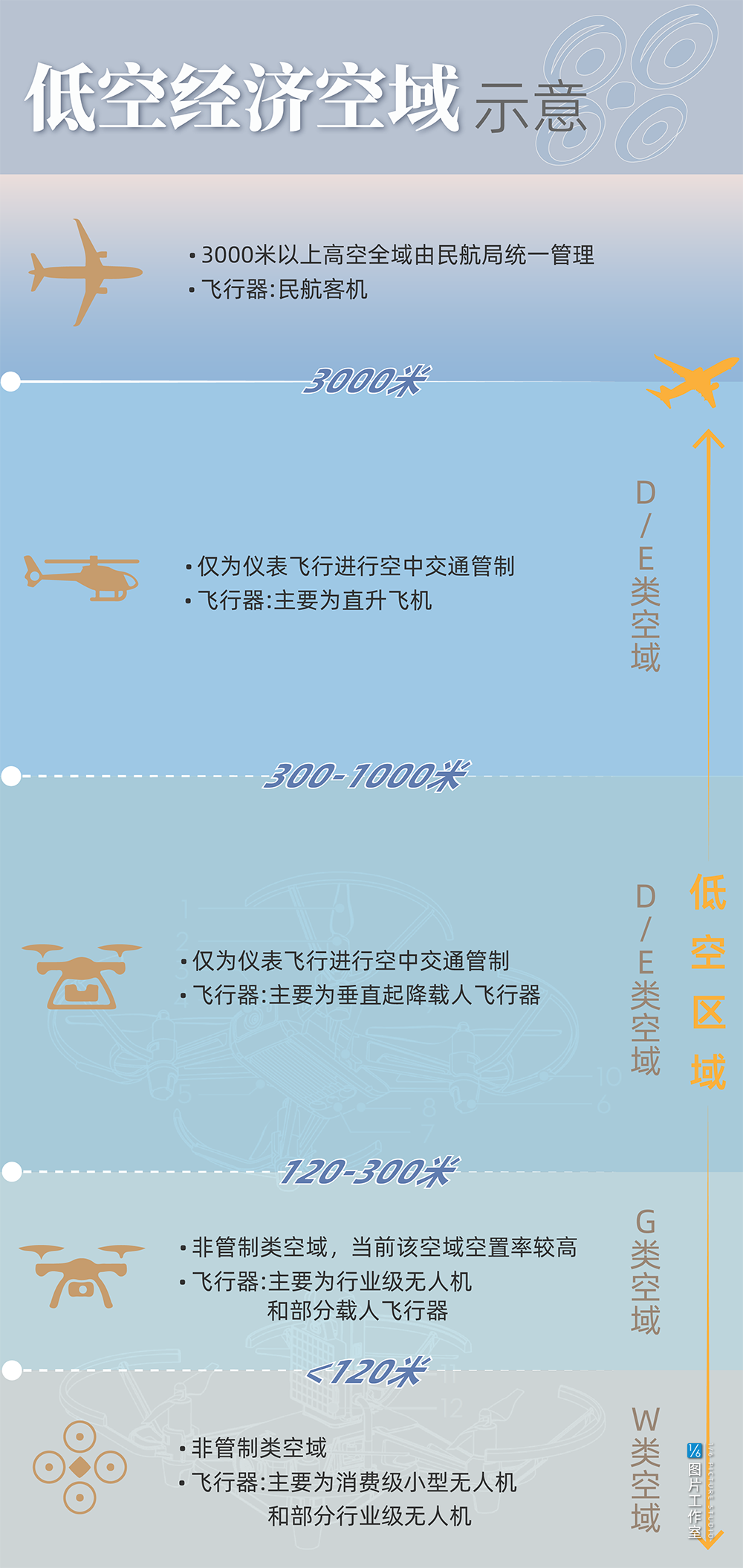
当人们还在讨论下一个风口是AI还是机器人时,一片全新的蓝海已经悄然在我们头顶展开。 "低空经济"——正以超乎想象的速度从科幻走进现实。它已连续两年被写入政府工作报告,相关数据显示,2024年,我国低空经济的市场规模 已经达到了5059.5亿元,同比增长了33.8%。 业界普遍预计,今年低空经济的规模将突破1.5万亿元,到2035年,这个数字将飙升至3.5万亿元,一个足以重塑产业格局的庞大市场正在加速 形成。 ▼低空经济特指在1000米以下,进行有人或无人低空飞行活动,带动相关领域融合发展的综合性经济形态 时至今日,全国已有超过30个省级行政区将低空经济明确写入政府工作报告的重点发展领域,从东部沿海到中西部腹地,一场关乎天空的竞赛 已然打响! 一、低空经济下的城市机遇 然而,伴随这股热潮而来的,也有一丝熟悉的担忧。很多人不禁会问:这会不会是三年前"元宇宙"热潮的重演? 毕竟,当初超过23个省份发布元宇宙相关政策,产业园遍地开花,资本疯狂涌入,NFT数字收藏品炒到了天价;但转眼间,热潮退去,科技巨 头纷纷裁撤部门,今年第一季度,NFT交易量同比暴跌70%。 那么,低空经济会是下一个"元宇宙"吗? 答案是:当然不会 ...

签约超45亿元,第三届软件创新发展大会在武汉举行
Zheng Quan Shi Bao Wang· 2025-06-13 14:25
Core Insights - The third Software Innovation Development Conference was held in Wuhan, where 24 software investment projects were signed, totaling over 4.5 billion yuan [1] - Wuhan has over 42,000 software-related enterprises, including 79 national-level specialized "little giant" companies, 21 listed companies, and 5 renowned Chinese software companies [1] - The software industry in Wuhan is projected to reach a scale of 352.1 billion yuan in 2024, maintaining the highest growth rate among national software cities for three consecutive years [1] Group 1 - Wuhan is promoting deep integration of technological and industrial innovation to enhance its "soft power" and accelerate its development as a leading digital economy city [1] - The city is focusing on building innovation platforms such as the Xiaomi super-large R&D center and an industrial software ecosystem [2] - By 2030, Wuhan aims to exceed 800 billion yuan in software industry scale, with a focus on key areas like basic software, industrial software, and artificial intelligence [1][2] Group 2 - The Ministry of Industry and Information Technology emphasizes the upcoming transformation and opportunities in the software industry due to a new wave of technological revolution [2] - Key initiatives include promoting "AI + software," enhancing the open-source Harmony ecosystem, and establishing incentives for first-version software applications [2] - The central six provincial capital cities are collaborating to sign an industrial software pilot verification cooperation agreement, focusing on high-end sectors like aerospace and automotive [3]
跨链技术:打破区块链壁垒,构建互联新生态
Sou Hu Cai Jing· 2025-06-12 16:21
Group 1: Challenges of Blockchain Interoperability - Early blockchain networks operate independently, creating natural barriers such as data isolation, asset freezing, and ecosystem fragmentation [1] - Bitcoin and Ethereum networks cannot read or verify each other's transaction states, leading to user assets being locked within a single ecosystem [1] Group 2: Cross-Chain Technology Overview - Cross-chain technology aims to securely and efficiently enable information and value transfer between different blockchains, with various mainstream technical approaches [3] - Notary schemes involve trusted third parties to monitor source chain events and trigger actions on target chains, though they rely heavily on third-party trust [3] - Hash Time-Locked Contracts (HTLC) facilitate trustless atomic swaps, ensuring either simultaneous asset exchange or a refund, but are limited in supporting complex interactions [3] - Relay chains and sidechains, like those in Polkadot and Cosmos, create dedicated chains to validate and relay messages from other chains [3] Group 3: Unlocking Value Beyond Asset Transfer - Cross-chain technology enables transformations beyond simple asset transfers, enhancing DeFi capabilities and allowing users to leverage assets across different chains for lending and liquidity mining [4] - NFTs and metaverse assets can be freely traded and used across platforms, unlocking their true value [4] - DApps can utilize resources from multiple chains, such as executing high-frequency trades on low-fee chains while securely storing data on others [4] - Shared infrastructure and collaboration between chains can reduce development costs and enhance the robustness of the entire blockchain ecosystem [4] Group 4: Future Challenges and Developments - Key challenges for cross-chain technology include security, as cross-chain bridges are prime targets for hackers, necessitating improvements in cryptographic proofs and auditing practices [6] - The lack of unified standards complicates interoperability, with industry direction leaning towards the promotion of universal standards like the Inter-Blockchain Communication (IBC) protocol [6] - User experience improvements are needed to address cumbersome processes, unpredictable fees, and long wait times, which hinder widespread adoption [7] - The evolution of protocols like Polygon and Wormhole, along with new architectures such as LayerZero, indicates a shift towards safer, more efficient, and user-friendly cross-chain technologies [7] - The transition from isolated blockchains to an interconnected network of blockchains is an unstoppable trend, marking a paradigm shift in blockchain infrastructure [7]

星网锐捷(002396) - 2025年6月12日投资者关系活动记录表
2025-06-12 09:30
Group 1: Company Overview and Strategy - The company focuses on "ICT infrastructure and AI application solutions," driving transformation and upgrading of the industry with innovative products [1] - Key areas of development include network infrastructure, optical communication, AI applications, and the metaverse, aiming to capture market opportunities [1][2] Group 2: Business Segments and Performance - Besides Ruijie Networks, the company is active in optical communication, automotive networking in the U.S., and financial sectors through its subsidiaries [1] - Ruijie Networks contributes over 50% of the company's revenue, primarily from switch products, with significant growth in intelligent computing center switches [2] Group 3: Financial Performance and Goals - The company aims for strong performance returns to shareholders, with a focus on various smart solution applications across multiple sectors [2] - In 2024, the company reported revenue from international transactions totaling 3.393 billion yuan, accounting for 20.25% of total revenue [2] Group 4: Future Outlook and Development Plans - The company plans to enhance its capabilities in ICT infrastructure and AI applications, leveraging national policies to capture growth opportunities [2] - For 2025, the company will continue to expand its overseas strategy, focusing on compliance and local partnerships to support market entry [2] Group 5: Dividend Policy - The 2024 dividend policy includes a cash distribution of 2.5 yuan per 10 shares, totaling approximately 146.44 million yuan based on the adjusted share count [3]

17家孤注一掷的创业公司,在2024年被计提减值
3 6 Ke· 2025-06-12 02:23
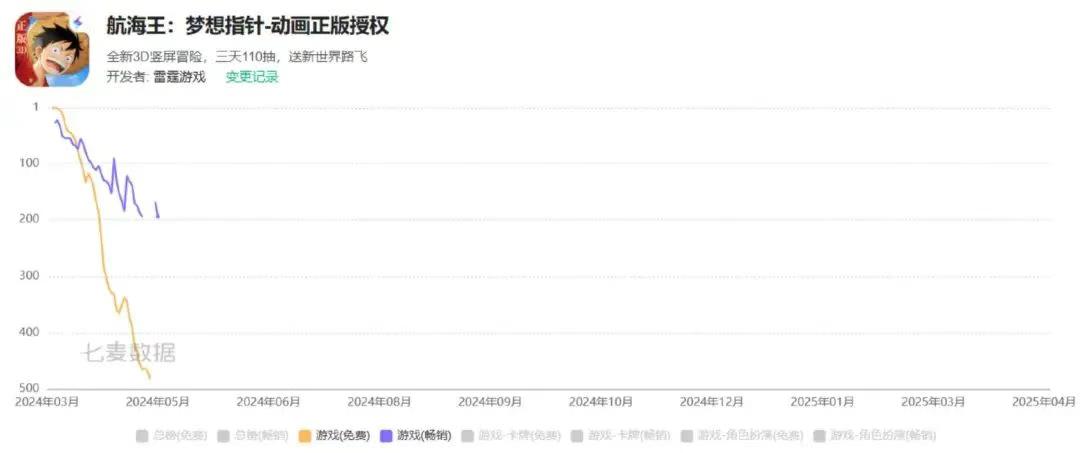
Core Insights - 2024 is seen as a pivotal year for the gaming industry, with companies facing challenges due to market shifts and increased competition [1] - A total of 30 publicly listed gaming companies reported impairment losses, indicating significant operational issues and reduced goodwill [1] - The trend of startups heavily investing in single products has led to many failures, particularly among newer companies [2] Group 1: Impairment Losses and Company Performance - Guangzhou Zhuoyou reported an impairment loss of approximately 26.66 million yuan due to poor performance of its game "One Piece: Dream Pointer," which was launched in April 2023 and subsequently taken down [3][5] - Chengdu Fanpas faced an impairment loss of about 4.31 million yuan, primarily due to the failure of its second game "Leap Rainbow Mirror," which was released in June 2023 [7][9] - Shanghai Mumu reported an impairment loss of approximately 16.79 million yuan, attributed to the underperformance of its game "Galaxy Explorers: New Home" [10][11] Group 2: Market Challenges and Competitive Landscape - The gaming market is increasingly saturated, making it difficult for new entrants to compete against established products, even with strong backing from major investors [18][26] - Companies like Shanghai Wuwei and Shanghai Yuelong Zhiyu are struggling due to poor performance of their flagship titles, leading to significant impairment losses [19][24] - The report highlights that many companies are facing a lack of clear financing plans and ongoing losses, which complicates their ability to recover [9][10] Group 3: Investment Trends and Strategic Shifts - Investment strategies among listed companies are shifting, with some focusing on expanding their strengths while others are exploring new areas [47][48] - Companies like Perfect World and Ke Ying Network are adjusting their investment approaches in response to market conditions, indicating a cautious outlook [48][49] - The overall trend suggests a cooling investment climate, impacting both established and emerging companies in the gaming sector [48]






马上消费与中国电子技术标准化研究院签署战略合作协议
Jing Ji Guan Cha Wang· 2025-06-11 12:43
Core Viewpoint - The strategic cooperation between Mashang Consumer and the China Electronic Technology Standardization Institute aims to promote the standardization and high-quality development of the fintech industry through a comprehensive collaboration framework [1][3]. Group 1: Strategic Cooperation - The partnership will focus on standard formulation, ecological construction, and talent cultivation in the fintech sector [1]. - Both parties will leverage their strengths to engage in comprehensive and multi-level cooperation, including the development of international, national, and industry standards [3]. - The collaboration will also involve testing, certification, and research projects in areas such as artificial intelligence, data, cloud computing, and the metaverse [3]. Group 2: Achievements and Recognition - Over the past ten years, Mashang Consumer has served over 200 million users and has received 12 significant honors, including being recognized as a national high-tech enterprise [3]. - The company has led the formulation of over 120 information technology standards and has recently initiated two international standards related to financial large language models and machine learning [2]. Group 3: Future Plans - Mashang Consumer plans to deepen its collaboration with the China Electronic Technology Standardization Institute and other ecological partners to create an open and secure ecosystem [4]. - The goal is to provide replicable and promotable "Chongqing experience" for the innovation and development of the national digital finance industry [4].
趋势研判!2025年中国蓝牙芯片行业发展历程、产业链、出货量、竞争格局及前景展望:物联网等智能终端加速普及,推动蓝牙芯片出货量持续增长[图]
Chan Ye Xin Xi Wang· 2025-06-11 01:29
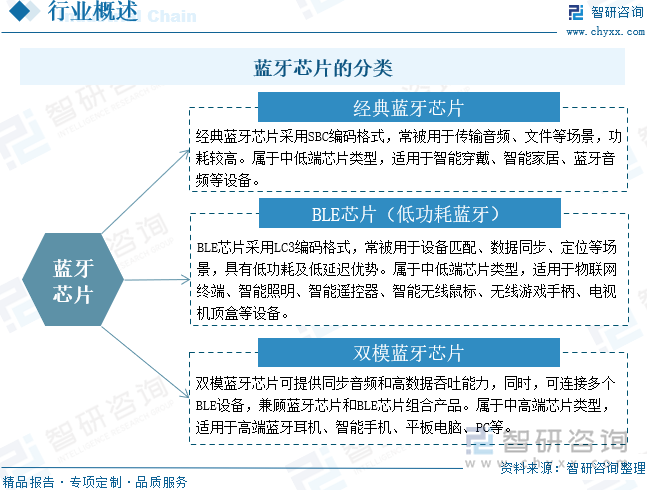
Core Insights - The Bluetooth chip market is experiencing significant growth, with global shipments increasing from 4.2 billion units in 2018 to 5.3 billion units in 2022, representing a compound annual growth rate (CAGR) of 5.99%. It is projected to reach approximately 5.9 billion units by 2024 [1][14]. - The market is characterized by a strong international presence, with Nordic, Dialog, and Texas Instruments holding a combined 61% share of the global BLE chip market. Chinese companies are emerging through differentiated strategies, focusing on low-power Bluetooth chips and specific application scenarios [1][14]. - The Bluetooth chip industry is expected to penetrate various applications, including smart industrial devices, automotive equipment, smart city solutions, and smart home technologies, driving rapid growth in the Chinese Bluetooth chip sector [1][14]. Industry Overview - Bluetooth chips are integrated circuits that enable short-range wireless communication, applicable in audio transmission, data transfer, and location services. They can be categorized into classic Bluetooth chips and BLE (low-energy) chips [4][15]. - The industry has evolved since the 1990s, with significant advancements driven by the rise of IoT, autonomous driving, and 5G technologies, leading to a high growth phase starting in 2017 [6][15]. Market Dynamics - The Bluetooth chip industry value chain consists of upstream resource providers, midstream chip manufacturers, and downstream users. Upstream includes design tool suppliers and wafer manufacturers, while midstream focuses on Bluetooth chip manufacturers providing various products [8][15]. - The Chinese Bluetooth chip industry is still in its early stages but holds substantial growth potential, especially with the advent of the metaverse era [1][14]. Key Players - Notable companies in the Bluetooth chip sector include: - **Yuchip Technology**: Focuses on low-power AIoT chip design, with significant revenue from smart audio SoC chips [29]. - **Hengxuan Technology**: Specializes in low-power wireless computing SoC chips, with a strong presence in smart wearable and home markets [31]. - **Zhongke Blue Communication**: Engages in wireless audio SoC chip development, covering various product lines [28][31]. - **Tai Ling Microelectronics**: Recently went public, focusing on low-power Bluetooth and Zigbee technology chips [28]. - **Jieli Technology**: Concentrates on system-level chips for audio and wearable devices [28]. Future Trends - The industry is expected to see technological innovations that enhance performance, including higher bandwidth and lower latency, driven by the adoption of Bluetooth 5.4 and subsequent versions [33]. - Application scenarios are diversifying beyond traditional consumer electronics into smart homes, wearables, and automotive electronics, with increasing demand for reliable solutions in B2B markets [34]. - Domestic Bluetooth chip companies are strengthening collaborations across the supply chain, aiming for a complete ecosystem from design to application, with a noticeable trend towards domestic substitution in the face of international competition [35].