
具身智能

Search documents
五洲新春(603667):跟踪报告:步入成长新阶段,高端装备与机器人共驱
GUOTAI HAITONG SECURITIES· 2026-02-26 08:16
Investment Rating - The report maintains a rating of "Accumulate" for the company [6][12]. Core Views - The company is entering a new growth phase driven by high-end equipment and robotics, with a significant improvement in gross margins and a robust revenue growth forecast for 2025-2027 [2][12]. - The company is strategically positioned in the robotics and automotive sectors, focusing on core components such as ball screw and intelligent driving parts, which are expected to open new long-term growth opportunities [2][12]. Financial Summary - Total revenue is projected to grow from 3,106 million in 2023 to 5,011 million in 2027, reflecting a compound annual growth rate (CAGR) of approximately 16.1% [4]. - Net profit attributable to the parent company is expected to increase from 138 million in 2023 to 228 million in 2027, with a notable recovery in 2025 after a dip in 2024 [4]. - Earnings per share (EPS) is forecasted to rise from 0.38 yuan in 2023 to 0.62 yuan in 2027 [4]. Revenue and Profitability - For the first three quarters of 2025, the company reported a revenue of 2,661 million, a year-on-year increase of 7.60%, and a net profit of 98.48 million, showing a slight increase of 0.25% [12]. - The gross margin for the first three quarters of 2025 was 17.31%, reflecting a year-on-year increase of 0.11 percentage points [12]. - The company has made significant strides in high-value-added business segments, particularly in the aerospace and gas turbine markets, which have contributed to improved profitability [12]. Market Position and Growth Drivers - The company has established partnerships with major automotive manufacturers such as Toyota and BMW, supplying high-end bearings for electric vehicles [12]. - The company is also capitalizing on the domestic high-end equipment market, achieving breakthroughs in aerospace and gas turbine products, with small batch orders already received [12]. - The recent fundraising efforts are aimed at expanding production capacity for high-end screws and bearings, which are expected to significantly enhance market share and product structure [12].

一年分野,深圳机器人八企突围记
2 1 Shi Ji Jing Ji Bao Dao· 2026-02-26 07:58
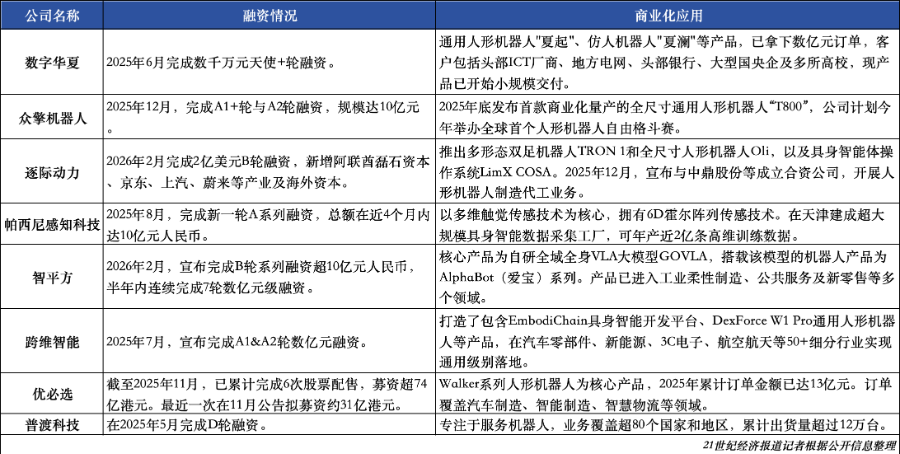
Core Insights - The article highlights the contrasting fortunes of robotics companies in the US and China, with Cartwheel Robotics ceasing operations due to funding failures, while Shenzhen's robotics sector thrives with significant investments and technological advancements [1][2][3]. Company Developments - Cartwheel Robotics, founded in 2022, has shut down due to unsuccessful financing efforts [1]. - Shenzhen's robotics companies, including Digital Huaxia, Zhongqing Robotics, Zhijijia, and others, have seen varied trajectories, with some achieving significant funding and commercial success [3]. - Zhijijia has completed 12 rounds of financing, surpassing a valuation of 10 billion yuan, becoming Shenzhen's first embodied intelligence company to reach this milestone [5]. - Zhongqing Robotics raised 1 billion yuan in multiple financing rounds and launched the T800 humanoid robot, marking a significant step in commercialization [5][9]. - Digital Huaxia has secured orders worth hundreds of millions for its humanoid robots, indicating strong market demand [8]. Industry Trends - The embodied intelligence sector has experienced explosive growth, with total financing exceeding 50 billion yuan, a 400% increase from the previous year [4]. - Shenzhen's government aims to establish the city as a global leader in artificial intelligence, with a target of over 1,200 related enterprises by 2027 [13]. - The robotics industry in Shenzhen has shown robust growth, with a 31.4% increase in added value in the first three quarters of 2025 [12]. Technological Advancements - Companies are focusing on practical applications of robotics, with significant innovations in product development and technology upgrades [6]. - Zhijijia launched the GOVLA 0.5 model, while Zhongqing Robotics introduced the T800 humanoid robot, showcasing advancements in robotics technology [6][9]. - Cross-dimensional Intelligence has developed a model that achieved over 100 million yuan in revenue, indicating successful market penetration [7]. Market Applications - Shenzhen's robotics companies are expanding into various sectors, including industrial manufacturing, commercial services, and household applications [9]. - Digital Huaxia's robots are being utilized in government and banking sectors, while Zhijijia's modular service space is set to deploy 1,000 units in three years [9]. - The industry is increasingly focused on real-world applications, with companies like Pudu Technology and others achieving significant sales and international reach [9].


人形机器人崛起
机器人圈· 2026-02-26 07:52
Core Viewpoint - Humanoid robots are transitioning from conceptual ideas to tangible entities, gaining public attention, yet doubts remain about their practical applications and societal acceptance [5][16]. Group 1: Industry Development and Trends - The humanoid robot industry is characterized by a blend of skepticism and anticipation, with a focus on commercial viability, capital market trends, and global competition [5]. - Performance remains the primary application area for humanoid robots in 2026, as their current capabilities do not meet the expectations for industrial deployment [17][22]. - The development of humanoid robots is expected to follow a path from entertainment to practical applications, with skills demonstrated in performances potentially translating to real-world tasks [19]. Group 2: Technological Advancements - The "brain" of humanoid robots is becoming a critical competitive factor, with investments shifting towards advanced algorithms and decision-making capabilities [26][27]. - Current humanoid robot intelligence is likened to that of a "newborn," lacking sufficient data for growth and learning [29]. - The competition between China and the U.S. in the humanoid robot sector is intensifying, with China excelling in hardware manufacturing and the U.S. leading in AI and algorithm development [28][30]. Group 3: Market Dynamics and Investment - The humanoid robot sector is anticipated to enter a significant growth phase in 2026, with increased focus on core manufacturers and their ability to secure substantial orders [32]. - The market is witnessing a surge in investment, with the number of humanoid robot companies in China increasing from over 120 to more than 320, and total financing surpassing 58 billion yuan [34]. - Investors are expected to prioritize projects with sustainable value realization and practical applications, moving away from short-term technology demonstrations [35]. Group 4: Societal Implications - The integration of humanoid robots into society raises questions about job displacement and the future role of humans in the workforce [41][42]. - The societal impact of humanoid robots is expected to be profound, potentially transforming production methods and labor dynamics [42][43]. - The readiness of society to coexist with humanoid robots is a critical consideration, reflecting both hope and concern about the future [44].

“科技年货”成消费新宠
Ke Ji Ri Bao· 2026-02-26 07:44
Group 1 - The core viewpoint of the articles highlights a significant shift in consumer behavior towards technology products, particularly during the Spring Festival, with smart glasses, AI toys, and robots becoming popular choices for gifts [1][2] - The rise of "technology New Year goods" indicates a transformation in consumer preferences from traditional physical goods to experiences that emphasize intelligence, efficiency, and warmth [1] - The popularity of humanoid robots and robotic dogs during the Spring Festival showcases the growing integration of technology into entertainment and daily life, with a surge in both purchase and rental demand [2] Group 2 - Despite the surge in technology consumption, challenges remain in transitioning from holiday purchases to everyday use, including issues of product homogeneity and inadequate differentiation among smart devices [2] - Experts suggest that future technology consumption should shift from being technology-driven to demand-driven, focusing on real-world needs to stimulate technological advancements [3] - Recommendations include strengthening core technologies such as AI chips and establishing standards for data security and privacy to support sustainable growth in the technology consumption market [3]
通用工业具身智能平台天元兴完成数千万元天使轮融资
Bei Jing Shang Bao· 2026-02-26 06:54
北京商报讯(记者 魏蔚)2月26日,通用工业具身智能平台深圳天元兴科技有限公司(以下简称"天元 兴")宣布,已完成数千万元天使轮融资。本次投资方包括弘德投资、盛世鸿元、海愿资本等机构,募 集资金将主要用于端到端具身智能控制技术研发、研发团队扩张及工业场景规模化落地。天元兴成立于 2024年12月,前身为商汤科技工业机器人事业部,由商汤工业机器人原班核心团队完成拆分成立,是商 汤科技X生态成员企业。目前,天元兴核心产品为轮式底盘人形双臂机器人TX01,主要面向工业场景 提供柔性搬运、上下料、精密装配及主动质检等核心作业能力,精准匹配工业产线柔性的多样化、灵巧 作业需求。 ...
湖北“新春第一会”定调,锚定支点建设启新程
2 1 Shi Ji Jing Ji Bao Dao· 2026-02-26 06:54
Core Insights - The "New Spring First Meeting" serves as a significant platform for local economic development discussions, emphasizing "high-quality development" as a common theme across various provinces and cities in China [1][2] Group 1: Economic Development Strategies - Hubei's focus for the "New Spring First Meeting" is to establish itself as a crucial strategic pivot for the rise of the central region, aiming for a total economic output of 6 trillion yuan by 2025, with Wuhan's economy expected to exceed 2 trillion yuan [2] - The meeting highlighted Hubei's commitment to leveraging technological innovation and industrial upgrades as key drivers for economic growth, particularly in the context of artificial intelligence and low-altitude economy [4][5] Group 2: Technological Advancements - Hubei showcased significant advancements in humanoid robotics, with 31 units displayed, indicating a rapid industrialization process. Key innovations include increased joint flexibility and local supply chain integration [3] - The province aims to achieve an artificial intelligence output of 1,107 billion yuan by 2024, with a target of surpassing 1,500 billion yuan by 2025, supported by local research institutions [4] Group 3: Industrial Growth and Infrastructure - Hubei is focusing on building modern industrial clusters, with five major industries reaching trillion-level scales, and plans to establish new enterprises in various categories [7] - The province is also prioritizing the development of county-level consumption and enhancing trade, aiming to become the leading province in foreign trade in the central region [7] Group 4: Governance and Implementation - To ensure the successful execution of its strategic plans, Hubei has introduced initiatives to enhance the capabilities of its workforce, focusing on high-quality development and proactive engagement [8]
对话独角兽 | 非夕科技引领自适应机器人产业发展:聚焦技术突围,拓展场景落地
Di Yi Cai Jing· 2026-02-26 06:36
Core Insights - The global industrial robot market is expanding, with China maintaining its position as the largest market, showcasing significant industry scale and resilience [1] - Non-Xi Technology, established in 2016, focuses on industrial-grade force control and AI integration, leveraging a core R&D team from Stanford University [1][3] - The company has achieved rapid growth, with revenue expected to reach 500 million yuan by 2025, supported by significant funding for capacity enhancement and new product development [4] Industry Trends - The industrial robot sector is evolving, facing challenges from traditional position control technologies, which struggle in complex scenarios [3][8] - There is a growing trend towards humanoid robot development, but many companies are caught in a "form over function" dilemma, hindering scalable commercial applications [3] Company Innovations - Non-Xi Technology adopts a unique approach by focusing on "human-like" capabilities, enhancing robots' adaptability and precision through advanced force control technology [3] - The company has developed proprietary sensors achieving a force perception accuracy of 0.03 Newtons, significantly surpassing existing products by 10-100 times [3] Market Applications - Non-Xi Technology is expanding its applications from industrial manufacturing to consumer services, addressing flexible production needs in sectors like automotive and electronics [5] - The company has successfully integrated its adaptive robots into the supply chains of major automotive manufacturers such as Tesla and Mercedes-Benz [5] Financial Growth - Over the past three years, Non-Xi Technology has experienced annual revenue growth of 2-3 times, with a successful Series C funding round completed in June 2025 [4] Strategic Positioning - The company is addressing industry challenges, including high technical barriers and reliance on imported components, by innovating across hardware, algorithms, and production processes [8] - Non-Xi Technology is expanding its global footprint, particularly in Southeast Asia and North America, while developing a collaborative approach with local enterprises [8] Future Outlook - The market potential for adaptive robots is expected to grow as the manufacturing sector continues its smart transformation and the embodied intelligence industry rises [9] - Non-Xi Technology is poised to lead the upgrade of adaptive robot categories, driving the domestic robot industry towards higher-end, intelligent, and scalable development [9]
广州工控集团景广军:努力以“三个千亿”“四个翻番”再造一个新工控
Guang Zhou Ri Bao· 2026-02-26 06:33
Core Insights - Guangzhou Industrial Control Group aims to become a "world-class advanced manufacturing industry ecosystem multinational operator" during the "14th Five-Year Plan" period, targeting significant growth and contributions to the city's development [1][2] Group 1 - The company plans to establish over 10 specialized industrial parks to support key industries in Guangzhou, creating a new manufacturing platform economy that integrates modern commerce, intelligent manufacturing, logistics, and multinational operations [2] - During the "14th Five-Year Plan," the company achieved an average annual revenue growth rate exceeding 15%, with 103 manufacturing enterprises across 15 provinces and cities in China [1] - The company has partnered with multinational firms like Panasonic, Siemens, and Hitachi, generating an industrial output value of approximately 45 billion yuan [1] Group 2 - The company aims to deepen the integration of industrial, innovation, capital, and talent chains, fostering a national-level intelligent equipment innovation center and investing in sectors such as integrated circuits and commercial aerospace [2] - By the end of the "14th Five-Year Plan," the company plans to double its overseas revenue to 55 billion yuan [2] - The company is also looking to establish a European headquarters and an industrial park in Southeast Asia to enhance its brand's overseas operational capabilities [2]
江浙沪县城独生女的科技年
投中网· 2026-02-26 06:27
将投中网设为"星标⭐",第一时间收获最新推送 轮到县城围剿科技财富盛宴了。 作者丨 韦香惠 来源丨 投中网 催婚、催育,这些往年春节餐桌上的"保留节目",今年几乎一夜之间失声。取而代之的,是机器人、具身智能和大模型。这样的转向放在北上广深或许 顺理成章,但发生在我所在的江苏小县城,多少让人感到诧异。 春节期间走亲访友,话题不时绕到我的工作,几位长辈竟然主动聊起我写的科技类报道。大舅关心的是"现在买哪只股票更有机会",小姨则替堂妹打 听"文科生毕业后能不能进AI大厂"。那一刻,我一边受宠若惊,一边也真切感受到某种情绪的涌动。每个人都在想尽办法加入到这场科技创新的盛宴当 中。 这或许是2026年春晚效应的外溢。这一年春晚可能是有史以来春晚科技含量最高的一届。多家具身智能公司,在同一时间窗口,面向14亿观众,集中 展示自己的机器人产品。其实不光具身智能,元宝、千问、豆包掀起的"红包"大战,也成为了大家新的谈资,进一步加速了AI在下沉市场的普及和应 用。 撒钱总是最有效的方式。 比如当时元宝发10亿红包,千问帮你买奶茶,我是实实在在薅了几十块的羊毛和两杯奶茶。中国太大了,不要小看这几十块钱的威力,它意味着两杯奶 茶, ...

反向过年、AI入局、非遗出圈——2026春节文旅三大“破圈”趋势
Zhong Guo Jing Ji Wang· 2026-02-26 06:19
Core Insights - The Chinese domestic tourism market experienced a record high during the Spring Festival, with 596 million trips taken and total spending reaching 803.48 billion yuan, marking an increase of 95 million trips and 126.48 billion yuan compared to the previous year [1][5] - The growth in the tourism market reflects a shift from quantity to quality, driven by evolving consumer lifestyles and cultural demands, laying a solid foundation for high-quality development in the tourism industry [1][5] Group 1: Market Performance - During the Spring Festival, the number of domestic travelers reached 596 million, an increase of 95 million from the previous year, while total spending was 803.48 billion yuan, up by 126.48 billion yuan [1] - The peak period saw significant service demand, with AI service robots deployed in hotels serving over 9.58 million people, and task execution volume increasing 2.2 times year-on-year [2] - The average transaction price for air tickets exceeded 700 yuan, and hotel prices averaged nearly 300 yuan per night, indicating a shift towards higher-value services [2] Group 2: Consumer Behavior Trends - The trend of "reverse New Year" is gaining popularity, with more young people inviting their parents to celebrate in their cities, reflecting a new balance between family warmth and personal needs [3] - Long-distance travel has become mainstream, with an average travel duration of 6.4 days, indicating a shift from traditional return-home patterns to more flexible travel arrangements [2][3] - The integration of intangible cultural heritage (ICH) into tourism experiences has enhanced engagement, with traditional customs becoming interactive and participatory [3][4] Group 3: Technological Integration - AI technology has played a crucial role in enhancing service efficiency, with AI systems handling various customer requests and significantly increasing the volume of AI-generated bookings [2][4] - The fusion of technology and tradition has led to new cultural expressions, with AI being used to generate personalized cultural designs and enhance traditional performances [4] - Data from platforms like Fliggy shows a significant increase in domestic travel orders, with ticket orders up over 80% and hotel night stays increasing by 75% compared to the previous year [4][5]