生成式AI

Search documents
专访龚克:AI时代对人的科学素养和价值判断力提出更高要求
Nan Fang Du Shi Bao· 2025-11-09 04:42
Core Viewpoint - The rapid proliferation of artificial intelligence (AI) applications necessitates higher levels of scientific literacy, questioning ability, and value judgment among individuals [1][4]. Group 1: AI Development and Trends - AI agents have become a significant focus for technology companies, seen as a new entry point for future traffic and services [3]. - The concept of "intelligent agents" has gained popularity due to the accelerated iteration of large models and the emergence of various functional models, serving as an interface between humans and AI [3][4]. - Despite initial excitement around AI agents, many have faced criticism for being "unusable" and "unreliable," often only capable of performing standardized tasks in specific scenarios [3][4]. Group 2: Human-AI Interaction - The effectiveness of AI tools depends on individuals' ability to communicate clearly and set boundaries for tasks and questions directed at AI [4][5]. - The ability to ask the right questions is emphasized as being more critical than solving problems in the era of large models, highlighting the importance of scientific and ethical literacy [5][6]. Group 3: Future Directions in AI - The evolution of AI is expected to transition from single-modal to multi-modal capabilities, expanding from text to images, audio, video, and code [6]. - The rise of embodied intelligence, which involves interaction with physical entities, is identified as a key trend in AI development [6]. - Open-source models are anticipated to play a crucial role in the future of large model development, promoting faster iteration and greater transparency [6]. - The necessity for green transformation in AI is highlighted, focusing on the sustainable use of resources and the integration of renewable energy in AI applications [6][7].


AI泡沫论再起,但这次不一样
经济观察报· 2025-11-09 04:19
Core Viewpoint - The current AI wave is characterized by the maturity of technology, the scale of capital investment, and the authenticity of commercial demand, making it more certain than past technological revolutions [1][5]. Group 1: Market Dynamics - Following Nvidia's market cap reaching $5 trillion, global concerns about an AI bubble have emerged, leading to a decline in AI-related stocks across major markets including the US, Japan, South Korea, and China [2]. - The current market correction is largely a recalibration of short-term valuation anchors and profit realization speeds after extreme optimism, representing a financial phenomenon rather than a refutation of the underlying industry logic [2][3]. Group 2: Historical Context - The article draws parallels between the current situation and historical bubbles, such as the 17th-century tulip mania and the 2000 internet bubble, emphasizing the cyclical nature of capital market enthusiasm and subsequent corrections [2][3]. - The infrastructure laid during the previous internet bubble, despite being seen as a resource misallocation at the time, significantly accelerated the evolution of technological foundations that support today's mobile internet era [3][4]. Group 3: AI as a Paradigm Shift - AI, particularly generative AI, represents a profound paradigm shift in productivity rather than merely an innovation in software or business models, necessitating a different valuation approach compared to traditional tech stocks [3][4]. - The current AI revolution is distinct from the early internet era, as it presents clearer business models and applications, such as Microsoft's Copilot and AIGC, which are rapidly proving their utility in enterprise processes [4][5]. Group 4: Long-term Perspective - Concerns about a potential bubble should focus less on short-term market fluctuations and more on the ability to navigate through cycles, as market volatility is inherent to capital behavior [5]. - Even if a bubble exists, it may provide necessary valuation nutrients for the emergence of new industries, and excessive fear of bubbles could lead to missing out on significant future opportunities [5].

机器人大军+DeepFleet,亚马逊云科技重塑物流AI未来
Sou Hu Cai Jing· 2025-11-08 08:03
Core Insights - Amazon has achieved two significant milestones in the robotics and AI sector: the deployment of its one millionth robot and the introduction of the DeepFleet generative AI model, enhancing fleet management efficiency [2][12]. Group 1: Robotics Milestones - The deployment of the one millionth robot solidifies Amazon's position as a leading global mobile robot manufacturer and operator, with this robot now operational in a distribution center in Japan [2]. - Amazon's robot fleet now spans over 300 facilities worldwide, showcasing the extensive reach and integration of its robotic systems [2]. Group 2: DeepFleet AI Model - DeepFleet is designed to optimize the movement of robots within Amazon's delivery network, increasing operational time by 10%, which leads to faster and more cost-effective package deliveries [2][12]. - The AI model utilizes Amazon's vast logistics data and cloud services like Amazon SageMaker to redefine fleet management efficiency [6]. Group 3: Robotics Innovation Journey - Amazon's robotics journey began in 2012 with a single type of robot, evolving into a diverse fleet that includes Hercules, Pegasus, and the fully autonomous Proteus robot, enhancing efficiency and safety in warehouse operations [7][11]. - The introduction of these robots has not only improved operational efficiency but also created new technical job opportunities for employees [11]. Group 4: Practical Value of Technology - DeepFleet exemplifies Amazon's pragmatic approach to AI innovation, focusing on solving real-world problems rather than technology for its own sake, resulting in faster delivery speeds and lower operational costs [12][14]. - The integration of robotics has significantly reduced the physical strain on employees by taking over high-risk repetitive tasks, while also fostering skill development through training programs [14]. Group 5: Future Vision and Investment - The combination of the one million robot milestone and DeepFleet technology presents a promising future where robots and AI will collaboratively reshape delivery and logistics [16]. - Amazon plans to invest $100 billion in AI computing power and cloud infrastructure, aiming to leverage its technological strength to support global opportunities and innovations for businesses [16].



企业培训| 未可知 x 浙江建投集团: 建筑施工科技趋势洞察
未可知人工智能研究院· 2025-11-08 03:01
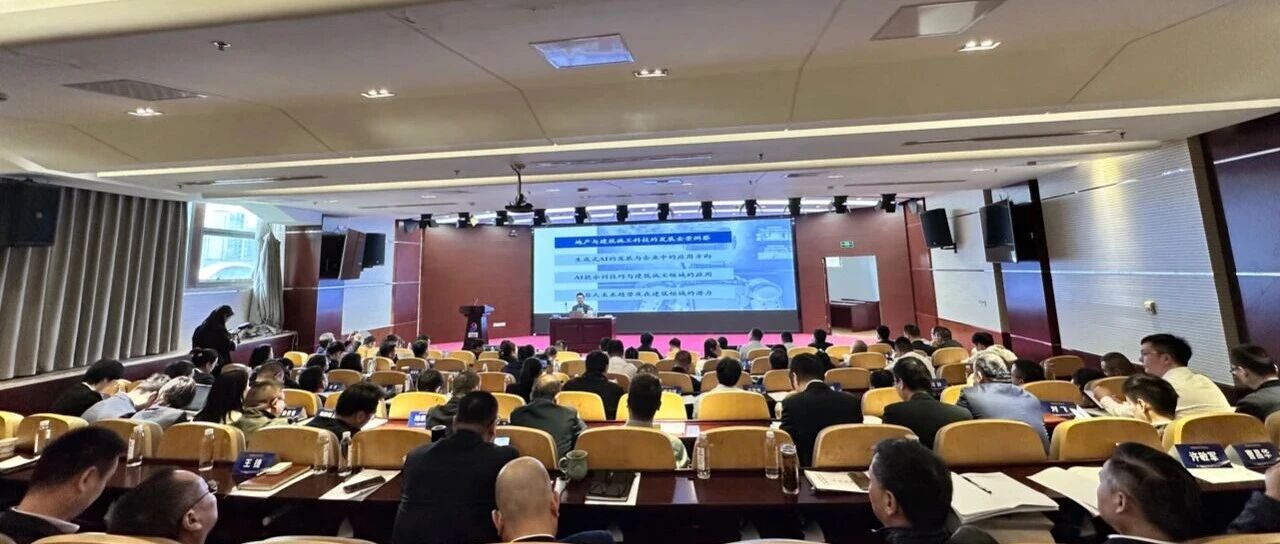
Core Insights - The article discusses the transformative impact of generative AI on the construction industry, highlighting its ability to enhance productivity and safety through real-time monitoring and efficient planning [3][4]. Group 1: AI in Construction - Generative AI has evolved from "decision-making" to "generative," enabling the creation of text, images, and videos, significantly boosting productivity [3]. - An example from the Nanning rail transit project demonstrates AI's capability to identify safety hazards, providing alerts for foundation risks within 10 minutes [3]. - The AecGPT model can generate high-quality construction schedules in 30 minutes, improving efficiency by over six times [3]. Group 2: AI Application Techniques - Zhang Ziming shared methodologies for AI prompt techniques, including "instruction-based" and "reasoning-based" approaches, which help in generating precise content for construction safety and project planning [3]. - These techniques lower the barriers to AI application, aiding companies in cost reduction and efficiency enhancement [3]. Group 3: Robotics in Construction - The training emphasized the potential of embodied intelligence, particularly humanoid robots, in security inspections and logistics sorting [3]. - The Zhiyuan robot has successfully performed bolt fastening tasks in electrical scenarios, indicating a future of "human-machine collaboration" on construction sites [3]. - The integration of BIM and AI is driving the industry from "human defense" to "technical defense" [3]. Group 4: Organizational Impact - The training showcased the leading experience of the Unknown AI Research Institute in implementing AI technology solutions and strategic consulting [4]. - The institute is committed to integrating education and industry, providing comprehensive support from training to implementation for traditional enterprises like Zhejiang Construction Investment Group [4].

Why Alamo (ALG) Stock Is Down Today
Yahoo Finance· 2025-11-07 21:06
Core Insights - Alamo Group's shares fell 4.5% after reporting third-quarter 2025 earnings that missed profit expectations despite higher-than-expected sales [1][2] Financial Performance - Adjusted earnings per share were $2.34, below Wall Street's forecast of $2.64 [2] - Total revenue increased by 4.7% year-on-year to $420 million, surpassing estimates [2] - Operating margin declined to 8.9% from 10% in the same quarter last year, indicating weakening profitability [2] - Adjusted EBITDA was $55.01 million, also missing analysts' expectations [2] Market Reaction - Shares closed at $166.69, down 3.6% from the previous close [3] - The stock has shown low volatility, with only five moves greater than 5% in the past year, suggesting the market views this news as significant [4] Historical Context - The stock is down 7.4% year-to-date and is trading 28.2% below its 52-week high of $232.42 from August 2025 [6] - Investors who purchased $1,000 worth of shares five years ago would see their investment worth $1,240 today [6] Analyst Sentiment - Investment firm Baird upgraded Alamo's stock to 'Outperform' from 'Neutral' three months ago, raising the price target to $260 from $209, indicating a potential 24.4% upside [5] - Baird cited a stabilizing market and growth opportunities in the utility and small tractor sectors as reasons for increased optimism [5]

AI是优秀的“作者”,写的论文很优质?丨中新真探
Zhong Guo Xin Wen Wang· 2025-11-07 11:46
Core Viewpoint - Current generative AI can produce seemingly fluent text but fundamentally mimics and reorganizes training data, lacking the critical thinking and creativity of human scientists, making it difficult to generate academically valuable papers [1] Group 1 - Generative AI is capable of writing high-quality papers that appear coherent [1] - AI may experience "AI hallucination," where it fabricates non-existent content such as references and experimental data [1]

估值36亿美元的可穿戴设备Whoop,在AI时代展示了哪些新价值?
3 6 Ke· 2025-11-07 10:14
Core Insights - Whoop, an AI wearable device company founded in 2012, initially focused on sleep and recovery for professional athletes, achieving a valuation of $3.6 billion as a unicorn in the sports wearable sector [1][4] - The company has integrated generative AI technology into its devices, enhancing accuracy and expanding its potential applications [1][6] - Whoop completed a $200 million Series F funding round in August 2021, led by SoftBank Vision Fund 2, with participation from various investors including notable athletes [1][2] Company Overview - Whoop was co-founded by Will Ahmed, John Capodilupo, and Aurelian Nicolae, who met at Harvard [2] - The initial idea stemmed from Ahmed's desire to monitor training, recovery, and sleep data as a Harvard athlete [4] Product Development - The release of Whoop 4.0 in September 2023 introduced the Whoop Coach, an AI health assistant that provides personalized fitness guidance based on user data and the latest sports science [6][9] - Whoop 5.0 features upgraded sensors, a redesigned processor for improved efficiency, and a 14-day battery life, while the new Whoop MG series includes medical-grade ECG sensors [7][11] Health Functionality - Whoop focuses on three core pillars: sleep, recovery, and consumption, generating daily recovery scores to assess user readiness [9][10] - The device tracks various metrics, including heart rate variability (HRV), resting heart rate, and sleep performance, to provide insights into user health [10][12] Targeted Features - Whoop 5.0 includes a menstrual cycle tracking feature for women, offering insights into hormonal changes and their effects on health [10] - The Whoop MG can perform on-demand ECG readings and estimate blood pressure, although the latter is still in testing [11] Business Model - Whoop operates on a subscription-based model, where hardware costs are included in the membership fee, with the highest tier (Whoop MG) priced at $359 annually [12] - The company aims to provide ongoing value to users, addressing challenges faced by previous fitness tech products that struggled with user retention and perceived value [13][14] Industry Outlook - The success of AI-native wearable devices hinges on their ability to deliver high-value health insights and maintain user engagement over time [15] - The market for AI-driven health wearables is expected to grow, with investments in early-stage companies indicating strong interest in this sector [15][16]

英伟达翻车?散户疯狂抄底 AI,机构却悄悄跑路,内部人士曝关键
水皮More· 2025-11-07 09:39
Core Viewpoint - The article discusses the ongoing debate about AI investments, highlighting contrasting views from bullish analysts like Goldman Sachs and bearish investors like Michael Burry, focusing on whether the current AI investment landscape is a bubble or a genuine growth opportunity [1][2]. Group 1: Bullish Perspective - Goldman Sachs asserts that AI investments are not yet overheated, with projections indicating that by October 2025, AI-related investments in the U.S. could reach $300 billion, which is less than 1% of the U.S. GDP [5][6]. - Historical comparisons show that during the peak of the internet bubble, IT investments accounted for 2% of GDP, while electrification reached 5%, suggesting that current AI investment levels are still significantly lower [6][9]. - Goldman Sachs estimates that generative AI could generate $20 trillion in present value benefits for the U.S. economy, with businesses potentially capturing $8 trillion of that value, far exceeding current investment levels [8]. - The allocation of the $300 billion investment includes $112 billion for semiconductor chips, $88 billion for data centers, and $65 billion for power supply upgrades, indicating a focus on infrastructure rather than speculative concepts [9][10]. - AI is seen as a genuine efficiency booster across various sectors, with practical applications already yielding tangible benefits, such as improved customer service and operational efficiencies [10][16]. Group 2: Performance of Leading Companies - Major companies like TSMC and NVIDIA are demonstrating strong financial performance, with TSMC reporting a 30.3% year-on-year revenue growth and a 39.1% increase in net profit, driven by high demand for AI chips [12]. - NVIDIA's mid-year report shows revenues of $90.805 billion and a net profit of $45.197 billion, underscoring its dominant position in the AI chip market [12]. - The profitability of these leading firms supports the argument that there is no bubble in the AI sector, as their financial results reflect real demand for AI infrastructure [12]. Group 3: Bearish Perspective - The bearish camp, represented by figures like Michael Burry, warns of potential bubbles in the AI sector, citing excessive spending with insufficient returns, and highlighting that many high-profile AI companies are operating at a loss [21][23]. - Concerns are raised about the sustainability of AI-driven GDP growth, with reports indicating that nearly 92% of U.S. GDP growth in the first half of 2025 was reliant on AI investments, suggesting a "hollow" economy [23]. - A significant portion of AI companies, including OpenAI, are facing substantial losses, with OpenAI reporting a net loss of $13.5 billion in the first half of 2025 [23]. - The debate centers around whether current high valuations can be justified by future earnings, with the potential for a market correction if these valuations are not supported by actual profitability [25][27]. Group 4: Future Outlook - The article concludes that the future of AI investments will depend on the ability of companies to deliver real value and efficiency improvements, distinguishing between those that can sustain high valuations and those that are merely speculative [29]. - As AI technology matures, companies that genuinely enhance productivity and meet new demands are expected to thrive, while those focused on hype without substance may be eliminated from the market [29].



独家对话群核科技董事长:未来机器人数量将超700亿
Sou Hu Cai Jing· 2025-11-07 08:11
Core Viewpoint - The "Hangzhou Six Little Dragons" are gaining attention, particularly with the focus on spatial intelligence and the potential for a significant increase in the number of robots globally, predicted to exceed 70 billion units [2][7]. Group 1: Company Overview - Qunhe Technology, a member of the "Hangzhou Six Little Dragons," has submitted its IPO application to the Hong Kong Stock Exchange, marking the beginning of the "Hangzhou Six Little Dragons IPO" [3]. - The company owns the spatial design software KuJiaLe, its overseas version Coohom, and the AI development platform SpatialVerse, and is recognized as the largest spatial design platform globally, holding a 22.2% market share in China [3]. Group 2: Spatial Intelligence - Qunhe Technology emphasizes a differentiated approach to spatial intelligence, focusing on understanding and reasoning about space rather than hardware development, which is already being addressed by other companies [3][4]. - The company believes that embodied intelligence requires spatial intelligence, as robots need to navigate physical environments, which involves spatial understanding and reasoning [3][4]. Group 3: AI Development - The current wave of generative AI has been anticipated by Qunhe Technology, which has previously encountered early forms of this technology. The unexpected aspect is the ability of algorithms to produce surprising intelligence through vast amounts of data [6]. - The company is leveraging its extensive physical design and spatial data accumulated through the KuJiaLe 3D cloud design platform to train models that generate spatial data consistent with the physical world, addressing issues of data scarcity and high acquisition costs [6]. Group 4: Future Predictions - The CEO predicts that the future may see a robot population ten times that of humans, with the global number of robots potentially exceeding 70 billion [7]. - The transition from automation to intelligent robots is expected to occur within the next two to three years, although achieving human-like flexibility and intelligence may take longer [7].

强化学习教父重出江湖, 生成式AI的时代要结束了?
3 6 Ke· 2025-11-07 07:11
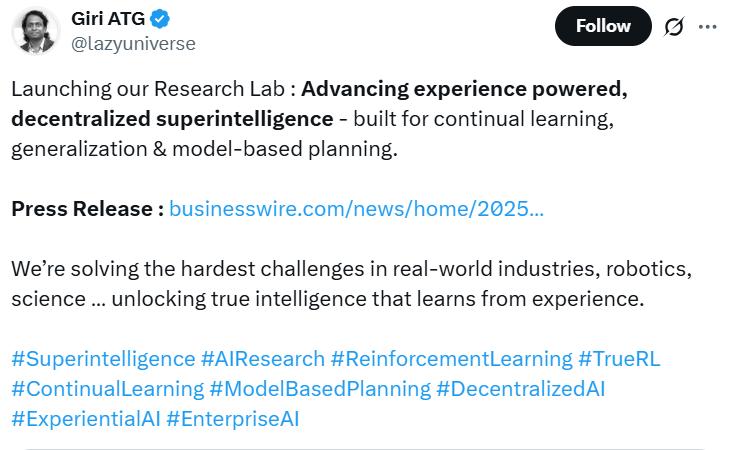
Core Insights - The era of generative AI is nearing its end, as Richard Sutton, the father of reinforcement learning, joins ExperienceFlow.AI to redefine intelligence through experience rather than human data [1][5][9] - ExperienceFlow.AI aims to create a decentralized superintelligence driven by experience, moving away from the reliance on large language models [12][13][26] Company Overview - ExperienceFlow.AI is a newly established AI company based in San Francisco, focusing on "experience-driven decentralized superintelligence" [12][13] - The company plans to develop a "superintelligence research laboratory" under Sutton's leadership, emphasizing the importance of learning from experience [6][12] Industry Context - The AI industry has seen rapid advancements in generative models, but Sutton argues that true intelligence requires interaction with the environment and learning from experiences [5][9][11] - Sutton's return signals a shift in the AI landscape, where the focus will be on understanding and learning rather than mere imitation [11][18] Technological Shift - ExperienceFlow.AI proposes a new paradigm of "experience-driven superintelligence," which allows AI to continuously explore, correct, and accumulate knowledge in open environments [15][26] - The company emphasizes decentralized intelligence, enabling organizations to build independent AI networks that learn from their unique experiences [16][20][21] Future Implications - The concept of "autonomous enterprises" is introduced, where AI systems can independently analyze, plan, and execute tasks based on accumulated experience [22][26] - This decentralized approach is expected to redefine the concept of enterprises, allowing for diverse and differentiated knowledge accumulation across various sectors [27][28][29]