多品牌战略

Search documents
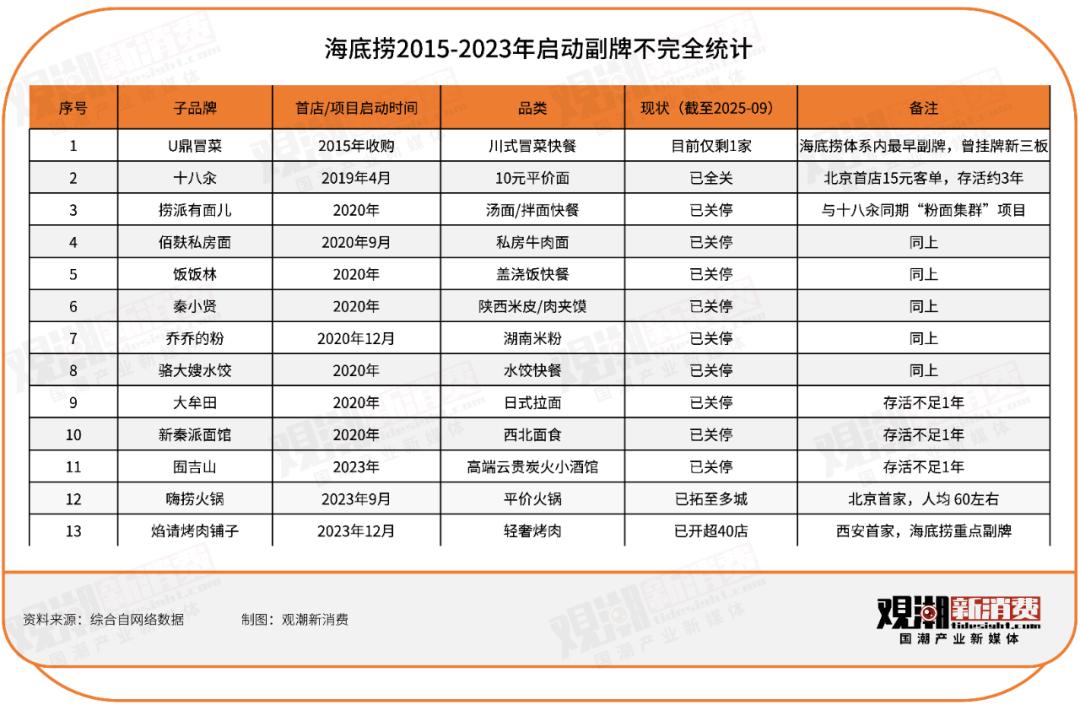
预制菜风波背后:西贝与海底捞们的副牌焦虑
3 6 Ke· 2025-09-22 11:34
Core Viewpoint - The restaurant industry is shifting from a "many brands, many blessings" strategy to a focus on "quality over quantity" in brand development, particularly in the context of a low-margin environment [1][27]. Group 1: Brand Strategy - Leading restaurant companies are adopting a "main brand holds the fort, sub-brands charge forward" strategy, but the success of sub-brands depends on strategic consistency and resource synergy [2][27]. - Haidilao, despite being a hotpot giant, is aggressively exploring sub-brands, having launched over 20 sub-brands across various categories, including baking and barbecue [1][3]. Group 2: Performance and Challenges - Haidilao's rapid expansion led to a significant increase in store count to 1,205 by 2020, resulting in operational challenges and a record loss of 4.2 billion yuan in 2021 [3][4]. - The company has since reassessed its sub-brand strategy, focusing on fewer launches and prioritizing its main brand, with only three sub-brands introduced in 2023 [3][4]. Group 3: Sub-Brand Development - The "Red Pomegranate Plan" encourages internal entrepreneurship among employees, allowing for quicker market adjustments and reducing trial costs for new sub-brands [5][27]. - By the end of 2024, Haidilao's other restaurant revenues reached 483 million yuan, showing a year-on-year growth of 39.6%, indicating initial success from its sub-brands [6]. Group 4: Pricing Strategy - The restaurant market is experiencing a structural shift towards lower price points, with average hotpot spending dropping from 86.7 yuan in 2022 to 77.1 yuan in 2025, a decline of 11% [13][16]. - Haidilao's sub-brands are strategically priced to attract a broader consumer base, with offerings like "Little Hi Hotpot" and "High High Self-Service Hotpot" focusing on affordability [14][15]. Group 5: Industry Trends - The competitive landscape is forcing companies to refine their sub-brand strategies, with many opting to consolidate resources and focus on core brands rather than spreading themselves too thin [23][26]. - West B's sub-brand exploration has resulted in cumulative losses of 700-800 million yuan over 7-8 years, leading to a strategic retreat to focus on its main brand [26][27].


360亿买下的始祖鸟,在5500米海拔炸翻了安踏的并购神话!
Sou Hu Cai Jing· 2025-09-22 10:31
Core Viewpoint - Anta's aggressive multi-brand acquisition strategy has led to significant revenue growth, but recent controversies highlight management challenges and potential risks to brand reputation [1][4]. Group 1: Acquisition Strategy - Anta has made substantial investments in various brands, including a 36 billion yuan acquisition of Amer Sports, the parent company of the brand Arc'teryx, in 2019 [1]. - In the same year, Anta acquired FILA for 314 million yuan, filling a gap in the high-end sports fashion market in China [2]. - In 2023, Anta expanded its portfolio by acquiring the women's yoga apparel brand MAIA ACTIVE and, in 2024, invested 2.9 billion USD for a 75.13% stake in the German outdoor brand Jack Wolfskin [2]. Group 2: Revenue Impact - FILA has become a significant revenue contributor for Anta, generating 14.182 billion yuan in the first half of the year, accounting for 36.79% of Anta's total revenue [4]. Group 3: Management Challenges - The rapid expansion through acquisitions has led to management difficulties, as evidenced by the recent backlash over an environmentally controversial fireworks display by Arc'teryx, which resulted in a 4% drop in Anta's stock price and a market value loss of over 4 billion yuan [1][4]. - The company faces the challenge of integrating these brands effectively, as acquisition is only the beginning, and proper management is crucial for maintaining brand value [4][5].
“男人的衣柜”欲赴港上市 手握111家海外门店深耕东南亚
Sou Hu Cai Jing· 2025-09-20 00:26
Core Viewpoint - The company, HLA (海澜之家), is initiating plans for a Hong Kong listing to enhance its global strategy and accelerate overseas business development [1][2]. Group 1: Overseas Expansion - HLA's overseas revenue has significantly increased from 6.17 million in 2017 to 355 million in 2024, with a 27.42% year-on-year growth in the first half of 2025 [2]. - The company is expanding into mature markets like Malaysia, Thailand, Vietnam, and Singapore, while also exploring new markets in Central Asia and the Middle East [2][18]. - As of the first half of 2025, HLA has opened 111 overseas stores, with a focus on profitability in various store formats [23]. Group 2: Business Strategy and Performance - HLA is transitioning from a men's clothing brand to a family-oriented brand, implementing a multi-brand strategy that includes women's wear, children's wear, and sportswear [4][5]. - Despite a 1.73% year-on-year revenue growth to 11.566 billion in the first half of 2025, the company's net profit decreased by 3.42% to 1.580 billion, indicating challenges in performance [5]. - The main brand, HLA, contributes approximately 75% of the company's revenue, with consistent performance over the years [8][9]. Group 3: Financial Overview - HLA's revenue from 2020 to 2024 showed fluctuations, with figures of 17.959 billion, 20.188 billion, 18.562 billion, 21.528 billion, and 20.957 billion respectively, reflecting varying growth rates [5][6]. - The company's net profit during the same period also experienced volatility, with figures of 1.785 billion, 2.491 billion, 2.155 billion, 2.952 billion, and 2.159 billion, indicating a challenging financial landscape [5][6]. Group 4: Market Position and Future Outlook - HLA's overseas business has a gross margin significantly higher than its domestic operations, with margins of 66.32%, 68.89%, and 68.13% from 2022 to 2024 [19]. - The overseas revenue still represents a small portion of total revenue, accounting for only 1.83% in the first half of 2025 [21][22]. - The company is actively pursuing new market opportunities and plans to open its first store in Australia in the second half of 2025 [18].

“男人的衣柜”启动上市,半年净赚超15亿元
Sou Hu Cai Jing· 2025-09-19 13:42
Core Viewpoint - The company, HLA (海澜之家), is initiating plans for a Hong Kong listing to enhance its global strategy and accelerate overseas business development, with a focus on diversifying its capital operation platform [2] Group 1: Overseas Expansion - HLA's overseas revenue has significantly increased from 6.1684 million in 2017 to 355 million in 2024, with a 27.42% year-on-year growth in the first half of 2025 [2] - The company has expanded its international presence in Southeast Asia and is exploring new markets in Central Asia and the Middle East, with plans to open its first store in Australia [11][12] - As of the first half of 2025, HLA has 111 overseas stores, with overseas revenue accounting for only 1.83% of total revenue [14] Group 2: Financial Performance - In the first half of 2025, HLA's revenue grew by 1.73% to 11.566 billion, but net profit decreased by 3.42% to 1.580 billion, indicating challenges in performance [3] - The company's revenue from its main brand, HLA, accounted for approximately 75% of total revenue in the first half of 2025 [5] - HLA's historical revenue from 2020 to 2024 showed fluctuations, with figures of 17.959 billion, 20.188 billion, 18.562 billion, 21.528 billion, and 20.957 billion, reflecting a mixed growth trajectory [3][4] Group 3: Strategic Initiatives - HLA has diversified its brand portfolio since 2021, including women's brand OVV, trendy brand HLA JEANS, and children's brand YeeHoO, alongside exclusive partnerships with international brands [3] - The company is investing in the sports sector, acquiring a 51% stake in a brand management company for 248 million, and has opened 529 Adidas stores in China [6][7] - HLA is collaborating with JD.com to create a new retail format, "JD Outlet," to tap into the high-value consumer market, with 23 stores established as of mid-2025 [8]

“男人的衣柜”启动上市,半年净赚超15亿元
21世纪经济报道· 2025-09-19 13:12
Core Viewpoint - The company, HLA, is initiating a plan for a Hong Kong listing to enhance its global strategy and accelerate overseas business development, with a focus on diversifying its capital operation platform [1] Group 1: Overseas Expansion - HLA's overseas revenue has significantly increased from 6.1684 million in 2017 to 355 million in 2024, with a 27.42% year-on-year growth in the first half of 2025 [1] - The company has expanded its presence in Southeast Asia, including Malaysia, Thailand, Vietnam, and Singapore, while also exploring new markets in Central Asia and the Middle East [1][8] - As of the first half of 2025, HLA has opened 111 overseas stores, with overseas revenue accounting for only 1.83% of total revenue [8][6] Group 2: Business Transformation - HLA is transitioning from being a "men's wardrobe" to a "family wardrobe" by implementing a multi-brand and multi-category strategy, which includes women's wear, children's wear, and sportswear [2] - Despite a 1.73% year-on-year revenue growth to 11.566 billion in the first half of 2025, the company's net profit attributable to shareholders decreased by 3.42% to 1.580 billion, indicating challenges in performance [2][3] - The main brand, HLA, contributed approximately 75% of the company's main business revenue in the first half of 2025, highlighting its significance in the overall revenue structure [4] Group 3: Financial Performance - HLA's revenue from the main brand has consistently accounted for over 70% of total revenue from 2020 to 2024, with figures of 137.68 billion, 151.33 billion, 137.53 billion, 164.58 billion, and 152.70 billion respectively [4] - The company's financial performance has shown volatility, with significant fluctuations in both revenue and net profit from 2020 to 2024, compared to its peak in 2019 [3][4] - The company has invested 248 million in acquiring a 51% stake in a sports brand management company to enhance its sports segment and has established 529 Adidas stores in China as of the first half of 2025 [4][5]

报 喜 鸟2025年9月19日涨停分析:多品牌战略+线上渠道拓展+企业治理稳定
Xin Lang Cai Jing· 2025-09-19 03:28
Core Viewpoint - The stock of Baoxiniang (SZ002154) reached its daily limit with a price of 4.68 yuan, marking a 10.12% increase, and a total market capitalization of 6.83 billion yuan [1] Company Summary - Baoxiniang's stock surge is attributed to several factors: the completion of the WOOLRICH brand acquisition, an 8.37% growth in the HAZZYS brand, and a continuous multi-brand strategy that enhances market share and brand influence [2] - Online sales have increased by 17.65%, with new channels like Douyin contributing to growth, providing new revenue streams for the company [2] - The successful re-election of the board of directors has stabilized corporate governance, with both independent and non-independent directors receiving high votes, indicating shareholder confidence in the new board [2] - The company maintains its high-tech enterprise status, allowing for a reduced corporate tax rate of 15%, which lowers tax burdens [2] - The pledge ratio of the controlling shareholder has decreased from 42.29% to 32.42%, suggesting a reduction in financial pressure on shareholders [2] Industry Summary - The apparel and home textile sector is currently gaining market attention, potentially leading to a sector-wide effect, as evidenced by the active performance of certain stocks in this category [2] - Technical analysis suggests that while more data is needed for a comprehensive judgment, the favorable fundamentals of Baoxiniang may attract investor interest, contributing to the stock's limit-up performance [2] - Despite the recent surge, previous trading data from September 17 indicated net selling by retail, institutional, and foreign investors, suggesting that the current price movement may also involve speculative trading [2]

11.6亿美元融资完成,蔚来再获市场“补血”
Huan Qiu Lao Hu Cai Jing· 2025-09-18 07:03
Group 1 - NIO announced the completion of a $1.16 billion financing through a public offering of approximately 209 million shares, including 161 million American Depositary Shares (ADS) and 21 million A-class ordinary shares [1] - The financing proceeds will be used for the development of core technologies for smart electric vehicles, future technology platforms, and expansion of the charging and battery swap network [1] - UBS raised NIO's target price to $8.50 following the financing announcement, expressing optimism about the company's growth potential driven by improved financial structure and new product competitiveness [1] Group 2 - In Q2, NIO reported revenue of 19.01 billion yuan, a year-on-year increase of 9.0% and a quarter-on-quarter increase of 57.9%, with a net loss of 4.995 billion yuan, narrowing by 1.0% year-on-year and 26% quarter-on-quarter [2] - NIO delivered 72,000 new vehicles in Q2, a year-on-year increase of 25.6% and a quarter-on-quarter increase of 71.2%, with August deliveries reaching a record high, growing 55.2% year-on-year [2] - For Q3, NIO expects revenue between 21.81 billion and 22.88 billion yuan and delivery volume between 87,000 and 91,000 vehicles, projecting a year-on-year growth of 40.7% to 47.1% [2]

蔚来-SW涨超8%创近一年新高 全新ES8将于本周六正式上市
Zhi Tong Cai Jing· 2025-09-17 02:35
Core Viewpoint - NIO's stock price surged over 8%, reaching a new high of 55.45 HKD since October last year, driven by positive market sentiment ahead of the upcoming NIO Day 2025 and the launch of the new ES8 model [1] Group 1: Stock Performance - NIO's stock increased by 8.13%, trading at 55.2 HKD with a transaction volume of 215 million HKD [1] Group 2: Upcoming Events - NIO Day 2025 is scheduled for September 20, where the new ES8 will be officially launched [1] Group 3: Market Strategy - According to Everbright Securities, NIO's multi-brand strategy is entering a harvest phase, with three brands covering price ranges from 150,000 to 800,000 RMB [1] - The new ES8 and the Lada L90 have gained significant market traction, with the Lada L90 receiving over 10,000 orders on its first day and the ES8 exceeding Lada L90's order performance in the same period [1] Group 4: Future Outlook - The firm is optimistic about NIO's product cycle in 2025, highlighting advantages in intelligence, battery swapping, and cost reduction [1]
港股异动 | 蔚来-SW(09866)涨超8%创近一年新高 全新ES8将于本周六正式上市
智通财经网· 2025-09-17 02:30
Group 1 - NIO-SW (09866) shares rose over 8%, reaching a new high of 55.45 HKD since October last year, with a trading volume of 215 million HKD [1] - NIO Day 2025 is scheduled for September 20, where the new ES8 will be officially launched [1] - Everbright Securities believes that the company's multi-brand strategy is entering a harvest period, covering price ranges from 150,000 to 800,000 RMB [1] Group 2 - The new ES8 and Lada L90 have opened up the pure electric large three-row SUV market with high cost-performance ratios, with Lada L90 receiving over 10,000 orders on its first day and ES8 orders exceeding those of Lada L90 in the same period [1] - The firm is optimistic about the new product cycle starting in 2025 for NIO's three brands, along with the advantages of intelligence and battery swapping, as well as the prospects for cost reduction and efficiency improvement [1]
港股异动 | 安踏体育(02020)涨超3% 首八个月体育用品社零快速增长 目前公司销售增长呈边际改善迹象
智通财经网· 2025-09-16 02:15
Core Viewpoint - Anta Sports (02020) shows a strong performance with a stock increase of over 3%, currently at HKD 97.05, with a trading volume of HKD 250 million [1] Group 1: Industry Insights - The textile and apparel retail sector shows a slight improvement in monthly growth rates, with a cumulative year-on-year growth of 2.9% from January to August 2025 [1] - The sports and entertainment goods retail sector demonstrates a faster growth rate, with a cumulative year-on-year increase of 20.6% and a monthly growth of 16.9% in August [1] - The retail discount levels in the branded apparel industry have slightly deepened year-on-year but remain at a manageable level, contributing to stable operating profit margins [1] Group 2: Company Performance - Anta is confident in achieving double-digit sales growth for the full year of 2025, with signs of improvement observed from late August to the present [1] - The company's strong performance is supported by a multi-brand strategy, increasingly focusing on niche sports such as outdoor activities, tennis, golf, and yoga [1] - Anta's cautious cost control measures are in place, and overseas business is expected to become a significant contributor to revenue, with plans to expand store numbers in ASEAN countries to 1,000 within three years, exceeding 200 stores by the first half of 2025 [1] - The management's multi-brand strategy aims to enhance operational superiority, and Citic Lyon expresses optimism regarding Anta's strong execution capabilities [1]