新发展格局

Search documents
2026年全国商务重点工作敲定:激发下沉市场消费活力
Sou Hu Cai Jing· 2026-01-11 19:45
大力提振消费,推进建设强大国内市场,积极扩大自主开放,推动贸易创新发展,拓展双向投资合作空 间,实现"十五五"商务高质量发展良好开局。 会议指出,2026年全国商务系统要自觉把思想和行动统一到党中央决策部署上来,学习好、运用好中央 经济工作会议关于"五个必须"的规律性认识,重点做好八个方面工作: 会议认为,"十四五"时期消费主引擎作用明显增强,贸易强国"三大支柱"更加巩固,利用外资总量稳 定、结构优化,对外投资平稳发展,产供链国际合作有序推进,高水平对外开放步伐加快,多双边经贸 合作不断深化,维护经济安全能力显著提升,为"十五五"时期商务发展奠定坚实基础。 会议强调,2026年是"十五五"开局之年,做好商务工作意义重大。全国商务系统要以习近平新时代中国 特色社会主义思想为指导,深入贯彻党的二十大和二十届历次全会精神,认真落实中央经济工作会议部 署,完整准确全面贯彻新发展理念,加快构建新发展格局,着力推动高质量发展,坚持稳中求进工作总 基调,更好统筹国内经济工作和国际经贸斗争,更好统筹发展和安全,立足商务工作"三个重要"定位, 1月10日至11日,全国商务工作会议在京召开。会议以习近平新时代中国特色社会主义思想 ...

商务部部署2026年重点工作
Xin Lang Cai Jing· 2026-01-11 06:30
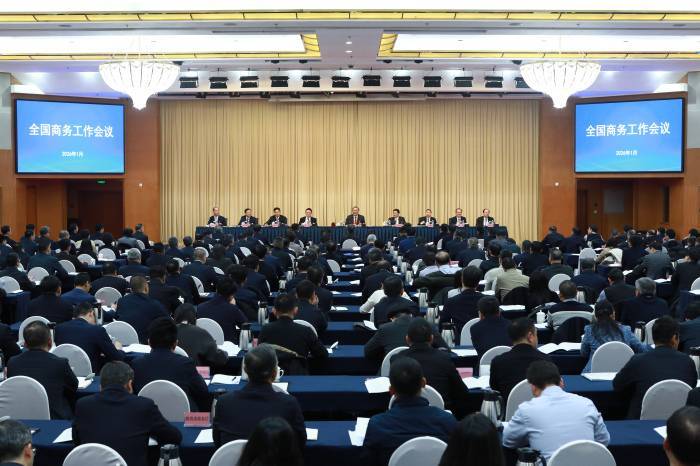
全国商务工作会议在京召开 1月10日至11日,全国商务工作会议在京召开。会议以习近平新时代中国特色社会主义思想为指导,深 入贯彻落实党的二十大和二十届历次全会精神,认真落实中央经济工作会议部署,坚持稳中求进工作总 基调,立足商务工作"三个重要"定位,总结2025年和"十四五"工作,研究"十五五"目标任务,部署2026 年工作。商务部党组书记、部长王文涛作工作报告,商务部党组副书记、国际贸易谈判代表兼副部长李 成钢主持会议。 会议指出,2025年是很不平凡的一年。在以习近平同志为核心的党中央坚强领导下,全国商务系统迎难 而上、奋力拼搏,推动党中央、国务院决策部署在商务领域落地见效,实现商务发展总体平稳、稳中有 进,提振消费加力显效,对外贸易顶压增长,利用外资结构优化,对外投资有序推进,为经济持续回升 向好作出积极贡献。 全国商务工作会议在京召开 会议认为,过去一年,商务部同各地方各部门密切配合、协同发力,扎实推动以下工作:一是大力提振 消费,加力扩围实施消费品以旧换新,推动服务消费提质惠民,创新打造消费场景,健全流通和市场体 系。二是千方百计稳外贸,大力开拓多元化市场,发展外贸新动能,提升服务贸易和数字贸易。三 ...
全国商务工作会议在京召开
Xin Lang Cai Jing· 2026-01-11 05:53
Core Viewpoint - The national business work conference held on January 10-11 emphasizes the importance of implementing the spirit of the 20th National Congress and the Central Economic Work Conference, focusing on stabilizing and advancing business development while preparing for the 15th Five-Year Plan [1][3]. Group 1: Business Development Goals - The conference outlines that 2025 will be a significant year for business, aiming for stable and progressive development in consumption, foreign trade, foreign investment, and international cooperation [1][2]. - The "14th Five-Year" period has seen a notable enhancement in the role of consumption as a main driver, with solid foundations laid for the "15th Five-Year" period in terms of trade, investment, and international cooperation [2][3]. Group 2: Key Initiatives for 2026 - The conference identifies eight key areas for the national business system to focus on in 2026, including boosting consumption, enhancing the modern market and circulation system, and promoting trade innovation [4]. - Specific initiatives include creating a "Buy in China" brand, optimizing consumption policies, and developing digital and green consumption [4][5]. Group 3: Leadership and Governance - The conference stresses the need for strong party leadership in business, promoting high-quality development through strict governance and adherence to the central government's directives [5][6]. - It highlights the importance of fostering a correct performance view and ensuring that business efforts align with the needs of the people [5].
惠民生促发展,第五篇“钟才平”关注“有温度”的新供给
Xin Lang Cai Jing· 2026-01-11 01:44
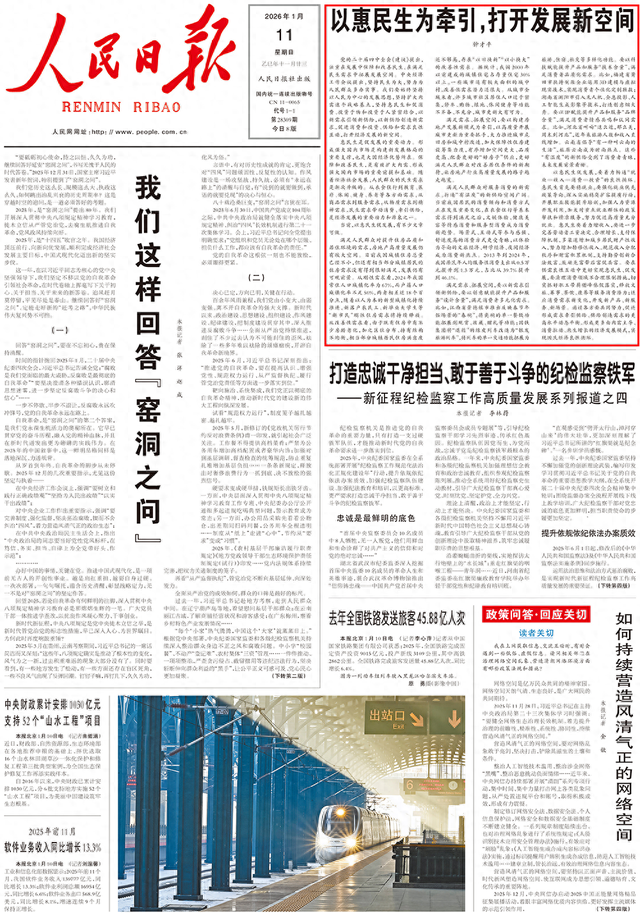
Core Viewpoint - The article emphasizes the importance of prioritizing people's livelihoods to drive economic development, advocating for a model that combines consumer demand with investment in both goods and people [8][9]. Group 1: Economic Development and Livelihood Improvement - The article highlights that ensuring and improving people's livelihoods is a crucial driver for economic growth, with a strong domestic market being essential for a new development pattern [8]. - It notes that as the economy develops, the public's demand for better living conditions is evolving, covering various aspects from basic needs to services like education and healthcare [8][9]. - The article points out that there is significant potential for high-quality development in the real estate sector, as many urban residents' housing needs remain unmet despite a large total housing stock [9][10]. Group 2: Real Estate and Urban Development - The article suggests that there is a need for a new model of real estate development, focusing on high-quality urban renewal and increasing the supply of better-quality housing to meet public expectations [10]. - It mentions that the urbanization rate for permanent residents is projected to reach 67% by 2024, indicating ongoing demand for housing from new urban residents [9]. - The article also discusses the potential for urban renewal, particularly in densely populated communities where infrastructure and amenities are lacking [9][10]. Group 3: Consumer Demand and Service Sector Growth - The article identifies a shift in consumer preferences towards service-oriented consumption, with spending on services expected to rise significantly, from 5,000 yuan to 13,000 yuan per capita between 2013 and 2024 [10]. - It emphasizes the importance of creating new supply that meets the diverse needs of consumers, including emotional and experiential aspects of consumption [11]. - The article highlights examples of innovative products and services that cater to changing consumer demands, such as personalized products and enhanced experiences in tourism and entertainment [11]. Group 4: Employment and Income Generation - The article stresses the need to maintain stable employment as a foundation for improving livelihoods, advocating for policies that support job creation and skills training [12]. - It calls for measures to increase income for urban and rural residents, including improving wage mechanisms and promoting wealth accumulation [12]. - The article suggests that a well-functioning cycle of employment, income, consumption, and investment is essential for achieving sustainable economic growth [12][13].
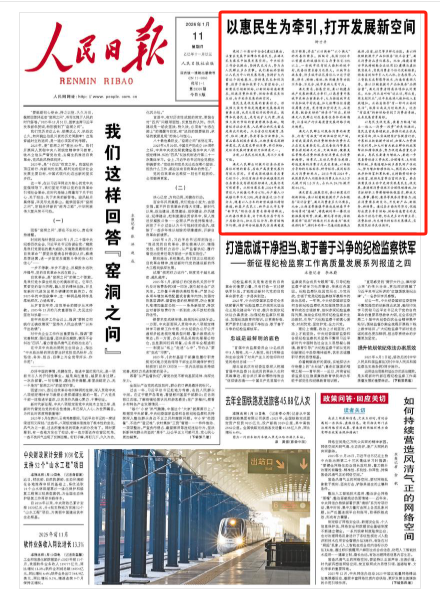
人民日报钟才平:以惠民生为牵引,打开发展新空间
Ren Min Ri Bao· 2026-01-11 00:50
Core Viewpoint - The article emphasizes the importance of prioritizing people's livelihoods to drive economic development, advocating for a strategy that combines consumer demand with investment in both material and human resources to create new growth opportunities [3][11]. Group 1: Economic Development and Livelihood Improvement - The 20th Central Committee's Fourth Plenary Session suggests focusing on improving people's livelihoods while expanding development space, highlighting the need for a people-centered development approach [3][11]. - The Central Economic Work Conference stresses the importance of prioritizing livelihoods and providing practical services to the public [3][11]. - Enhancing people's livelihoods is seen as a crucial driver for economic growth, with a strong domestic market being essential for a new development pattern [3][11]. Group 2: Housing Market and Urbanization - There is significant potential for high-quality development in the real estate sector, as many urban residents' housing needs remain unmet despite a substantial total housing stock [4][12]. - By 2024, the urbanization rate for the resident population is projected to be 67%, while the registered population's urbanization rate is below 50%, indicating a gap of nearly 18 percentage points [4][12]. - The demand for improved housing quality is driven by aging properties and uneven distribution, with over 30% of urban residential buildings constructed before 2000 [4][12][13]. Group 3: Service Consumption Trends - There is a notable shift in consumer preferences towards experiential and service-oriented consumption, with spending on service consumption per capita increasing from 5,000 yuan to 13,000 yuan from 2013 to 2024, rising from 39.7% to 46.1% of total consumption [5][13]. - New consumption trends include a focus on emotional and experiential services, such as cultural tourism and wellness, which are becoming increasingly popular [5][13]. Group 4: Employment and Income Generation - To promote livelihoods, it is essential to stabilize employment through policies that support job retention and expansion, as well as vocational training initiatives [7][15]. - Increasing income through improved wage mechanisms and diversified income sources is crucial for enhancing residents' financial stability [7][15]. - A balanced interaction between supply and demand is necessary to achieve livelihood improvements and economic growth, with a focus on removing unreasonable restrictions in the consumption sector [7][15].
刘宁会见中国黄金集团董事长周洲总经理殷长波
He Nan Ri Bao· 2026-01-09 11:03
Core Viewpoint - The meeting between the Henan Provincial Party Secretary Liu Ning and the leadership of China National Gold Group emphasizes the importance of collaboration to enhance resource security, technological innovation, and project development in Henan province [1][2]. Group 1: Government and Corporate Collaboration - Liu Ning expressed gratitude for China National Gold Group's support in the economic and social development of Henan [1]. - The meeting focused on the "14th Five-Year Plan" and the need for both parties to work together on key projects and ecological protection [1]. - The government aims to create a favorable business environment and enhance investment efforts to ensure the successful implementation of key projects [1]. Group 2: China National Gold Group's Commitment - China National Gold Group acknowledged the support from the Henan government and highlighted the province's rich mineral resources and market potential [2]. - The company plans to focus on areas such as mineral resource development, green smelting technology, and extending the industrial chain to convert resource advantages into developmental benefits for Henan [2]. - The group aims to enhance its production capabilities and contribute to the province's economic growth by aligning its efforts with local needs [2].

连山入选全国第三批共同现代化试点
Nan Fang Ri Bao Wang Luo Ban· 2026-01-08 08:06
Core Insights - The article highlights the recognition of Lianshan Zhuang and Yao Autonomous County as part of the third batch of national modernization pilot projects, marking it as the only county in Guangdong province to be selected [1] - Lianshan has achieved significant economic development, completing its "14th Five-Year Plan" economic targets a year ahead of schedule, and has established the first agricultural new productivity development center in the province [1] Economic Development - Lianshan has successfully created the Qingyuan Lianshan Industrial Park, achieving a breakthrough in provincial-level ecological industrial park establishment since its founding in 1962 [1] - The county's total area is 1,265 square kilometers, with a registered population of 125,000, of which 65.47% are from ethnic minorities [1] Ecological and Agricultural Initiatives - The county is focusing on ecological agriculture, strengthening the "Lianshan Rice" industry, and has been recognized as a first batch of Guangdong's characteristic agricultural product advantage areas [2] - Lianshan has developed over 20,000 acres of under-forest economy, significantly increasing the annual income of participating farmers by over 30,000 yuan [2] - The county has issued 234,200 tons of carbon reduction credits, generating an additional income of 8.6 million yuan for village collectives [2] Cultural and Tourism Development - Lianshan is leveraging its selection as a provincial-level pilot for cultural industry empowerment in rural revitalization to enhance its brand as the "City of Zhuang and Yao Culture" [2] - The county has developed nine tourism routes recognized at the provincial level, with one case being awarded as one of the top ten nationwide [2] - In 2024, the county expects an 80.51% increase in tourist numbers and a 103.77% increase in tourism revenue compared to 2022 [2] Technological Advancements in Agriculture - Lianshan has established the county agricultural new productivity development center, focusing on seed innovation and promoting over 3000 rare rice varieties [3] - The county aims to promote the planting of seven characteristic rice varieties across 500,000 acres in the Guangdong, Hunan, and Guangxi regions, increasing the average annual income of 32,000 farmers by 8,000 yuan [3] - The "Cloud Lianshan" e-commerce platform has achieved online sales exceeding 150 million yuan for geographical indication products [3] Future Development Plans - Lianshan plans to implement a three-year systematic reform from 2026 to 2028, focusing on green industrialization and creating a modernization development pattern that aligns with the unique characteristics of ethnic regions [3] - The vision includes enhancing cultural tourism, ecological beauty, thriving industries, practical livelihoods, and ethnic harmony [3]
原磊:充分挖掘中国经济潜能
Jing Ji Ri Bao· 2026-01-08 00:06
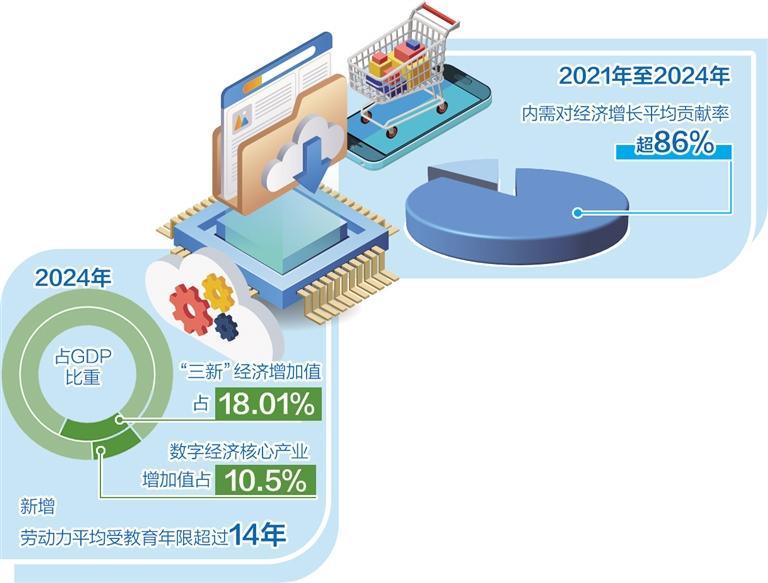
Core Viewpoint - The central economic work conference emphasizes the necessity to fully tap into economic potential as a fundamental guideline for current and future economic work, highlighting the importance of leveraging China's resilience, ample potential, and flexibility to drive high-quality economic development [1][2]. Economic Potential - China's economy is characterized by its large scale and significant untapped potential, which allows for strong internal circulation and resilience against external risks. The emphasis on "fully tapping economic potential" reflects an accurate understanding of China's economic characteristics and future development trends [2]. - The "14th Five-Year Plan" period has seen major breakthroughs in economic development, with GDP steadily increasing and expected to reach approximately 140 trillion yuan by 2025. The average contribution rate of final consumption to economic growth from 2021 to 2024 is close to 60% [3]. High-Quality Development - The transition to high-quality development necessitates tapping into potential as a means to address challenges and achieve upgrades. By 2024, per capita GDP is projected to rise to $13,445, maintaining a position among upper-middle-income countries [4]. - To achieve the goal of reaching the per capita GDP of developed countries by 2035, economic development during the "15th Five-Year Plan" period must maintain an appropriate pace, focusing on deepening the exploration of comprehensive potential in market scale, industrial systems, human resources, and innovation capabilities [4]. New Development Pattern - Tapping into economic potential is crucial for leveraging domestic demand and achieving high-level self-reliance. The new development pattern relies on China's vast market advantages, fostering domestic demand, promoting independent innovation, and optimizing industrial structure [4]. - The emphasis on resource allocation optimization and market vitality is aimed at transforming the scale advantage of the domestic market into real economic growth, providing strong support for the new development pattern [4]. Regional Development - The activation of potential must consider China's unique national conditions, utilizing effective market mechanisms and regional policies to create a new pattern of coordinated regional development. Differences in resource endowments and industrial foundations among regions present opportunities for complementary development [5]. Economic Advantages - The "15th Five-Year Plan" suggests that China's economic foundation remains stable, with numerous advantages and strong resilience, indicating that the long-term supportive conditions and basic trends have not changed [6]. - The four major dividends of economic potential include: - Institutional dividends from the advantages of the socialist system, which enable effective mobilization and coordination [7]. - Market dividends from the vast market size, with over 1.4 billion people and a growing middle-income group, leading to continuous market expansion [8]. - Industrial dividends from a complete industrial system, enhancing supply chain efficiency and promoting innovation [9]. - Talent dividends from a rich talent pool, with a labor force of approximately 860 million and increasing educational attainment [10]. Transforming Potential into Development Momentum - The key to tapping economic potential lies in transforming the four advantages into four dividends, creating strong momentum for economic development. This involves deepening institutional reforms, expanding consumption and investment, promoting industrial innovation, and ensuring a positive cycle of education and talent [11]. - Specific strategies include enhancing the socialist market economy, increasing consumer spending through income growth and social security improvements, and investing in technology and green transformation [12]. - Emphasizing technological innovation to drive industrial advancement, focusing on key areas such as integrated circuits and advanced manufacturing, is essential for fostering new economic growth points [13]. Systematic Approach - Tapping into economic potential is a systematic project that requires a comprehensive understanding of key focus points, balancing current needs with future trends, and integrating policy support with reform and innovation [14].
项目引擎轰鸣 发展动力十足
Xin Lang Cai Jing· 2026-01-07 22:24
Group 1 - Guizhou Er Yi Medical Technology Co., Ltd. is focused on the production of medical protective clothing and isolation gowns, with a target output value of 100 million yuan for the year, and orders already booked until March [1] - The Shiwangguo Group's 5G smart factory has achieved an annual output value exceeding 800 million yuan from the production of processed products from prickly pears, benefiting over 20,000 local farmers [1] - The construction of the Qiannan Pumped Storage Power Station is a key project under the national "14th Five-Year" energy development plan, with 80% of the main engineering completed and expected to reduce carbon dioxide emissions by 1.6 million tons annually upon completion in 2027 [1] Group 2 - Qiannan Prefecture has initiated a series of consumption promotion activities with a budget of 30 million yuan, aiming to boost consumption by over 500 million yuan through various measures including subsidies and promotional events [2] - The economic work meeting in Qiannan has set clear development directions and paths for 2026, emphasizing high-quality development and the implementation of the "316" overall deployment strategy [2][3] - The focus on enhancing the real economy includes strengthening industrial growth, optimizing agriculture, improving tourism, and expanding the service sector, while also fostering new industries and building a green manufacturing system [3]
充分挖掘中国经济潜能
Xin Lang Cai Jing· 2026-01-07 21:21
Core Insights - The central economic work conference emphasizes the necessity to "fully tap economic potential" as a primary strategy for driving high-quality economic development in China [2][3]. Group 1: Economic Potential - China's economy is characterized by its large scale and significant untapped potential, which can enhance resilience and independence against external risks [3]. - The conference highlights the importance of recognizing and effectively stimulating this potential to transform it into robust economic growth [4]. Group 2: Economic Achievements - During the "14th Five-Year Plan" period, China's economy has made significant strides, with GDP expected to reach approximately 140 trillion yuan by 2025, following a steady increase past 110 trillion, 120 trillion, and 130 trillion yuan [4]. - The average contribution of final consumption to economic growth from 2021 to 2024 is projected to be close to 60%, indicating a strengthening role of domestic demand [4]. Group 3: Strategic Focus Areas - The need to enhance economic potential is elevated to a strategic level, particularly in light of profound changes in both domestic and international environments, including a new wave of technological revolution and industrial transformation [4]. - The transition to high-quality development necessitates a focus on deepening the integration of traditional growth drivers with new ones, leveraging market scale, industrial systems, human resources, and innovation capabilities [5]. Group 4: Advantages and Dividends - The "15th Five-Year Plan" outlines four key advantages that represent China's economic potential: institutional, market, industrial, and talent dividends [7][8][9][10]. - Institutional dividends stem from the advantages of the socialist system, which enables coordinated efforts and long-term strategic focus [7]. - Market dividends arise from China's vast market size and the growing middle-income population, which enhances consumption and innovation opportunities [8]. - Industrial dividends are linked to China's comprehensive industrial system, which supports efficiency and innovation in production [9]. - Talent dividends are derived from a large and increasingly educated labor force, which is crucial for driving technological and economic advancements [10]. Group 5: Implementation Strategies - To effectively stimulate economic potential, it is essential to focus on deepening institutional reforms, expanding consumption and investment, and promoting industrial innovation [11]. - Strategies include enhancing the domestic market through increased consumer income and investment in key sectors such as technology and green transformation [12]. - Emphasis on technological innovation is critical for driving industrial upgrades and fostering new economic growth points [13].