
研发投入

Search documents
财经观察:从三组数据看中国EV发展潜能
Huan Qiu Wang· 2026-01-07 22:39
Core Viewpoint - BYD has surpassed Tesla to become the world's largest electric vehicle manufacturer, selling 2.26 million pure electric vehicles in 2025 compared to Tesla's 1.64 million, marking a significant shift in the global EV market dynamics [1] Group 1: R&D Investment and Workforce - BYD's revenue for the first three quarters of the year reached 566.27 billion yuan, with R&D expenses amounting to 43.75 billion yuan, representing 7.7% of its revenue [2] - The company has over 120,000 R&D personnel across 11 research institutes, with more than 50,000 recent graduates hired in the last three years, of which over 70% hold master's or doctoral degrees [4] - BYD's R&D investment has consistently ranked first among A-share listed companies, with a cumulative investment exceeding 220 billion yuan [4] Group 2: Competitive Landscape and Market Position - BYD's R&D investment is significantly higher than that of Tesla by 10.9 billion yuan, indicating a strong commitment to innovation [2] - The company has achieved a remarkable 145% year-on-year growth in overseas sales, reaching 1.049 million units in 2025, which accounts for over 22% of its total sales [9] - BYD's strong position in the battery supply chain, being the second-largest in global battery installations, gives it a competitive edge in the EV market [7] Group 3: Global Market Trends and Future Outlook - The global market share of Chinese new energy passenger vehicles reached 68.4% in 2025, with a peak of 73.7% in November, reflecting the impact of R&D investments over the past decade [6] - The geopolitical landscape poses challenges for Chinese automakers, with significant tariffs imposed by the U.S. and EU on Chinese electric vehicles, pushing companies to focus on developing markets in Southeast Asia, Latin America, Africa, and the Middle East [12] - Analysts suggest that BYD has the potential to surpass Toyota in global sales, with a projected growth space of approximately 1x, contingent on the speed of EV adoption over traditional fuel vehicles [12]


依顿电子:2025年前三季度研发投入1.3亿元,同比增长19.37%
Zheng Quan Ri Bao Wang· 2026-01-07 12:13
Core Viewpoint - The company emphasizes its commitment to industry development trends and technological innovation, highlighting significant increases in research and development (R&D) investment for the upcoming years [1] R&D Investment - The company plans to invest 150 million yuan in R&D in 2024, representing a year-on-year increase of 18.98% [1] - For the first three quarters of 2025, the R&D investment is projected to be 130 million yuan, showing a year-on-year growth of 19.37% [1] Technological Breakthroughs - The company has achieved breakthroughs in HDI and multilayer embedded copper block processes [1] - It has successfully developed and iterated high value-added products for automotive electronics, computing, and communication sectors, enhancing its core competitiveness [1]

乐歌股份:公司始终坚信扎实的研发投入和核心技术积累是长期发展的根本
Zheng Quan Ri Bao Wang· 2026-01-06 13:12
Core Viewpoint - The company emphasizes that solid R&D investment and core technology accumulation are fundamental for long-term development [1] Group 1: Company Strategy - The company management will continue to focus on its main business and strengthen communication through compliant channels [1] - The company aims to ensure that the market fully recognizes its intrinsic value [1] Group 2: Market Context - Different listed companies have varying business structures, business models, development stages, and market expectations [1]
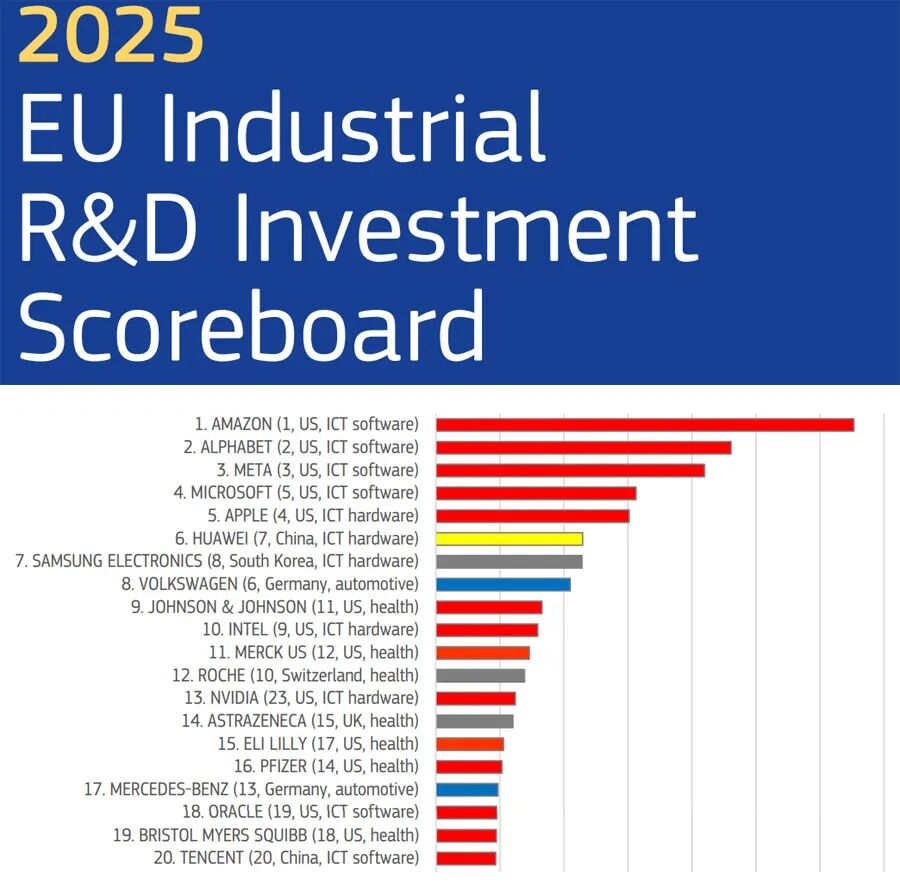
全球企业研发投入榜:美企前五,华为第六,腾讯阿里进前五十
Guan Cha Zhe Wang· 2026-01-06 08:15
Core Insights - The European Commission's "2025 EU Industrial R&D Investment Scoreboard" indicates that the total R&D investment of the top 2000 global companies for the 2024 fiscal year reached €1.446 trillion, reflecting a year-on-year growth of 6.3%, slightly higher than in 2023 but below the average growth rate since 2014 [2] Group 1: R&D Investment Overview - A total of 525 Chinese companies made the list, ranking second after the United States (674 companies), and surpassing the European Union (318 companies) and Japan (192 companies) [2] - Chinese companies' total R&D investment amounted to €233.2 billion, with a year-on-year increase of 3.9%, while U.S. companies invested €680.8 billion, marking a 7.8% increase [2] Group 2: Industry Focus - U.S. companies' R&D investments are heavily concentrated in information and communication technology (ICT) and healthcare, with 76% of their investment in ICT [3] - Chinese R&D investments are focused on ICT hardware manufacturing and the automotive industry, with notable strengths in construction and industrial engineering [3] Group 3: Global Rankings - Among the top 50 global companies, the U.S. holds 25 spots, with the top five being major tech giants: Amazon, Alphabet, Meta, Apple, and Microsoft [4] - Six Chinese companies made it to the top 50, with Huawei ranking sixth globally with an R&D investment of €22.94 billion, the only Chinese company in the top ten [4] - Other notable Chinese companies include Tencent (20th), Alibaba (31st), BYD (37th), and TSMC from Taiwan (41st) [4] Group 4: Trends and Future Outlook - The report highlights a significant increase in both total R&D investment and its share from Chinese companies, showcasing the rise of China in the global innovation landscape [5] - This trend is expected to drive China's economic transformation and upgrade, injecting new momentum into global technological development [5]






奕瑞科技(688301):增资扩股发展新业务,业绩有望延续高增长
China Post Securities· 2026-01-05 13:43
Investment Rating - The investment rating for the company is "Buy" [8] Core Insights - The company is expected to maintain high growth due to the expansion of its OLED microdisplay backplane business through a capital increase and introduction of strategic investors [3] - The company reported strong performance in the first three quarters of 2025, with revenue of 1.549 billion yuan, a year-on-year increase of 14.22%, and a net profit of 471 million yuan, up 20.61% [4] - The company is increasing its R&D investment to accelerate product innovation, with key products expected to launch in 2026, which will enhance its competitive edge [5] - Revenue projections for 2025-2027 are 2.32 billion yuan, 2.90 billion yuan, and 3.73 billion yuan respectively, with net profits of 629 million yuan, 838 million yuan, and 1.028 billion yuan [6] Company Overview - The latest closing price of the company's stock is 101.11 yuan, with a total market capitalization of 21.4 billion yuan [2] - The company has a total share capital of 211 million shares, with 200 million shares in circulation [2] - The company has a debt-to-asset ratio of 48.8% and a price-to-earnings ratio of 31.02 [2]

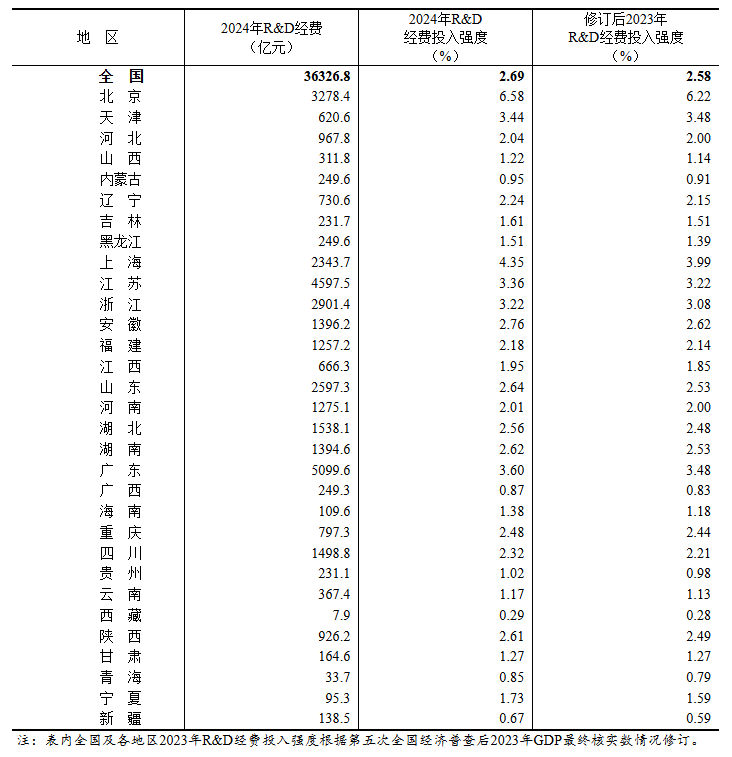
广东研发经费“九连冠” :投入破5000亿,强度超欧盟
2 1 Shi Ji Jing Ji Bao Dao· 2026-01-05 08:21
| | 2024年R&D经费 | 2024年R&D 经费投入强度 | 修订后2023年 R&D经费投入强度 | | | --- | --- | --- | --- | --- | | 地 区 | (亿元) | | | | | | | (%) | (%) | | | 全 国 | 36326.8 | 2.69 | | 2.58 | | 北 京 | 3278.4 | 6.58 | | 6.22 | | 天 津 | 620.6 | 3.44 | | 3.48 | | 河 北 | 967.8 | 2.04 | | 2.00 | | 山 西 | 311.8 | 1.22 | | 1.14 | | 内蒙古 | 249.6 | 0.95 | | 0.91 | | 辽 宁 | 730.6 | 2.24 | | 2.15 | | 吉 林 | 231.7 | 1.61 | | 1.51 | | 黑龙江 | 249.6 | 1.51 | | 1.39 | | 上 海 | 2343.7 | 4.35 | | 3.99 | | 江 苏 | 4597.5 | 3.36 | | 3.22 | | 浙 江 | 2901.4 | 3.22 | ...
贝泰妮(300957) - 2025年12月投资者关系活动记录表
2026-01-05 02:20
Group 1: R&D and Innovation - R&D expenses decreased in the first three quarters of 2025, aligned with the company's established research plans and progress [1] - The company leverages resources from its Yunnan Province plant extraction laboratory and research institutes in Japan and France to conduct targeted research in various areas, including innovative raw material development and functional cosmetics [1] Group 2: Competitive Advantage - The company's core competitive advantage is a brand trust barrier formed by "medical endorsement + consumer mindset," which is difficult to replicate in the short term [2] - This trust is built on years of deep engagement with hospital channels, professional doctor recognition, and extensive clinical validation data, resulting in a large, loyal customer base of sensitive skin users [2] Group 3: Profitability Improvement - The company's product profitability has improved, primarily due to a focus on brand building and member operation strategies [2] - Strategies include differentiated member operations, maintaining stable pricing, reducing promotional benefits, and streamlining product lines to concentrate resources on core products [2]
欧盟公布 2024 年全球研发投入百强企业:亚马逊第一,华为成唯一进前十的中国企业
Xin Lang Cai Jing· 2026-01-04 12:25
IT之家 1 月 4 日消息,欧盟委员会于 2025 年 12 月底公布了 2025 全球研发投入百强企业榜单,追踪并比较 2024 年欧盟领先的 工业研发投资者与其全球同行的表现。自 2004 年以来,该榜单为公司、研究人员和政策制定者提供见解和数据。 作为一项新举措,2025 年排名榜首次纳入了亚马逊,其预计的研发投资使其成为全球最大的研发投资者(650 亿欧元)。 2024 年,全球研发投资增长了 6.3%(按通胀调整为 4.0%),略高于 2023 年的增长,但低于过去十年的平均增长率 7.5%。欧盟 企业名义上的研发投资仅增长了 2.9%,落后于其他地区:世界其他地区(8.1%)、美国(7.8%)、日本(7.1%)和中国 (3.9%)。美国的科技大公司,尤其是在 ICT 软件和硬件领域,推动了大部分增长。 674 家美国企业(占总研发投资的 47.1%) 525 家中国企业(16.1%) 318 家欧盟企业(16.2%) 192 家日本企业(7.8%) 291 家其他地区企业(12.9%) ICT 软件行业占全球研发投资的 24.9%,其中美国企业贡献了 77%。这种集中程度是自 20 多年前首次发 ...


三瑞智能以价换量增长可持续性遭拷问 研发费用率下滑分红1.7亿后再募7.7亿
Chang Jiang Shang Bao· 2025-12-28 23:35
Core Viewpoint - Sanrui Intelligent Technology Co., Ltd. has successfully passed the IPO review and is expected to become the "first stock of drone power systems" in China, despite concerns over the sustainability of its performance growth due to significant price reductions in its core products [1][3]. Group 1: Company Performance - Sanrui Intelligent has been deeply engaged in the drone and robot power system sector for over a decade, showing impressive financial performance with revenues of 3.62 billion yuan, 5.34 billion yuan, 8.31 billion yuan, and 4.36 billion yuan from 2022 to the first half of 2025 [3]. - The company achieved a net profit attributable to shareholders of 1.13 billion yuan, 1.72 billion yuan, 3.33 billion yuan, and 1.6 billion yuan during the same period, indicating a strong growth trend [3]. - The company holds a 7.1% market share in the global civil drone electric power system market (excluding batteries) in 2024, ranking second after DJI [3]. Group 2: Pricing and Competition - The average selling price of Sanrui's drone motors has decreased from 295 yuan per unit to 110.40 yuan per unit over three and a half years, representing a decline of 62.57% [4]. - The price of the robot power system motors also fell from 1,455.31 yuan per unit in 2022 to 615.26 yuan per unit in the first half of 2025, a drop of over 57% [4]. - The company has adopted a "price for volume" strategy in response to intensified competition, leading to concerns about the sustainability of this growth model [3][4]. Group 3: Research and Development - Sanrui's R&D expense ratio has declined to 4.27%, contrasting with its high growth and profitability, raising market skepticism about its commitment to innovation [6]. - The company spent 1.86 million yuan on R&D in the first half of 2025, which is significantly lower than its competitors [6]. - As of the first half of 2025, Sanrui holds 368 domestic patents, with only 45 being invention patents, indicating a relatively weak core technology patent barrier [6]. Group 4: Financial Health - As of June 2025, Sanrui's debt-to-asset ratio is only 12.33%, significantly lower than the industry average, and it has maintained positive operating cash flow from 2022 to 2024 [7]. - The company has a total of 683 million yuan in cash and trading financial assets, nearly matching the total amount it aims to raise through the IPO [7]. - Despite having sufficient funds for business development and R&D, the company plans to raise 769 million yuan, which raises questions about the rationale behind this fundraising [8]. Group 5: Production Capacity - Of the funds raised, 258 million yuan is intended for the "R&D center and headquarters construction project," while 407 million yuan is allocated for expanding production capacity, despite underutilization of existing capacity [9]. - In 2024, the utilization rate of the electronic speed controller production capacity was only 44.97%, even though it is expected to rise to 87.08% in the first half of 2025, which remains below industry averages [9].
振华科技:不同的应用场景对产品性能及可能性有着不一样的要求
Zheng Quan Ri Bao Wang· 2025-12-25 11:13
Core Viewpoint - Zhuhai Technology (000733) emphasizes the varying performance and potential requirements of products across different application scenarios, particularly in critical fields such as aerospace, which demand high reliability and longevity [1] Group 1: Company Overview - The company’s main products are widely used in important sectors including aerospace, electronics, weapons, shipping, and nuclear industries, establishing itself as a significant support force in these fields [1] - The company plans to continue focusing on industry development opportunities and technological application scenarios, increasing R&D investment to enhance core competitiveness [1]
