灵鸢车载无人机系统

Search documents
比亚迪,狼真的来了
虎嗅APP· 2026-03-30 00:16
Core Viewpoint - BYD's 2025 annual report indicates a revenue of 804 billion, a year-on-year growth of 3.5%, and a net profit of 32.62 billion, a decline of 19% [5]. The company continues to invest heavily in R&D, with expenditures reaching 63.4 billion in 2025, and has introduced several advanced technologies [5][24]. Group 1: Sales and Market Strategy - BYD maintains a dual strategy of pure electric and plug-in hybrid vehicles, which has allowed it to become the global sales leader in new energy vehicles [7][8]. - Sales data shows a fluctuating trend between pure electric and plug-in hybrid vehicles from 2021 to 2025, with significant shifts in market share [10][12]. - In 2025, BYD's sales of pure electric and plug-in hybrid vehicles were nearly equal, with 2.256 million and 2.289 million units sold, respectively [10]. Group 2: Profitability and Competitive Position - Since 2023, BYD's gross profit from vehicle sales has surpassed that of Tesla, with a gross profit of 101.6 billion and a margin of 21% in 2023, compared to Tesla's 943 billion and 17.1% [16]. - BYD's gross profit margin is consistently higher than Tesla's, with a notable increase in the "BYD to Tesla" ratio, reaching 195% by 2025 [16][18]. Group 3: Export Business - BYD's export business saw significant growth in 2025, with 1.046 million units exported, a year-on-year increase of 140% [19]. - The average selling price of BYD vehicles is significantly higher in international markets compared to domestic sales, with an average of 183,000 yuan per vehicle overseas versus 128,000 yuan domestically [19][21]. - The company has entered 119 countries and regions, with a focus on establishing a sales and service network to support its international expansion [22]. Group 4: R&D and Technological Advancements - BYD's R&D investment has been substantial, reaching 634 billion in 2025, which is 192% of Tesla's R&D spending [24]. - The company has filed over 71,000 patents, with 42,000 granted, indicating a strong focus on innovation [27]. - Recent technological advancements, such as the second-generation blade battery and fast-charging technology, are expected to enhance consumer perception and sales [31][32]. Group 5: Charging Infrastructure and Market Dynamics - The introduction of fast-charging technology is set to change the economics of charging infrastructure, potentially reducing the need for a large number of charging stations [34][36]. - BYD's fast-charging stations could serve significantly more vehicles than traditional charging stations, improving efficiency and profitability [34][36]. - The company aims to build 20,000 fast-charging stations by the end of 2026, with a total storage capacity of approximately 10 GWh [37].



深圳创新四姐妹,2025年三大关键词
2 1 Shi Ji Jing Ji Bao Dao· 2025-12-31 13:03
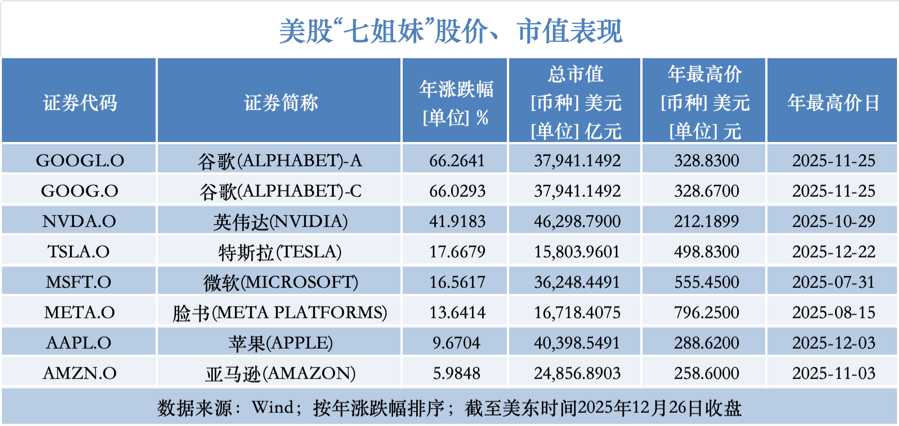
Core Viewpoint - The rapid development of artificial intelligence (AI) is prompting a revaluation of technology assets globally, with Shenzhen emerging as a focal point for investors seeking opportunities in China. The city has produced several leading tech giants, referred to as the "Four Sisters" of innovation: Huawei, Tencent, Ping An, and BYD, all of which have market capitalizations exceeding 1 trillion yuan and revenues above 600 billion yuan, with Ping An surpassing 1 trillion yuan in revenue for 2024 [1][2][4]. Group 1: Value Reassessment - The "Four Sisters" have experienced a collective value reassessment, with stock prices and market capitalizations reaching new highs. Excluding Huawei, which is not publicly listed, Tencent, Ping An, and BYD have all recorded significant stock price increases this year, benefiting from the narrative of asset revaluation in China [4][5]. - As of December 29, the average stock price increase for the "Four Sisters" was 44.87%, outperforming the average increase of 27.95% for the "Magnificent Seven" in the U.S. [5][6]. - Ping An's stock price rose by 52.25%, Tencent by 44.29%, and BYD by 10.47% this year, with all three companies achieving new market capitalization highs [7][9]. Group 2: AI Development - The "Four Sisters" are heavily investing in AI, engaging in a talent acquisition race and increasing R&D expenditures to secure a competitive edge in AI technology. For instance, Tencent has recruited top AI talent, while Huawei has launched a global recruitment initiative for AI experts [11][12]. - R&D spending has surged, with Huawei's R&D expenses reaching 96.95 billion yuan, accounting for 22.7% of its revenue, and Tencent's R&D expenditure hitting 22.82 billion yuan, a 28% increase year-on-year [12][13]. - Each company has adopted a differentiated approach to AI: Huawei focuses on foundational technologies, Tencent aims to integrate AI into its social applications, Ping An emphasizes AI in financial and healthcare services, and BYD incorporates AI into smart transportation solutions [15][16]. Group 3: Global Influence and Expansion - The global influence of the "Four Sisters" has increased, as evidenced by their improved rankings in the 2025 Fortune Global 500 and Kantar BrandZ lists. Ping An ranked 13th, Huawei 24th, BYD 27th, and Tencent 32nd in the Fortune list [16][17]. - BYD has surpassed Tesla to become the world's top electric vehicle seller, with exports growing by 144% year-on-year [16][17]. - Tencent's international gaming revenue grew by 43% to 20.8 billion yuan, while its cloud business has maintained high double-digit growth, serving a significant portion of leading overseas internet and gaming companies [17][18].

深圳创新四姐妹,2025年三大关键词
21世纪经济报道· 2025-12-31 12:50
Core Viewpoint - The rapid development of artificial intelligence (AI) is prompting a revaluation of technology assets globally, with Shenzhen emerging as a focal point for investors seeking opportunities in China. The city has produced several tech giants, referred to as the "Four Sisters" of innovation: Huawei, Tencent, China Ping An, and BYD, all of which have market capitalizations exceeding 1 trillion yuan and revenues above 600 billion yuan, with Ping An's revenue surpassing 1 trillion yuan in 2024 [1][2]. Group 1: Characteristics of the "Four Sisters" - The "Four Sisters" have experienced a collective revaluation, with stock prices and market capitalizations reaching new highs. Except for Huawei, which is not publicly listed, Tencent, Ping An, and BYD have all seen significant stock price increases this year, benefiting from the narrative of asset revaluation in China [3][4]. - The average stock price increase for the "Four Sisters" is 44.87% year-to-date, outperforming the average increase of 27.95% for the "Magnificent Seven" in the U.S. [4][5]. - Each of the "Four Sisters" has achieved record market capitalizations this year, with Tencent reaching a peak of 683 HKD per share and a market cap of 5.45 trillion HKD, while Ping An's market cap is around 1.3 trillion HKD [6][7]. Group 2: AI Investment and Strategy - The "Four Sisters" are heavily investing in AI, engaging in a talent acquisition race and increasing R&D expenditures. For instance, Huawei's R&D spending reached 96.95 billion yuan in the first half of the year, accounting for 22.7% of its revenue [8][9]. - Each company has a differentiated AI strategy: Huawei focuses on foundational technologies, Tencent integrates AI into its social applications, Ping An emphasizes AI in financial and healthcare services, and BYD incorporates AI into smart transportation solutions [12][13]. Group 3: Global Expansion and Influence - The global influence of the "Four Sisters" is on the rise, as evidenced by their improved rankings in the 2025 Fortune Global 500 and Kantar BrandZ lists. Ping An ranks 13th, Huawei 24th, BYD 27th, and Tencent 32nd [13][14]. - BYD has surpassed Tesla in global electric vehicle sales, exporting 878,000 units from January to November, a 144% increase year-on-year. Huawei operates in over 170 countries, while Tencent's international gaming revenue grew by 43% [14][15].

“深圳创新四姐妹”年终三重奏:价值重估、AI突围、全球拓局
2 1 Shi Ji Jing Ji Bao Dao· 2025-12-31 11:27
Core Viewpoint - The rapid development of artificial intelligence (AI) is prompting a revaluation of technology assets globally, with Shenzhen emerging as a focal point for investors seeking opportunities in China. The city has produced several leading tech giants, referred to as the "Shenzhen Innovation Four Sisters," including Huawei, Tencent, China Ping An, and BYD, all of which have market capitalizations exceeding 1 trillion yuan and revenues above 600 billion yuan [1][2]. Group 1: Performance and Market Trends - The "Shenzhen Innovation Four Sisters" have experienced significant stock price and market capitalization increases, benefiting from a narrative of asset revaluation in China. Notably, Tencent, Ping An, and BYD have all reached new highs in stock prices and market values this year [1][4]. - The average annual stock price increase for the "Four Sisters" is 44.87%, outperforming the average increase of 27.95% for the "Magnificent Seven" in the U.S. stock market [4][6]. - As of December 29, 2025, China Ping An's stock price increased by 52.25%, Tencent by 44.29%, and BYD by 10.47%, with Ping An leading the group [4][6]. Group 2: AI Development and Talent Acquisition - The "Four Sisters" are heavily investing in AI, with each company focusing on different aspects of AI technology to gain competitive advantages. They are engaged in a talent acquisition race to attract top AI professionals [9][10]. - Huawei's R&D expenditure reached 96.95 billion yuan in the first half of the year, accounting for 22.7% of its revenue, while Tencent's R&D spending in Q3 was 22.82 billion yuan, marking a 28% year-on-year increase [10][11]. - The companies are implementing differentiated AI strategies: Huawei focuses on foundational technologies, Tencent aims to reshape consumer services, Ping An emphasizes specialized AI services, and BYD integrates AI into smart mobility solutions [12][11]. Group 3: Global Expansion and Influence - The global influence of the "Four Sisters" is on the rise, as evidenced by their improved rankings in the 2025 Fortune Global 500 and Kantar BrandZ lists. China Ping An ranks 13th, Huawei 24th, BYD 27th, and Tencent 32nd in the Fortune list [12][13]. - BYD has surpassed Tesla to become the top seller of electric vehicles globally, with exports reaching 878,000 units from January to November, a 144% increase year-on-year [13][14]. - Tencent's international gaming revenue grew by 43% to 20.8 billion yuan in Q3, while Huawei's wearable device shipments exceeded 200 million units globally, maintaining a leading position in the market [13][14].
当传统巨头收缩战线:比亚迪的研发“豪赌”为何赢了?
经济观察报· 2025-12-03 14:22
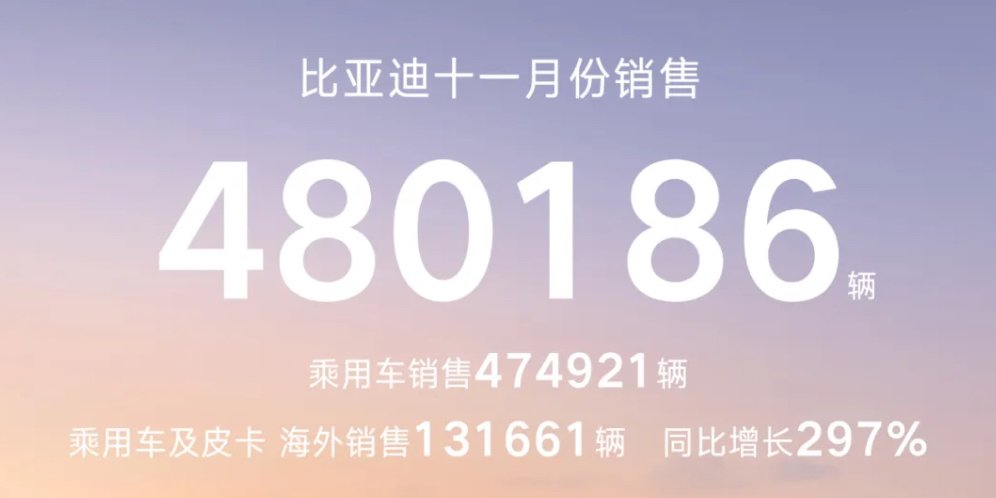
Core Viewpoint - BYD demonstrates a long-term commitment to R&D, with investments exceeding net profits for 13 out of the last 14 years, driving its sales to rank among the top five globally, showcasing a "technology is king" strategy [1][5]. Group 1: Sales Performance - In November, BYD achieved a record monthly sales of 480,000 new energy vehicles, marking a significant year-end sales push [2]. - Cumulatively, BYD's sales reached 4.182 million units in the first 11 months, reflecting an 11.3% year-on-year growth, maintaining its leading position in the industry [2][3]. Group 2: R&D Investment - BYD's R&D expenditure for the first three quarters of this year reached 43.7 billion yuan, a 31% increase year-on-year, positioning it as a leader in R&D investment among global automakers [3]. - Over the past decade, BYD has invested over 220 billion yuan in R&D, ranking it among the top in A-share listed companies [5]. - The company's R&D spending has consistently exceeded its net profits, emphasizing its focus on long-term technological advantages [5]. Group 3: Competitive Landscape - Chinese automakers, including BYD, are experiencing positive performance while traditional foreign automakers face challenges, indicating a shift in the industry dynamics [3][5]. - While Chinese companies are increasing R&D investments, traditional foreign automakers like Volkswagen and BMW are reducing their R&D budgets, potentially compromising their future competitiveness [5]. Group 4: Technological Advancements - BYD's innovations, such as the Tian Shen Eye driver assistance system and the Super e-platform, are enhancing its product competitiveness [8]. - In the battery sector, BYD ranked second globally in electric vehicle battery usage in Q3, with a 28.4% year-on-year growth [8]. Group 5: Global Expansion - BYD's overseas sales reached 700,000 units in the first three quarters, a 136% increase year-on-year, becoming a significant growth driver for the company [12]. - The company's global presence is expanding, with its products integrated into various international markets, showcasing its competitive edge in the global automotive landscape [12].
当传统巨头收缩战线:比亚迪的研发“豪赌”为何赢了?
Jing Ji Guan Cha Wang· 2025-12-03 09:37
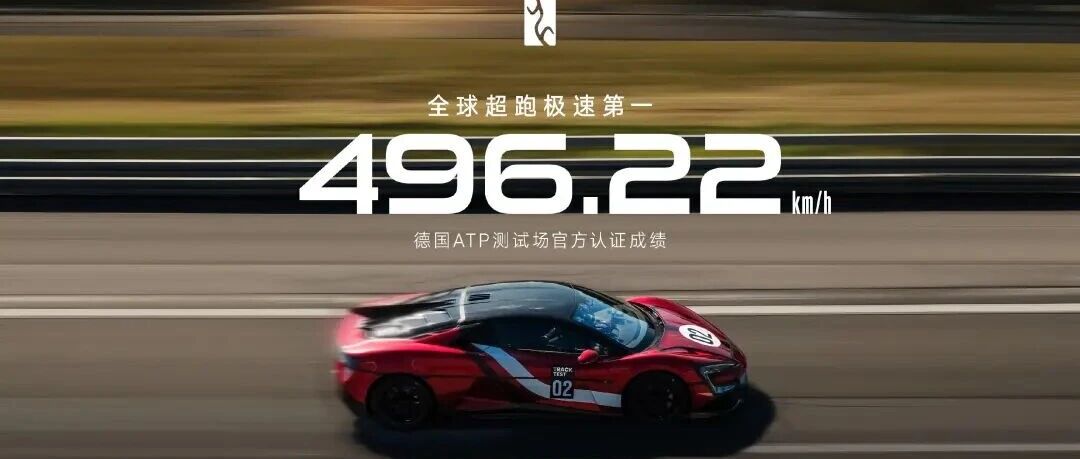
Core Insights - The November sales data highlights the strong performance of China's electric vehicle (EV) industry, with BYD achieving a record monthly sales of 480,000 units, marking a year-high [1] - BYD's cumulative sales for the first eleven months reached 4.182 million units, reflecting a year-on-year growth of 11.3%, maintaining its leading position in the industry [1] - A divergence in performance is noted between Chinese automakers, led by BYD, and foreign giants, with the former showing robust growth while the latter struggles [1][4] Sales Performance - In November, BYD's sales reached 480,000 units, while other major players like SAIC and Geely also reported strong sales figures [1] - BYD's cumulative sales for the first eleven months of the year reached 4.182 million units, a year-on-year increase of 11.3% [1] R&D Investment - BYD's R&D expenditure for the first three quarters of the year was 43.7 billion yuan, a 31% increase year-on-year, positioning it as a leader in R&D investment among global automakers [1][4] - Over the past decade, BYD has invested over 220 billion yuan in R&D, consistently prioritizing technology as a core strategy [4] - In contrast, traditional foreign automakers like Volkswagen and BMW have reduced their R&D spending, indicating a more conservative approach to innovation [4] Technological Advancements - BYD has introduced innovative technologies such as the Tian Shen Eye driver assistance system and the Super e-platform, enhancing its product competitiveness [6] - The company ranks second globally in electric vehicle battery usage, with a total of 55.1 GWh in the third quarter, reflecting a year-on-year growth of 28.4% [6] Market Expansion - BYD's energy storage systems have positioned it among the top three globally, with significant projects like the largest energy storage project in Germany [7] - The company has seen a 136% year-on-year increase in overseas sales, reaching 700,000 units in the first three quarters, contributing significantly to its growth [11] Brand Development - BYD's high-end brand strategy has led to rapid increases in sales and market share, enhancing its global influence and technological authority [9] - The U9 Xtreme model has set a world record for electric vehicles, showcasing BYD's technological prowess and elevating the brand's status in the automotive industry [9]
1200万辆之后,中国新能源汽车靠什么增长?
Bei Jing Ri Bao Ke Hu Duan· 2025-11-06 13:16
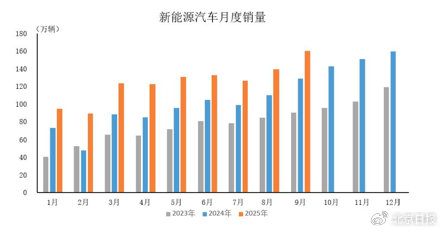
Core Insights - The Chinese new energy vehicle (NEV) industry has shown strong growth since the "14th Five-Year Plan," with annual production and sales exceeding 12 million units, enhancing core competitiveness and contributing to high-quality economic development [1] - The automotive industry is undergoing a transformation from traditional industrial expansion to a technology-driven model, focusing on innovation and quality improvement [1][3] - In September, NEV production reached 1.617 million units and sales reached 1.604 million units, marking year-on-year increases of 23.7% and 24.6% respectively [1][3] - BYD has achieved cumulative global sales of 3.26 million units from January to September, a year-on-year increase of 18.64%, and has completed 70.87% of its annual sales target [3][5] Industry Growth - The NEV market is shifting from policy-driven to market-driven, indicating increasing consumer acceptance [3] - The total production of NEVs in the first three quarters of 2025 reached 11.243 million units, with sales of 11.228 million units, reflecting year-on-year growth of 35.2% and 34.9% respectively [1] Technological Innovation - Technological advancements have led to improvements in battery range, charging efficiency, energy consumption, and intelligence levels, enhancing product competitiveness [3][5] - BYD's R&D expenses reached 43.75 billion yuan, a 31% increase year-on-year, with total R&D investment exceeding 220 billion yuan [5] - The introduction of the "Tiangshen Eye" advanced driving assistance system has significantly contributed to BYD's sales, with over 1.7 million units sold since its launch [3][5] User-Centric Development - BYD's focus on technology innovation addresses user needs for safety, efficiency, and environmental sustainability, creating a strong link between user demand and industry development [3][11] - The fifth-generation DM technology has achieved a thermal efficiency of 46.06% and a fuel consumption of 2.6 liters per 100 kilometers, directly responding to user demands for lower operating costs [7][9] - BYD's "Yunlian" intelligent vehicle body control system and "Tiangshen Eye" system enhance driving comfort and safety, making advanced features accessible to more consumers [9][11]

今年前三季度研发投入超1.16万亿,168家企业超十亿,科创板强度领先
3 6 Ke· 2025-11-05 10:52
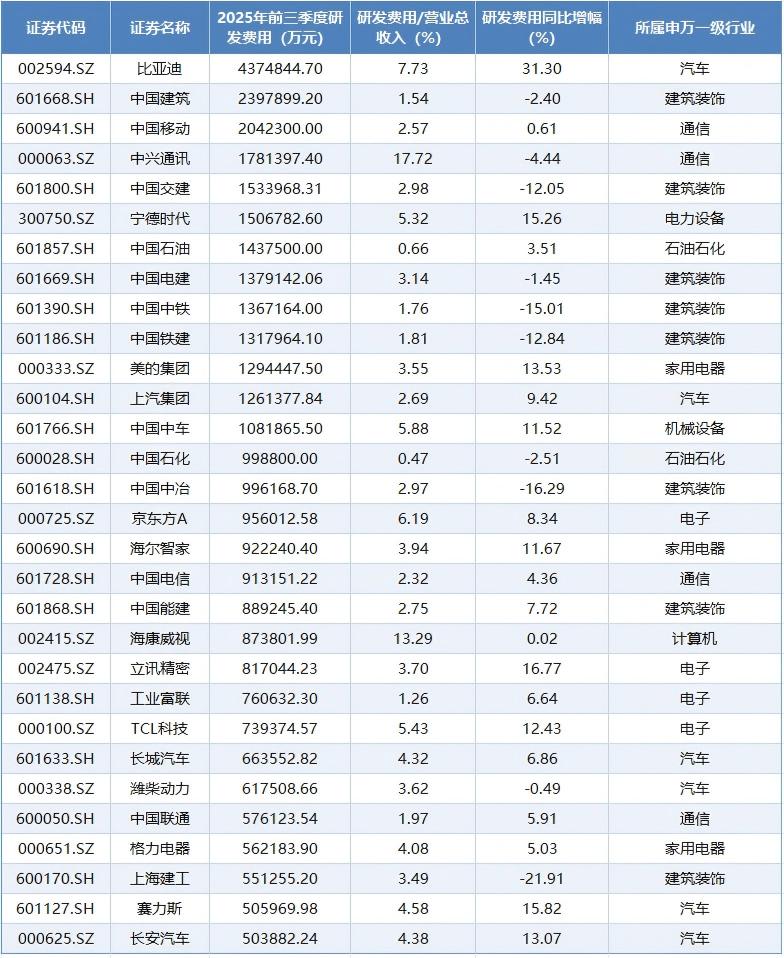
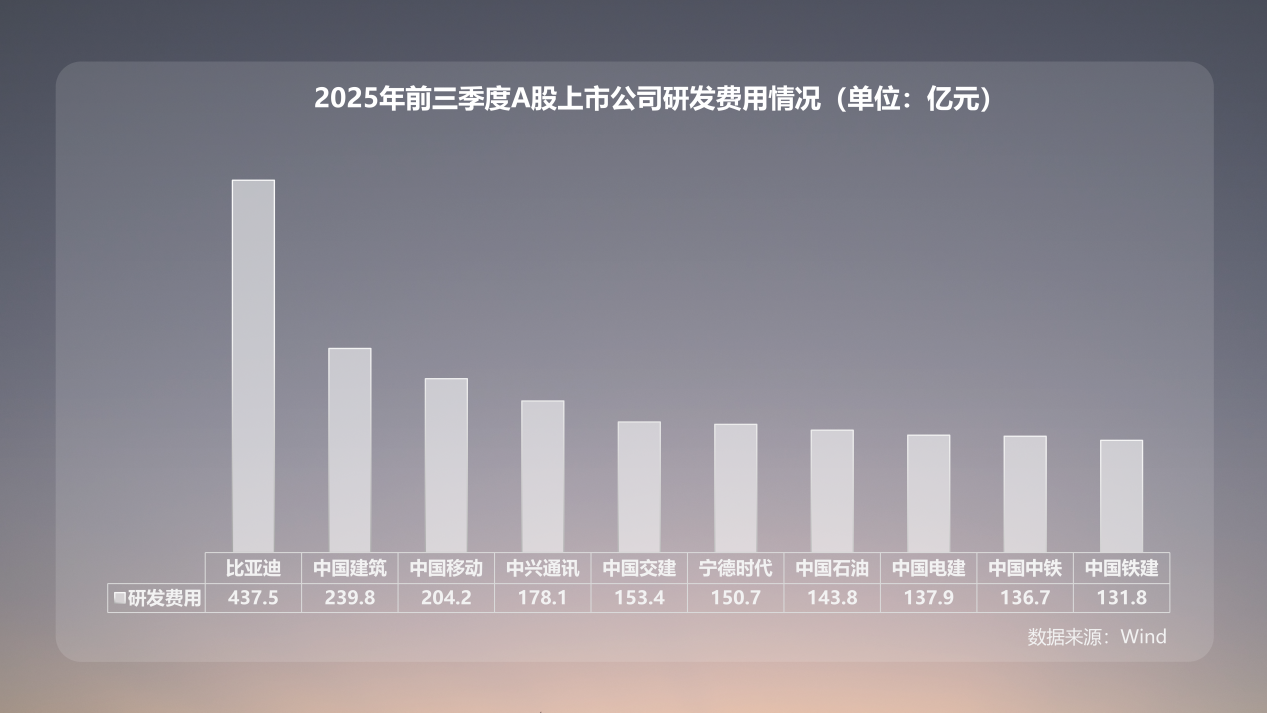
Core Insights - A-share listed companies in China have seen a continuous increase in R&D investment, reaching a total of 1.16 trillion yuan in the first three quarters of 2025, marking a year-on-year growth of 3.88% [1][2] - High R&D investment is becoming a significant driver for performance growth among listed companies, particularly in sectors like biomedicine, semiconductors, and artificial intelligence [1][4] R&D Investment Overview - In the first three quarters of 2025, 168 companies invested over 1 billion yuan in R&D, with 13 companies exceeding 10 billion yuan [2] - BYD leads with R&D expenses of 43.748 billion yuan, followed by China State Construction and China Mobile with 23.979 billion yuan and 20.423 billion yuan respectively [2][3] Sector-Specific Insights - Companies with high R&D investment are primarily in biomedicine, semiconductors, and AI, which are crucial for building technological barriers and driving industry innovation [1][10] - China State Construction is advancing digital innovation and smart construction technologies, while China Mobile has established the world's first 6G small-scale test network [4] Notable Companies - ZTE Corporation reported R&D expenses of 17.814 billion yuan, accounting for 17.72% of its revenue, focusing on AI-related product development [4] - CATL's R&D expenses reached 15.068 billion yuan, with a year-on-year growth of 15.26%, highlighting its innovation in battery technology [5] R&D Intensity by Market Segment - The overall R&D intensity in the A-share market is 2.16%, with the Sci-Tech Innovation Board showing a significantly higher intensity of 11.22% [6] - The median R&D intensity for companies on the Sci-Tech Innovation Board is 12.4%, indicating a strong focus on technology [6][7] Industry Trends - The computer, biomedicine, and electronics sectors exhibit high R&D intensity, with 43 companies in computing, 25 in biomedicine, and 15 in electronics among the top 100 for R&D investment [8] - The differences in R&D investment ratios among A-share companies reflect industry characteristics and corporate strategies, with biomedicine and semiconductors requiring higher investment due to long development cycles and international competition [10]


研发投入等于三大车企之和 比亚迪的技术护城河有多深?
Jing Ji Guan Cha Wang· 2025-11-04 09:59
Core Viewpoint - BYD has demonstrated a strong commitment to research and development (R&D), with significant investments leading to a competitive edge in the global automotive market, particularly in the context of the ongoing transformation towards electrification and smart technology [1][5][10]. Financial Performance - In the first three quarters of this year, BYD's revenue reached 566.27 billion yuan, marking a 13% year-on-year increase [1]. - R&D expenses for the same period amounted to 43.75 billion yuan, representing a substantial 31% increase compared to the previous year, exceeding net profit by 20.5 billion yuan [1][5]. R&D Leadership - BYD maintains its position as the "R&D King" among over 5,400 listed companies in the A-share market, with a lead of nearly 20 billion yuan over the second-ranked company [3]. - The cumulative R&D investment has surpassed 220 billion yuan, with 14 out of the last 15 years seeing R&D expenditures exceed net profits [5]. Technological Achievements - BYD's "Tian Shen Zhi Yan" advanced driver-assistance system has seen cumulative sales of over 1.7 million vehicles by September [6]. - The company has filed over 65,000 patents globally, showcasing a robust cycle of R&D investment leading to technological achievements and market recognition [8]. Market Expansion - In the first three quarters of 2025, BYD's overseas sales reached 701,600 units, a remarkable 132% increase year-on-year [8]. - The launch of the K-EV BYD RACCO at the Tokyo Motor Show reflects BYD's strategy of localized product innovation driven by strong R&D capabilities [8]. Sales Performance - In October, BYD achieved a record monthly sales figure of 441,706 vehicles, indicating successful market conversion of its R&D investments [9]. Strategic Outlook - BYD's R&D-driven model is expected to undergo further value reassessment as technological advantages are realized in international markets, reinforcing its competitive position globally [10].
比亚迪狂砸437亿搞研发,远超特斯拉
2 1 Shi Ji Jing Ji Bao Dao· 2025-11-03 12:09
Core Insights - China's R&D expenditure reached 1.16 trillion yuan in the first three quarters of 2025, marking a 3.88% year-on-year increase, indicating a strong shift towards innovation-driven development [1][3] - The overall revenue of listed companies in China was 53.46 trillion yuan, with a net profit of 4.70 trillion yuan, reflecting a growth of 1.36% and 5.50% respectively [3] - The R&D intensity across the A-share market is 2.16%, with the Sci-Tech Innovation Board showing a significantly higher intensity of 11.22% [4][5] R&D Investment Trends - Over 2,780 listed companies reported an increase in R&D expenses, with more than 1,200 companies seeing a rise of over 15% [3] - The strategic emerging industries have an overall R&D intensity of 5.21%, with sectors like aerospace and new energy vehicles showing fixed asset investment growth exceeding 10% [4] - The top R&D spenders include BYD, China State Construction, and ZTE, with BYD leading at 437.48 billion yuan, significantly higher than its competitors [9][10] Sector Performance - The Sci-Tech Innovation Board companies achieved a revenue of 1.01 trillion yuan, with a year-on-year growth of 6.6% [5] - Key technological breakthroughs have been reported, including the approval of 26 new drugs and advancements in semiconductor technology [6] - The electronics industry has surpassed the banking sector in total market value, indicating a shift in industry leadership [12]