
数字化

Search documents
华测检测(300012):2025H1预告点评:Q2归母业绩同比增7.5%-10.0%,国际化并购推进
Changjiang Securities· 2025-07-11 14:15
Investment Rating - The investment rating for the company is "Buy" and is maintained [8]. Core Views - The company, HuaCe Testing, forecasts a net profit attributable to shareholders of 463-471 million yuan for the first half of 2025, representing a year-on-year increase of 6.06%-7.80%. For Q2, the net profit is expected to be 327-334 million yuan, reflecting a year-on-year growth of 7.5%-10.0%. This performance demonstrates the resilience of the company as a comprehensive national testing institution amidst macroeconomic pressures [2][6][7]. Summary by Sections Revenue Performance - In 2024, the environmental testing sector experienced high growth due to the third national soil survey, but this is expected to decline in 2025, creating revenue growth pressure. The company is countering this by enhancing marine environmental monitoring and other emerging demands. The food and agricultural testing sector is driven by innovation, while industrial product testing is seeing improvements in gross margins due to upgrades in construction testing services [7]. Profitability - The company is advancing lean management practices and exploring AI, digitalization, and automation to enhance operational efficiency. The implementation of a "Talent Refinement Plan" aims to continuously improve organizational capabilities and innovation vitality, contributing to steady net profit growth [7]. International Expansion - The company is actively pursuing international acquisitions, including a planned acquisition of South Africa's Safety SA, which is expected to enhance its service capabilities in Africa. This acquisition is part of the company's broader internationalization strategy [7][13]. Financial Forecast - Revenue projections for 2025-2027 are 6.521 billion yuan, 7.191 billion yuan, and 7.921 billion yuan, with year-on-year growth rates of 7.18%, 10.28%, and 10.15%, respectively. Net profit attributable to shareholders is forecasted to be 1.014 billion yuan, 1.143 billion yuan, and 1.287 billion yuan for the same period, with corresponding growth rates of 10.1%, 12.6%, and 12.7%. The price-to-earnings (PE) ratios are estimated at 20.0x, 17.8x, and 15.8x [7][13].

太力科技(301595) - 投资者关系活动记录表
2025-07-11 12:40
Group 1: Company Development Plans - The company aims for short-term stability by consolidating its main business and advancing new product launches [1] - In the medium term, the focus will be on capacity upgrades and expanding into overseas markets to establish a global industrial layout [1] - Long-term goals center on innovation in materials, emphasizing technological breakthroughs and expanding diverse application boundaries [1] Group 2: R&D and Innovation - The company has invested over 20 years in time and talent for R&D, driven by market demand, resulting in a strong technical foundation and market insight [1] - Core competitiveness is built around new materials technology, with a focus on nanotechnology and multiple composite material technology platforms [1] Group 3: Financial Performance and Workforce - Despite stable employee numbers, the company has seen continuous revenue growth, attributed to digitalization and the integration of AI tools enhancing overall efficiency [2] - The company plans to increase strategic investments in foundational and applied research, talent development, market insights, and digital capabilities over the next 2-3 years [2] Group 4: Talent Management - The company assesses engineers not only on technical breakthroughs but also on their contribution to sales, creating a closed-loop value contribution system [2] - A dual-dimensional incentive system is in place, combining market-based compensation with recognition of technical achievements and career development opportunities [2]
华测检测(300012):2025年半年度业绩预告点评:业绩略超预期,积极推进国际化战略
GUOTAI HAITONG SECURITIES· 2025-07-11 11:07
Investment Rating - The report maintains a rating of "Accumulate" for the company [11][18]. Core Views - The company has slightly exceeded performance expectations for the first half of 2025, with a gradual recovery in the pharmaceutical and medical sectors, and steady growth in traditional testing services. Additionally, the company plans to acquire South Africa's Safety SA, accelerating its internationalization strategy [3][11]. Financial Summary - Total revenue is projected to grow from 5,605 million in 2023 to 7,501 million in 2027, reflecting a compound annual growth rate (CAGR) of approximately 7.7% [5]. - Net profit attributable to the parent company is expected to increase from 910 million in 2023 to 1,310 million in 2027, with a notable growth rate of 15.7% in 2025 [5]. - Earnings per share (EPS) is forecasted to rise from 0.54 in 2023 to 0.78 in 2027 [5]. Market Data - The company's market capitalization is approximately 20,295 million, with a current share price of 12.06 [6][11]. - The stock has traded within a range of 10.24 to 16.64 over the past 52 weeks [6]. Strategic Developments - The company is actively pursuing an international strategy, with the planned acquisition of Safety SA expected to enhance its service capabilities in South Africa and the broader African market [11]. - Previous acquisitions include German and Greek testing institutions, indicating a consistent approach to expanding its global footprint [11]. Performance Metrics - The company’s return on equity (ROE) is projected to remain stable around 13.3% to 14.7% from 2023 to 2027 [5][12]. - The price-to-earnings (P/E) ratio is expected to decrease from 22.30 in 2023 to 15.49 in 2027, indicating potential value appreciation [5][12].
盘兴数智递交招股书:港股舞台上的政企数智化解决方案新势力
Sou Hu Cai Jing· 2025-07-11 10:36
Group 1 - The core viewpoint of the article highlights the successful IPO application of Zhejiang Panxing Smart Technology Co., Ltd. on the Hong Kong Stock Exchange, showcasing its rapid growth driven by AI technology and SaaS services [1] - The company has achieved a doubling of its performance over three years, reflecting the broader trend of digitalization in China as outlined in the "14th Five-Year Plan" [1] - The business model is characterized by a dual-engine approach of "intelligent SaaS + full-link marketing," which is reshaping industry value [1] Group 2 - Panxing Smart's competitive advantage lies in its self-developed AI technology system, which supports a commercial collaborative platform that integrates multi-source data for decision-making [3] - The platform generates over 30,000 short video materials monthly and lowers the digitalization threshold for SMEs, enabling quick deployment of private domain operation systems [3] - The company invested nearly 14 million yuan in R&D in 2023, contributing to significant projects like the AI landscape compliance detection system for the Hangzhou Asian Games [3] Group 3 - The company has demonstrated strong financial performance, with 2023 revenue reaching 812 million yuan, a 65% year-on-year increase, and a pre-tax operating profit surge of 205% to 34.37 million yuan [4] - For the first three quarters of 2024, revenue has already surpassed the total for 2022, indicating robust growth [4] - The IPO proceeds will be allocated to upgrading the AI-driven collaborative platform, expanding service centers in central and western regions, and acquiring complementary technology firms [4]


远毅资本:AI和数字化正在重塑医疗体系,投资关注两类机会
2 1 Shi Ji Jing Ji Bao Dao· 2025-07-11 09:19
Group 1 - The core viewpoint is that AI and digitalization are reshaping the global healthcare system, with digital healthcare being the future of medical health [1][2] - Yuan Yi Capital, established in 2016, focuses on early-stage investments in digital healthcare technology, having invested in over 70 companies with a total management scale exceeding 30 billion RMB [1][2] - The 2024 China Digital Healthcare Innovation Development Blue Book indicates that digital healthcare is an emerging field created by the integration of digital technology and medical scenarios, optimizing the entire diagnostic process [2][3] Group 2 - In the U.S. market, digital healthcare is a mainstream investment area, with AI and digitalization-related projects accounting for 50% of the top 100 financing deals in 2024 [3] - The evolution of medical models is driven by technology, transitioning from reliance on doctors' experience to data-driven personalized treatment and comprehensive management [3][5] - The rapid development of digital healthcare is attributed to the inefficiencies in the current healthcare system, which leads to insufficient supply and rising costs [3][5] Group 3 - Generative AI is seen as a golden opportunity in the healthcare sector due to strong demand, a large market, and high barriers to entry [5][6] - Generative AI can enhance various aspects of the healthcare ecosystem, including improving diagnostic efficiency for doctors and transforming hospital management [5][6] - A survey indicates that 90% of doctors find AI tools trustworthy, with over half willing to inform patients about AI's involvement in their treatment [6] Group 4 - Yuan Yi Capital identifies two types of innovative opportunities brought by generative AI: infrastructure development for traditional sectors and specialized AI applications in specific disease areas [6] - The focus on specialized AI applications is seen as a trillion-scale new market that can drive high-quality, low-cost personalized medical services [6]
波交所张竞优:中国航运业活力进一步凸显,助力全球海运互联互通的未来
Xin Hua Cai Jing· 2025-07-11 07:54
Group 1 - The core viewpoint of the article emphasizes the transformation trends in the shipping industry, including digitalization, intelligence, and greening, which are redefining the concept of a "world-class shipping center" [1][2] - The Baltic Exchange's International Shipping Center Development Index has been published for 12 consecutive years, reflecting the evolution and changes in the global shipping industry [1] - The assessment results for 2025 indicate a dynamic and evolving shipping landscape influenced by changes in trade patterns, decarbonization trends, and accelerated digitalization [1] Group 2 - China's ports are leading in digitalization, intelligence, and greening, with Shanghai ranking third in the International Shipping Center Development Index, while Ningbo-Zhoushan Port continues to rise in rankings [2] - In 2024, Shanghai's container throughput exceeded 51.51 million TEUs, marking a 4.8% year-on-year increase, making it the first port globally to surpass 50 million TEUs [2] - Shanghai's leading position in the global shipping system is attributed not only to its throughput but also to its mature shipping ecosystem, which includes key insurance institutions, shipbuilding companies, shipping finance institutions, maritime courts, and international trade hubs [2] Group 3 - The Baltic Exchange is the only independent and authoritative shipping market information provider globally, offering benchmark data for spot and derivative contracts [3] - The Baltic Exchange has a network of over 5,000 international members representing core interests in the global shipping industry, adhering to strict business conduct standards [3]
中国足协招标打造中国足球行业大模型,投标限价1068万元
Zhong Guo Xin Wen Wang· 2025-07-11 07:30
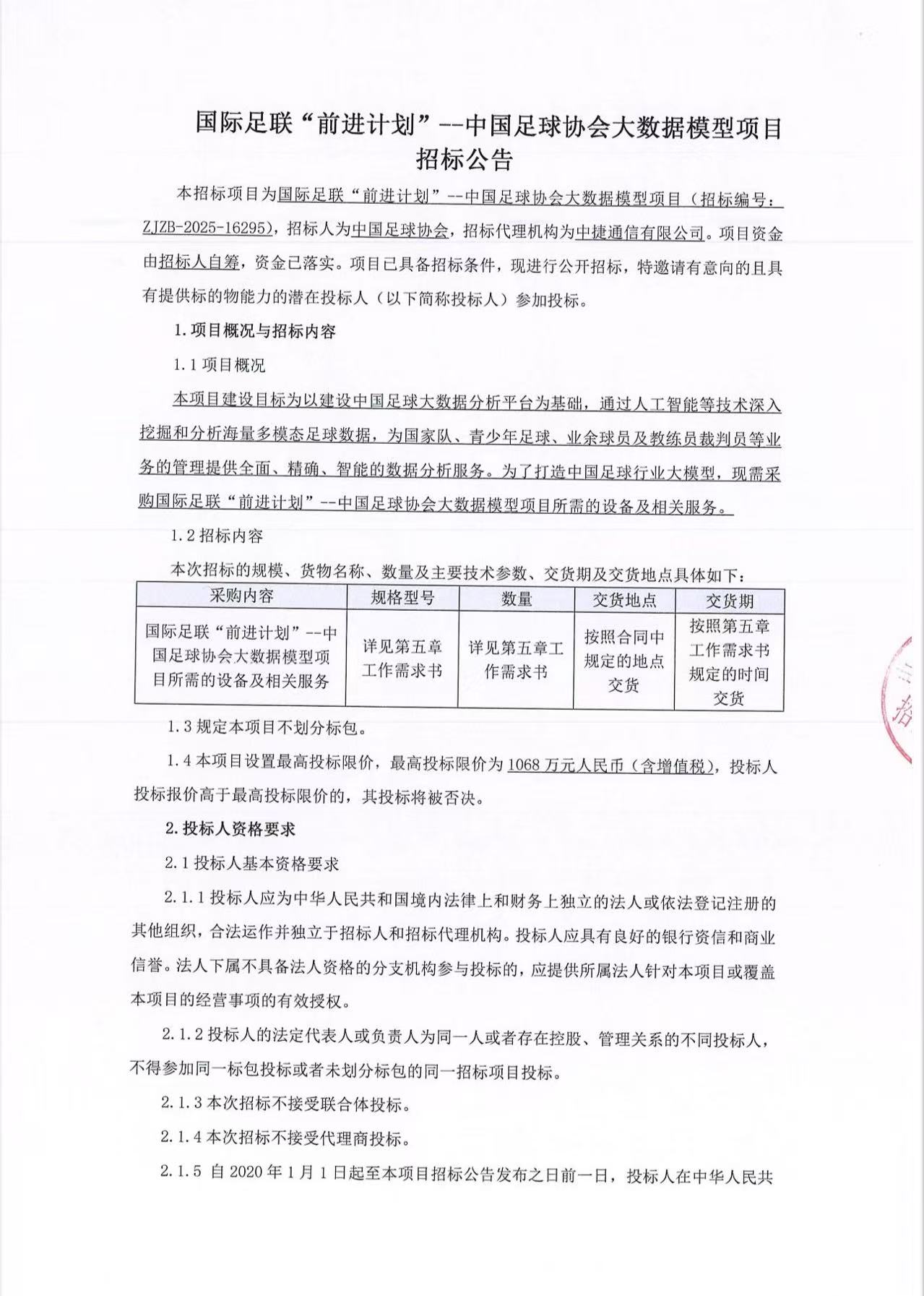
Group 1 - The Chinese Football Association (CFA) has announced a bidding notice for the FIFA "Forward Program" aimed at developing a big data analysis platform for Chinese football [1] - The project aims to utilize artificial intelligence and other technologies to analyze vast amounts of multimodal football data, providing comprehensive and intelligent data analysis services for national teams, youth football, amateur players, coaches, and referees [1] - The maximum bidding limit for the project is set at 10.68 million RMB (including VAT), and any bids exceeding this limit will be rejected [1] Group 2 - In recent years, the CFA has made significant strides in digitalization, including the launch of a smart integration platform for business systems in October 2024 [5] - The platform supports major business management areas such as registration, competitions, training, youth development, and national teams, facilitating data collection and analysis [5] - As of June 30, 25,487 individuals have registered in the CFA's player self-recommendation system, with 6,813 submitting personal information and 1,055 completing the upload of technical data [6]
交通运输部:航运业绿色低碳转型取得显著成效
Zhong Guo Xin Wen Wang· 2025-07-11 07:29
Core Viewpoint - The 2025 China Maritime Day emphasizes "Green Navigation for New Strength," highlighting the country's commitment to sustainable maritime development and the achievements in the shipping industry [1]. Group 1: Event Overview - The main event for the 2025 Maritime Day took place in Qionghai, Hainan, featuring over 20 activities including forums, seminars, and cultural experiences [1]. - The event released the 2024 China Shipping Development Report and announced lists of safe and trustworthy shipping companies, labor models, and award winners in maritime science and technology [1]. Group 2: Industry Achievements - China boasts the world's largest shipping fleet and port cluster, with nearly one-third of global maritime transport volume, contributing significantly to global trade stability [1]. - In 2024, waterway freight volume reached 9.81 billion tons, a 1.64 times increase over the past decade, with a turnover of 14 trillion ton-kilometers, accounting for 55.6% of total cargo turnover [3]. Group 3: Green Transformation Initiatives - The Ministry of Transport is promoting the green transformation of the shipping industry by optimizing transport structures, enhancing clean energy technology, and developing green port infrastructure [2]. - Significant progress has been made in the application of new energy and clean energy vessels, with major ports like Shanghai successfully implementing clean energy refueling operations [3]. Group 4: Future Directions - The Ministry of Transport plans to enhance the green shipping policy framework, develop carbon emission monitoring standards, and promote the construction of international green shipping corridors [4]. - The focus will also be on integrating new technologies such as AI, IoT, and 5G into the shipping sector to improve digitalization across the entire supply chain [4].
中银晨会聚焦-20250711
Bank of China Securities· 2025-07-11 02:05
证券研究报告——晨会聚焦 2025 年 7 月 11 日 | 7 月金股组合 | | | --- | --- | | 股票代码 | 股票名称 | | 002244.SZ | 滨江集团 | | 002352.SZ | 顺丰控股 | | 1519.HK | 极兔速递-W | | 002648.SZ | 卫星化学 | | 688019.SH | 安集科技 | | 688680.SH | 海优新材 | | 603011.SH | 合锻智能 | | 600054.SH | 黄山旅游 | | 300476.SZ | 胜宏科技 | | 688519.SH | 南亚新材 | 中银晨会聚焦-20250711 ■重点关注 【策略研究】策略点评*王君 徐亚。上证指数"站上"3500 点,主因金融行业 股价强势及"反内卷"政策效果预期。后续上证指数"更进一步",需要"反内卷" 等增量政策落地效果展现。 【策略研究】策略点评报告*王君 徐沛东。2025 年 6 月 23 日—2025 年 7 月 6 日。本期中国 A 股上市公司并购重组市场整体活跃度减弱,呈现出"频率 高、主体多、领域广"的三大特点。 【社会服务】人力资源服务行业:具 ...
新紫光三周年|新紫光集团赋能新华三,扬帆智能新时代
Huan Qiu Wang· 2025-07-11 01:51
Core Insights - The restructuring of New Unisplendour Group from 2022 to 2025 coincides with a global surge in intelligence and the acceleration of digital China, positioning Xinhua San Group as a leader in digital and AI solutions [1][2] - The strategic transformation of New Unisplendour Group is characterized by a comprehensive internal and external renewal, enhancing its role in driving technological innovation and industrial upgrades across the sector [2][4] Group 1: Strategic Transformation - New Unisplendour Group's strategic restructuring aligns perfectly with the explosive growth of China's AI industry, providing a platform for Xinhua San to seize opportunities in the evolving market [2][3] - In 2024, Xinhua San achieved significant recognition, winning national science and technology awards, highlighting its advancements in AI technology [2][3] Group 2: Technological Advancements - Xinhua San has deepened its "AI in ALL" strategy, launching new generation products that enhance its competitive edge in the intelligent computing infrastructure sector [3][4] - The introduction of the DDC architecture and the S12500AI series core switches has improved bandwidth utilization by 107%, supporting high-performance AI computing [3] Group 3: Ecosystem Collaboration - The strategic positioning of Xinhua San as a core entity within New Unisplendour Group has led to enhanced resource acquisition and technological investment [4][5] - Xinhua San's collaboration with other subsidiaries has fostered a thriving industrial ecosystem, leveraging AI capabilities to create smarter products and solutions [4][6] Group 4: Innovative Models - The "Turing Town" model has been successfully implemented in multiple cities, creating a comprehensive platform for computing power services that meets diverse industry needs [5][6] - This model has been recognized as a typical application case by the Ministry of Industry and Information Technology, showcasing its effectiveness in advancing computing capabilities [6] Group 5: Global Impact - Xinhua San's initiatives are contributing to a broader intelligent revolution in China, with significant participation from high-tech enterprises and AI companies [7][8] - The company's global outreach includes partnerships with over 2,900 overseas collaborators, delivering Chinese technological solutions to 181 countries [7][8]