数字化转型

Search documents
飞天“i茅台”又“秒光”,茅台全资控股新公司官宣成立,注册资本6亿元
Mei Ri Jing Ji Xin Wen· 2026-01-02 02:17
Group 1 - The core point of the news is the launch of a new subsidiary by Kweichow Moutai, which will focus on digital marketing and e-commerce through the "i Moutai" app, enhancing its online sales strategy [1] - The "i Moutai" app, launched in 2022, has seen significant user growth, surpassing 76 million registered users by May 2025, indicating strong consumer interest and engagement [1] - The app's shopping interface has been revamped, integrating previous features into a unified "i Buy" section, streamlining the purchasing process for users [1] Group 2 - Starting January 1, 2026, the 2026 vintage of Feitian Moutai will be available for purchase at a price of 1499 yuan per bottle, with a purchase limit of 12 bottles per person per day [1] - The initial release of the 2026 vintage sold out within half an hour, demonstrating high demand, which continued on the following day with another quick sell-out [1] - Future product releases will include a full range of Moutai offerings from 2019 to 2024, expanding the product matrix available to consumers [2]

飞天“i茅台”又“秒光”!茅台全资控股新公司官宣成立 注册资本6亿元
Mei Ri Jing Ji Xin Wen· 2026-01-02 02:02
Group 1 - The core point of the news is the launch of a new subsidiary by Kweichow Moutai, which will focus on digital marketing and e-commerce through the "i Moutai" app, enhancing its online sales strategy [2] - The "i Moutai" app, which was launched in 2022, has seen significant user growth, surpassing 76 million registered users by May 2025, indicating strong consumer interest and engagement [2] - The app's shopping interface has been revamped, integrating previous features into a unified "i Buy" section, streamlining the purchasing process for both new and existing users [2] Group 2 - Starting January 1, 2026, the 2026 vintage Feitian Moutai will be available for purchase at a price of 1499 yuan per bottle, with a purchase limit of 12 bottles per person per day, highlighting the product's high demand as it sold out within half an hour [2] - Following the 2026 vintage, a full range of products including the 2019 to 2024 vintages and special edition Moutai will be launched, creating a comprehensive product matrix [3]

2025年中国餐饮食品连锁加盟行业白皮书
艾瑞咨询· 2026-01-02 00:03
Core Insights - The Chinese restaurant food chain franchise industry is undergoing significant transformation, driven by macroeconomic recovery and increasing consumer spending power, leading to market expansion and digital transformation [1][4][12] - The rise of home dining and heightened consumer demand for health, efficiency, and social value are reshaping industry structures, prompting chain brands to accelerate their digital transformation and omnichannel marketing strategies [1][10] - The relationship between brands and franchisees is shifting from extensive expansion to refined operations and mutual selection, with a growing group of experienced "professional franchisees" [1][47] Market Overview - The Chinese restaurant food market reached 12.6 trillion yuan, with a compound annual growth rate (CAGR) of approximately 7.2% from 2020 to 2024, driven by both service and retail sectors [9] - The restaurant service sector is recovering strongly post-pandemic, with an annual growth rate nearing 9%, while food retail is experiencing structural upgrades with high-value subcategories [9][10] - The home dining market is growing rapidly at an annual rate of 18.4%, expected to account for 13.5% of the overall food retail market by 2029, indicating a significant shift towards retailization in the industry [10][36] Consumer Spending Trends - From 2020 to 2024, urban and rural residents' per capita consumption expenditure is showing a recovery trend, with urban growth at 6.4% and rural at 8.9%, reflecting the ongoing vitality of the lower-tier market [6] - Food and beverage spending remains stable and resilient, providing a solid demand foundation for the restaurant food industry [6] Franchise Market Dynamics - The franchise market is dominated by the restaurant sector, which accounts for nearly 50% of the market, indicating its high-frequency consumption and standardization advantages [20] - The chain rate in the restaurant service sector is expected to rise from 15% to 24% between 2020 and 2025, although it still lags behind developed markets like Japan and the U.S. [12] - The competitive environment is shifting towards refined operations, with franchisees focusing on quality site selection and cost structures as market saturation increases [24][48] Investment Considerations - Franchisees are increasingly favoring low-investment, high-profit margin segments, with the home dining sector being particularly attractive due to its lower entry barriers and shorter investment return periods [34][36] - The home dining segment is characterized by a high degree of standardization and flexibility in product offerings, making it appealing for franchisees [32][34] Brand Selection Criteria - Franchisees prioritize brands with clear profit models, operational support, and a proven track record, leading to a dual selection mechanism between brands and franchisees [48] - The leading brand in the home dining sector, Guoquan Shihui, is recognized for its low investment threshold, mature replicable model, and diverse product matrix, making it a preferred choice for franchisees [39][40] Digital Transformation - The industry is witnessing a pressing need for digital transformation to support scale expansion and profitability, with brands leveraging data-driven site selection and standardized operational systems [44] - Digital management of supply chains is enhancing control, reducing waste, and improving efficiency, which is crucial for increasing single-store profitability [44] Conclusion - The Chinese restaurant food chain franchise industry is poised for growth, driven by changing consumer behaviors, digital transformation, and evolving franchisee dynamics, presenting numerous opportunities for investment and expansion [1][9][12]

2025年越南信息与通信技术十大新闻发布
Shang Wu Bu Wang Zhan· 2026-01-01 16:46
Core Viewpoint - The year 2025 is a significant milestone for Vietnam's information and communication technology (ICT) sector, marked by important decisions in various areas such as institutional mechanisms, organizational structure, cybersecurity, data, and strategic technologies, aimed at accelerating digital transformation and shaping the long-term development framework of a digital nation. Group 1 - The National Assembly of Vietnam passed a series of important laws to establish a solid legal framework for science and technology, innovation, digital transformation, and the field of news and communication [1] - The Vietnamese government, National Assembly, and various departments and localities are committed to implementing the Central Committee's resolution on technological innovation and national digital transformation [2] - The Ministry of Information and Communications has been merged into the Ministry of Science and Technology, with some functions transferred to the Ministry of Public Security and the Ministry of Culture, Sports, and Tourism [3] Group 2 - The National Assembly approved the Cybersecurity Law and the Personal Data Protection Law, drafted by the Ministry of Public Security [4] - The government issued Decree No. 1131, announcing 11 strategic technology areas and 35 key product categories for Vietnam [5] - Vietnam hosted the signing ceremony for the UN Convention on Cybercrime and the Hanoi Convention, with participation from 72 countries, highlighting Vietnam's proactive role in shaping cyberspace governance and deepening international cooperation [6] Group 3 - The government issued a decree to pilot the development of a cryptocurrency market [7] - The government legally prosecuted several key opinion leaders and public figures for disseminating false advertisements and selling counterfeit goods online [8] - The National Credit Information Center of Vietnam suffered a cyberattack [9] - Vietnam has begun developing its low-altitude economy [10]
期货日报2026新年献词:在波动中坚守 在创新中前行
Qi Huo Ri Bao Wang· 2026-01-01 14:13
Core Insights - The year 2025 was marked by significant market fluctuations driven by various uncertainties, including trade wars, geopolitical shifts, and monetary policy divergences, leading to both challenges and opportunities for market participants [1][5] - The total capital in the market exceeded 2 trillion yuan, with the number of effective clients surpassing 2.7 million, and institutional clients holding over 65% of positions, indicating a growing participation from various sectors [4] Market Dynamics - The market experienced notable price movements, with gold reaching new highs, silver gaining momentum, and copper and tin markets rebounding, reflecting the interplay of supply, demand, expectations, and sentiment [1] - Traders have become more sophisticated, implementing disciplined strategies such as stop-loss orders and options to mitigate risks, while also leveraging technology for decision-making [1] Industry Developments - The number of futures and options increased to 164, achieving full options coverage for mature futures products, and enhancing market depth through the introduction of series options and average price futures [4] - The industry is undergoing a digital transformation, with advancements in research, risk management, and the implementation of smart technologies to improve service efficiency and strategy precision [4] Future Outlook - The industry aims to deepen reforms and innovations, focusing on key areas such as green development and specialized agriculture, while introducing new futures products to meet evolving risk management needs [5] - There is a commitment to enhancing talent development within the industry, emphasizing the importance of cultivating professionals who can navigate the complexities of the market [5] - A robust risk monitoring and control system will be established to ensure market risks are measurable, controllable, and manageable, reinforcing the industry's commitment to risk prevention [5]
全球主权财富基金:AUM达15万亿,AI投资660亿
Sou Hu Cai Jing· 2026-01-01 11:15
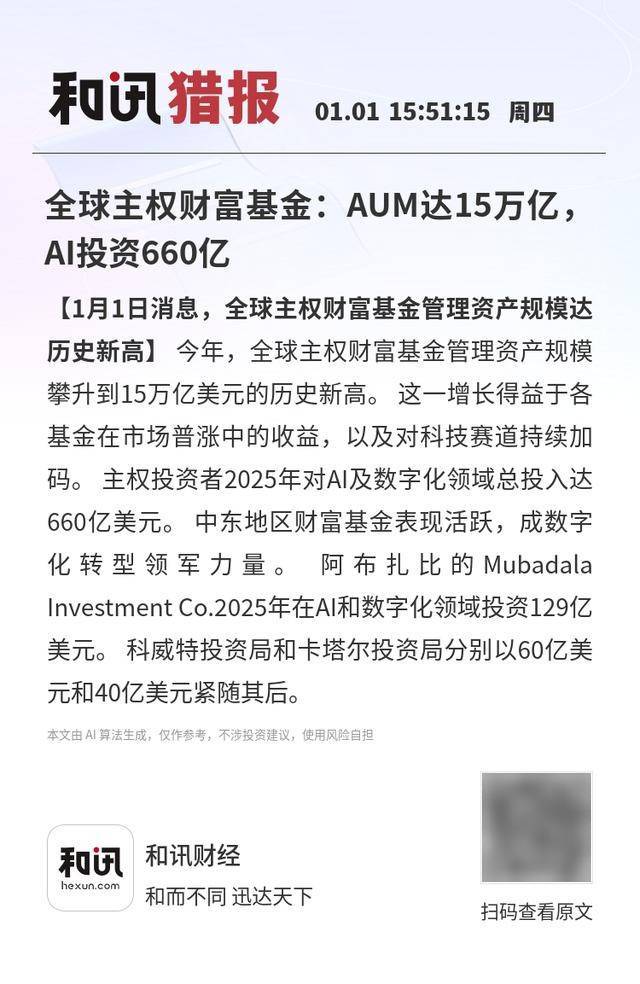
Group 1 - The global sovereign wealth funds' assets under management (AUM) have reached a historic high of $15 trillion this year [1][2] - This growth is attributed to the gains from a rising market and increased investments in technology sectors [1][2] - Sovereign investors are projected to invest a total of $66 billion in AI and digitalization by 2025 [1][2] Group 2 - Middle Eastern wealth funds are becoming key players in digital transformation [1][2] - Mubadala Investment Co. from Abu Dhabi plans to invest $12.9 billion in AI and digitalization by 2025 [1][2] - The Kuwait Investment Authority and Qatar Investment Authority are following with investments of $6 billion and $4 billion, respectively [1][2]
“i茅台”开售1499元茅台!业内人士:更以消费者为中心了
新浪财经· 2026-01-01 07:42
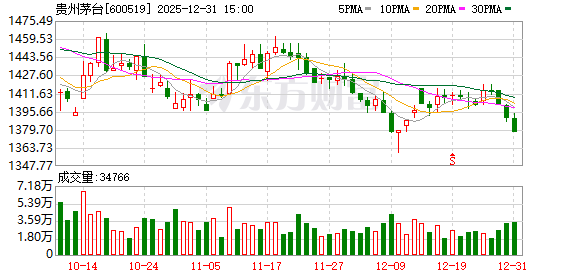
Core Viewpoint - Guizhou Moutai has launched the sale of its Feitian 53% vol 500ml liquor on the iMoutai App starting January 1, 2026, allowing consumers to purchase directly, indicating a strong demand for Moutai and a shift towards consumer-centric strategies [3][10]. Group 1: Sales and Consumer Response - The Feitian Moutai sold out quickly after its launch at 9:00 AM, with consumers expressing excitement on platforms like Xiaohongshu, referring to it as their "dream liquor" [4][7]. - The iMoutai App will continue to offer the Feitian Moutai daily at 9:00 AM, allowing consumers who missed out to try again the next day [5][10]. Group 2: Market Strategy and Consumer Engagement - Moutai's pricing strategy has returned to 1499 yuan, which is expected to stabilize the market and enhance user experience, making it more accessible to a broader audience [7][9]. - The launch of the iMoutai App is part of Moutai's digital transformation, aiming to connect directly with consumers and ensure authenticity in purchases [10][11]. Group 3: Industry Impact - The return of Moutai to a lower price point is anticipated to increase its consumer base and drinking scenarios, potentially impacting competitors like Wuliangye and Guojiao 1573 [9][11]. - Experts believe that the fixed pricing on the iMoutai platform will discourage speculative pricing behaviors, reinforcing Moutai's position as a consumer product rather than an investment asset [11].

剑南春2025年多维拓进,激活品牌发展新动能
Sou Hu Cai Jing· 2026-01-01 07:21
Core Viewpoint - The strategic movements of famous liquor companies are crucial amid deep adjustments in the liquor industry and evolving consumer demands. In 2025, Jian Nan Chun focuses on five dimensions: product innovation, capacity upgrades, scene expansion, brand outreach, and liquor responsibility to strengthen quality and activate new brand development momentum [1]. Group 1: Product Strategy - Jian Nan Chun maintains strategic stability and resilience in the face of industry adjustments and market changes, with stable pricing and strong product sales. The "Shuijing Jian Nan Chun" product continues to gain market influence, becoming a preferred choice for business and wedding banquets [3]. - The company has successfully launched cultural creative products in collaboration with top historical museums, such as "Jian Nan Chun·Liujin Ji" and "Jian Nan Chun·Bingwu Year of the Horse Commemorative Wine," which have become benchmarks in the cultural consumption sector [3]. - During the 2025 Double 11 shopping festival on Tmall, Jian Nan Chun achieved the top position in total transaction volume in the liquor industry, showcasing its strong market appeal [3]. Group 2: Quality and Innovation - Quality is the foundation of famous liquor, and Jian Nan Chun integrates traditional craftsmanship with modern technology to solidify its quality base. The "Datang National Liquor Ecological Park Phase II" project, with an investment exceeding 1.6 billion yuan, will increase annual production capacity by 30,000 to 50,000 tons [5]. - Jian Nan Chun's "Tianyi Laohua" winery site was recognized as a national industrial heritage, and its chief engineer was named a national-level intangible cultural heritage inheritor, highlighting the clarity of its traditional brewing techniques [5]. - The company has been recognized as a digital innovation benchmark in the liquor industry, reflecting its successful digital transformation [5]. Group 3: Brand Expansion - Jian Nan Chun is innovating traditional liquor consumption scenarios and actively expanding its brand ecosystem through various channels, including high-profile media exposure and partnerships with sports events [8]. - The company has partnered with CCTV to enhance brand visibility and has engaged in sports sponsorships, such as becoming the chief partner for the English Premier League broadcasts [8]. - Cultural initiatives, such as the micro-variety show "Four Seas Spring Flavor" and collaborations with CCTV for cultural heritage tours, aim to engage younger audiences and promote traditional culture [9]. Group 4: Social Responsibility - Jian Nan Chun is committed to social responsibility, particularly in education, by launching initiatives like the "Jian Nan Chun Strong Country Youth Scholarship Project" to support youth development [11]. - The company actively participates in industry events, such as the 2025 Sichuan International Wine Expo, and has won over ten major industry awards, enhancing its international influence [11]. - Jian Nan Chun continues to focus on quality, culture, and innovation to support the liquor industry's high-quality development and navigate through industry cycles [11].

山东高速:给高速装上“智慧大脑”,让出行驶入“智能车道”
Da Zhong Ri Bao· 2026-01-01 05:27
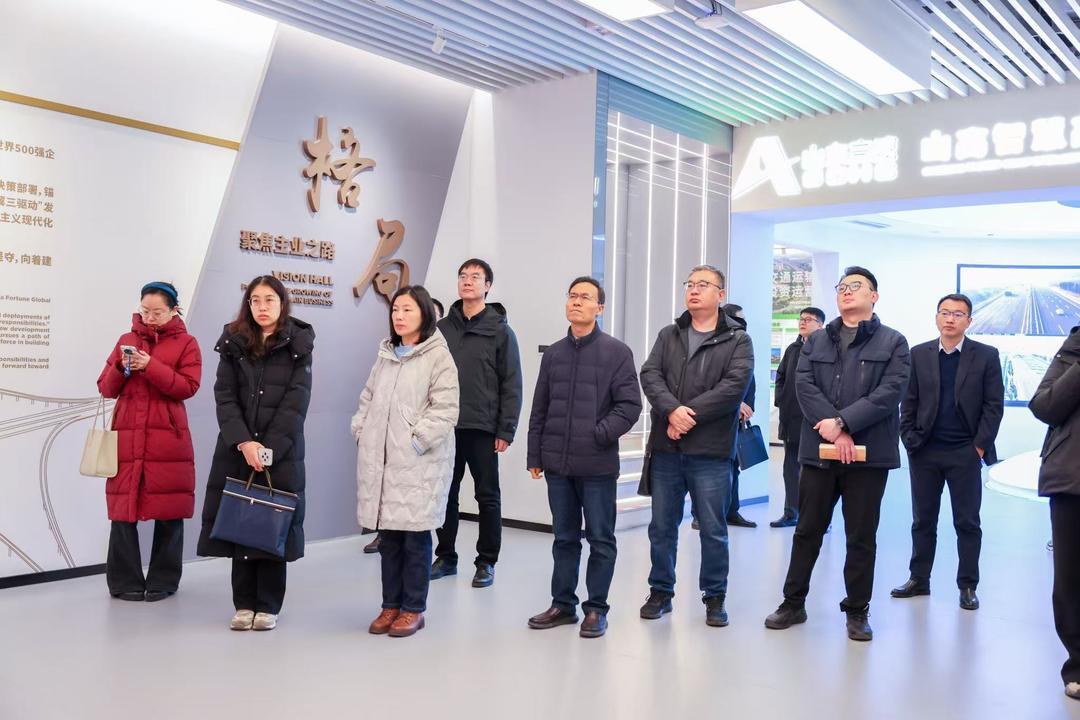
Group 1 - Shandong High-Speed Group showcased four technological innovation achievements at the provincial enterprise technology innovation ecological construction promotion meeting [1] - The "Key Technology and Comprehensive Detection Equipment for High-Precision Spatiotemporal Collaborative Perception of Multi-source Diseases and Hazards in Tunnels" was selected as one of the top ten innovative achievements of provincial enterprises [1] - The "Shandong University 'Four Chains' Integration to Support the Construction of the Provincial Demonstration Zone for 'Strong Transportation Country'" was recognized as an excellent case [1] Group 2 - Shandong High-Speed Group operates 84% of the highways in Shandong Province, with total assets exceeding 1.7 trillion yuan, ranking among the world's top 500 companies [3] - The Jing-Tai Expressway's Jiqi section is the first long-distance, three-dimensional composite digital transformation expressway in the country, expected to improve toll station efficiency by over 30% [3] - The "Smart Eye" series products create an integrated intelligent perception system, achieving an average rescue time reduction of over 6 minutes [3] Group 3 - The group has established the longest and most diverse closed testing base for intelligent connected technology in the country, covering 34 automatic driving and networking testing scenarios [4] - The testing base has provided services for over 40 automotive companies and testing institutions, accumulating over 25 million kilometers of testing mileage [4] Group 4 - In the "Four Chains" integration field, the group co-established the Qilu Transportation College with Shandong University, nurturing 26 high-level talents and jointly undertaking 67 research projects [5] - The technology achievement transformation effect exceeded 1 billion yuan, creating a new paradigm of mutual promotion among the "Four Chains" [5] - The group led the formation of the Intelligent Transportation Innovation Consortium, focusing on traffic digital cloud brain and reshaping the smart travel industry ecosystem [5]

长虹数字化转型以“智”破圈
Sou Hu Cai Jing· 2026-01-01 05:23
Core Insights - Sichuan Province has approved the "14th Five-Year Plan" with the ambitious goal of maintaining an economic growth rate above the national average, presenting both opportunities and challenges for local industries [1] - The plan emphasizes the transformation of manufacturing towards high-end, intelligent, and green development, with a focus on technological innovation and regional coordination [1] - Changhong Holding Group's industrial layout and development strategy align closely with the provincial planning, positioning it as a potential "industry star" in the next five years [1] Group 1: Manufacturing Foundation - Changhong has established a comprehensive manufacturing system covering various processes, including molds, injection molding, and precision electronic components, which is crucial for its competitive edge [4] - The company has achieved significant production milestones, such as over 40 million units of smart home appliances annually and being the global leader in refrigerator compressor shipments for 12 consecutive years [4] - Changhong's commitment to manufacturing is evident in its extensive product range and production capabilities, which are essential for the province's industrial upgrade goals [4][6] Group 2: Industrial Internet and Digital Transformation - Changhong initiated its industrial internet platform in 2017, which has become a key support for its digital transformation and has empowered nearly 3,000 small and medium-sized enterprises [7][9] - The platform utilizes a "data + AI" core to enhance operational efficiency across various industries, significantly improving supply chain collaboration and production processes [9][10] - The company has received over 30 national and provincial honors for its industrial internet initiatives, showcasing its leadership and innovation in the sector [10] Group 3: Green Manufacturing and Sustainability - Changhong has implemented AI technology to achieve substantial carbon reduction, exceeding 50,000 tons annually, and has developed a comprehensive green manufacturing system [11][12] - The company has made significant strides in energy efficiency, such as reducing energy consumption through digital controls and innovative production techniques [12] - Changhong is actively involved in recycling and resource regeneration, with the capacity to process over 14 million discarded electrical appliances annually [13] Group 4: Smart Supply Chain and Collaboration - Changhong has developed a smart supply chain platform that integrates AI to enhance procurement processes, inventory management, and logistics, resulting in improved operational efficiency [15][17] - The platform allows for real-time tracking and automated procurement, significantly reducing approval times and enhancing supply chain resilience [15][17] - The company has successfully transformed its supply chain collaboration model, fostering a digital ecosystem that promotes shared risks and benefits among partners [17][18] Group 5: Future Outlook and Innovation - Changhong has been recognized as a pioneer in the development of a trusted data space, which aims to facilitate data sharing and drive new productivity in the manufacturing sector [18][19] - The company continues to innovate and expand into future industries such as healthcare and robotics, reinforcing its commitment to high-quality development [19] - With over 60 years of experience, Changhong is poised to redefine its growth boundaries and achieve new heights in becoming a world-class enterprise [19]