资产配置

Search documents
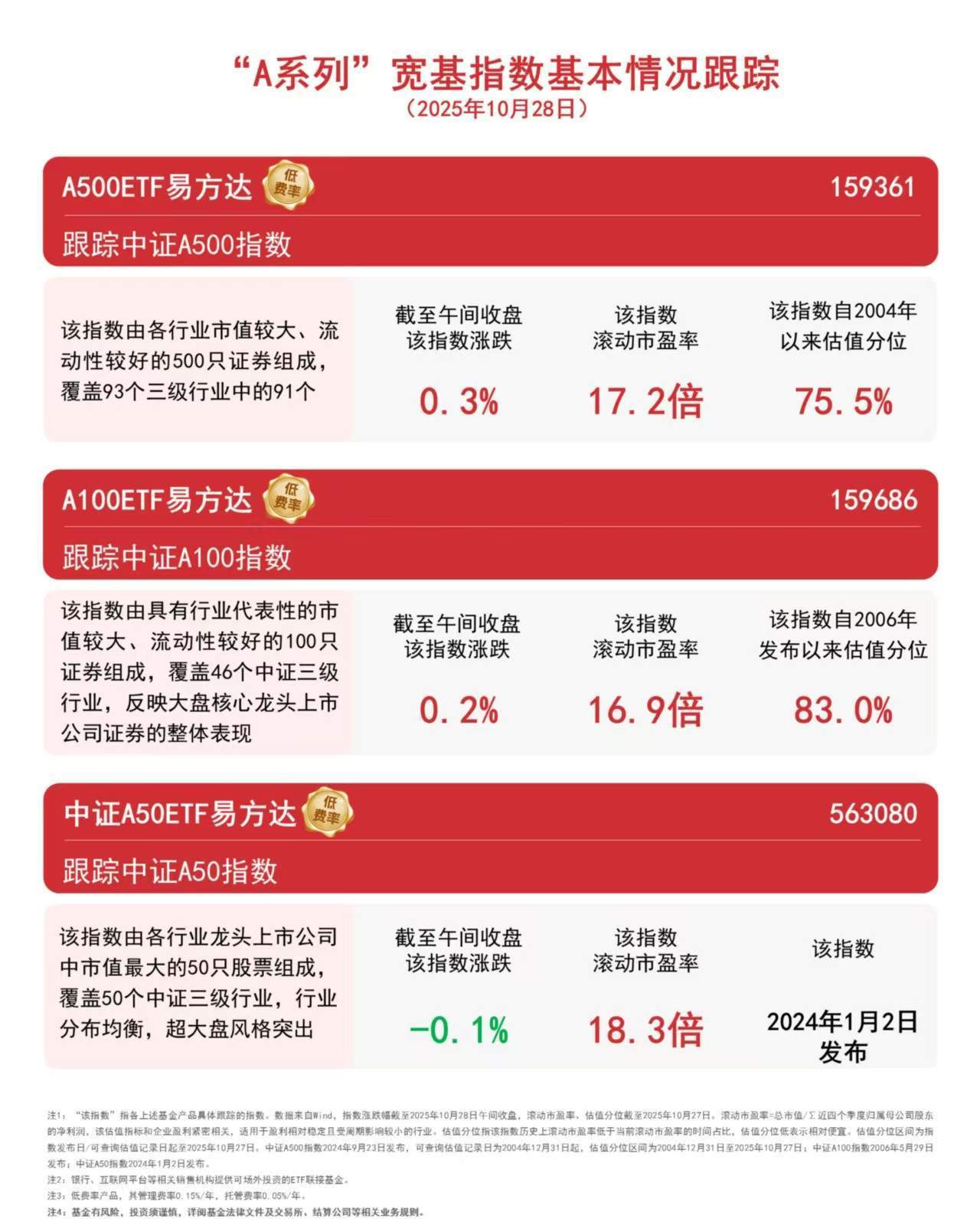
“A系列”指数早盘窄幅震荡,A500ETF易方达(159361)半日获1.5亿份净申购
Sou Hu Cai Jing· 2025-10-28 05:56
Group 1 - The core viewpoint of the article highlights the performance of various indices in the Chinese stock market, with the CSI A500 index rising by 0.3%, the CSI A100 index increasing by 0.2%, and the CSI A50 index declining by 0.1% [1] - The A500 ETF from E Fund (159361) recorded a trading volume of nearly 2.5 billion yuan, with a net subscription of 150 million shares [1] - The Chairman of the China Securities Regulatory Commission, Wu Qing, emphasized the importance of stability and balance in asset allocation during the risk repricing and asset rebalancing process, indicating a continued revaluation of Chinese assets such as A-shares and Hong Kong stocks [1][3] Group 2 - The CSI A500 index is composed of 500 securities with larger market capitalizations and better liquidity, covering 91 out of 93 three-level industries [3] - The rolling price-to-earnings ratio of the CSI A500 index stands at 17.2 times [3]

金价暴跌!未来趋势如何?黄金之外怎样合理配置资产?
Sou Hu Cai Jing· 2025-10-28 05:21
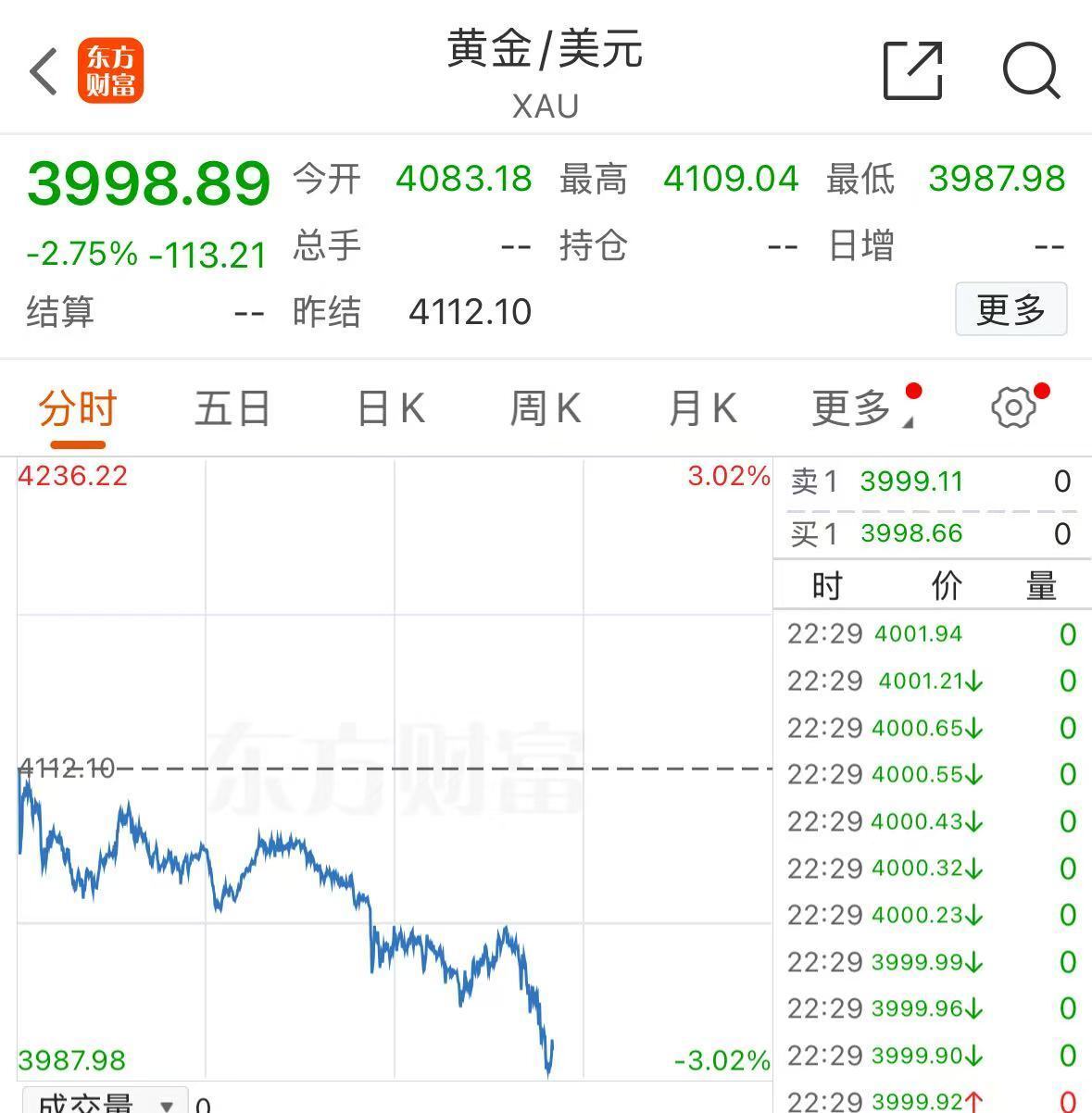
晚上,北京时间10月27日,现货黄金一路走低进而向下跌破4000美元/盎司,此为10月10日以来第一次,日内跌幅到2.75% 。 | 黄金/美元 | | | | | | --- | --- | --- | --- | --- | | XAU | | | | | | 3998.89 今开 4083.18 最高 4109.04 最低 3987. | | | | | | 总手 持世 -- -2.75% -113.21 | | | | 日增 | | 结算 昨结 4112.10 | i | | | | | 分时 五日 團K | | 月K | | 申多, | | 4236.22 | | 3.02% | | 卖1 3999.11 | | | | | | 21 3998.66 | | | | | | 时 价 | | 4172.10 | | | 22:29 4001.94 | | | | | | | 22:29 4001.21V | | | | | | 22:29 4000.65 | | | | | | 22:29 4000.55 | | | | | | 22:29 4000.43V | | Japan | | | | 22: ...

上证指数时隔十年再上4000点,成交额仍待放量|市场观察
Di Yi Cai Jing· 2025-10-28 04:42
Core Viewpoint - The A-share market has shown resilience, with the Shanghai Composite Index breaking the 4000-point mark, reflecting improved market sentiment and investor confidence, supported by ongoing developments in U.S.-China trade negotiations and favorable regulatory policies [1][3][4] Market Performance - On October 28, the Shanghai Composite Index rose by 0.21% to close at 4005 points, with total trading volume in Shanghai, Shenzhen, and Beijing reaching 1.36 trillion yuan, a decrease of 216.5 billion yuan compared to the previous day [1] - The index initially broke through 4000 points but experienced a pullback before regaining that level later in the morning [1] Regulatory Environment - The China Securities Regulatory Commission (CSRC) has introduced measures to optimize the Qualified Foreign Institutional Investor (QFII) system, enhancing access and operational efficiency for foreign investors [2] - Future plans include the introduction of a refinancing framework to support mergers and acquisitions, and encouraging listed companies to improve governance and increase shareholder returns through dividends and buybacks [2] Investor Sentiment - Analysts suggest that the recent market movements indicate a structural bull market, with the 4000-point level serving as a psychological barrier that, if maintained, could attract further capital inflow [3] - There is a cautionary note regarding high valuations in certain sectors, particularly technology and semiconductors, which may lead to profit-taking and increased volatility [2][3] Economic Context - The market is influenced by global economic conditions, including expectations of a potential interest rate cut by the Federal Reserve, which could support global liquidity [4] - The upcoming APEC meeting may provide opportunities for U.S.-China dialogue, potentially easing geopolitical tensions and trade friction [4]
理财的真正意义:让生活有底气,让未来有选择
Sou Hu Cai Jing· 2025-10-28 03:57
Core Insights - Financial management is not just for the wealthy; it is about gaining the freedom of choice and facing life with confidence [1] - The essence of financial management is not merely to earn more money but to make existing money work smarter [2] Group 1: Importance of Financial Management - Everyone should engage in financial management to prevent inflation from eroding savings and to avoid living paycheck to paycheck [2] - The first step in financial management is self-management, focusing on controlling expenses rather than immediately seeking investments [2] Group 2: Steps to Effective Financial Management - Controlling expenses is crucial; saving 10%-20% of income each month helps in wealth accumulation [3] - Establishing an emergency fund equivalent to 3-6 months of expenses is recommended for financial security [4] - Clearing high-interest debts is essential before considering investments to ensure a stable financial path [5] Group 3: Asset Allocation - The core of financial management lies in balancing risk and return through proper asset allocation [7] - Recommended asset allocation includes 40% in stable assets (e.g., bank deposits, bonds), 40% in growth assets (e.g., stocks), and 20% in opportunity assets (e.g., real estate) [8][9] - Asset allocation should be dynamic, adjusting according to age, income, and financial goals [10] Group 4: Key Financial Concepts - The two most powerful forces in investment are compound interest and time, where money generates more money over time [11] - An example illustrates that investing 1,000 yuan monthly at an 8% annual return can grow to approximately 180,000 yuan in 10 years and over 1.1 million yuan in 30 years [12] Group 5: Financial Mindset - A stable approach to financial management is more important than seeking quick profits; it is a long-term commitment [13] - Financial management should be integrated into daily life, influencing lifestyle choices and overall quality of life [14] Group 6: Conclusion - The significance of financial management lies in mastering control over one's finances, regardless of current wealth [15] - Starting small, such as saving 500 yuan monthly, can lead to significant changes over time [15]

A股盘中站上4000点!科创50、中证A500成最“吸金”宽基指数,科创50ETF单日净流入9.8亿!
Ge Long Hui· 2025-10-28 02:44
Group 1 - The Shanghai Composite Index has surpassed 4000 points, reaching a 10-year high with a year-to-date increase of 19%. Historically, the index has only been above 4000 points in 2007, 2008, and 2015 [1] - On the backdrop of positive US-China trade talks and expectations of Federal Reserve interest rate cuts, A-shares peaked at 3999.07 points, with trading volume exceeding 2 trillion yuan [1] - The stock ETF market saw a net outflow of over 2.7 billion yuan from thematic ETFs, while broad-based ETFs attracted net subscriptions, with the CSI A500 and STAR 50 indices receiving net inflows of 1.563 billion yuan and 680 million yuan respectively [1] Group 2 - The STAR 50 ETF (588000), which has over 60% semiconductor content, has a scale exceeding 70 billion yuan and ranks first in liquidity among its peers, with an average daily trading volume of 4.212 billion yuan this year [2] - The A500 ETF (512050) is the most actively traded among its peers, with an average daily trading volume of 4.023 billion yuan this year, combining both "value and growth" characteristics [2]
“黄金+”理财产品成市场新宠
Jin Rong Shi Bao· 2025-10-28 00:30
Core Insights - The recent surge in gold prices has led to the popularity of "gold+" wealth management products, which are now seen as market favorites [1][2] - These products are designed to include gold as a long-term strategic asset in investment portfolios, with returns linked to gold price movements [1][2] Group 1: Product Overview - "Gold+" wealth management products include fixed income plus gold and structured products linked to gold, with returns varying based on gold price trends [1] - ICBC Wealth Management has launched four "gold+" products that incorporate gold into diversified asset allocation, aiming for risk hedging and yield enhancement [1] - Recent data shows that among the "gold+" products, two have achieved an annualized return close to 10% over the past three months, and over 5% in the past year [1] Group 2: Market Trends - As of October 23, there are 47 "gold+" wealth management products in the market, with 16 from bank wealth management companies, indicating a growing trend [2] - The average annualized return for "gold" products this year is reported at 4.69%, outperforming other types of investment products [2] Group 3: Investment Considerations - The introduction of "gold+" products reflects changing market demand and macroeconomic expectations, driven by factors such as central bank monetary policies and rising risk aversion [3] - Despite the popularity of these products, experts caution that they are not risk-free and highlight the importance of careful risk assessment [3][4] - Current high gold prices present both opportunities and risks, with experts suggesting that gold should be viewed as a stabilizing asset rather than a speculative tool [3][4] Group 4: Long-term Outlook - Long-term factors supporting gold prices include the restructuring of the global monetary credit system, de-dollarization trends, and ongoing central bank purchases [4] - The fundamental support for gold is expected to remain stable over the next 2 to 3 years, suggesting a continued bullish trend for gold in the long run [4]
黄金,跌破4000美元!现在该怎么投?
Mei Ri Jing Ji Xin Wen· 2025-10-27 15:15
Group 1 - The spot silver price has dropped by 4.2%, reaching $46.57 per ounce, marking a new low since October 2 [2] - The highest and lowest prices for silver during the recent trading session were $48.41 and $48.69, respectively, with a closing price of $48.61 [3] - The recent volatility in gold prices has made it a significant topic of interest for investors, especially after surpassing key price thresholds [2] Group 2 - Current mainstream investment methods for gold include physical gold, gold ETFs, gold stocks, and gold futures, with recommendations for investors to maintain a portfolio allocation of 10%-20% in gold [4] - The gold price has increased by over 120% since the beginning of 2023, with historical data showing significant bull markets in gold prices since 1970 [6] - Central banks have been major buyers of gold, with net purchases exceeding 1,000 tons for three consecutive years, providing strong support for gold prices [6]
今天、明天、未来做什么……吴清:进一步深化投融资综合改革
Jing Ji Guan Cha Wang· 2025-10-27 13:44
Group 1 - The core viewpoint emphasizes the increasing importance of stability and balance in asset allocation, with a growing consensus among international investors to diversify investments [1] - In the first nine months of this year, international funds flowing into emerging markets exceeded $150 billion, highlighting the revaluation of Chinese assets such as A-shares and Hong Kong stocks [1] - The China Securities Regulatory Commission (CSRC) has launched the "Qualified Foreign Investor System Optimization Work Plan," which includes measures to enhance access management, improve investment operation efficiency, and expand investment scope [1] Group 2 - The CSRC will release several opinions aimed at strengthening the protection of small and medium investors in the capital market, introducing 23 practical measures to enhance investor protection [1] - The first batch of newly registered companies will be listed on the Sci-Tech Innovation Board, with reforms such as the introduction of professional institutional investors and pre-review processes already implemented [2] - The CSRC plans to deepen the reform of the Growth Enterprise Market, setting listing standards that better align with the characteristics of emerging industries and future technological enterprises [2] Group 3 - The CSRC acknowledges that the internal and external environment for capital market development will face complex changes over the next five years, presenting both challenges and opportunities [3] - The focus will be on risk prevention, strong regulation, and promoting high-quality development, with an emphasis on serving new productive forces and balancing development with safety [3] - The CSRC aims to enhance the inclusiveness, adaptability, attractiveness, and competitiveness of China's capital market to better serve economic and social development [3]
中证A500指数走出三连阳,A500ETF易方达(159361)获资金大幅加仓
Sou Hu Cai Jing· 2025-10-27 13:17
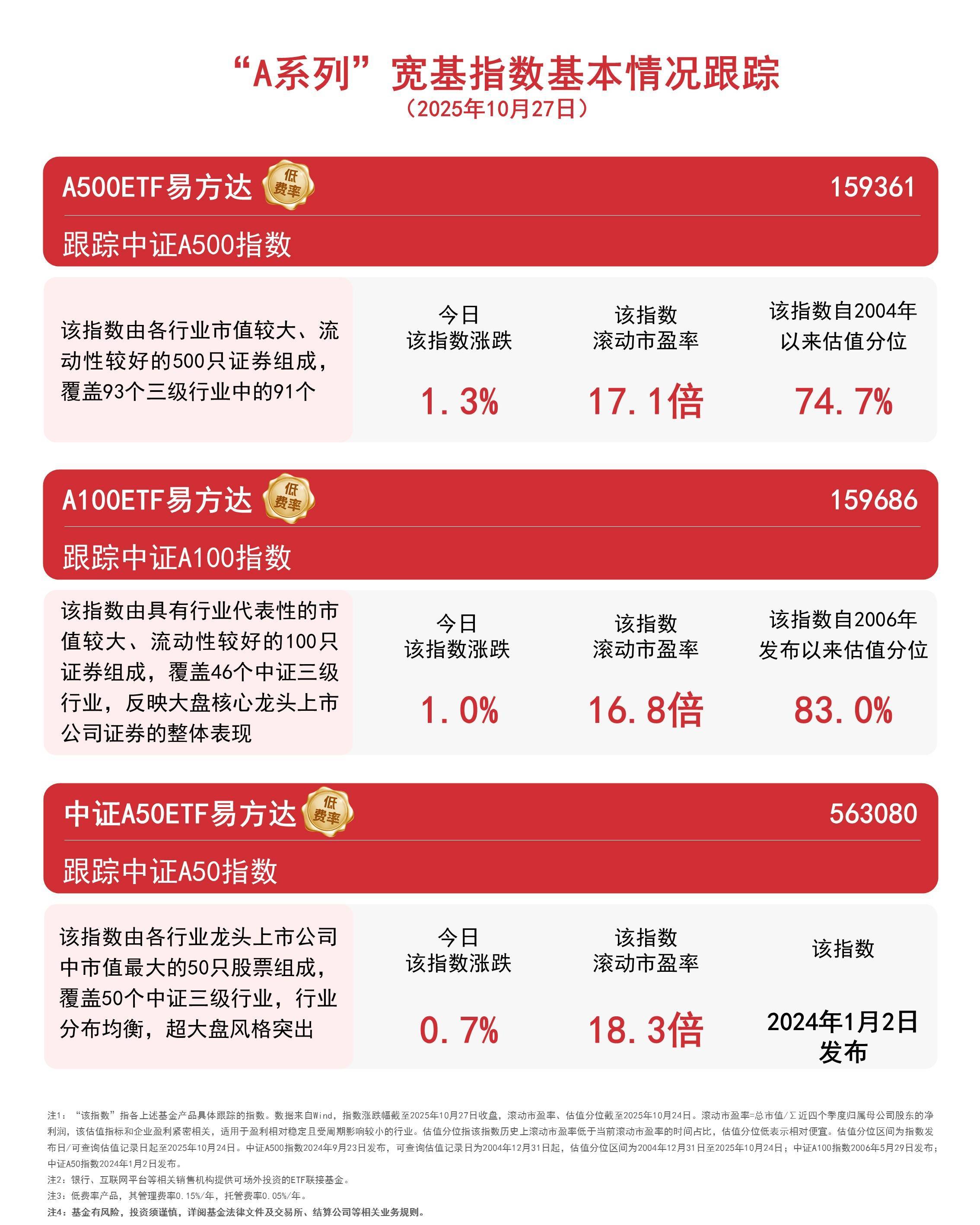
Group 1 - The core viewpoint of the article highlights the positive performance of Chinese stock indices, with the CSI A500 index rising by 1.3%, the CSI A100 index by 1.0%, and the CSI A50 index by 0.7%, all achieving three consecutive days of gains [1] - The trading volume of the E Fund A500 ETF (159361) reached nearly 4 billion yuan, marking a new high since March, with a net subscription of 378 million units [1] - The Chairman of the China Securities Regulatory Commission, Wu Qing, emphasized at the 2025 Financial Street Forum that stability and balance are becoming priority options for asset allocation amid risk repricing and asset rebalancing [1] Group 2 - Wu Qing noted that Chinese assets, including A-shares and Hong Kong stocks, are undergoing continuous revaluation, with their allocation value becoming more apparent [1]
证监会主席:将启动实施深化创业板改革,设置更契合上市标准
Nan Fang Du Shi Bao· 2025-10-27 12:15
Core Insights - The 2025 Financial Street Forum in Beijing focuses on "Innovation, Transformation, and Reshaping Global Financial Development" [2] - The Chairman of the China Securities Regulatory Commission (CSRC), Wu Qing, emphasizes the importance of risk repricing and asset rebalancing, advocating for diversified asset allocation among international investors [2] - The CSRC plans to deepen comprehensive reforms in investment and financing, enhancing the inclusiveness, adaptability, attractiveness, and competitiveness of China's capital markets [2] Group 1 - Wu Qing highlights the need for a multi-layered capital market system that is inclusive and covers a broader range of sectors, with plans to reform the Growth Enterprise Market to better serve emerging industries [2] - The CSRC aims to solidify the internal foundation for market stability and will introduce a refinancing framework at an appropriate time, encouraging listed companies to improve governance and increase dividends and buybacks [2] - The focus is on establishing a "long money, long investment" market ecosystem to stabilize the market [2] Group 2 - Wu Qing announces the optimization of the Qualified Foreign Institutional Investor (QFII) system to provide a more transparent, convenient, and efficient environment for foreign investors [3] - The CSRC aims to strengthen risk prevention and regulatory measures while enhancing the protection of investors' rights, with plans to release several opinions and practical measures for investor protection [3] - Beijing is positioned as a key window for capital market reform and opening up, with initiatives to attract quality industry institutions and long-term capital to enhance the capital market's capabilities [3]