
中长期资金

Search documents
证监会:社保基金等中长资金为战略投资者,最低持股5%!
2 1 Shi Ji Jing Ji Bao Dao· 2026-01-31 05:46
Group 1 - The core viewpoint of the article is that the capital market is undergoing significant changes with the China Securities Regulatory Commission (CSRC) seeking public opinion on the draft decision to amend the "Interpretation of Securities and Futures Law No. 18" [2] - The revision defines long-term funds such as social security funds, pension insurance, corporate annuities, occupational annuities, commercial insurance, public funds, and bank wealth management as "capital investors," placing them alongside traditional "industrial investors" to form strategic investors [3] - Strategic investors are required to subscribe to at least 5% of a listed company's shares, which is linked to the ability to nominate directors and participate in corporate governance, shifting investors from "financial bystanders" to "governance participants" [4] Group 2 - The new regulations aim to close all arbitrage loopholes by prohibiting indirect shareholding, margin trading, and derivative transactions that may reduce holdings, ensuring "genuine strategy and genuine long-term" investments [5] - Listed companies are mandated to continuously disclose the implementation and actual effects of strategic cooperation in their annual reports, subjecting them to long-term market scrutiny [6] - The responsibilities of intermediary institutions are further reinforced, requiring sponsoring institutions and issuer lawyers to provide independent opinions on the existence of any interest transfer [7] Group 3 - The overall purpose of the new regulations is to ensure that "patient capital" genuinely participates in corporate governance, enhances the quality of listed companies, and ends the phenomenon of "fake strategy, real arbitrage," thereby promoting high-quality development of the capital market [8]
2026年A股资金面展望-策略周中谈
2026-01-29 02:43
Summary of Key Points from the Conference Call Industry Overview - The insurance industry is expected to contribute over 840 billion yuan in net incremental funds in 2026, driven by continuous growth in premium income and asset allocation needs, with a projected new premium income growth rate of 7% [4][1] - The A-share market is anticipated to see a net inflow of approximately 1.5 trillion yuan in 2026, with the first quarter being the most abundant period for funds [2][2] Core Insights and Arguments - Incremental funds from the insurance sector are projected to be significant, with a total of 11.5 trillion yuan expected for 2026, marking one of the best historical levels [3][14] - The proportion of equity asset allocation by insurance funds is expected to reach 16% in 2026, with 20% potentially flowing into Hong Kong stocks and the remainder into A-shares [4][1] - Bank wealth management products and fixed-income products are also important sources of medium to long-term funds, with potential contributions of 913 billion to 1,227 billion yuan based on different equity allocation ratios [5][5] - A significant wave of fixed-term deposits maturing in 2026, estimated at 40-50 trillion yuan, may lead to increased investment in insurance or wealth management products if a quarter of depositors choose not to renew [6][7] Additional Important Content - The state-owned funds are expected to see reduced inflows in the slow bull market of 2026, but they remain a crucial market participant, with an equity asset scale of 5.75 trillion yuan by the end of 2025 [9][9] - High-risk funds, including margin financing and private equity, are projected to remain active, with private equity expected to grow to 8.5 trillion yuan and margin financing net inflow estimated at 450 billion yuan [10][11] - Public funds are expected to see increased participation from individual investors, with a projected net inflow of around 230 billion yuan for passive public funds [12][12] - Foreign capital is anticipated to enter a new phase of strategic allocation to Chinese assets, driven by a weak dollar cycle and a strong yuan, potentially replicating the favorable conditions seen in the 2020-2021 period [13][13] - The current market valuation is at a historical high of 24 times earnings, and the sustainability of this valuation will depend on fundamental improvements and the ability of high-valuation sectors to continue delivering high growth [20][20] - Frequent sector rotation is influenced by abundant capital chasing performance improvement expectations and changes in market sentiment, indicating varying levels of attention and investment across different sectors [21][21]
固本强基 稳市机制建设进入“精耕细作”阶段
Xin Lang Cai Jing· 2026-01-18 21:31
Group 1 - The core focus of capital market reform is to enhance internal stability and establish a long-term stabilization mechanism, transitioning from "cyclical fluctuations" to "institutional stability" by 2026 [1][2][4] - Since 2025, regulatory bodies have implemented various reform measures, including the introduction of plans to promote long-term capital investment, which have led to significant progress in stabilizing the market [2][3] - The quality of listed companies is crucial for market stability, with regulatory efforts emphasizing information disclosure and corporate governance, alongside actions against financial fraud [2][3] Group 2 - The protection of investors, particularly small and medium investors, remains a key theme, with new policies aimed at enhancing their protection and encouraging companies to increase dividend payouts [3][4] - By the end of 2025, various long-term funds are expected to hold approximately 23 trillion yuan in A-share market value, reflecting a 36% increase from the beginning of the year, indicating a shift towards long-term investment [3][4] - The fundamental logic of the capital market is changing, with a focus on institutional stability rather than emotional and external factors, leading to a more structured and stable market environment [4][5][6] Group 3 - Looking ahead to 2026, the emphasis will be on creating a self-stabilizing ecosystem within the market, with a focus on enhancing the role of long-term capital and ensuring that good companies are rewarded while poor performers face consequences [7][8] - The market's ability to absorb fluctuations without external intervention is a key goal, with strategies to strengthen the role of long-term funds and improve transparency in policy communication [7][8] - The establishment of a robust legal framework is essential to prevent market manipulation and ensure accountability, contributing to a resilient market that relies on high-quality companies and rational investors [8]
证监会定调“十五五”资本市场改革,五大举措深化投融资综合改革
2 1 Shi Ji Jing Ji Bao Dao· 2026-01-12 05:00
Core Viewpoint - The Chinese capital market has developed into the world's second-largest market, aligning with the country's economic strength, and is at a critical stage for advancing modernization and building a strong financial system [1] Group 1: Importance of Investment and Financing Coordination - Investment and financing are fundamental functions of the capital market, and their coordination is essential for high-quality development [2] - A lack of balance between investment and financing can exacerbate market volatility and increase vulnerability [2] Group 2: Enhancing the Quality of Listed Companies - High-quality listed companies attract long-term investment, creating a virtuous cycle of quality improvement, investment returns, and efficient financing [3] - Poor quality of listed companies can undermine investor confidence and hinder the financing function [3] Group 3: Protecting Small and Medium Investors - There are over 250 million A-share investors in China, with over 95% being small and medium investors who require better protection and information disclosure [4] - Balancing the interests of various stakeholders in the capital market is challenging, necessitating targeted institutional design and innovation [4] Group 4: Seizing Opportunities from Technological and Industrial Changes - The global technological revolution and industrial transformation present historical opportunities for the capital market [5] - Domestic production capabilities are growing, and changes in asset allocation among residents are raising new demands on the capital market [5] Group 5: Data on Reform Outcomes - By the end of 2025, various long-term funds are expected to hold approximately 23 trillion yuan in A-share market value, a 36% increase from the beginning of the year [6] - The number of technology companies among the top 50 A-share companies has increased from 18 to 24 over five years [6] Group 6: Future Reform Directions - Five key directions for deepening investment and financing reforms have been outlined, including improving the environment for long-term investments and enhancing services for technology innovation companies [8][9] - There is a focus on increasing the value creation capabilities of listed companies and fostering first-class investment banks and institutions [10][11] - Enhancing regulatory enforcement and investor protection is also a priority, with a commitment to strict regulation and addressing severe violations [12]
A股,两大利好下,周一开盘怎么走?
Sou Hu Cai Jing· 2025-12-08 05:41
Group 1 - The market experienced a significant decline in trading volume, with a potential drop below 1.5 trillion yuan, raising concerns about market confidence and signaling bearish trends [1] - Two major positive developments over the weekend aimed to stabilize the market, but their immediate impact on stock prices, particularly on Monday's opening, remains uncertain [1] - The adjustment of risk factors for insurance companies is expected to release over 100 billion yuan in liquidity, promoting a long-term investment mindset among insurance funds [1] Group 2 - Optimizing risk control indicators for quality institutions is part of institutional development, but the specific impact is difficult to assess without detailed guidelines [3] - The brokerage industry struggles with low return rates compared to banks and insurance, leading to underperformance in stock prices, despite regulatory improvements [3] - Recent reforms in fund manager compensation aim to link performance with pay, addressing investor concerns, but the industry needs more than regulation for long-term growth [4] Group 3 - The market is likely to open higher on Monday due to the positive news, but significant upward movement is challenging, and a volatile market is expected [5]

六方面提高资本市场制度包容性适应性
Zheng Quan Ri Bao· 2025-11-02 00:48
Core Viewpoint - The article emphasizes the importance of enhancing the inclusiveness and adaptability of the capital market during the "14th Five-Year Plan" period, outlining six key tasks to achieve this goal [1][2]. Group 1: Key Tasks for Capital Market Improvement - Actively develop direct financing through equity and bonds, focusing on reforms in the Sci-Tech Innovation Board and the Growth Enterprise Market to enhance service capabilities for real enterprises [4]. - Promote the cultivation of more high-quality listed companies, optimizing the structure of listed companies and enhancing their investment value [4]. - Create a more attractive environment for long-term investments, establishing mechanisms that encourage long-term capital to enter and remain in the market [5][6]. Group 2: Regulatory and Open Market Enhancements - Enhance the scientific and effective regulation of the capital market, adapting to rapid market changes and improving risk monitoring and response mechanisms [6]. - Gradually expand high-level institutional openness in the capital market, promoting the coordinated development of onshore and offshore markets and improving the participation of foreign investors [7]. - Foster a standardized, inclusive, and vibrant capital market ecosystem, strengthening legal frameworks and investor protection mechanisms [7].
上证指数时隔十年再上4000点 成交额仍待放量
Di Yi Cai Jing· 2025-10-28 04:52
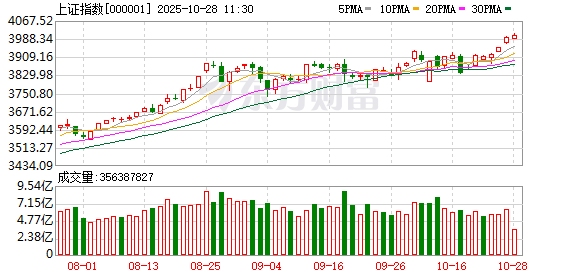
Core Viewpoint - The A-share market has shown resilience, with the Shanghai Composite Index breaking the 4000-point mark, reflecting improved market sentiment and investor confidence, driven by progress in US-China trade negotiations and supportive regulatory policies [2][4]. Market Performance - As of the morning close, the Shanghai Composite Index rose by 0.21%, closing at 4005 points, with a total trading volume of 1.36 trillion yuan, a decrease of 216.5 billion yuan compared to the previous day [2]. - The index's ability to maintain above 4000 points is seen as a psychological barrier that could attract more capital inflow and support future market trends [4]. Regulatory Environment - The China Securities Regulatory Commission (CSRC) has introduced measures to optimize the Qualified Foreign Institutional Investor (QFII) system, enhancing access and operational efficiency for foreign investors [2]. - Future plans include the introduction of a refinancing framework to broaden support for mergers and acquisitions, alongside encouraging listed companies to improve governance and increase shareholder returns through dividends and buybacks [3]. Investment Sentiment - Analysts suggest that the market is currently experiencing a "slow bull" trend, with expectations of continued upward movement in the index, albeit with increased volatility [5]. - There is a cautionary note regarding high valuations in certain sectors, particularly technology and semiconductors, which may lead to profit-taking behavior among investors [3][4]. Economic Context - The market's recent performance is influenced by global economic conditions, including expectations of a potential interest rate cut by the Federal Reserve and the possibility of a meeting between US and Chinese leaders at the APEC summit, which could ease geopolitical tensions [5]. - The overall market sentiment is supported by a marginally easing domestic policy environment, which is expected to bolster risk appetite among investors [3].
上证指数时隔十年再上4000点,成交额仍待放量|市场观察
Di Yi Cai Jing· 2025-10-28 04:42
Core Viewpoint - The A-share market has shown resilience, with the Shanghai Composite Index breaking the 4000-point mark, reflecting improved market sentiment and investor confidence, supported by ongoing developments in U.S.-China trade negotiations and favorable regulatory policies [1][3][4] Market Performance - On October 28, the Shanghai Composite Index rose by 0.21% to close at 4005 points, with total trading volume in Shanghai, Shenzhen, and Beijing reaching 1.36 trillion yuan, a decrease of 216.5 billion yuan compared to the previous day [1] - The index initially broke through 4000 points but experienced a pullback before regaining that level later in the morning [1] Regulatory Environment - The China Securities Regulatory Commission (CSRC) has introduced measures to optimize the Qualified Foreign Institutional Investor (QFII) system, enhancing access and operational efficiency for foreign investors [2] - Future plans include the introduction of a refinancing framework to support mergers and acquisitions, and encouraging listed companies to improve governance and increase shareholder returns through dividends and buybacks [2] Investor Sentiment - Analysts suggest that the recent market movements indicate a structural bull market, with the 4000-point level serving as a psychological barrier that, if maintained, could attract further capital inflow [3] - There is a cautionary note regarding high valuations in certain sectors, particularly technology and semiconductors, which may lead to profit-taking and increased volatility [2][3] Economic Context - The market is influenced by global economic conditions, including expectations of a potential interest rate cut by the Federal Reserve, which could support global liquidity [4] - The upcoming APEC meeting may provide opportunities for U.S.-China dialogue, potentially easing geopolitical tensions and trade friction [4]
锚定“五个着力” 资本市场高质量发展路线图明确
Zheng Quan Shi Bao· 2025-10-26 17:41
Core Viewpoint - The China Securities Regulatory Commission (CSRC) emphasizes the importance of capital market reform, outlining a roadmap for high-quality development through five key focuses, including enhancing market resilience and promoting long-term investments [1][2]. Group 1: Market Stability - The first focus is on enhancing the resilience and risk resistance of the capital market, which includes cultivating high-quality listed companies and establishing a long-term stable market mechanism [2][3]. - Recent measures taken by various departments, including the central bank's monetary policy tools and the establishment of a domestic stabilization fund, have effectively stabilized the market amid international volatility [2][3]. Group 2: Long-term Investment - A long-term funding mechanism is essential for market stability, with mid- to long-term capital acting as a stabilizer for healthy market operations [3]. - As of August 2023, various long-term funds held approximately 21.4 trillion yuan in A-share market capitalization, indicating the effectiveness of reforms aimed at attracting long-term investments [3]. Group 3: Innovation and Technology - The second focus is on enhancing the capital market's ability to support technological innovation, which includes deepening reforms in the Sci-Tech Innovation Board and the Growth Enterprise Market [4][5]. - Over 90% of newly listed companies this year are from strategic emerging industries, reflecting a favorable policy environment for tech firms [4]. Group 4: Regulatory Effectiveness - The third focus is on improving the effectiveness and deterrence of regulatory enforcement, with a commitment to strictly combat various securities violations [6][7]. - Recent actions have led to significant penalties for companies involved in fraudulent activities, reinforcing the regulatory framework and market integrity [6][7]. Group 5: Market Openness - The CSRC aims to deepen capital market openness, with a growing willingness among foreign investors to increase their exposure to Chinese assets, as indicated by a recent Morgan Stanley survey [7]. - Recommendations include aligning market infrastructure and rules with international standards and facilitating cross-border financing for tech companies [7].
“十四五”资本市场蝶变 为经济高质量发展注入活力韧性
Zheng Quan Ri Bao· 2025-10-12 16:02
Group 1: Capital Market Development - The number of A-share listed companies increased from over 4,100 to over 5,400, and total market capitalization rose from 70 trillion yuan to 100 trillion yuan during the "14th Five-Year Plan" period [1] - The total financing through stock and bond markets reached 57.5 trillion yuan, while the total amount of dividends and buybacks by listed companies was 10.6 trillion yuan [1] - The capital market has achieved both quantitative and qualitative improvements, providing solid financial support for the transformation and upgrading of the real economy [1] Group 2: Investment and Financing Coordination - The capital market has increased support for technological innovation and new productive forces, promoting the entry of long-term funds and cultivating patient capital [2] - Since 2021, 1,444 new companies have been listed on A-shares, raising a total of 1.63 trillion yuan, with 90.37% being technology companies [2][3] - The issuance of technology innovation corporate bonds has reached 1.77 trillion yuan, significantly supporting the strategy for a strong technological nation [2] Group 3: Long-term Capital Investment - As of August this year, various types of long-term funds held approximately 21.4 trillion yuan of A-share circulating market value, a 32% increase from the end of the "13th Five-Year Plan" [3] - Public funds held over 7 trillion yuan of A-share circulating market value, a 46% increase, with over 5 trillion yuan invested in manufacturing and technology sectors [3] Group 4: Regulatory and Governance Improvements - The capital market aims to enhance the ecosystem for the "technology, industry, and finance" cycle through coordinated efforts in systems, funding, and governance [4] - Reforms in the Sci-Tech Innovation Board and the Growth Enterprise Market are being deepened to optimize mechanisms for issuance pricing and mergers and acquisitions [4] Group 5: Investor Engagement and Market Activity - The number of A-share investors has surpassed 200 million, with significant improvements in investor protection mechanisms [7] - A-share trading activity has notably increased, with August trading volume exceeding 3 trillion yuan and daily average trading volume reaching 1.66 trillion yuan, a 100% year-on-year increase [7] Group 6: Internationalization and Market Openness - The capital market is transitioning from partial to comprehensive institutional openness, with an increase in foreign investment and the establishment of foreign-controlled securities and fund companies [8][9] - As of August this year, foreign capital held 3.4 trillion yuan in A-shares, reflecting the growing attractiveness of the Chinese stock market to foreign investors [8] Group 7: Future Outlook - The next five years are expected to see deeper reforms and openness in the capital market, aiming to create a vibrant and resilient ecosystem that benefits innovation and economic growth [10]