算力

Search documents
工信部推进算力标准构建,数字经济ETF(560800)调整蓄势
Xin Lang Cai Jing· 2025-10-23 02:50
Group 1 - The China Securities Digital Economy Theme Index (931582) decreased by 1.72% as of October 23, 2025, with the leading stocks being Tuojing Technology (688072) up by 3.49%, Runhe Software (300339) up by 3.10%, and China Software (600536) up by 2.93% [1] - The Digital Economy ETF (560800) experienced a significant scale growth of 1.0124 million yuan in the past week, with a total of 6 million shares added [1] - Over the last 10 trading days, the Digital Economy ETF attracted a total of 18.6144 million yuan in inflows [1] Group 2 - On October 21, the Ministry of Industry and Information Technology publicly solicited opinions on the "Computing Power Standard System Construction Guide (2025 Edition)", aiming to establish or revise over 50 standards by 2027 across various fields related to computing power [2] - The computing power sector is viewed positively in the long term, with a focus on PCB, domestic computing power, IP licensing, and chip inductors, despite short-term adjustments [2] - AI is identified as the core driver of growth in the cloud computing industry, with major global cloud vendors increasing capital expenditures for high-performance infrastructure to meet the growing demand for computing power [2] Group 3 - The Digital Economy ETF closely tracks the China Securities Digital Economy Theme Index, which includes companies involved in digital economy infrastructure and high levels of digitalization [3] - As of September 30, 2025, the top ten weighted stocks in the index accounted for 54.31% of the total index weight, with notable companies including Dongfang Wealth (300059) and SMIC (688981) [3]

“中国芯”,南京浦口造
Nan Jing Ri Bao· 2025-10-23 02:29
Core Insights - The launch of the fully domestically produced general-purpose GPU, Xiyun C600, marks a significant breakthrough in China's high-performance GPU capabilities [1][2] - The GPU is designed to meet the demands of next-generation generative AI training and inference, integrating large-capacity storage and mixed-precision computing [2][3] - The development of the Xiyun C600 is part of a broader strategy to establish a complete domestic semiconductor ecosystem, with over 300 companies in the integrated circuit industry located in the Pukou Economic Development Zone [1][6] Company Overview - Muxi Integrated Circuit (Nanjing) Co., Ltd. has positioned itself as a key player in the GPU sector, focusing on overcoming challenges in hardware and software to create a secure and controllable computing infrastructure [2][3] - The company has developed dozens of core IPs independently, with all manufacturing and testing processes handled by domestic firms [3][4] - Muxi has successfully completed multiple rounds of financing, raising over 10 billion yuan from domestic investors, and is in the final stages of preparing for its IPO [5][6] Industry Context - The integrated circuit industry in Nanjing has seen significant growth, with a reported output value of 13.988 billion yuan in the first half of the year, reflecting an 8.55% year-on-year increase [1] - The Pukou Economic Development Zone is actively fostering a complete industrial ecosystem, focusing on technological innovation and the localization of semiconductor production [6][7] - Companies like Chipde Semiconductor and Huada Technology are making strides in advanced packaging and testing technologies, contributing to the overall advancement of the domestic semiconductor industry [6][7]
算力概念牛股辈出,14股上涨空间获机构看好
Zheng Quan Shi Bao Wang· 2025-10-23 01:06
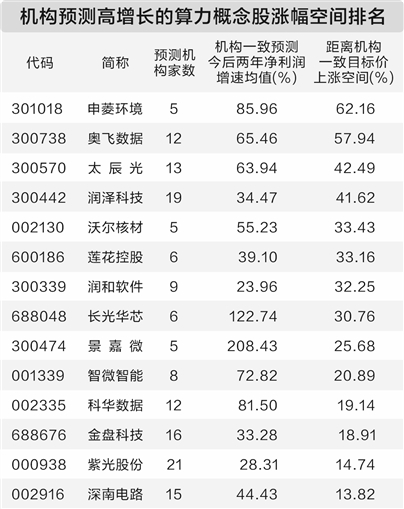
Group 1: Market Trends and Predictions - The Ministry of Industry and Information Technology of China is soliciting opinions on the "Guidelines for the Construction of Computing Power Standard System (2025 Edition)" to accelerate the establishment of a national integrated computing power network [2] - By 2027, over 50 standards will be revised to support the construction of the computing power standard system, focusing on various aspects such as infrastructure, equipment, and applications [2] - China's computing power industry has a total scale growth rate of approximately 30% annually, with intelligent computing demand rapidly increasing due to advancements in artificial intelligence [3] Group 2: Company Performance and Opportunities - Nine concept stocks reported significant profit growth in the first three quarters, including companies like Shijia Photon and Cambricon, with Shijia Photon achieving a net profit of 300 million yuan, a year-on-year increase of 727.74% [4] - The computing power sector has seen multiple stocks with over 100% cumulative growth this year, with Shenghong Technology leading at a 564.6% increase [5] - Companies like Shenling Environment are predicted to have substantial growth potential, with a projected net profit growth rate of 62.16% over the next two years [5]
朱少醒、傅鹏博、谢治宇等知名基金经理出手“擒牛”
Zhong Guo Zheng Quan Bao· 2025-10-23 00:33
Core Viewpoint - The recent quarterly reports from listed companies and public funds reveal significant adjustments by well-known fund managers, indicating a bullish sentiment towards the Chinese equity market for the upcoming quarter [1][5]. Fund Manager Adjustments - Notable fund managers such as Fu Pengbo and Xie Zhiyu have increased their stakes in leading companies like Dongshan Precision and Huaxin Cement, reflecting a strategic shift towards high-performing stocks [2][3]. - Fu Pengbo's fund, Ruiyuan Growth Value, increased its holdings in Dongshan Precision from 7.85 million shares to 21.34 million shares, while Xie Zhiyu's fund, Xingquan Helun, entered the top ten shareholders of the same company [2]. - The stock price of Dongshan Precision has surged over 81% since the second half of the year, indicating strong market performance [2]. Performance of High-Quality Funds - Several high-performing funds have reported significant gains in Q3, with funds managed by Ren Jie and Zhao Yi showing increases of nearly 100% and over 45%, respectively [4]. - Ren Jie's fund focused on the global cloud computing industry, making substantial investments in companies like Xinyi Technology and Zhongji Xuchuang, which have seen stock price increases of over 204% and 185% [4]. Market Outlook - Fund managers express optimism about the long-term stability and growth of the Chinese equity market, with expectations of improved liquidity due to potential changes in US dollar liquidity [5]. - However, there are concerns about increased macroeconomic events impacting market volatility, particularly in growth sectors [5]. Sector Insights - The AI computing sector remains a focal point for investment, with expectations of new market opportunities arising from collaborations between leading model manufacturers and various industries [6]. - The lithium battery sector is also highlighted, with predictions of a healthier and more sustainable price and demand cycle, particularly for key materials like hexafluorophosphate and separators [6].
我国加快算力标准体系建设 构建全国算力“一张网”
Zheng Quan Shi Bao· 2025-10-22 17:21
Group 1 - The Ministry of Industry and Information Technology of China is soliciting opinions on the "Guidelines for the Construction of Computing Power Standard System (2025 Edition)" to accelerate the establishment of a national integrated computing power network and a suitable standard system for industrial development [1] - By 2027, the guidelines aim to revise and formulate over 50 standards related to various aspects of computing power, including infrastructure, equipment, and applications, to effectively promote the construction of the computing power standard system [1] - The guidelines also emphasize the importance of collaboration among research institutions, industry associations, and industrial alliances to foster innovation, industrial promotion, infrastructure development, and talent cultivation [1] Group 2 - China's computing power industry accounts for nearly 30% of the global market, with a diverse supply system that includes general computing, intelligent computing, and supercomputing [2] - The total scale of computing power in China has been growing at an annual rate of approximately 30%, driven by the rapid development of artificial intelligence [2] - By June 2025, China's intelligent computing power scale is expected to reach 788 EFLOPS, representing 32% of the global total, maintaining the second position worldwide [2] Group 3 - Nine concept stocks have reported significant profit growth in the first three quarters of the year, including companies like Shijia Optoelectronics and Cambricon Technologies, with Shijia Optoelectronics achieving a net profit of 300 million yuan, a year-on-year increase of 727.74% [3] - Cambricon Technologies turned a profit with a net profit of 1.605 billion yuan in the same period, significantly increasing revenue through market expansion and AI application support [3] - DingTong Technology reported a net profit of 177 million yuan, a year-on-year increase of 125.39%, driven by growth in its communication connector business [3] Group 4 - The computing power sector has seen multiple stocks with over 100% increase in their market value this year, with 21 concept stocks achieving this milestone [4] - Shenghong Technology leads with a cumulative increase of 564.6% year-to-date, indicating strong market performance [4] - Analysts predict that 38 concept stocks are expected to have a net profit growth rate exceeding 20% in the next two years, with 14 stocks showing an upside potential of over 10% based on current prices [4] Group 5 - Shenling Environment has the highest potential upside of 62.16%, focusing on digital and computing power applications, as well as energy [5] - The company is ranked first in the liquid cooling data center market for China's intelligent computing industry and has seen its data service orders double compared to the same period last year [5] - Other companies with significant upside potential include Aofei Data, Taicheng Light, and Runze Technology [5]
通信ETF(515880)年内涨幅第一,年初至今涨近98%,光模块占比近50%
Mei Ri Jing Ji Xin Wen· 2025-10-22 15:05
Group 1 - The current AI wave is considered at least a medium-scale industrial revolution, with a focus on computing power as a key driver [1] - Overseas, infrastructure investment is resonating with performance, and AI is accelerating significantly, with expectations for upcoming quarterly reports from relevant companies and the release of Google's Gemini 3 series models [1] - Domestic computing power is bringing new narratives to the semiconductor industry chain, indicating broad growth potential [1] Group 2 - The optical module market is expected to maintain high prosperity due to continuous investment in computing power infrastructure both domestically and internationally [1] - As of October 21, the communication ETF (515880) has a scale of 8.983 billion, ranking first among similar products, with "optical modules + servers + copper connections + optical fibers" accounting for nearly 79% as of September 30 [2] - Optical modules alone account for nearly 50% of the ETF, presenting potential investment opportunities in related sectors [1][2]
首批基金三季报:百亿资金被锁3年刚回本,有产品规模增百亿
Sou Hu Cai Jing· 2025-10-22 12:10
Core Viewpoint - The public fund industry is experiencing significant performance and scale growth, particularly in technology-focused funds, while bond funds show mixed results due to market adjustments [2][3][4]. Group 1: Equity Funds Performance - Multiple equity funds have achieved impressive returns due to the surge in technology sectors, with funds like Yongying Technology Smart A and Huafu CSI Artificial Intelligence Industry ETF reporting quarterly returns of 99.7% and 73.9%, respectively [2][3]. - Yongying Technology Smart A's total scale increased to 115.2 billion yuan, marking an 8.9-fold increase from the previous year, with a year-to-date return of 195% [3]. - The top ten holdings of Yongying Technology Smart A are concentrated in popular AI-related stocks, accounting for 73.25% of the fund's net value [3]. Group 2: Bond Funds Performance - Bond funds have shown a divergence in performance, with the overall bond market declining in Q3 2025, leading to negative returns for several pure bond funds [6][7]. - Among the seven bond funds that disclosed their Q3 reports, four experienced losses, while three achieved positive returns ranging from 4.4% to 9.4% [6][7]. - "Fixed income plus" products have gained attention, with significant increases in scale, such as Anxin Ju Li Enhanced A, which saw its scale grow from 4.5 million yuan to 39.7 million yuan, a six-fold increase [7]. Group 3: Fund Management Insights - Fund managers express optimism about the technology sector's long-term growth potential while emphasizing the importance of risk management and rational investment decisions [4][7]. - The manager of Yongying Technology Smart A cautions investors against relying solely on past performance to predict future results, highlighting the need for diversified investment strategies [4]. Group 4: Specific Fund Highlights - The performance of the "Billion Fund" by Quanguo Fund, which was locked for three years, has recently returned to break-even after a significant recovery, with a quarterly return of 45.6% [8][9]. - Quanguo Fund's strategy focuses on high-end manufacturing sectors, including new energy and technology, reflecting a dual allocation framework [9].
【国信电子胡剑团队|1019周观点】AI算力+存力高需求共振,台积电收入超预期
剑道电子· 2025-10-22 11:43
Core Viewpoint - The report highlights the strong demand for AI computing power and storage, which has led to TSMC's revenue exceeding expectations, despite a general decline in market risk appetite [3]. Market Performance - In the past week, the Shanghai Composite Index fell by 1.47%, while the electronics sector dropped by 7.14%. Sub-sectors such as optical optoelectronics and consumer electronics saw declines of 6.23% and 9.10%, respectively [3]. - The Hang Seng Tech Index decreased by 7.98%, while the Philadelphia Semiconductor Index and Taiwan Information Technology Index increased by 5.78% and 0.27%, respectively [3]. Earnings Season Insights - As the third quarter of 2025 earnings season approaches, there is a noted decline in market risk appetite due to previously high consensus on AI themes and significant upward revisions in earnings forecasts for leading companies. This, combined with ongoing US-China tariff disputes, has led to increased volatility in the tech sector during the earnings verification period [3]. - TSMC's recent earnings call indicated that AI demand remains strong and has exceeded prior expectations [3].


注意,重大消息,明天要大跌了吗?……
Sou Hu Cai Jing· 2025-10-22 11:25
Market Sentiment - The market is experiencing low trading volume and weak investor sentiment, with only over 2,000 stocks rising, most with minimal gains [1] - Despite some gains earlier in the week, the overall market appears to be struggling, leading to concerns about potential losses for investors [1] Sector Performance - Notable gains were observed in the technology sector, particularly with companies like Cambrian, which is approaching the market cap of Moutai, indicating ongoing opportunities in technology [1] - There is speculation about potential growth in areas such as AI, computing power, semiconductors, storage chips, and domestic replacements, as well as the renewable energy sector [1] Investment Strategy - Investors are advised to differentiate between short-term and medium-term strategies, with short-term trading being riskier due to chasing high-flying stocks [1] - A more cautious approach is suggested for medium-term investments, focusing on lower-priced stocks for better safety [1] Market Outlook - The market is currently in a phase of style transition, making it challenging for investors, with a focus on the 3900-point level as a potential support [2] - There is a belief that a market rebound is possible, with the next target being the 4000-point level, encouraging patience among investors [2] Investment Mindset - A reminder that if long-term profitability is elusive, it may indicate a fundamental issue with the investment approach [3] - Emphasis on the importance of strategic buying and selling, advocating for a disciplined investment mindset [3]
AI“万亿闭环”内幕:黄仁勋的“激进”、孙正义的野心、微软的“隐忍”
华尔街见闻· 2025-10-22 10:48
Core Insights - OpenAI's CEO Sam Altman is strategically binding major tech giants to its AI initiatives, creating a robust ecosystem that ties the industry's fate to a startup that has yet to turn a profit [1][2] - Recent high-profile deals led by Altman have resulted in significant market reactions, with a combined market value increase of $630 billion for involved companies following announcements [2][3] Group 1: Strategic Partnerships - Altman has orchestrated a series of high-stakes deals, including a $500 billion "Stargate" project with SoftBank and a $1 trillion collaboration with Nvidia [2][9][22] - Oracle signed a $300 billion contract with OpenAI, leading to a nearly 40% surge in its stock price [16] - AMD and Broadcom have also entered into significant agreements with OpenAI, further solidifying the competitive landscape [28][34] Group 2: Market Dynamics - The competitive landscape is characterized by a "fear of missing out" (FOMO) among tech giants, driving them to invest heavily in AI capabilities [3][9] - Microsoft's cautious approach to its partnership with OpenAI reflects concerns over financial risks associated with Altman's ambitious plans [10][13][15] - Nvidia's willingness to provide financial support and chip rentals to OpenAI indicates a shift from product sales to service and financial backing [26] Group 3: Financial Implications - OpenAI's projected power consumption goal of 250 gigawatts by 2033 raises questions about the sustainability of its financial model, given its current revenue of $13 billion [4][14] - The interdependencies created by these partnerships could lead to significant financial risks for companies involved, particularly if OpenAI struggles to meet its obligations [27]