
绿色金融

Search documents
许正宇:香港政府积极引导国际资本投资可持续发展项目
Zhi Tong Cai Jing· 2025-11-25 09:04
许正宇表示,截至今年9月,香港证监会认可的ESG基金超过200只,资产管理规模逾1.1万亿港元。在 债券市场方面,去年香港绿色与可持续债券发行总额超过840亿美元,其中约430亿美元由香港安排发 行。自2018年起已经连续7年居亚洲市场首位,约占区内总额约40%左右。 他说,为了更加有效地去推动绿色金融转型,香港特区政府一直和金融监管机构和一众持份者紧密合 作,透过推动创新、市场发展、培养人才,以及国际和区域合作这四个方面,去完善香港的绿色金融发 展。 香港财经事务及库务局局长许正宇在出席"ESG论坛2025─创新推动绿色可持续未来"致词时表示,香港 作为亚洲领先的国际金融中心和可持续金融枢纽,拥有既深且广的资本市场,而香港政府也将绿色和可 持续金融列为重点工作之一,积极引导国际资本投资在不同领域的可持续发展项目,为绿色金融转型出 力。 他指,气候变化是当今全球面临最紧迫的挑战之一,香港作为地球一份子可以出一份力。刚在巴西贝伦 市落幕的联合国气候变化大会(COP30)强调,绿色资金是应对气候变化的关键。 ...
人民银行吉林省分行:做好“五篇大文章”支持实体经济高质量发展
Xin Hua Cai Jing· 2025-11-25 08:10
Core Viewpoint - The People's Bank of China Jilin Branch is focusing on enhancing financial support for high-quality economic development in Jilin Province through five key financial initiatives during the 14th Five-Year Plan period [1] Group 1: Financial Initiatives - The five key financial initiatives include technology finance, green finance, inclusive finance, pension finance, and digital finance [1] - As of the end of September this year, the loan balance for these five initiatives has increased by 12.1% year-on-year, accounting for 30.7% of the total loan balance [1] Group 2: Monetary Policy Tools - The Jilin Branch is actively utilizing various structural monetary policy tools, such as re-loans for technological innovation and carbon reduction support, to guide credit funds towards key areas of the real economy [1] - A total of 23.4 billion yuan has been allocated through special structural monetary policy tools during the 14th Five-Year Plan period [1] Group 3: Policy Framework and Goals - The Jilin Branch aims to establish a comprehensive policy framework for the five financial initiatives, focusing on coordination, key areas, tool support, and effectiveness assessment [1] - The goal is to create a series of financial practices that lay a solid foundation for long-term development and promote the continuous improvement of financial policy frameworks to better serve the real economy [1]
四川省首笔|兴业银行成都分行支持全省首个再生资源碳减排项目开发成功
Zhong Guo Jin Rong Xin Xi Wang· 2025-11-25 08:01
Core Viewpoint - The article highlights the successful implementation of carbon reduction projects in Sichuan, emphasizing the role of financial institutions like Industrial Bank Chengdu Branch in supporting sustainable development and carbon neutrality initiatives [1][4]. Group 1: Carbon Reduction Projects - Sichuan has fully implemented the new development concept and actively promoted carbon peak and carbon neutrality goals, with the support of financial institutions [1]. - Sichuan Yingu Carbon Sink Recycling Resource Co., Ltd. has successfully developed the first carbon reduction project in the province, achieving over 120,000 tons of CDCER issuance [1][3]. - The company has established a recycling system for waste materials and has been recognized as a pilot enterprise for the "Recycling System of Recycled Resources" by the Ministry of Commerce [3]. Group 2: Financial Support and Innovation - Industrial Bank Chengdu Branch has provided a loan of 4 million yuan to support the "Carbon Benefit Tianfu" mechanism carbon reduction project, demonstrating its commitment to green finance [1][4]. - The bank has developed customized financial service plans linked to the success of carbon reduction projects, offering interest rate reductions upon successful project completion [3]. - The Chengdu Branch has introduced various innovative financial products, including "carbon footprint" loans and regional carbon rights pledge loans, to support carbon neutrality goals [4]. Group 3: Commitment to Sustainable Development - The company plans to donate 80,000 tons of carbon reduction to support the carbon neutrality initiative for the Chengdu World Universiade [4]. - Industrial Bank Chengdu Branch is recognized as a pioneer in green finance, actively promoting sustainable development and contributing to the "Beautiful China" initiative [4].


山东首笔“生物多样性+海洋碳汇+可持续渔业”贷款在烟台落地
Xin Hua Cai Jing· 2025-11-25 07:15
Core Insights - The People's Bank of China (PBOC) Yantai Branch has guided Yantai Bank to issue a loan of 9 million yuan (approximately 1.3 million USD) to Changshan Haizhenpin Co., Ltd. for a project focused on "biodiversity + marine carbon sink + sustainable fisheries" [1][2] - This loan marks the first instance of a financial product that simultaneously addresses biodiversity, marine carbon sinks, and sustainable fisheries since the trial of biodiversity financial standards began in Shandong [1][2] - The loan received support from the PBOC's re-lending program aimed at supporting agriculture and small enterprises, benefiting from low-cost funding and interest rate discounts [1][2] Financial Innovation and Support - Following the launch of biodiversity financial standards in October, the PBOC Yantai Branch has actively engaged in promoting financial products that support biodiversity and sustainable fisheries through various initiatives, including meetings and site visits [2][3] - A specialized service team was formed to assess the compliance of the company's ecological breeding model and biodiversity protection measures, facilitating a streamlined loan approval process [2] - The initiative aims to provide timely financial support for ecological-friendly breeding technologies, genetic resource protection, and optimization of breeding environments [2][3] Strategic Importance - The loan is seen as a significant step in promoting green finance and integrating ecological protection with industrial development, serving as a practical example of innovative financial support for biodiversity conservation [3]
绿色金融,“挂钩贷”助推六盘水向绿而行
Jin Rong Shi Bao· 2025-11-25 07:03
Core Viewpoint - The People's Bank of China, Liupanshui Branch, is actively promoting financial support for the local economy's green and low-carbon transition through innovative financial products like "linked loans" [1] Group 1: Financial Initiatives - The Liupanshui Branch has introduced "linked loans" specifically aimed at supporting green and low-carbon transitions in the local economy [1] - As of the end of October this year, financial institutions in Liupanshui have issued a total of 7.028 billion yuan in green low-carbon transition "linked loans" [1] Group 2: Collaboration and Development - The branch collaborates with local banks, such as Guiyang Bank, to understand and support the green low-carbon transition of enterprises like Meijin Huayu New Energy Co., Ltd. [1]
福建省首笔碳配额数据产品交易成功落地
Zhong Guo Jin Rong Xin Xi Wang· 2025-11-25 06:07
Core Insights - The successful transaction of carbon quota data products in Fujian marks a significant step in the marketization of carbon data elements, facilitating better understanding and financing for low-carbon transformation of enterprises [1][3] Group 1: Transaction Details - The first carbon quota data product transaction in Fujian involved the purchase of the "Green Credit Report - Corporate Carbon Asset Report" by Huaxia Bank Fuzhou Branch [1] - This data product was developed by Fujian Piao Fu Tong Information Technology Co., Ltd., which integrates various public and social data to create a customizable and high-value carbon quota data product [2] Group 2: Application and Impact - The data product allows banks to gain a comprehensive and precise understanding of clients' production and operational conditions during the loan period, serving as a "green qualification certificate" [2] - Huaxia Bank Fuzhou Branch has already applied this data product in assessing the green qualifications of a steel profile manufacturing enterprise, planning to offer lower interest rates due to the company's significant emission reduction achievements [2] Group 3: Future Prospects - The Fujian Big Data Exchange aims to support the development of more market-demand-adapted data products while facilitating compliance and market transactions [3] - As of now, the Fujian Big Data Exchange has listed over 1,400 data products and has more than 1,000 participating businesses, indicating a robust data element market [3]

长三角6家上市城商行的韧性增长:息差承压之下营收净利双增,对公业务成信贷投放“主引擎”
Mei Ri Jing Ji Xin Wen· 2025-11-25 06:00
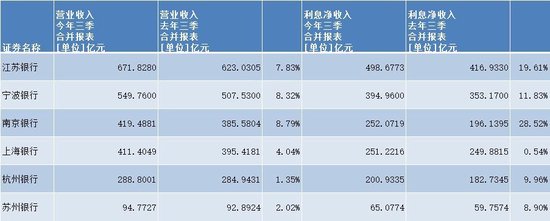
Core Viewpoint - The six A-share listed city commercial banks in the Yangtze River Delta region are demonstrating resilient growth, achieving increases in both revenue and net profit despite the pressure of narrowing interest margins [1][2]. Revenue and Profit Growth - All six city commercial banks reported year-on-year growth in both revenue and net profit for the first three quarters, with five banks achieving profits exceeding 10 billion yuan, except for Suzhou Bank, which is relatively smaller [2]. - Jiangsu Bank led with a revenue of 67.183 billion yuan and a net profit of 30.583 billion yuan, ranking first among A-share city commercial banks [2]. Interest Income Performance - Despite the overall pressure on interest margins, all six banks achieved year-on-year growth in net interest income, with Nanjing Bank and Jiangsu Bank showing significant increases of 28.52% and 19.61%, respectively [3]. - Nanjing Bank attributed its growth in net interest income to increased credit investment and optimized asset allocation strategies, alongside a reduction in deposit costs [3]. Asset Expansion - The six banks are steadily expanding their asset scales, with Jiangsu Bank holding the largest total assets of 4.93 trillion yuan, marking a 24.68% increase from the beginning of the year, the fastest growth among A-share listed banks [6]. - All banks exhibited strong growth in both deposits and loans, with Jiangsu Bank's total deposits reaching 2.54 trillion yuan, a 20.22% increase, and total loans growing by 17.87% to 2.47 trillion yuan [6]. Corporate Lending Growth - Corporate lending has become the main driver of credit expansion for these banks, with significant growth in loans for technology finance, inclusive finance, and green finance [9]. - For instance, Nanjing Bank's corporate loans increased by 14.63%, with notable growth in green finance (33.03%), technology finance (17.47%), and inclusive finance (16.16%) [9]. Asset Quality - The asset quality of the six banks remains stable, with non-performing loan (NPL) ratios either holding steady or declining. Jiangsu Bank's NPL ratio decreased by 0.05 percentage points to 0.84% [10]. - Nanjing Bank's NPL ratio remained stable at 0.83%, reflecting effective risk management and asset disposal strategies [10]. Capital Adequacy - Shanghai Bank reported a high core Tier 1 capital adequacy ratio of 10.52%, up 0.17 percentage points from the beginning of the year, supported by improved profitability and capital management [11]. - Both Hangzhou Bank and Nanjing Bank completed convertible bond conversions, with their core Tier 1 capital ratios rising to 9.64% and 9.54%, respectively [11]. Dividend Distribution - Several banks, including Shanghai Bank and Suzhou Bank, have completed mid-term dividend distributions, with Jiangsu Bank and Ningbo Bank also advancing their mid-term dividend plans [12]. - Hangzhou Bank has consistently increased its cash dividend ratio, with a projected mid-term dividend of 2.755 billion yuan for 2025, reflecting a commitment to enhancing shareholder returns [13].





大公国际:“十五五”时期债券市场支持金融“五篇大文章”的路径探析
大公国际资信· 2025-11-25 05:57
Group 1: Report Industry Investment Rating - No relevant information provided Group 2: Core Viewpoints of the Report - The "15th Five-Year Plan" proposes to develop science and technology finance, green finance, inclusive finance, pension finance, and digital finance, and the bond market will play a key foundational role in promoting the implementation of these "five major articles" [1][2] - The bond market has achieved significant progress in the areas guided by the "five major articles," but there are still problems such as insufficient funds, structural imbalance, and imperfect mechanisms in some areas [3][16] - Through mechanism, product, and technology innovation, the bond market has broken through inherent bottlenecks and provided precise impetus for the real economy [17] - During the "15th Five-Year Plan" period, the bond market will play a more systematic and strategic role in serving the "five major articles" [26] Group 3: Summary by Relevant Catalogs I. Significant Progress in the Bond Field under the Guidance of the "Five Major Articles" (A) Science and Technology Innovation Bonds - Since 2024, the total issuance of science and technology innovation bonds in the market has reached approximately 2.72 trillion yuan, with 2,567 bonds issued [7] - Features include longer financing terms, a high proportion of high-credit ratings, cost advantages in issuance interest rates, and a high proportion of central and state-owned enterprises among financing entities [7][8] (B) Green Finance - As of the end of 2024, the cumulative issuance of green bonds in China reached 4.1 trillion yuan, and in 2025, the issuance of labeled and non-labeled green bonds totaled 936.765 billion yuan [9] - The average issuance interest rate of green bonds has steadily declined, and the main issuers are commercial banks and traditional green industries such as public utilities and transportation [12][13] (C) Inclusive, Pension, and Digital Finance Bonds - The bond market has enhanced financial support for the grass-roots economy and key regions through diversified bond varieties, with a cumulative issuance scale of nearly 2.47 trillion yuan, and the "Three Rural Issues" special financial bonds have reached 1.21 trillion yuan [14] - The bond market is relatively weak in pension and digital finance, facing problems such as single bond varieties and difficulties in bond financing for digital enterprises [16] II. Three Major Innovation Points for the Bond Market to Support Key Areas (A) Mechanism Innovation - In the green finance field, the trading association optimized the green bond rules, allowing the replacement of self-owned funds in advance and implementing hierarchical and classified information disclosure management [18] - In the inclusive finance field, counter bond repurchase business and other measures have enhanced the liquidity of small and medium-sized institutions [20] - In the science and technology finance field, the establishment of the bond market's "science and technology board" has solved the problem of patient capital sources and built a comprehensive support system [20] (B) Product Innovation - Science and technology innovation bills have expanded the use of raised funds to equity investment and fund contributions, effectively introducing long-term and low-cost funds into early-stage scientific research [21] - In the green finance field, the issuance of carbon-linked and carbon asset - pledged debt financing instruments has been encouraged, exploring the integration of green finance and the carbon market [21] - In the inclusive and pension finance fields, there have been product innovations such as small and medium - sized enterprise support bonds and pension - specific financial bonds [22] (C) Technology Innovation - The application of digital RMB in bond issuance has improved settlement efficiency, ensured the special use of funds, and enhanced transaction traceability and regulatory penetration [24] - The application of artificial intelligence technology in bond investment research and risk control has been continuously deepened, showing significant value [24] III. New Trends for the Bond Market to Empower the "Five Major Articles" during the "15th Five-Year Plan" Period - Science and technology finance will be the key direction for the bond market to support the layout of new productive forces, providing stable capital guarantee for key core technology research [26] - Green finance will assume a more core function of green capital supply, guiding social funds to flow to key green fields [27] - In the inclusive finance field, the role will shift from making up for shortcomings to deeply integrating into the industrial chain and supply chain system, providing long - term and low - cost funds for small and medium - sized enterprises [27] - Pension finance will become an important growth area for expanding long - term funds and securitizable assets, with the potential for the expansion of special pension bonds [28] - Digital finance will lead the systematic digital upgrade of infrastructure and factor allocation, promoting the formation of a new ecosystem covering "frontier technology - digital industry - bond financing" [28]
国泰君安期货商品研究晨报:绿色金融与新能源-20251125
Guo Tai Jun An Qi Huo· 2025-11-25 05:16
Report Overview - Date: November 25, 2025 - Report Type: Commodity Research Morning Report - Green Finance and New Energy - Research Institution: Guotai Junan Futures Report Industry Investment Rating - Not provided in the report Core Views - Nickel: The inventory accumulation rhythm has slightly slowed down, with short - term disturbances from macro and news factors [2][4] - Stainless steel: Steel prices are under pressure and oscillating at a low level, but the downside potential is limited [2][4] - Lithium carbonate: Spot trading has improved, and the high - level range oscillation continues [2][9] - Industrial silicon: The bottom support of the futures price is obvious [2] - Polysilicon: Attention should be paid to the subsequent changes in warehouse receipts [2][12] Summary by Commodity Nickel and Stainless Steel - **Fundamental Data**: The closing price of Shanghai Nickel's main contract was 115,530 yuan, down 1,220 yuan from T - 5. The closing price of stainless steel's main contract was 12,335 yuan, down 80 yuan from T - 5. Other data such as trading volume, prices of related products in the industrial chain also showed different degrees of changes [4] - **Macro and Industry News**: There were multiple events including the takeover of an Indonesian nickel mine by the forestry working group, China's suspension of non - official subsidies for Russian copper and nickel imports, and various policies and regulations in Indonesia and the US tariff threat [4][5][6] - **Trend Intensity**: The trend intensity of nickel and stainless steel is 0, indicating a neutral outlook [8] Lithium Carbonate - **Fundamental Data**: The closing price of the 2601 contract was 90,480 yuan, down 4,720 yuan from T - 5. The closing price of the 2605 contract was 92,040 yuan, down 3,680 yuan from T - 5. There were also changes in trading volume, positions, and prices of related products in the industrial chain [9] - **Macro and Industry News**: The SMM battery - grade lithium carbonate index price decreased, and the UK government announced plans to support domestic lithium production [10][11] - **Trend Intensity**: The trend intensity of lithium carbonate is 0, indicating a neutral outlook [11] Industrial Silicon and Polysilicon - **Fundamental Data**: The closing price of Si2601 was 8,940 yuan/ton, down 140 yuan from T - 5. The closing price of PS2601 was 53,315 yuan/ton, up 660 yuan from T - 5. There were also changes in trading volume, positions, basis, and prices and profits of related products [12] - **Macro and Industry News**: The National Energy Administration released power industry statistics, showing significant growth in solar and wind power installed capacity [13][14] - **Trend Intensity**: The trend intensity of industrial silicon is 0 (neutral), and that of polysilicon is 1 (slightly bullish) [14]
绿色金融助力全球治沙典范
Jin Rong Shi Bao· 2025-11-25 03:39
Core Viewpoint - The integration of ecological governance and green finance in the Kubuqi Desert has transformed it from an ecological threat to a model of sustainable development, significantly reducing sediment flow into the Yellow River and creating employment opportunities for local communities [1][2][3]. Group 1: Ecological Governance and Financial Support - The Kubuqi Desert, covering an area of 2,116 million mu, has seen a reduction in sediment flow from 27 million tons to 4 million tons due to comprehensive management efforts [1]. - The innovative governance model in Ordos City emphasizes government leadership, financial support, enterprise involvement, and community participation, leading to a successful ecological revolution [1][2]. - In the first half of the year, the People's Bank of China in Ordos issued low-cost loans totaling 1.01 billion yuan for integrated photovoltaic projects aimed at desertification control, resulting in a carbon reduction of 41,580 tons [2]. Group 2: Project Implementation and Impact - The successful integration of photovoltaic projects in the Kubuqi Desert has led to a projected annual power generation of over 1.8 billion kWh, replacing approximately 600,000 tons of standard coal and reducing CO2 emissions by about 570,000 tons [2][3]. - The first completed project in the region, a 500,000 kW photovoltaic initiative, has effectively reduced wind speed by 40% and sand dust migration by 65% through various ecological measures [3]. - Financial institutions have provided comprehensive support, with total credit exceeding 5 billion yuan for photovoltaic desertification control projects, including 130 million yuan in low-cost funds [3]. Group 3: Innovative Financial Products - The People's Bank of China in Ordos has promoted innovative financial products such as "desertification loans" and "rural revitalization loans" to support long-term desertification projects [4]. - A loan of 2 million yuan was issued to a local agricultural company under favorable interest rates and government subsidies, enabling the company to manage 4,000 mu of desert land and create over 50 jobs [4][5]. - The Industrial and Commercial Bank of China has developed a "desertification loan" product to address funding challenges faced by cooperatives and collective economic organizations involved in ecological projects [5][6].