
电力市场化改革

Search documents
储能增长逻辑分析--两部委最新储能政策解读
傅里叶的猫· 2025-11-10 12:48
Core Insights - The article emphasizes the importance of new energy consumption and regulation, with a focus on establishing a multi-level consumption regulation system by 2030 and a new power system by 2035 to support carbon peak goals [1][3]. New Energy and Storage - The document highlights new energy sectors, particularly wind and solar power, which are expected to see moderate growth rates due to established development targets from 2025 to 2035 [3]. - New energy storage is identified as a critical growth area, transitioning from a mere "auxiliary adjustment tool" to an essential infrastructure for high-quality new energy consumption, impacting various scenarios including centralized and distributed energy projects [3][5]. - The disparity between the distribution of new energy generation and consumption necessitates robust storage support to achieve the outlined consumption goals [3]. Market Dynamics - The U.S. energy market is experiencing a surge in demand for storage solutions due to regulatory changes, with all new solar projects required to enter market transactions starting January 1, 2026, leading to real demand for storage [5][6]. - In China, the current surge in installations is seen as a correction of historical underinvestment, with a conservative estimate suggesting a need for at least 2000 GWh of storage capacity to stabilize the power system [6][10]. Regional Profitability - Economic conditions for storage projects in Inner Mongolia have improved significantly due to policy changes and industry scaling, with market dynamics allowing for greater profitability through various revenue models [7][10]. - The profitability logic varies by region, with eastern provinces benefiting from significant peak-valley price differences, while western regions rely on capacity compensation [10][11]. Long-term Industry Outlook - The storage market is expected to grow at an annual installation rate of 40%-50% over the next five years, driven by inherent market demand rather than subsidies [10][13]. - The relationship between storage and new energy is characterized as a one-way support system, where storage provides flexibility and energy time-shifting capabilities to complement generation [12][13]. - The article concludes that the growth of the storage industry is essential for the energy transition, with storage becoming a critical component in stabilizing the grid as renewable energy sources expand [13].

省级电力现货全面覆盖,LNG最高气化服务费确定为0.20元/方
Xinda Securities· 2025-11-08 07:40
Investment Rating - The investment rating for the utility sector is "Positive" [2] Core Views - The report highlights that the domestic power sector is expected to see profit improvement and value reassessment following multiple rounds of supply-demand tensions. The ongoing market reforms are likely to lead to a gradual increase in electricity prices, with the promotion of spot and ancillary service markets [5] - The report also notes that the highest gasification service fee for LNG has been set at 0.20 yuan per cubic meter, effective from November 1, 2025 [5] Summary by Sections Market Performance - As of November 7, the utility sector rose by 2.4%, outperforming the broader market, with the electricity sector increasing by 2.54% and the gas sector by 1.23% [4][12] - Key sub-sectors within electricity showed varied performance, with thermal power up by 2.09% and hydropower by 2.00% [14] Electricity Industry Data Tracking - The price of thermal coal at Qinhuangdao Port (Q5500) increased by 40 yuan to 808 yuan per ton as of November 7 [4][21] - Coal inventory at Qinhuangdao Port was 5.77 million tons, up by 20,000 tons week-on-week [28] - Daily coal consumption in inland provinces was 3.241 million tons, down by 94,000 tons from the previous week [30] Natural Gas Industry Data Tracking - The LNG ex-factory price index in Shanghai was 4,383 yuan per ton as of November 6, a 0.21% increase week-on-week [56] - The EU's natural gas supply for week 44 was 6.5 billion cubic meters, a year-on-year increase of 14.4% [64] - Domestic natural gas consumption in September was 33.19 billion cubic meters, a 2.0% decrease year-on-year [5] Key Industry News - The State Grid has achieved comprehensive coverage of the provincial electricity spot market, with several provinces entering trial operations ahead of schedule [5] - The report emphasizes the potential for significant performance improvement for power operators due to controlled costs and ongoing reforms [5] Investment Recommendations - The report suggests focusing on leading coal-fired power companies such as Guodian Power, Huaneng International, and Huadian International, as well as regional leaders in tight supply areas [5] - For natural gas, companies with low-cost long-term gas sources and receiving station assets are expected to benefit from market conditions [5]





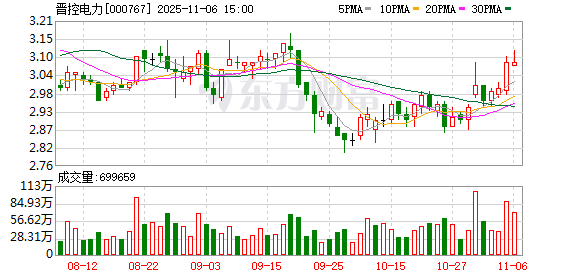
晋控电力:公司积极适应市场化改革的不断深化
Zheng Quan Ri Bao· 2025-11-06 07:07
Core Insights - The company, Jinkong Electric Power, announced on November 6 that it is adapting to the deepening market-oriented reforms in Shanxi Province, particularly in response to the upcoming adjustments in electricity trading rules set for 2025 [2] Group 1: Policy Changes - Shanxi Province will release supporting policies related to Document No. 136, which will further refine electricity trading rules [2] - Adjustments will be made in areas such as continuous trading over multiple months and auxiliary service trading [2] Group 2: Company Strategy - The company emphasizes a marketing-led approach and a unified strategy across the organization to enhance its operational efficiency [2] - The company aims to effectively manage electricity generation in line with the evolving market conditions [2]

当前焦点!板块掀涨停潮 电力行业有望迎来 盈利改善和价值重估
Zhong Guo Zheng Quan Bao - Zhong Zheng Wang· 2025-11-05 23:36
Core Viewpoint - The electricity sector is experiencing a strong market performance, with over 20 stocks hitting the daily limit up, driven by multiple favorable factors including policy support and market growth [1][4][6] Market Performance - On November 5, the electricity equipment index rose by 3.40%, with significant gains in stocks such as Shuangjie Electric and Artis, which both hit the 20% limit up [4] - The strong performance is attributed to a robust increase in electricity market transactions, particularly in green electricity trading, which saw a 40.6% year-on-year growth [4][5] Investment Trends - The State Grid's fixed asset investment exceeded 420 billion yuan in the first nine months of the year, marking an 8.1% increase year-on-year, indicating sustained high investment levels in the grid [5] - The procurement of core transmission and transformation equipment is ongoing, with a recent procurement amounting to over 3 billion yuan [5] Long-term Outlook - Analysts expect the electricity sector to benefit from deepening market reforms and cost improvements, leading to profit enhancements and value reassessment throughout the year [3][6] - The transition towards a new power system under the "dual carbon" goals will require significant investment in system regulation and market mechanisms, which will further support the sector's growth [6][7] Specific Sector Insights - In the thermal power segment, the value of coal power is expected to remain significant, especially with the increasing emphasis on energy security [6][7] - The wind power sector is anticipated to see growth driven by both domestic and international demand, with opportunities arising for component manufacturers [7][8] Price and Market Dynamics - Predictions for 2025 suggest a mixed outlook for electricity prices, with potential reductions in long-term contract prices but increases in coal power capacity prices [8] - The overall market is expected to stabilize, with improved performance in hydropower and ongoing developments in energy storage policies [8]

电力行业有望迎来 盈利改善和价值重估
Zhong Guo Zheng Quan Bao· 2025-11-05 22:19
Core Viewpoint - The power sector is experiencing a strong market performance, with over 20 stocks hitting the daily limit up, driven by multiple favorable factors including policy support and market growth [1][2] Market Performance - On November 5, the power equipment index rose by 3.40%, with significant gains in stocks such as Shuangjie Electric, Arctech, and Jinguang Electric, all reaching the 20% limit up [2] - The cumulative electricity market transaction volume from January to September 2025 reached 49,239 billion kWh, a year-on-year increase of 7.2%, accounting for 63.4% of total electricity consumption [2] Investment Trends - The State Grid's fixed asset investment exceeded 420 billion yuan from January to September, marking an 8.1% year-on-year increase, with a focus on high-voltage and inter-regional transmission projects [3] - The procurement for core transmission and transformation equipment is ongoing, with a recent procurement amounting to over 3 billion yuan [3] Future Opportunities - The power sector is expected to see profit improvements and value reassessment due to ongoing growth in renewable energy installations and supportive energy policies [4] - The integration of coal and electricity enterprises is anticipated to enhance profitability, especially for those with self-owned coal resources or high long-term contract ratios [4] Wind Power Sector - The demand for onshore and offshore wind power is expected to rise, benefiting component manufacturers, with domestic deep-sea construction accelerating [5] - The market outlook for 2025 includes a potential reduction in long-term contract prices, but an increase in coal-fired capacity prices, indicating a shift in market dynamics [5]
电力行业有望迎来盈利改善和价值重估
Zhong Guo Zheng Quan Bao· 2025-11-05 20:08
Core Viewpoint - The electricity sector is experiencing a strong market performance, with over 20 stocks hitting the daily limit up, driven by multiple favorable factors including policy support and market growth [1][2] Group 1: Market Performance - On November 5, the electricity sector showed robust performance, with the electricity equipment index rising by 3.40% [1] - Key stocks such as Shuangjie Electric, Aters, and Jinguang Electric reached the daily limit up of 20% [1] Group 2: Market Data and Trends - From January to September 2025, the cumulative electricity market transaction volume reached 49,239 billion kilowatt-hours, a year-on-year increase of 7.2% [2] - The share of electricity market transactions in total electricity consumption rose to 63.4%, up by 1.4 percentage points year-on-year [2] - Green electricity transaction volume increased by 40.6% to 2,348 billion kilowatt-hours [2] Group 3: Investment Opportunities - Analysts suggest that the electricity sector is poised for profit improvement and value reassessment due to ongoing reforms and cost improvements [2][3] - The focus on high-voltage and cross-regional transmission investments is expected to drive continued growth in the electricity grid investment [2] - The integration of coal and electricity enterprises is anticipated to enhance profitability, supported by stable coal supply agreements [2][3] Group 4: Sector-Specific Insights - In the wind power sector, both domestic and international demand are expected to drive growth in onshore and offshore wind installations, benefiting component manufacturers [3] - The upcoming years (2025-2026) are projected to see a resonance in wind power demand, leading to improved performance for related companies [3]
太阳能(000591) - 000591太阳能投资者关系活动记录表 20251105三季度业绩说明会
2025-11-05 10:26
Group 1: Performance Overview - The company's power generation in Q3 increased by over 20% compared to the previous year [2] - The decline in Q3 performance was primarily due to the drop in average electricity prices for clean energy and limitations on solar energy usage in certain regions [3] - The company is actively pursuing various strategies to mitigate the impact of market changes, including enhancing power trading capabilities and exploring new project resources [3] Group 2: Shareholder Concerns - Shareholders expressed concerns about the low dividend payout of over 1 yuan per share, suggesting an increase to over 3 yuan [3] - The company acknowledged the need to balance shareholder returns with investment and operational development [3] - There were suggestions for converting reserves into shares to benefit small shareholders, which the company noted would not significantly pressure operations [4] Group 3: Operational Strategies - The company is focusing on composite projects that integrate solar power with agriculture and aquaculture, outsourcing the farming aspects to specialized agencies [6] - It is also exploring policies and technologies related to energy storage and auxiliary power services [3] - The management is committed to completing operational goals despite the challenges posed by the current market environment [3]

电力板块活跃走强 闽东电力涨停
Zheng Quan Shi Bao Wang· 2025-11-05 03:18
Core Viewpoint - The power sector is experiencing a significant rally, with companies like Mindong Electric and Hengsheng Energy seeing substantial gains, driven by expectations of profit improvement and value reassessment in the wake of ongoing energy supply-demand tensions [1] Industry Summary - The domestic power sector is poised for profitability improvement and value reassessment after multiple rounds of supply-demand conflicts [1] - The rapid growth of new energy installations and ongoing emphasis on energy security in policies are expected to highlight the peak value of coal power [1] - The construction of a new power system under the "dual carbon" goals will likely continue to rely on enhanced system regulation and investment [1] - The introduction of a capacity price mechanism solidifies the foundational role of coal power, while the promotion of electricity spot markets and ancillary service market mechanisms is anticipated [1] - Continued market reforms in the electricity sector are expected to lead to a stable increase in electricity prices [1] Company Summary - The National Development and Reform Commission is increasing efforts to ensure long-term coal supply agreements, which is expected to marginally improve the fulfillment rate of these agreements [1] - Coal power companies are likely to maintain controllable costs, benefiting from self-owned coal or high ratios of long-term coal supply agreements [1] - Integrated coal and power companies are expected to achieve profit stability while also realizing performance growth [1] - Future performance of power operators is anticipated to improve significantly [1]

“不平衡电费”致桂冠电力利润大减3亿多,是怎么一回事?
Xin Lang Cai Jing· 2025-11-05 00:00
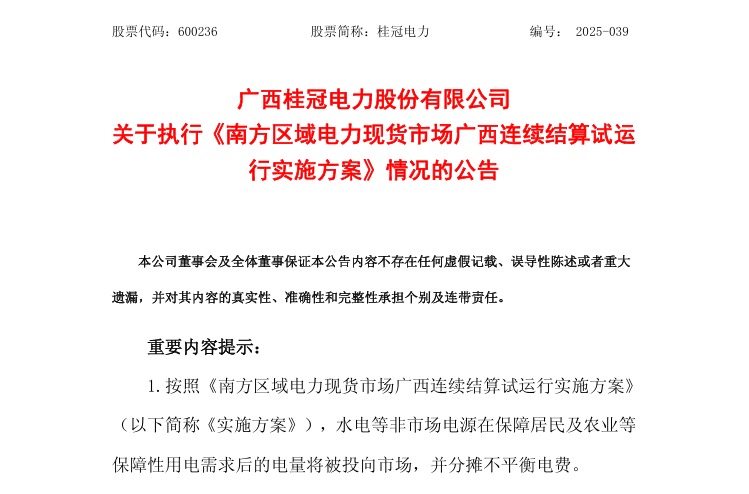
Core Insights - The announcement from Guiguan Electric Power reveals the challenges faced by power generation companies in the electricity spot market, particularly regarding the allocation of imbalance electricity fees [1][2] - Guiguan Electric Power reported a revenue reduction of 459 million yuan and a net profit decrease of 327 million yuan due to the sharing of imbalance electricity fees, which accounted for 14.3% of the previous fiscal year's net profit [1][2] Company Summary - Guiguan Electric Power is the first publicly listed company to disclose the specific financial impact of imbalance electricity fees [2] - The company operates in the Guangxi region, where it has a significant presence in hydropower generation, with a total installed capacity of 9.1932 million kilowatts, representing two-thirds of the region's regulated hydropower capacity [10] - The company is currently seeking policy optimization suggestions from the Guangxi government, including adjustments to the guaranteed electricity volume and potential increases in market settlement prices [10] Industry Context - The Southern Regional Electricity Spot Market began continuous settlement trial operations on June 29, 2023, which has led to new rules affecting non-market power sources like hydropower [3][5] - Imbalance electricity fees arise from discrepancies between generation and consumption in the electricity market, and these fees are shared among all power generation and consumption entities [6][7] - The phenomenon of imbalance funds is not unique to Guangxi, as similar issues have been observed in other provinces, with imbalance funds accounting for over 30% of market operating costs in Shanxi [6][7]

Presentation:供需模型—电价企稳,26年估值+业绩双提升
Haitong Securities International· 2025-11-04 10:58
Group 1: Core Insights - The report highlights a dual growth in valuation and performance for the electricity sector by 2026, driven by stabilizing electricity prices and structural changes in supply and demand dynamics [1][3]. - The report indicates that coal-fired power generation in northern regions is expected to see price increases due to scarcity, while southern regions may experience price declines [3][22]. - The renewable energy sector, particularly wind and solar, is projected to continue as the main source of new capacity additions, with a focus on structural and regional investment opportunities [3][4]. Group 2: Supply and Demand Dynamics - By Q3 2025, national renewable energy installed capacity reached 1.71 billion kilowatts, with a compound annual growth rate (CAGR) of 27.4% from 2020 to 2024, accounting for 46% of total installed capacity [4]. - Gansu province's renewable energy installed capacity was 75GW, representing 64.8% of its total capacity, while Guangdong's was 74.1GW, only 30.5% of its total [4][7]. - The report notes that the share of coal-fired power generation is gradually decreasing, with northern regions showing a higher proportion of new energy installations compared to southern regions [12][18]. Group 3: Pricing Trends - The report discusses the recent upward trend in spot electricity prices in Gansu, marking the first increase after three years of decline, with expectations for annual long-term contracts to rise in 2026 [3][22]. - The average spot price for coal-fired electricity in Gansu is projected to increase, while prices in Guangdong are expected to decline [22][48]. - The report emphasizes that coal-fired power generation is sensitive to real-time supply and demand, with prices influenced by the operational hours outside of peak renewable generation [46]. Group 4: Renewable Energy Policies - The report outlines new targets for renewable energy installations, with wind and solar expected to dominate future capacity growth, supported by government policies aimed at stabilizing electricity prices [57][60]. - The impact of the 136 policy document is highlighted, indicating a shift towards prioritizing quality over quantity in renewable energy projects, which may lead to a slowdown in installation growth [58][60]. - The report also notes that competitive bidding results for renewable energy projects have led to lower mechanism prices, affecting project profitability and potentially reshaping the competitive landscape [61][62]. Group 5: Hydropower Insights - The report states that large hydropower projects have largely been developed, with remaining projects facing higher costs and longer construction periods, leading to increased scarcity of stable hydropower assets [67][71]. - It is projected that hydropower prices will see a moderate increase as market transactions advance, although they remain significantly lower than other energy sources [72][73].