
险资入市

Search documents
A股,重大利好!
中国基金报· 2025-07-21 02:38
Core Viewpoint - The establishment of a long-cycle assessment mechanism for insurance funds aims to shift the focus from short-term profit-seeking to long-term stable investment, enhancing the investment logic of insurance capital [4][14][16]. Group 1: Long-Cycle Assessment Mechanism - The core value of the long-cycle assessment mechanism is to break the "long money short investment" dilemma, reshaping the investment logic of insurance capital [4][14]. - The adjustment of key indicators' assessment weights to 70% for long-cycle metrics significantly reduces the impact of short-term market fluctuations on insurance companies' profits, promoting a shift towards long-term value investment [14][15]. - The long-cycle assessment mechanism is expected to stabilize market fluctuations, introduce incremental funds, and optimize the investment ecosystem by focusing on high-dividend and technology growth sectors [14][15][16]. Group 2: Impact on Capital Market - The long-cycle assessment mechanism will enhance insurance companies' resilience to short-term investment volatility, supporting an increase in equity investment ratios and stabilizing the stock market [10][16]. - Insurance capital's entry into the market can increase the supply of long-term funds, helping to lower market volatility and guide funds towards high-potential enterprises [16][17]. - The mechanism encourages insurance funds to strengthen asset-liability management and actively seek quality long-term targets, promoting a shift from passive following to active leading in industry trends [16][17]. Group 3: Encouragement of Insurance Capital Market Entry - Recent policies have been encouraging insurance capital to enter the market, aiming to leverage its long-term stable funding advantages to support capital market stability and real economic development [19][20]. - Future policies are expected to focus on lowering risk factors for stock investments and expanding pilot programs for long-term equity investments [20][21]. - The continuous improvement of policies is anticipated to enhance the enthusiasm of insurance capital for market entry, with expectations for more encouraging measures to be introduced [21][22]. Group 4: Potential for Market Capital Injection - As of the end of 2024, the balance of commercial insurance funds is expected to be approximately 33 trillion yuan, with an actual investment ratio in A-shares around 11%, indicating significant room for growth [23][24]. - If the equity allocation increases by 10 percentage points, it could lead to an injection of approximately 3.5 trillion yuan into the market [24][25]. - The long-cycle assessment mechanism is projected to release the equity investment potential of insurance funds, particularly benefiting high-dividend and undervalued quality listed companies [25][26]. Group 5: Long-Term Investment Benefits - In a low-interest-rate environment, the long-cycle assessment mechanism is expected to enhance the long-term investment yield of insurance funds by allowing for greater allocation to equity assets [27][28]. - The mechanism encourages insurance funds to adopt a "dividend for interest" strategy, alleviating investment pressure in a low-interest environment and improving long-term investment yield levels [28][29]. - By allowing for smoother management of asset value fluctuations, the long-cycle perspective helps insurance funds focus on intrinsic asset value, reducing irrational trading caused by short-term interest rate fluctuations [29][30]. Group 6: Shift in Investment Style - The increase in insurance capital's investment ratio in A-shares is expected to promote a shift in market style towards value investment, enhancing market stability [31][32]. - Insurance funds typically adopt a "barbell" investment strategy, focusing on both high-dividend and high-growth sectors, which will benefit from the increased allocation of insurance capital [31][32][33]. - The investment style transition is likely to reduce speculative trading and increase the focus on long-term cash flow stability and sustainable dividend capabilities [33][34]. Group 7: Opportunities for Public Funds - Public funds are expected to play a crucial role as a bridge for insurance companies' equity investments, with significant business growth potential in various areas [35][36]. - The development of products that meet the investment needs of insurance funds, such as low-volatility dividend products and REITs, is anticipated to attract insurance capital [35][36]. - Customized account services and specialized products are expected to meet the specific needs of insurance funds, driving the public fund industry towards a more segmented and professional direction [36][37].


分红进行时!中证红利指数本周9股派息,农业银行439亿元领衔
Jin Rong Jie· 2025-07-15 01:33
Core Viewpoint - The A-share market continues to see significant dividend distributions, with a total of 740 billion yuan distributed among nine constituent stocks of the CSI Dividend Index this week, driven by supportive policies for high-dividend assets [1][23]. Group 1: Dividend Distribution - The total dividend distribution for the CSI Dividend Index in 2024 reached a record high of 9,237 million yuan, with a payout ratio exceeding 36% [21][22]. - Major contributors to this week's dividends include Agricultural Bank with 439 million yuan, Shanghai Pudong Development Bank with 124 million yuan, and China State Construction Engineering with 112 million yuan [23][24]. Group 2: Policy Impact on Insurance Capital - A recent notification from authorities aims to guide insurance funds towards long-term stable investments by extending the performance evaluation period to five years, which is expected to release more capital into the market [8][21]. - According to Guosen Securities, this policy change could resolve the mismatch between the nature of insurance funds and performance evaluations, potentially increasing the scale of funds entering the market [8][21]. Group 3: Asset Allocation Insights - As of Q1 2025, the total balance of insurance capital utilization was 34.93 trillion yuan, with 2.8 trillion yuan allocated to stocks, representing 8.4% of the total [2][8]. - If insurance funds increase their stock allocation by 1%, it could correspond to an additional 350 billion yuan entering the market, with a focus on high-quality dividend assets [2][8]. Group 4: Market Performance Metrics - The CSI Dividend Index has a current dividend yield of 5.37%, significantly higher than the 10-year government bond yield of 1.67%, highlighting the attractiveness of high-dividend investments [9][10]. - The performance of the CSI Dividend Index over the past decade shows a total return of 91.33% [5].


长周期考核机制进一步完善,险资入市再迎重磅利好
Sou Hu Cai Jing· 2025-07-14 10:23
Core Viewpoint - The Ministry of Finance issued a notification to guide state-owned commercial insurance companies to establish a long-term assessment mechanism, emphasizing a shift towards long-term investment strategies to stabilize the market and support economic development [1][3]. Group 1: Policy Changes - The new assessment mechanism combines annual indicators with 3-year and 5-year indicators, with weights of 30%, 50%, and 20% respectively, breaking away from the traditional annual assessment model [3]. - The policy aims to align with the long-term nature of insurance funds, which have stable sources and long repayment cycles, but have been constrained by short-term assessment pressures [3]. Group 2: Impact on Capital Markets - The notification is expected to introduce significant capital into the market, with estimates suggesting that a 1% increase in stock asset allocation by insurance funds could bring approximately 350 billion yuan into the market [4]. - The policy is anticipated to enhance the tolerance of insurance companies towards short-term market fluctuations, thereby increasing their allocation to A-shares [4]. Group 3: Long-term Investment Strategy - The new regulations will encourage insurance companies to focus on value investing and increase their equity investment ratios, aligning asset investments with insurance liabilities [5]. - The long-term investment reforms have already seen significant progress, with a total of 222 billion yuan approved for long-term investment pilot programs [6]. Group 4: Challenges and Recommendations - Despite the positive developments, challenges remain, particularly regarding solvency constraints that limit the ability of insurance companies to increase equity investments [6]. - Recommendations include optimizing solvency measures and accounting standards to facilitate better capital allocation for long-term investments [7].
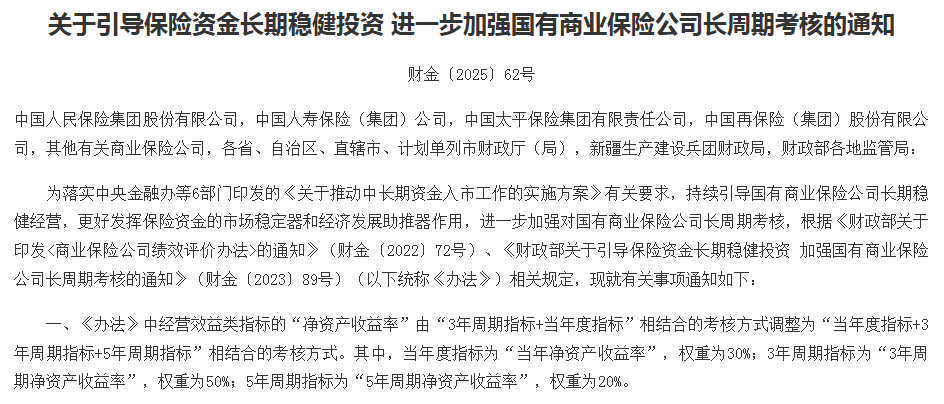
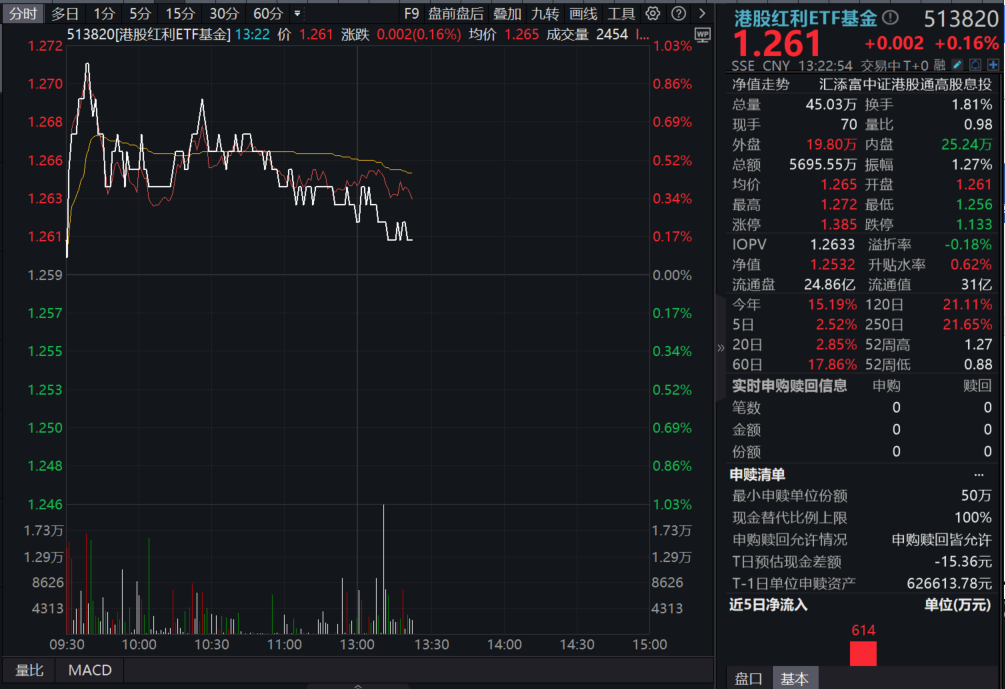
长周期考核落地,险资投向全解析!银行股点燃红利基金,港股红利ETF基金(513820)盘中价又创新高!资金跑步涌入高股息板块
Xin Lang Cai Jing· 2025-07-14 06:40
Group 1 - The Hong Kong Dividend ETF (513820) experienced fluctuations and reached a new high since its listing, with a slight increase of 0.16% as of 13:24 [1] - The leading Bank ETF (512820) also showed positive movement, with a minor increase of 0.13%, attracting over 40 million yuan in investment over the past two days [1] - Major component stocks of the Hong Kong Dividend ETF saw significant gains, with China National Materials rising over 7% and China Shenhua increasing over 4% [3] Group 2 - The Bank ETF's component stocks mostly rose, with notable increases in the shares of Agricultural Bank of China, Bank of China, and others, all gaining over 1% [5] - The Agricultural Bank announced a dividend distribution of 1.646 yuan per 10 shares, totaling 58.664 billion yuan [5] - The recent regulatory changes aim to optimize the long-term assessment mechanism for state-owned insurance companies, potentially increasing their investment in the stock market [6][8] Group 3 - Insurance funds are expected to increase their stock market investments significantly, with projections of an additional 600 to 800 billion yuan over the next three years, particularly favoring high-dividend stocks [9][10] - The Hong Kong Dividend ETF (513820) is highlighted as a leading choice for investors seeking high dividend yields, with a total size exceeding 3 billion yuan [13] - The ETF has maintained a consistent monthly dividend distribution for 12 consecutive months, making it a prominent option in the market [13]
进一步加强长周期考核,更好发挥险资长期资
Dongguan Securities· 2025-07-14 03:25
Investment Rating - The report maintains an "Overweight" rating for the insurance industry, indicating an expectation that the industry index will outperform the market index by more than 10% over the next six months [1][8]. Core Insights - The recent adjustment in the evaluation method for insurance funds' net asset return and capital preservation rate emphasizes long-term performance, with a weight distribution of 30% for the current year, 50% for a three-year cycle, and 20% for a five-year cycle, effective from 2025 [3][5]. - The report highlights that the allocation of insurance capital to equity assets needs to be increased, as the current investment in A-shares is only about 11% of the total insurance fund utilization balance of approximately 33 trillion yuan by the end of 2024, which is significantly below the 25% policy cap [4][5]. - The shift towards long-term assessments is expected to encourage insurance companies to increase their equity investments, aligning with their long-term, stable investment characteristics and improving their investment strategies [5][6]. Summary by Sections Policy Changes - The Ministry of Finance's new guidelines aim to guide insurance funds towards long-term, stable investments, addressing the current short-term focus that has hindered the sector's growth [3][4]. Market Dynamics - The report notes that the lack of mid-to-long-term funds is a significant constraint on the healthy development of the capital market, and the adjustment in evaluation metrics is a step towards alleviating this issue [4][5]. Investment Strategy - The report suggests focusing on stable companies such as China Pacific Insurance (601601), Ping An Insurance (601318), and New China Life Insurance (601336) as potential investment opportunities due to their robust operational performance and asset flexibility [6].
长周期考核,化解长投顾虑!险资渐成“托底”主力军!
Sou Hu Cai Jing· 2025-07-14 01:48
Group 1 - The Ministry of Finance has issued a notice to guide insurance funds towards long-term stable investments, emphasizing a three-year long-cycle assessment mechanism with increased weight on net asset return and capital preservation metrics [1] - The long-cycle assessment aims to reduce anxiety over short-term performance fluctuations, encouraging insurance funds to focus on long-term investments, which historically yield higher returns [2] - The recent surge in insurance capital's stake acquisitions, nearly 40 instances, reflects a response to regulatory calls for insurance capital to act as patient capital and a stabilizing force in the market [3] Group 2 - The current low interest rate environment is driving insurance companies to seek high-dividend stocks as a strategy to mitigate risks associated with interest rate and fee losses [3] - The shift towards long-term investment strategies is indicative of a broader market and policy transformation, influenced by factors such as low interest rates and the need to boost capital markets [4] - The global landscape is undergoing significant changes, necessitating a supportive environment for long-term investments to counteract rising uncertainties and market volatility [5]
四大证券报精华摘要:7月14日
Zhong Guo Jin Rong Xin Xi Wang· 2025-07-13 23:59
Group 1 - Insurance capital is increasingly aligning with patient, strategic, and long-term capital, driven by policy encouragement and growing allocation needs [1] - The number of companies listed on the New Third Board increased by 41% year-on-year in the first half of the year, reaching 158, with a total of 6060 companies by June 30, 2025 [1] - A profound transformation in corporate governance is occurring in China's listed companies, shifting from "formal compliance" to "substantive checks and balances" [1] Group 2 - The A-share market saw the Shanghai Composite Index surpass 3500 points, with a trading volume exceeding 1.7 trillion yuan, driven by the financial sector [2] - Institutions suggest a shift in investment strategy from trading to holding, as the market's risk appetite increases [2] Group 3 - The Shanghai Stock Exchange has implemented new rules for the Sci-Tech Innovation Board, allowing 32 unprofitable companies to enter the growth tier [3] - Foreign long-term capital is increasingly targeting Chinese markets, with significant investments from entities like German pension funds and Barclays Bank [3] Group 4 - The public REITs market is becoming competitive, with a subscription confirmation rate of 0.7755% for a recent REIT offering, indicating high demand [4] - The public fund industry is undergoing significant reforms, with sales institutions transitioning from a commission-based model to a service-oriented approach [4] Group 5 - Major public funds are actively researching high-tech companies in sectors like smart manufacturing and AI, focusing on long-term technological advancements [5] Group 6 - The activity of mergers and acquisitions among state-owned listed companies has surged, with 849 cases reported this year, a 182% increase from the previous year [6] - A new notice from the Ministry of Finance encourages insurance funds to adopt a long-term investment approach, enhancing their tolerance for short-term volatility [6] Group 7 - Several provinces in China have announced the establishment of large-scale industrial funds, with a focus on supporting key technologies and avoiding redundant investments [7]
政策“组合拳”协同发力险资“长钱长投”打开空间
Shang Hai Zheng Quan Bao· 2025-07-13 19:46
Group 1 - The core viewpoint of the articles highlights the acceleration of insurance capital's entry into the market, driven by a series of supportive policies aimed at promoting long-term investments [1][2][4] - Insurance capital has made 19 equity stakes in listed companies this year, which is consistent with the total from the previous year, indicating a stable investment trend [2][4] - The implementation of policies such as increasing the proportion of equity asset allocation and expanding long-term investment pilot programs has provided more opportunities for insurance capital to invest [2][4][5] Group 2 - A total of 1,720 billion yuan has been approved for long-term investment pilot funds, with many insurance companies actively participating in these initiatives [2][4] - The financial regulatory authority has raised the equity asset allocation limits for insurance companies, potentially increasing their investment capacity by approximately 500 billion yuan [5] - The recent adjustments in risk factors for insurance stock investments are expected to lower the capital requirements, allowing more funds to be allocated to the stock market [5][7] Group 3 - The introduction of a long-term assessment mechanism for state-owned insurance companies aims to encourage a shift from short-term to long-term investment strategies [6][8] - There is a growing interest among smaller insurance companies to participate in long-term stock investment trials, indicating a broader industry trend towards long-term capital deployment [3][4] - Industry experts suggest further optimization of solvency requirements and risk factor assessments to enhance the effectiveness of insurance capital in the market [7][8]


【财经分析】“长周期考核”细则落地:更好发挥险资市场稳定器作用
Zhong Guo Jin Rong Xin Xi Wang· 2025-07-13 08:47
Core Viewpoint - The Ministry of Finance has announced a new regulation to enhance the long-term assessment of state-owned commercial insurance companies, increasing the weight of three and five-year assessments to 70%, effective from the 2025 performance evaluation [2][3]. Group 1: Long-term Assessment Mechanism - The new long-term assessment scheme adjusts the weight of net asset return rates to 30% for the current year, 50% for three years, and 20% for five years [3]. - The capital preservation and appreciation rate for state-owned insurance companies will also follow a similar adjustment in weight distribution [3]. - The regulation aims to improve asset-liability management and enhance the matching of investment returns and risks [3][4]. Group 2: Impact on Market and Investment - The establishment of a long-term assessment mechanism is expected to smooth out the impact of short-term market fluctuations on performance, encouraging long-term capital investment in the market [2][4]. - Insurance funds, which currently have about 33 trillion yuan in investment balance, have significant room to increase their equity investment from the current 11% towards the 25% policy cap [5]. - The new policy is projected to bring substantial incremental funds into the market, with estimates suggesting that a 1% increase in equity allocation could lead to over 300 billion yuan in additional market funds [5][6]. Group 3: Industry Perspectives - Experts believe that the long-term assessment will help insurance companies focus on value and stable investments, thereby increasing their equity investment ratio [4][6]. - The policy is seen as a critical step in addressing the barriers to long-term capital entering the market, allowing for a more stable investment environment [4][5]. - The anticipated recovery in economic expectations and market confidence is expected to sustain the performance of insurance stocks, benefiting from the influx of long-term capital [6].

险资加速入市超2000亿元 保险系私募基金陆续成立
Zhong Guo Jing Ying Bao· 2025-07-13 05:32
Core Viewpoint - Insurance funds are accelerating their entry into the capital market through private equity funds, driven by regulatory policies and declining interest rates [1][5]. Group 1: Private Fund Establishment - The recently established Honghu Fund Phase 1 and Phase 2 are part of the third batch of long-term investment pilot funds for insurance capital, with a total scale of 225 billion yuan, equally funded by New China Life and China Life [1][2]. - Since the long-term investment reform pilot began at the end of 2023, three batches have been approved, totaling 222 billion yuan, with the first batch fully invested in the stock market [1][2]. - Major insurance companies, including China Life, Ping An, and New China Insurance, have been actively setting up private equity funds since 2025 [2][4]. Group 2: Investment Strategies and Focus - The newly established funds primarily focus on long-term equity investments, targeting companies with stable cash flows and growth potential [6][7]. - The Honghu Fund Phase 1 aims for steady dividend income through low-frequency trading and long-term holding of large-cap A+H shares [5][6]. - Sunshine Insurance's fund will invest in stocks from the CSI 300 Index and Hang Seng Index, utilizing various investment methods to enhance capital market participation [6][7]. Group 3: Market Impact and Trends - The orderly entry of insurance funds into the market is expected to enhance market depth and resilience, fostering the development of high-quality listed companies [5][6]. - The focus of these pilot funds is on companies with good fundamentals and stable dividends, reflecting a long-term investment philosophy [6][7]. - Insurance capital is increasingly concentrated in sectors such as banking, telecommunications, automotive, electronics, and pharmaceuticals, as indicated by recent investment trends [7].


