
科技金融

Search documents
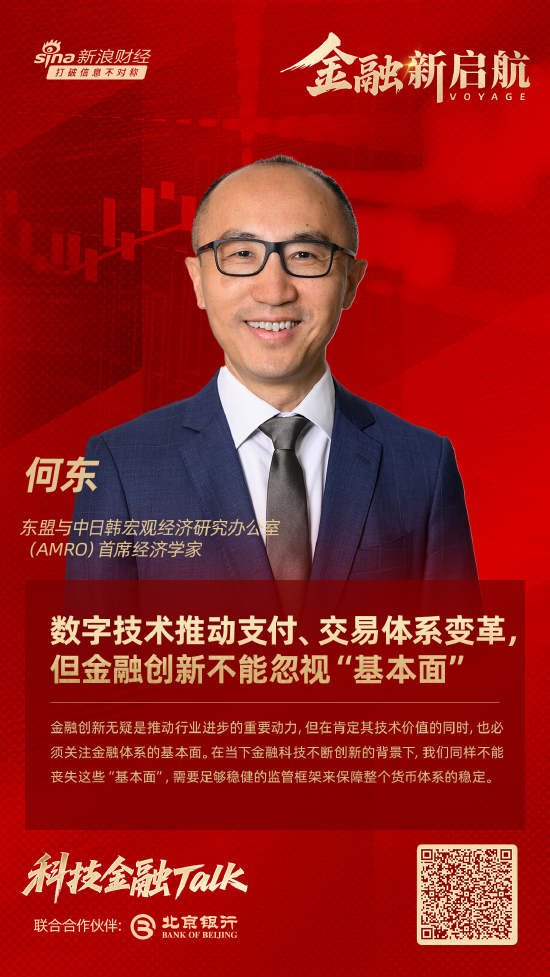
AMRO首席经济学家何东:数字技术推动支付、交易体系变革,但金融创新不能忽视“基本面”
Xin Lang Cai Jing· 2025-11-04 07:33
Core Insights - The rise of digital technology is profoundly reshaping the financial landscape, with the integration of technology and finance driving innovation and providing robust services to the real economy [1] - The dialogue series "Tech Finance Talk" aims to explore the real pathways and future possibilities of tech finance through discussions with financial executives and industry experts [1] - The chief economist of AMRO, He Dong, emphasizes the significant role of digital payments in promoting inclusive finance and enhancing economic development [1][10] Digital Payments and Financial Inclusion - Digital payments offer low-cost transactions through mobile platforms, significantly benefiting small and frequent payment scenarios, thus supporting inclusive finance [5][6] - Digital transactions create a digital trail, allowing financial institutions to build credit profiles for customers, enabling access to credit for low-income groups who lack traditional collateral [5][6] Cross-Border Payment Efficiency - In Southeast Asia, cross-border payment networks are evolving from traditional bilateral cooperation to multilateral systems, enhancing payment efficiency [2][6] - The Project Nexus initiative in Singapore aims to create a multilateral payment network to serve individuals and SMEs, addressing high costs and inefficiencies in cross-border transactions [6] - Stablecoins are emerging as a new tool for cross-border payments, but they also introduce regulatory challenges, particularly concerning anti-money laundering and customer identification [7][12] Variability in Digital Payment Development - The pace and model of mobile payment development vary significantly across Asian countries due to historical, regulatory, and consumer behavior factors [10] - Countries like Singapore have fewer unbanked individuals, while in lower-income nations, digital payments are crucial for remittances and financial access [8][10] Importance of Regulatory Frameworks - Financial innovation must be balanced with a robust regulatory framework to ensure the stability of the monetary system [12][13] - Historical lessons indicate that achieving currency stability requires long-term institutional development and strict regulation [13] - The regulatory environment plays a critical role in fostering competition and innovation within payment systems, as seen in China's experience [14]

兴业银行上海分行科技金融贷款总量已超850亿元
Zhong Guo Jin Rong Xin Xi Wang· 2025-11-04 06:32
Core Insights - Industrial Bank is committed to establishing technology finance as its "fourth business card" and is actively building a technology finance ecosystem [1] - As of the end of September, Industrial Bank's Shanghai branch has exceeded 85 billion yuan in technology finance loans, with a loan balance of nearly 60 billion yuan, reflecting a growth of 19.5% since the beginning of the year [1] - The bank has served over 18,000 technology finance clients, emphasizing the importance of directing more financial resources towards technological innovation [1] Group 1 - The bank aims to support technology innovation enterprises that have technical barriers and can address national strategic needs, highlighting the integration of finance and technology as a crucial mission [1] - A recent event titled "Xinghuo Technology - Entering Investment Institutions" was held to bridge the gap between the technology industry and capital markets, facilitating high-quality development for technology enterprises [1] - The bank plans to focus on national technology innovation strategies, deepen investment-loan collaboration, and integrate financial and industrial resources to support hard technology enterprises and the construction of Shanghai as an "international financial center" [1] Group 2 - Representatives from several biopharmaceutical companies discussed common challenges in the industry, noting the high reliance on credit loans due to the sector's light asset and high R&D investment characteristics [2] - Industrial Bank's Shanghai branch will continue to conduct the "Xinghuo Technology" series of activities to enhance its comprehensive service capabilities in technology finance, providing integrated financial services throughout the entire lifecycle of technology enterprises [2] - The bank aims to leverage Shanghai's advantages as a science and technology innovation center to provide more precise and efficient financial support for hard technology enterprises, contributing to Shanghai's goal of becoming a globally influential technology innovation hub [2]

重点领域贷款增量创新高 服务实体经济“挑大梁”
Jin Rong Shi Bao· 2025-11-04 02:06
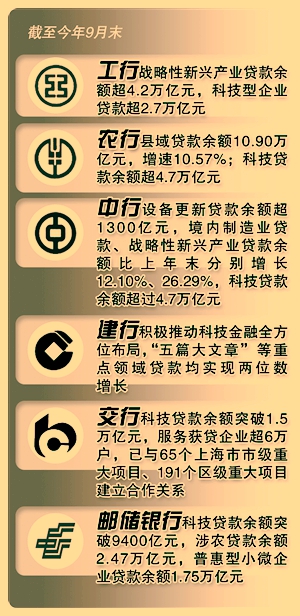
Core Insights - The six major state-owned banks in China reported stable loan growth and effective support for key sectors of the economy in their Q3 reports, demonstrating leadership in addressing weak links in the economy [1][2]. Loan Growth and Focus Areas - The total loan volume of the six major banks has shown steady growth, with targeted lending in key areas such as manufacturing, strategic emerging industries, and agriculture [4][5]. - Industrial and Commercial Bank of China (ICBC) reported a significant increase in loans, with RMB loans from domestic branches rising by 2.04 trillion yuan [4]. - Agricultural Bank of China (ABC) prioritized county-level resource allocation, with a loan balance of 10.90 trillion yuan and a growth rate of 10.57%, which is 2.21 percentage points higher than the bank's average [4]. - China Bank's loans for manufacturing and strategic emerging industries grew by 12.10% and 26.29%, respectively [4]. Support for Agriculture and Small Enterprises - Postal Savings Bank of China focused on agricultural finance, with an agricultural loan balance of 2.47 trillion yuan and inclusive finance loans exceeding 1 trillion yuan [5]. - ABC's loans for rural industries and construction reached 2.74 trillion yuan and 2.47 trillion yuan, with growth rates of 22.8% and 9.7% respectively [4]. Technology Loan Growth - The six banks have significantly increased their loan scales in the technology sector, with ICBC's loans for strategic emerging industries exceeding 4.2 trillion yuan and technology enterprise loans surpassing 2.7 trillion yuan [6]. - Agricultural Bank and China Bank also reported technology loan balances exceeding 4.7 trillion yuan [6]. AIC Equity Investment Development - Several banks have initiated AIC equity investment pilot projects, with ICBC covering 18 pilot regions and establishing 38 funds with a subscribed scale exceeding 45 billion yuan [7]. - China Bank has set up 16 equity investment funds focusing on key emerging industries, with a total subscribed scale of 11.76 billion yuan [7]. Risk Management and Control - The six banks have enhanced their risk management frameworks, particularly in agricultural loans, to ensure asset quality remains stable [8]. - ABC has integrated risk control measures throughout the loan process, utilizing financial technology to improve risk identification and management [8]. - Construction Bank has implemented monitoring measures for loan usage to prevent misuse of funds, ensuring compliance with policies [10].






普惠、绿色、科创三大领域信贷增量显著
Jin Rong Shi Bao· 2025-11-04 02:01
Core Viewpoint - The major state-owned banks in China have reported stable performance in Q3, with a focus on supporting high-quality development of the real economy through optimized credit allocation and increased lending in key sectors [1][2]. Group 1: Credit Allocation and Key Sectors - The overall trend in credit issuance for the year has been characterized by "total growth + structural optimization," with significant support directed towards inclusive small and micro enterprises, green development, and technological innovation [1][2]. - As of the end of Q3, the Agricultural Bank of China reported a balance of inclusive loans at 4.33 trillion yuan, with an increase of 731.1 billion yuan, while the balance of green loans reached 5.8 trillion yuan [2]. - The China Construction Bank's green loan balance stood at 5.89 trillion yuan, reflecting an 18.38% increase from the beginning of the year [2]. Group 2: Consumer Loans and Spending - There has been a notable increase in consumer loans, with the Industrial and Commercial Bank of China reporting a debit card transaction volume of 13.8 trillion yuan and credit card spending of 1.4 trillion yuan in the first three quarters [4]. - The China Bank's personal consumption loan balance grew by 26.11% year-on-year, reaching a significant increase in consumer spending [4][5]. - The Postal Savings Bank has implemented measures to boost consumption, resulting in a more than 10% year-on-year increase in loans for non-housing consumption [5]. Group 3: Digital Transformation and Future Outlook - Experts anticipate that the credit structure will continue to optimize, with a dual focus on consumption and inclusive finance, supporting stable growth in public enterprises and promoting domestic demand [6]. - The integration of digitalization in credit services is expected to enhance efficiency and precision in loan approvals, with the application of AI and big data technologies further reducing credit risks [7]. - Future credit allocations are likely to prioritize green, low-carbon, and digital economy sectors, aligning with national policy directions [6].
坚定走高水平科技自立自强之路
Jin Rong Shi Bao· 2025-11-04 00:53
《中共中央关于制定国民经济和社会发展第十五个五年规划的建议》(以下简称《建议》)提 出"建设现代化产业体系,巩固壮大实体经济根基""加快高水平科技自立自强,引领发展新质生产力"等 要求。 分析人士认为,与"十四五"规划相比,《建议》进一步强化了"科技自立自强"的要求。基于全会对 形势的判断,意味着"十五五"期间我国必须实现科技自立自强,强化产业链安全。 "中国式现代化要靠科技现代化作支撑。'十五五'时期,中国必须更加坚定地走高水平科技自立自 强之路,巩固拓展优势,破除瓶颈制约,补短板强弱项,在激烈的国际竞争中赢得战略主动。"中银证 券全球首席经济学家管涛表示。 建设现代化产业体系 为高质量发展注入持久动能 《建议》将"建设现代化产业体系,巩固壮大实体经济根基"摆在战略任务的第一条。 产业是实体经济发展的物质基础。我国已经是制造业强国,传统产业增加值在制造业中占比80%左 右,是我国产业体系的基本盘。同时,新兴产业正成长为经济增长新引擎。2024年,我国"三新"经济增 加值占国内生产总值比重已经超过18%。 在此背景下,《建议》部署了四方面重点任务。"可以从'固本升级、创新育新、扩容提质、强基增 效'来把握。" ...

惠及近1.5万家企业 湖北发放知识价值信用贷款超770亿
Chang Jiang Shang Bao· 2025-11-04 00:08
Core Insights - The Hubei Provincial Science and Technology Department has implemented a knowledge value credit loan program for technology-based enterprises, which has disbursed a total of 774.27 billion yuan, supporting 14,916 companies by the end of October 2025, effectively alleviating the financing difficulties faced by asset-light technology enterprises [1][3]. Group 1: Loan Program Overview - The program allows technology enterprises to apply for loans online based solely on their knowledge value, without the need for collateral, with a maximum loan amount of 10 million yuan and a term of up to 3 years [2][4]. - A risk compensation fund of 10 billion yuan has been established by the provincial and municipal governments to cover 80% of the principal loss on bad loans, enhancing banks' willingness to lend [3][6]. - All 21 banks in Hubei, excluding policy and foreign banks, are participating in the knowledge value loan program, with major banks offering interest rate discounts [4][6]. Group 2: Support for Technology Enterprises - The program targets all 28.5 million technology enterprises in Hubei, providing zero-threshold policy support to facilitate their financing needs [2][5]. - The knowledge value assessment results categorize enterprises into five credit levels (A, B, C, D, E), allowing banks to offer differentiated loan amounts and interest rates based on these evaluations [2][5]. - The program has streamlined the loan application process through a data-sharing platform that integrates information from 13 departments, enabling automatic credit rating and efficient loan processing [5][6]. Group 3: Case Studies - Companies like Wuhan Zhongke Ruize Optoelectronics and Yichang Wuxing Material Technology have successfully secured loans of 10 million yuan and 5 million yuan, respectively, demonstrating the program's effectiveness in meeting urgent funding needs [4][5].
“商行+投行+投资”协同联动!中银证券助力科技企业“加速跑”
券商中国· 2025-11-03 23:33
Core Viewpoint - The article emphasizes the importance of financial support for the development of new productive forces, particularly through the enhancement of technology finance services, which is crucial for supporting technology-driven enterprises at various stages of their lifecycle [2][3]. Group 1: Technology Finance Development - The key to developing technology finance lies in improving comprehensive financial service levels that can support technology enterprises from inception to maturity [2]. - 中银证券 has established a comprehensive service system that provides precise financial support to technology enterprises, enhancing its competitive advantage in the technology finance sector [2]. Group 2: Investment Strategies and Fund Establishment - 中银证券 has launched the 中银科创母基金, which has exceeded 10 billion yuan in scale, aimed at nurturing patient capital for hard technology sectors [3]. - The fund employs a dual-track investment strategy, allocating 70% of its funds to technology sub-funds and 30% to direct investments in high-quality technology projects [3]. Group 3: Financing Solutions for Technology Enterprises - 中银证券 has effectively utilized its investment banking capabilities to create diverse financing channels for technology enterprises, addressing their financing challenges [5]. - In the first eight months of 2025, 中银证券 ranked second in equity underwriting and achieved significant milestones in issuing innovative bonds for technology-driven small and medium enterprises [6]. Group 4: Mergers and Acquisitions - 中银证券 has demonstrated strong performance in the mergers and acquisitions sector, successfully advising on the largest "A+H" merger in China's capital market, showcasing its expertise in complex transactions [7]. Group 5: Comprehensive Lifecycle Support - The collaboration between 中银证券 and 中国银行 is pivotal in providing full-cycle financial services to technology enterprises, exemplified by the support given to the biopharmaceutical company 药捷安康 [8]. - 中银证券 aims to continuously enhance its collaborative service system to better support technological innovation and industrial transformation [9].


透视上海农商行三季报:“硬实力”抗压增长,“软实力”创造价值
21世纪经济报道· 2025-11-03 23:28
Core Viewpoint - The article highlights Shanghai Rural Commercial Bank's resilient growth in the face of industry challenges, showcasing its robust operational strategies and commitment to creating value for customers while maintaining strong financial performance [1][10]. Financial Performance - As of the end of September, Shanghai Rural Commercial Bank reported operating income of 19.831 billion yuan and net profit attributable to shareholders of 10.567 billion yuan, reflecting a year-on-year growth of 0.78% [1]. - Total assets reached 155.8094 billion yuan, an increase of 4.72% from the end of the previous year, while total liabilities grew by 5.00% to 142.7882 billion yuan [1]. - The bank achieved a non-interest net income of 5.370 billion yuan, up 2.24% year-on-year, with investment income significantly increasing by 72.23% to 3.458 billion yuan [3][4]. Risk Management and Asset Quality - Shanghai Rural Commercial Bank maintained a non-performing loan ratio of 0.97%, which is industry-leading, with a non-performing loan generation rate of 0.36%, down by 15 basis points [5]. - The bank's capital adequacy ratios are strong, with a core Tier 1 capital ratio of 14.49%, Tier 1 capital ratio of 14.52%, and total capital ratio of 16.87%, supporting future business expansion [5]. Business Strategy and Value Creation - The bank focuses on creating value through its service-oriented banking model, emphasizing the integration of commercial value and social function [1][10]. - It has developed a specialized service system for technology-driven enterprises, with loans to technology companies exceeding 120 billion yuan, and 81.06% of these loans going to small and medium-sized tech firms [6][7]. - The bank has also innovated in green finance, with green loan balances increasing by 3.31% to 99.349 billion yuan, and has launched various initiatives to support ecological sustainability [8]. Community Engagement and Social Responsibility - In response to the aging population in Shanghai, the bank has extended its services beyond finance, establishing 1,033 "Heart Home" public service stations to provide emotional and community support for elderly clients [8]. - The bank has integrated financial services with community governance, enhancing convenience for residents and contributing to a better living environment [8]. Dividend Policy and Investor Relations - Shanghai Rural Commercial Bank has a strong dividend policy, having distributed a total of 188.44 billion yuan in dividends since its IPO, which is 2.20 times the total amount raised during the IPO [9][10]. - The bank's mid-term cash dividend payout ratio reached 33.14%, reflecting its commitment to sharing value creation with investors [9].

透视上海农商行三季报:“硬实力”抗压增长,“软实力”创造价值
2 1 Shi Ji Jing Ji Bao Dao· 2025-11-03 23:17
Core Viewpoint - The overall performance of the banking industry is under pressure due to narrowing interest margins, weak credit demand, and fluctuations in the bond market, yet Shanghai Rural Commercial Bank has achieved resilient growth through robust operational strategies and optimized business structures [1][2]. Financial Performance - As of the end of September, Shanghai Rural Commercial Bank reported operating income of 19.831 billion yuan and net profit attributable to shareholders of 10.567 billion yuan, reflecting a year-on-year growth of 0.78% [1]. - Total assets reached 1.558 trillion yuan, an increase of 4.72% from the end of the previous year, while total liabilities grew by 5.00% to 1.428 trillion yuan [1]. - Non-interest income for the first three quarters was 5.370 billion yuan, up 2.24% year-on-year, with investment income significantly increasing by 72.23% to 3.458 billion yuan [2]. Risk Management and Asset Quality - The bank maintained a non-performing loan ratio of 0.97%, consistent with the previous period, and a non-performing loan generation rate of 0.36%, which decreased by 15 basis points [3]. - Capital adequacy ratios are strong, with a core Tier 1 capital ratio of 14.49%, a Tier 1 capital ratio of 14.52%, and a total capital ratio of 16.87%, supporting future business expansion [3]. Strategic Initiatives - Shanghai Rural Commercial Bank aims to create value for customers by focusing on five key areas: commercial value, ecological value through green finance, social value, and investment value for shareholders [4][5]. - The bank has developed a specialized technology finance service system, with loans to technology enterprises exceeding 120 billion yuan, supporting small and medium-sized technology innovation companies [5]. Green Finance - The bank has implemented innovative green finance solutions, such as the first water rights pledge loan in Shanghai and sustainable development-linked loans to encourage carbon emission reductions [6]. - As of September, the bank's green finance asset scale reached 99.349 billion yuan, with green loan balances increasing by 3.31% from the previous year [6]. Social Responsibility and Community Engagement - The bank has extended its services to non-financial areas, establishing over 1,033 "Heart Home" public service stations to support elderly clients and enhance community life [7]. - In September, the bank distributed a mid-term cash dividend of 2.41 yuan per share, totaling 2.324 billion yuan, with a mid-term dividend payout ratio of 33.14% [8]. Conclusion - Shanghai Rural Commercial Bank's performance reflects a commitment to both financial stability and social responsibility, positioning itself as a stabilizing force in regional economic development while maintaining a strong focus on customer value creation [8].
科技金融赋能科技创新与产业升级交流会举行
Shan Xi Ri Bao· 2025-11-03 23:08
Core Insights - The conference "Intelligent Innovation and Financial Empowerment for Technological Innovation and Industrial Upgrading" was held in Xi'an, showcasing Shaanxi's efforts in integrating technology, industry, and finance for innovative development [1][2] - The event included the signing of four key agreements, including the first batch of Shaanxi's technology innovation mother fund sub-funds, aimed at enhancing the service system for technological innovation and promoting efficient capital-technology connections [1][2] Group 1 - The first batch of seven sub-fund management institutions includes top 50 industry players and leading investment platforms, covering strategic emerging industries such as new generation information technology, aerospace, advanced manufacturing, and new materials [1][2] - The strategic cooperation agreement for building a professional and high-quality technical manager team aims to support the transformation and industrialization of Shaanxi's technological achievements [2] - The signing of experts for major innovative application scenarios will strengthen Shaanxi's technological capabilities in fields like new energy and advanced manufacturing, aiming to create a competitive technological innovation hub [2] Group 2 - The strategic investment industry consultant signing aims to provide forward-looking strategic guidance and think tank support for the development of Qin Chuang Yuan [2] - The release of the "Nine Emerging Industries Innovation Chain Map" and the "Shaanxi Province Technology Achievement Transformation Annual Report (2025)" aims to build a healthy ecosystem of "technology-industry-finance" [2] - Qin Chuang Yuan Investment Company has established a comprehensive service system for technological innovation, with a provincial mother fund of 100 billion efficiently implemented to support technology-driven enterprises [2]