AI泡沫

Search documents
打破封锁!中国芯片强势突围 引发美股动荡,英伟达一夜蒸发上万亿
Sou Hu Cai Jing· 2025-08-26 12:12
Core Insights - The article discusses the recent volatility in the US stock market, particularly focusing on the significant drop in Nvidia's stock price, which resulted in a market value loss of approximately 1.1 trillion RMB, attributed to the rise of China's chip industry and advancements in AI technology [1][5]. Group 1: Market Dynamics - Nvidia's stock fell by 3.5% on August 19, marking its largest drop since April 21, with a single-day market value loss of about 150 billion USD [5]. - The entire semiconductor sector faced declines, with Intel's stock dropping over 7% and other chip companies also experiencing varying degrees of losses [5]. - In contrast, Chinese AI company DeepSeek launched its new language model DeepSeek-V3.1 on August 21, showcasing significant advancements in AI technology [7]. Group 2: Technological Advancements - DeepSeek-V3.1 features a mixed expert architecture that balances efficiency and performance, allowing users to switch between two thinking modes based on different scenarios [7]. - The model is specifically designed to adapt to the next generation of domestic chips, optimizing parameter precision formats to reduce redundancy in chip computing units, enhance computational efficiency, and lower memory usage by 50%-75% compared to FP16 [9][12]. - The new model demonstrates impressive performance metrics, achieving similar or slightly higher accuracy with fewer tokens compared to its predecessor, indicating significant resource optimization [14]. Group 3: Industry Implications - The decline in US chip stocks is linked to growing skepticism about the commercial returns of AI investments, with a report indicating that 95% of organizations see no returns from generative AI investments [16]. - The launch of DeepSeek's model represents a major opportunity for the Chinese semiconductor industry, particularly benefiting domestic AI chip manufacturers like Cambricon, Huawei Ascend, and others, with Cambricon's stock rising over 45% in five trading days [20]. - The collaboration between models and chips signifies a critical breakthrough for China's AI industry, moving towards self-reliance in computing power and reshaping the global semiconductor landscape amid US-China tech competition [22][27]. Group 4: Future Outlook - The release of DeepSeek-V3.1 marks a fundamental shift in AI development focus from merely scaling parameters to balancing practicality and efficiency, indicating a new phase in global AI competition [31]. - The model's ability to operate in both "thinking" and "non-thinking" modes and its compatibility with Anthropic API environments suggest a significant advancement in AI capabilities [33]. - As Chinese tech companies continue to break Western monopolies, there is potential for China to lead a new wave of AI chip innovation globally [38].



周三,美股真正的“命运判官”要来了
Feng Huang Wang Cai Jing· 2025-08-25 23:35
Group 1 - The core focus of the market is on Nvidia's upcoming earnings report, which is expected to significantly influence market trends due to its substantial weight in the S&P 500 index, close to 8% [1][2] - Nvidia's market capitalization has surpassed $4 trillion, with its stock price increasing nearly 34% year-to-date, outperforming the S&P 500's 9.5% gain [2] - Analysts are monitoring key technical levels for Nvidia, including a 50-day moving average around $167 and a short-term resistance level at $184 [3] Group 2 - Intel's recent government stake, valued at approximately $11 billion, poses risks to its business, particularly if specific manufacturing thresholds are not met, potentially increasing government ownership to 15% [4][5] - The intervention by the Trump administration in Intel's operations has raised concerns about the impact on the company's agility and the broader business environment, drawing comparisons to unprecedented government actions during the 2008 financial crisis [5]

周三,美股真正的“命运判官”要来了
凤凰网财经· 2025-08-25 23:13
Core Viewpoint - The upcoming Nvidia earnings report is seen as a critical test for the market, especially after the recent comments from Federal Reserve Chairman Jerome Powell regarding potential interest rate cuts [1][2][4]. Group 1: Nvidia's Impact - Nvidia's market capitalization has surpassed $4 trillion, with its stock price increasing nearly 34% year-to-date, significantly outperforming the S&P 500's 9.5% gain [2]. - Nvidia holds a weight of nearly 8% in the S&P 500 index, making its performance crucial for the overall market sentiment [2][4]. - Analysts are closely monitoring key technical levels for Nvidia, including a 50-day moving average around $167 and a short-term resistance level at $184 [3]. Group 2: Market Concentration Risks - Nvidia is the last among the "Big Seven" tech companies to report quarterly earnings, raising concerns about market concentration risks as these companies collectively account for nearly one-third of the S&P 500 index [4]. - Despite a strong earnings season where 80% of the 474 S&P 500 companies that reported exceeded expectations, the market's focus remains on Nvidia as the true test of market resilience [4]. Group 3: Intel's Government Involvement - Former President Trump announced a government stake in Intel valued at approximately $11 billion, claiming it would generate more funds and jobs for the U.S. [5]. - Intel warned that the government's 10% stake could pose risks to its business, potentially increasing to 15% if certain manufacturing thresholds are not met, which could lead to a decline in sales [5]. - Critics argue that this government intervention is unprecedented and threatens the agility of the business environment, drawing parallels to the financial crisis of 2008 [6].

“AI泡沫”可能要破灭了?华尔街忧心忡忡
Sou Hu Cai Jing· 2025-08-25 15:41
Core Viewpoint - Investors are increasingly concerned about a potential "AI bubble" about to burst, as evidenced by significant stock price declines in companies like Nvidia, CoreWeave, Microsoft, and Alphabet [1][11] Group 1: AI Bubble Concerns - Sam Altman, founder of OpenAI, acknowledges the existence of an AI bubble among VC-backed private startups, with a report from MIT indicating that 95% of generative AI investments have not yielded returns for businesses, and half of the projects have failed [3][4] - The MIT report highlights that 95% of AI pilot projects fail to improve profits or reduce costs, suggesting a critical need for better application of AI technologies within organizations [4][6] - Previous reports have echoed similar findings, with Capgemini noting that 88% of AI projects fail to reach practical application, and S&P Global stating that 42% of generative AI projects are abandoned [6] Group 2: Reasons for AI Project Failures - The primary reason for AI project failures is not the inadequacy of AI models but rather the lack of understanding among individuals and organizations on how to effectively utilize AI tools and integrate them into workflows [7] - Successful integration of AI requires specialized knowledge and iterative testing, as many organizations are hindered by bureaucratic processes [7] - Companies that purchase existing AI models and solutions have a success rate of 67%, compared to only one-third for those that build their own systems [7] Group 3: Historical Context and Market Reactions - The current AI industry is drawing parallels to the internet bubble of the early 2000s, with significant market value losses in the tech sector, exceeding $1 trillion [11] - High valuations in the S&P 500, with two-thirds of stocks having P/E ratios above 30, raise concerns about sustainability and the need for extraordinary growth to justify these valuations [11] - Despite concerns, there remains a strong investment interest in AI infrastructure, with significant funding being allocated for data center construction by major firms like Meta and partnerships involving JPMorgan and Mitsubishi UFJ [12][13]


人工智能焦虑令美股市场陷入慌乱,根源何在?
财富FORTUNE· 2025-08-25 13:05
Core Insights - Recent significant declines in major AI-related tech stocks have raised concerns about the industry's ability to deliver promised billions in revenue [2][3] - A report from MIT indicates that approximately 95% of generative AI pilot projects have minimal or no impact on revenue or profits, highlighting execution challenges within companies [4] - Experts suggest that while there is skepticism about AI valuations, the underlying technology remains valuable, and the current market fluctuations are part of a long-term transformation process [5][6] Group 1: Market Reactions and Stock Performance - Major tech stocks related to AI, such as Palantir Technologies, Oracle, AMD, Arm Holdings, and Nvidia, experienced significant stock price declines, with Palantir dropping over 9% [2] - SoftBank's stock fell more than 7%, reflecting broader concerns about the tech sector's correction and the sustainability of high valuations in AI-focused companies [3] - The market is distinguishing between companies with genuine AI revenue and those merely leveraging the AI label for marketing purposes [7] Group 2: Insights from Research and Experts - The MIT report, based on extensive interviews and surveys, concluded that most generative AI projects have not justified their substantial expenditures, with execution issues being a primary concern [4] - Experts emphasize that the current market volatility is typical of technology cycles, and while there may be a bubble, the fundamental potential of AI technology is strong [5][8] - The consensus among experts is that the recent market downturn serves as a necessary correction, separating speculative investments from those with real, sustainable value [8][9] Group 3: Long-term Perspectives on AI - AI is expected to have a transformative impact comparable to the Industrial Revolution, despite current market bubbles [5] - Companies that successfully integrate AI into their operations are likely to emerge as winners in the long run, while those that fail to do so may face significant corrections [6][8] - The anticipated increase in AI spending, projected to exceed $360 billion by 2025, indicates a robust underlying demand for AI technologies [7]





AI基建狂潮--让华尔街“假也不休”,为五年后不知道是什么的技术,进行20-30年期限的融资
3 6 Ke· 2025-08-25 03:34
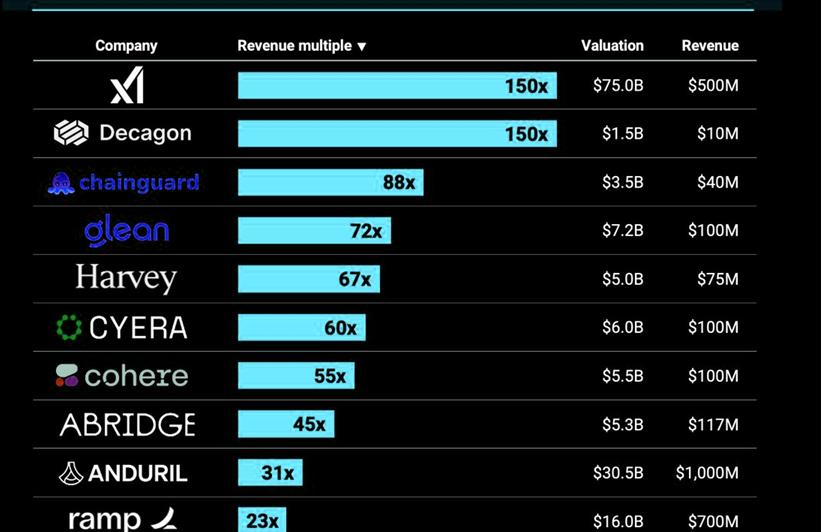
Core Insights - A historic surge in AI infrastructure financing is occurring on Wall Street, with hundreds of billions of dollars flowing into data center construction, leading to concerns about a potential bubble [1][2] - Major transactions include a reported $22 billion loan led by JPMorgan and Mitsubishi UFJ for Vantage Data Centers, and Meta securing $29 billion for data center development in Louisiana [1][3] - Analysts express concerns over the long-term profitability of these investments, drawing parallels to the late 1990s internet bubble, with a study indicating that 95% of generative AI projects fail to generate profits [1][7] Financing Trends - The scale of AI data center financing is reaching unprecedented levels, with projections for 2023 expected to reach $60 billion, double that of 2024 [3][4] - Private credit markets are increasingly funding these projects, with significant transactions occurring in July and August, including Meta's $26 billion loan and $3 billion equity deal [3][5] - The shift from self-funding by tech giants to reliance on bond investors and private credit institutions is notable, with companies like Microsoft and Amazon issuing high-quality bonds to finance infrastructure [5][6] Market Dynamics - The rise of private debt funds seeking higher returns has led to increased investment in data center transactions, which offer yields higher than typical corporate loans [5][6] - Concerns are growing regarding the sustainability of cash flow predictions for data centers, with historical data lacking to support long-term forecasts [2][7] - The prevalence of "PIK (Payment-in-Kind) loans" indicates rising financial pressure on borrowers, with a significant portion of income from these loans being non-cash [7][8] Valuation Concerns - The valuation of AI unicorns has reached alarming levels, with 498 companies valued at $2.7 trillion, and revenue multiples exceeding 100x for many startups [8][9] - The economic viability of AI startups is under scrutiny, as the cost structure shows that for every dollar a user pays, the application layer pays significantly more to underlying service providers [9][10] Regulatory and Operational Challenges - Rising electricity costs and regulatory scrutiny over data center energy consumption could pose risks to the financing model, as operational costs increase [12][14] - The stock market is reflecting skepticism, with notable declines in the share prices of AI-related companies, such as CoreWeave, which has seen a nearly 50% drop from its peak [14]
AI泡沫下,OpenAI创始人奥特曼的理性与矛盾
Sou Hu Cai Jing· 2025-08-23 13:10
Core Viewpoint - The CEO of OpenAI, Sam Altman, believes that the current AI industry is experiencing a bubble driven by excessive investor enthusiasm and irrational valuations, similar to the internet bubble period [1][3] Group 1: AI Bubble Concerns - Altman explicitly stated that the AI industry indeed has a bubble, primarily due to the rapid growth in user demand for AI, which has led to a surge in computing power and data requirements [1] - He warned that if this demand slows down, the computing power and data, once seen as assets, could quickly become burdens, potentially leading to severe financial pressure for some AI companies [1][3] - OpenAI's CFO, Sarah Fryer, acknowledged the risk of asset depreciation if AI usage growth slows or enthusiasm for existing models wanes, comparing it to the early stages of the real estate market [3] Group 2: Economic Value and Long-term Potential - Despite the bubble concerns, both Altman and Fryer emphasized the significant economic value and application potential of AI across various sectors, including healthcare, finance, and automation [1][7] - They believe that the substantial investments in data centers and computing clusters could serve as a "legacy" for future, more powerful, and inclusive AI technologies, even if the current AI application bubble bursts [7] Group 3: Financing and Market Expectations - OpenAI is reportedly planning to raise $6 billion, with a valuation projected to reach $500 billion, significantly higher than its current annual revenue, indicating high market expectations for AI technology [3] - Altman is seeking innovative financing methods and has not disclosed specific details, while OpenAI relies heavily on partners like Microsoft and Oracle to share the financial burden of building data centers [4][5]

科技股发出警告:AI叙事开始动摇,风险正蔓延至“看不见”的角落
Hua Er Jie Jian Wen· 2025-08-23 10:45
Group 1: Market Dynamics - The global market, historically driven by large tech stocks, is showing signs of fatigue, with recent sell-offs indicating potential risks in both public and private markets [1] - The concentration of market performance in a few tech giants, such as Nvidia with a market cap of $4.3 trillion, raises concerns about market stability, as the top 10 companies account for approximately 40% of the S&P 500 index [2] Group 2: AI Investment Concerns - There are growing doubts about the sustainability of the AI narrative, with OpenAI's CEO acknowledging the presence of a "bubble" and warning that many investors may incur significant losses [3][4] - A report from MIT indicates that around 95% of organizations investing in AI have seen "zero returns," highlighting the gap between expectations and actual outcomes [3] Group 3: Private Market Risks - The funding for AI development is increasingly reliant on opaque private markets, with an estimated $3 trillion needed for AI infrastructure over the next three years, of which tech giants may only cover half [5] - Private credit markets are projected to see a $100 billion increase in risk exposure to AI, reaching approximately $450 billion by early 2025, surpassing public credit market funding [6] - The influx of capital into private markets raises concerns about overheating risks, as the concentration of risk is no longer limited to public equity markets but extends throughout the private sector [7]
AI 泡沫?麻省理工学院报告 95% 企业 AI 投资几乎无回报
Sou Hu Cai Jing· 2025-08-23 06:04
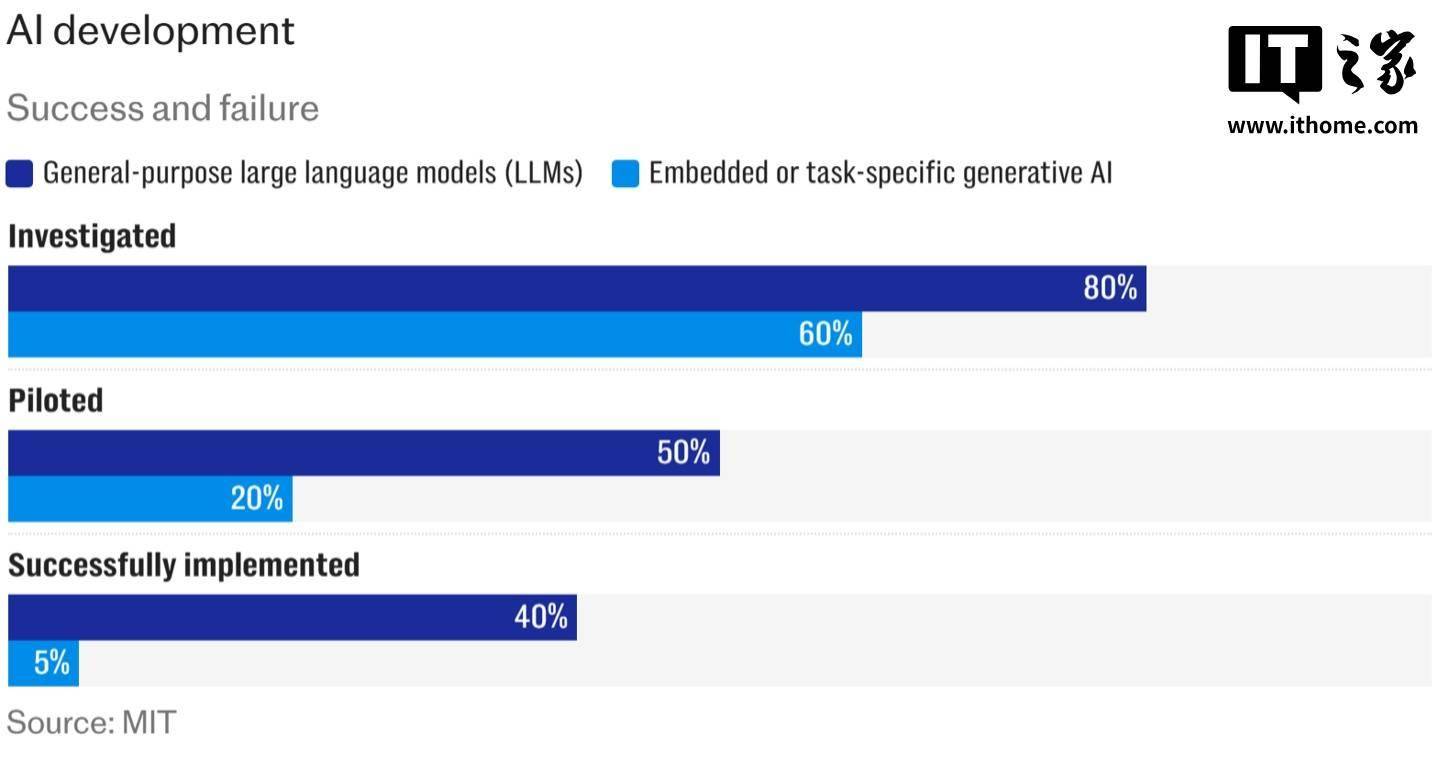
Core Insights - A recent MIT report warns that 95% of generative AI investments have yielded little to no returns for businesses, with half of the projects failing and only 5% achieving commercialization [1][3][4] Investment and Market Impact - The report has led to market concerns about a potential AI bubble, resulting in significant stock declines for major tech companies: Nvidia down 3.5%, Palantir down 9%, and SoftBank down 7% [1][3] - Despite investments ranging from $30 billion to $40 billion (approximately 215.18 billion to 286.91 billion RMB), 95% of AI projects have not generated financial returns, and only 40% of companies have deployed AI applications [1][3] Industry Trends - Many companies are reportedly "quietly abandoning" complex and expensive enterprise-level AI systems, with employees preferring to use consumer-grade tools like ChatGPT at their own expense [3] - The report's release coincides with a decline in confidence regarding AI's profitability, as expectations set since the launch of ChatGPT in 2022 have not been met [4] - OpenAI's release of ChatGPT-5 has been perceived as having limited upgrades, with some users requesting a return to previous versions, indicating dissatisfaction with current offerings [4]
小扎“亿元俱乐部”车门焊死,被曝冻结招聘,禁止内部人员流动
3 6 Ke· 2025-08-22 01:46
| Name | | Tenure @ Meta YoE | | Current Job | Prior Roles | Expertise | Advanced Degree | Undergrad Degree | | --- | --- | --- | --- | --- | --- | --- | --- | --- | | Nat Friedman | American | 18 days | 26 | VP, Meta Superintelligence | NFDG; CEO, Github | Developer ecosystems | | BS, MIT (CS) | | Daniel Gross | Israeli | 18 days | 15 | VP Product, Meta Superintelligence Cofounder, SSI; NDFG | | Al product & venture | | | | | | | | | | | | - | | Yann Le Cun | French | 11.6 yrs | 37 | VP + Chief Al Scientis ...