
数字化

Search documents
广州商贸会展向绿色智慧转型
Jing Ji Ri Bao· 2025-05-23 22:10
Group 1: Retail and Exhibition Industry in Guangzhou - Guangzhou's total retail sales of social consumer goods reached 291.27 billion yuan, with a year-on-year growth of 3.5% [1] - The number of economic and trade exhibitions held in Guangzhou's professional exhibition venues reached 60, marking a year-on-year increase of 36.4%, with an exhibition area of 2.402 million square meters, up 14.2% [1] - The cumulative number of exhibitors and visitors reached 2.484 million, reflecting a year-on-year growth of 9.3% [1] Group 2: Miniso's Strategic Initiatives - Miniso is focusing on transforming into quality retail and enhancing interest consumption, with 2025 marking the second year of this transition [1] - The company has launched over 90 new IP events this year, including collaborations with major franchises like Harry Potter and "Black Myth: Wukong" [1] - Miniso has established a robust supply chain with over 1,400 quality suppliers globally, with approximately 50% of suppliers located in the Pearl River Delta [1] Group 3: SHEIN's Innovations in Fashion Industry - SHEIN's innovation research center in Panyu integrates cutting-edge technology exploration, quality testing, and supply chain training [2] - The company is promoting digital and green upgrades in the fashion industry, with nearly 80% of its green electricity usage coming from rooftop solar projects [2] - SHEIN is committed to driving carbon reduction through technology innovation and sustainable practices across the product lifecycle [2] Group 4: Exhibition Growth in Guangzhou - In 2024, Guangzhou's exhibition industry is expected to reach a new scale with 358 exhibitions and an exhibition area of 11.86 million square meters, reflecting an 8.9% growth [3] - The number of attendees for exhibitions is projected to reach 23.13 million, a significant increase of 30.7% [3] - Guangzhou's conference industry is also growing, with 6,406 meetings expected to be held, marking a 13.7% increase in participation [3]
双汇携旗下明星产品参展第二十二届中国(漯河)食品博览会
第一财经· 2025-05-23 15:30
Core Viewpoint - The article highlights the successful participation of Shuanghui at the 22nd China (Luohe) Food Expo, showcasing its diverse range of meat products and commitment to quality and innovation in the food industry [1][4][17]. Group 1: Company Overview - Luohe is recognized as the first Chinese Food City, with a robust food industry ecosystem that spans from raw material cultivation to deep processing and logistics [4]. - Shuanghui has evolved from a small meat processing plant to a globally recognized leader in the meat industry, benefiting from the support of local government and consumer trust [4][17]. Group 2: Product Offerings - Shuanghui's exhibition featured over 260 products across four categories: American products, comprehensive meat products, fresh products, and seasoning products, reflecting its strategic focus on innovation and diversification [7]. - The product range includes various packaged meat products, fresh pork, poultry, and a variety of seasonings, catering to the increasingly diverse and personalized consumer demands [9][11][13]. Group 3: Consumer Engagement - The Shuanghui booth attracted significant attention, with visitors enjoying product tastings and engaging in discussions about flavors and preparation methods, establishing a strong connection with consumers [15][16]. - Feedback from attendees highlighted the comprehensive nature of Shuanghui's product offerings and the company's strong positioning within the meat industry [16]. Group 4: Future Directions - Shuanghui plans to continue its focus on meat products, guided by its "Four Modernizations" strategy, while enhancing its efforts in technological innovation, product development, and digital transformation to meet diverse consumer needs [17].


电声股份业绩会:推动业务向数字化、智能化转型
Zheng Quan Shi Bao Wang· 2025-05-23 11:53
Core Viewpoint - The company reported a slight increase in revenue for 2024 but faced a significant decline in net profit due to increased competition and rising management costs, particularly in the interactive display and retail terminal management sectors [1][2] Group 1: Financial Performance - In 2024, the company achieved operating revenue of 2.287 billion yuan, a year-on-year increase of 1.58% [1] - The net profit attributable to shareholders was 14.04 million yuan, representing a year-on-year decrease of 57.33% [1] Group 2: Business Operations - The company's main business includes interactive display, retail terminal management, brand communication, and digital retail services, establishing itself as a leading experiential marketing service provider in China [1] - The company operates 34 subsidiaries and 268 roadshow lines, covering over 300 prefecture-level cities and nearly 1,400 county-level cities [1] Group 3: New Energy Vehicle Business - The new energy vehicle business became a highlight for the company in 2024, operating 780 vehicles and generating revenue of 27.29 million yuan, a year-on-year increase of 63.77% [2] Group 4: Digital Transformation - The company is focusing on digital and intelligent transformation, planning to utilize technologies such as generative AI, VR/AR, and naked-eye 3D to enhance its marketing services [2][3] - In October 2024, the company will launch ten AI+ products aimed at retail terminal scenarios to further integrate online and offline retail [2] Group 5: International Expansion - The company plans to expand internationally by focusing on domestic brands going abroad, cross-border e-commerce, and overseas brand development [2] - The company aims to provide customized cross-border marketing services to meet diverse market demands in different countries and regions [2] Group 6: Future Development Strategy - The company’s future development strategy includes three main directions: technology-driven innovation, building a brand product matrix, and international expansion [3] - The company is actively seeking investment and acquisition opportunities in IP and consumer brands to meet diverse consumer needs [3]

解禁期刚过萌生退意 德迈仕实控人拟变更为潘异
Zheng Quan Ri Bao· 2025-05-23 05:09
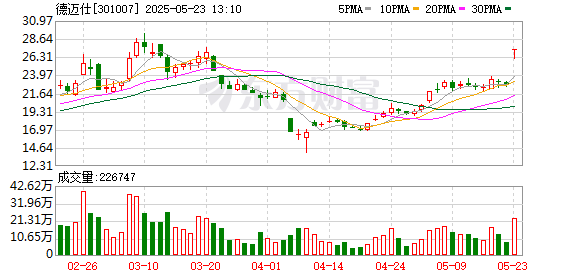
Core Viewpoint - The announcement of a change in control at Dalian Demais Precision Technology Co., Ltd. (Demais) has led to a significant stock price increase, indicating market optimism regarding the new controlling shareholder's potential impact on the company's future growth and operational efficiency [2][6]. Group 1: Shareholder Changes - Demais disclosed that its controlling shareholder, Dalian Demais Investment Co., Ltd., plans to transfer all its shares to Suzhou Huixin Chuangzhi Investment Co., Ltd., which was established in early April 2023 [2][3]. - If the transaction is completed, the actual controller of Demais will change from He Jianping to Pan Yi, who has strong ties to Shenzhen Inovance Technology Co., Ltd. [2][4]. - The total transaction price for the share transfer is 66.91 million yuan [3]. Group 2: Company Background - Demais is a leading enterprise in the domestic precision shaft and precision cutting parts market, focusing on precision component processing with strong product development and market expansion capabilities [3]. - The company was listed on the Shenzhen Stock Exchange's Growth Enterprise Market on June 16, 2021, and has been publicly traded for less than four years [3]. Group 3: New Shareholder Profile - Huixin Chuangzhi has seven natural person shareholders, many of whom have backgrounds in Inovance Technology, including Pan Yi, who is a founding shareholder and former actual controller of Inovance [5]. - The new shareholders are expected to bring additional capital and resources, potentially enhancing Demais's operational capabilities and market reach [6]. Group 4: Market Reaction - Following the announcement, Demais's stock price surged by 20% upon resuming trading, with a significant number of buy orders remaining [2].
Thermon(THR) - 2025 Q4 - Earnings Call Transcript
2025-05-22 16:02
Financial Data and Key Metrics Changes - The company generated $498 million in revenue for fiscal year 2025, a 1% increase year-over-year despite a 37% decline in large capital projects [10] - Adjusted EBITDA margin for fiscal year 2025 was 22%, up 86 basis points from the previous year, reflecting a more favorable revenue mix and productivity gains [10] - Free cash flow for the year was $53 million, with a gross margin expansion of 196 basis points [11][28] Business Line Data and Key Metrics Changes - Organic growth of 3% was achieved in the fourth quarter, marking the first growth in over a year, driven by improved order trends in various verticals, particularly in the LNG market [7][10] - OpEx revenues for the fourth quarter were $111.8 million, a 7% increase compared to the previous year, representing 83% of total revenues [25] - Large project revenue for the fourth quarter was $22.3 million, down 5% year-over-year but up 20% compared to the previous quarter [24] Market Data and Key Metrics Changes - US sales increased by 6%, while EMEA revenue rose by 51% year-over-year, indicating strong performance in those regions [26] - The backlog as of March 31 increased by 29% from the previous year, with organic backlog up 20% [8] - The company reported a book-to-bill ratio of 1.04 times for the fourth quarter, reflecting balanced strength across diversified end markets [25] Company Strategy and Development Direction - The company is focused on three strategic pillars: growing the installed base, pursuing decarbonization, digitization, and diversification, and maintaining disciplined capital allocation [13][16] - The acquisition of Vapor Power has expanded the addressable market, increasing the sales pipeline by 25% [12] - The company aims to leverage existing solutions and new product development to meet customer decarbonization needs, with a strong emphasis on electrification of industrial heating [18] Management's Comments on Operating Environment and Future Outlook - Management expressed confidence in the underlying demand for products despite macroeconomic uncertainties, with a focus on navigating a dynamic global trade environment [31][35] - The company anticipates margin headwinds in the first half of fiscal year 2026 due to tariffs but expects to offset these through pricing actions in the latter half of the year [35][44] - The guidance for fiscal year 2026 includes revenue expectations between $495 million and $535 million, representing a 3.5% growth at the midpoint [35] Other Important Information - The company repurchased $14 million in shares during the fourth quarter, with a total of over $20 million in share repurchases for fiscal year 2025 [28] - The board approved a refresh of the share repurchase program back to $50 million, reflecting optimism for future growth [9][29] - The company is actively working on extending the maturity of its existing credit facility, which becomes current in September 2025 [29] Q&A Session Summary Question: Can you elaborate on the resurgence in LNG? - Management noted that since the lift of the moratorium in January, several projects have moved forward quickly, particularly in the U.S. Gulf Coast and the Middle East, with approximately $80 million in LNG opportunities in the pipeline [40][41] Question: What are the expectations for FY 2026 regarding margins and growth? - Management indicated that there will be near-term impacts on gross margins in the first half due to tariffs, but pricing actions are expected to mitigate these effects in the second half [42][44] Question: How is the company viewing the overtime category in the forecast for FY 2026? - Management mentioned a strong backlog build in overtime projects, with expectations for muted order rates until clarity on trade policy is achieved [50] Question: What is the competitive landscape regarding tariffs and trade policy? - Management highlighted that the company has a significant presence in the U.S. and Canada, which provides an advantage, and noted that they are not heavily dependent on China, reducing exposure to tariff impacts [78][80]

煤炭消费比重不足1%,北京成中国首个全面实现清洁能源发电城市
Xin Jing Bao· 2025-05-22 14:24
Group 1 - The 29th World Gas Conference is focusing on "Digitalization and Technological Innovation Shaping a Sustainable Future" [1] - Beijing aims to become a global benchmark city for digital and green economies, emphasizing the role of energy technology innovation and the transformation of the natural gas industry [2] - Beijing's energy structure has historically optimized, with coal consumption projected to be less than 1% of total energy consumption by 2024, and green electricity usage reaching 29.3% of total electricity consumption [1][2] Group 2 - The city plans to enhance the dual development of digital industries and energy, creating a comprehensive digital and intelligent urban energy system [2][3] - Beijing will focus on energy technology innovation in sectors like energy conservation, hydrogen energy, and energy storage, supported by a green energy investment fund [3] - The forum featured discussions from international experts on the practical applications of green and digital transformations in the energy sector [3]
北京将推进能源科技创新和绿色低碳深度转型
Zhong Guo Xin Wen Wang· 2025-05-22 12:26
Group 1 - The 29th World Gas Conference is being held in Beijing, focusing on energy technology innovation and green low-carbon transformation [1] - Beijing aims to enhance energy efficiency and has achieved a historical optimization of its energy structure, with coal consumption accounting for less than 1% of total energy consumption [1][2] - The city plans to increase the proportion of green electricity to 29.3% by 2024, with a total electricity consumption of 138.9 billion kilowatt-hours [1] Group 2 - Beijing is the second-largest natural gas consumer globally, with a projected supply of 19.5 billion cubic meters in 2024, accounting for about one-third of the city's total energy consumption [2] - The average annual PM2.5 concentration in Beijing has decreased from 89.5 micrograms per cubic meter in 2013 to 30.5 micrograms per cubic meter in 2024, a reduction of 65.9% [2] - The city is focusing on digital and technological innovation to drive high-quality development in the energy sector, with several key technological breakthroughs and rapid growth of energy tech companies [2] Group 3 - Beijing will strengthen the dual development of digital industries and energy, creating a comprehensive digital energy system and promoting the "Artificial Intelligence+" action plan [3] - The city plans to enhance energy technology innovation and green low-carbon transformation, focusing on energy-saving, hydrogen energy, and energy storage industries [3] - Beijing aims to optimize the business environment and expand high-level opening-up, actively constructing a more open and inclusive development environment [3] Group 4 - The Beijing Development and Reform Commission and the Beijing Energy Conservation and Environmental Protection Center held a policy promotion meeting for advanced energy industry development [4] - The "Green Beijing Guest Hall" platform is facilitating cooperation and investment opportunities, with foreign enterprises expressing interest in exploring the investment environment [4]
商业贸促会聚焦服务贸易,推动标准化建设与国际合作
Zhong Guo Jing Ji Wang· 2025-05-22 08:00
Group 1 - The China Council for the Promotion of International Trade (CCPIT) emphasizes the importance of service trade in promoting high-quality economic development and actively participates in the formulation of national, industry, and group standards in the service trade sector [1][2] - The CCPIT has developed a group standard for "Cross-border E-commerce Logistics Service Guidelines" to support small and medium-sized enterprises in their international expansion [1] - The China Service Trade Standardization Forum has been successfully held eight times, becoming an authoritative platform for communication in the field of service trade standardization in China [1] Group 2 - The CCPIT focuses on international cooperation in service trade by creating platforms for international exhibitions, trade negotiations, and training exchanges to facilitate the "going out" of Chinese services and the "bringing in" of high-quality overseas resources [2] - The upcoming ninth China Service Trade Standardization Forum will explore new models and directions for service trade standardization under the theme "New Paths for Standard Cooperation, New Future for Service Trade" [2] - Future plans include enhancing service trade innovation with a focus on digitalization, greening, and specialization, as well as strengthening talent cultivation through partnerships with universities and vocational schools [2]
浙江余杭经济开发区挂牌一周年的“破”与“立”
Hang Zhou Ri Bao· 2025-05-22 03:19
Group 1 - The core viewpoint of the article emphasizes the transformation and modernization of traditional manufacturing industries in the Yuhang Economic Development Zone, focusing on digitalization and green manufacturing initiatives [8][9][10]. - The Yuhang Economic Development Zone has officially changed its name and is embarking on a new development journey, showcasing a vibrant landscape of high-quality growth through the transformation of traditional industries [8][9]. - Southern Pump Industry has implemented significant digital and automated upgrades in its production processes, achieving a 100% first-pass yield and reducing delivery times by 70% [9][10]. Group 2 - The Yuhang Economic Development Zone has successfully completed 100% digital transformation coverage among industrial enterprises, fostering a matrix of smart manufacturing and digital workshops [11]. - The zone has attracted numerous projects, including a new intelligent manufacturing project by Huaguang New Materials, which has increased production line automation by 75% and reduced production cycles by 30% [10][11]. - The region's strategic focus on attracting key enterprises and strengthening industrial chains has led to the establishment of competitive industrial clusters in smart manufacturing, new materials, and new energy [12][13]. Group 3 - In 2024, the Yuhang Economic Development Zone has successfully introduced 51 quality projects with a total investment exceeding 29 billion [14]. - The zone's proactive approach to investment attraction includes targeted strategies to identify and engage potential enterprises, ensuring that each project contributes to the industrial ecosystem [12][14]. - The Yuhang Economic Development Zone has demonstrated a commitment to optimizing the business environment, providing tailored support to enterprises, and enhancing their operational efficiency [16][18].
欧盟新预算改革面临多重制约
Jing Ji Ri Bao· 2025-05-21 22:41
Core Viewpoint - The European Commission President Ursula von der Leyen has proposed an ambitious budget reform plan aimed at promoting fiscal integration within the EU, enhancing strategic autonomy, and creating a more flexible and efficient fiscal mechanism to address global geopolitical risks and high-tech competition [1][2]. Group 1: Reasons for the Reform - The geopolitical crisis, particularly following the Ukraine conflict, has exposed the limitations of the EU in security and diplomacy, prompting a reevaluation of "strategic autonomy" [2]. - The EU is falling behind in key areas such as digitalization, artificial intelligence, and green energy, necessitating a more robust fiscal stimulus to invest in future industries [2]. - There is a lack of sufficient fiscal tools and limited financing options, as demonstrated by the successful introduction of a joint borrowing plan during the pandemic, which the Commission aims to institutionalize [2][3]. Group 2: Key Components of the Reform - Defense spending exemption: The proposal suggests exempting defense expenditures from the fiscal deficit calculations, allowing member states to significantly increase their defense budgets [3]. - Establishment of a European Competitiveness Fund: This fund aims to consolidate existing research and industry support tools to invest in strategic projects like chip manufacturing and clean energy [3]. - Reform of budget allocation methods: The plan proposes reducing traditional agricultural subsidies and structural funds, shifting to conditional direct payments to member states based on their performance in climate transition and fiscal reforms [3]. - Institutionalization of a joint borrowing mechanism: The proposal seeks to create a permanent EU joint debt issuance mechanism to ensure long-term strategic investment and crisis response capabilities [3]. Group 3: Internal Divisions and Challenges - There are significant divisions within the EU regarding the reform, with countries like France and Italy supporting it for strategic autonomy, while others, particularly the "frugal four" (Denmark, Netherlands, Sweden, and Austria), oppose expanded borrowing [4][5]. - Some Eastern European countries, while potentially benefiting from EU funds, resist conditional funding that may infringe on national sovereignty [5]. - The political landscape suggests that while the reform is likely to pass, it will require extensive negotiations and compromises, indicating a shift in the EU's institutional development and its future direction [5].