算力

Search documents
AI周报|Sora下载量突破100万次;AMD与OpenAI达成巨额算力供应协议
Di Yi Cai Jing Zi Xun· 2025-10-12 03:25
Group 1: OpenAI Developments - OpenAI's video AI application Sora achieved over 1 million downloads within 5 days of launch, surpassing the download speed of ChatGPT [1] - Sora is currently limited to iOS devices and operates on an invitation-only basis, which contrasts with ChatGPT's initial public release [1] - OpenAI is enhancing ChatGPT into a "super app" that allows users to directly access third-party applications within conversations [6] Group 2: Strategic Partnerships and Investments - AMD has issued a warrant to OpenAI allowing the purchase of up to 160 million shares at $0.01 each, as part of a strategic partnership to deploy 6 gigawatts of AMD GPU capacity [2] - NVIDIA is also collaborating with OpenAI, with plans to invest up to $100 billion, contingent on the construction of data centers [2] - NVIDIA confirmed its investment in Elon Musk's xAI, contributing $2 billion in a recent funding round, as part of its broader strategy to support AI applications [4] Group 3: Industry Trends and Performance - Hon Hai Precision Industry (Foxconn) reported a 38.01% quarter-over-quarter revenue increase, driven by a surge in AI server shipments [3] - SoftBank is acquiring ABB's robotics unit for $5.375 billion, indicating a strategic shift towards physical AI and automation technologies [7] - Tencent's Hunyuan-Vision-1.5-Thinking model ranked third globally in the latest visual model rankings, highlighting the competitive landscape in AI model development [9] Group 4: Talent Movement in AI Sector - Yao Shunyu, a notable physicist, transitioned from Anthropic to Google DeepMind, citing a desire for more opportunities in the rapidly evolving AI field [10][11]


帮主郑重财经解读:七部门力推服务型制造,A股这些方向藏真机会!
Sou Hu Cai Jing· 2025-10-12 03:15
Core Viewpoint - The recent implementation plan for service-oriented manufacturing by seven departments is not just a policy document but a roadmap for investment opportunities over the next three to four years, emphasizing the integration of manufacturing and services [1][3]. Group 1: Service-Oriented Manufacturing - Service-oriented manufacturing transforms traditional manufacturing by combining product sales with services, such as remote monitoring and maintenance, enhancing efficiency and stability for businesses [3]. - The plan outlines specific goals to be achieved by 2028, including the establishment of 20 standards, the creation of 50 leading brands, and the development of 100 innovation hubs, indicating a clear growth trajectory for the industry [3][4]. Group 2: Investment Opportunities - Companies that can effectively integrate "manufacturing + services" are expected to receive more policy support and capture greater market share, leading to improved performance [3][4]. - The plan highlights the need for adequate computing power infrastructure to support smart manufacturing, suggesting that companies providing such services will have tangible orders and growth potential [4]. - The integration of AI with service-oriented manufacturing is emphasized, with a focus on companies that can deliver practical solutions rather than just concepts [4]. Group 3: Shared Manufacturing - The concept of shared manufacturing, such as shared factories and open testing resources, is gaining attention, allowing smaller companies to access high-end equipment at reduced costs, thus driving growth for companies operating these platforms [4]. Group 4: Long-Term Planning - The policy spans from 2025 to 2028, indicating a long-term commitment to the integration of advanced manufacturing and modern service industries, which are crucial for building a modern industrial system [4][5]. - Companies must demonstrate a genuine commitment to service-oriented manufacturing with real orders and revenue to be considered viable investment opportunities, rather than relying solely on branding [5].


新华文轩(601811):管理、运营均稳健的出版龙头
Xin Lang Cai Jing· 2025-10-12 00:29
Core Viewpoint - The publishing sub-sector exhibits high dividend attributes and stability within the media sector, with leading companies showing gross margins between 30%-40%, net margins around 10%, and ROE generally above 8% [1] Group 1: Publishing Sector Overview - The publishing sector is characterized by a clear competitive landscape, with at least one publishing group in each province, focusing on both publishing and distribution, including textbooks and supplementary materials as key business areas [1] - The stock price changes in the publishing sub-sector in 2023 are attributed to a market consensus on valuation reassessment, as the content copyrights of publishing companies serve as important sources for data corpus in the context of AI developments [1] - In 2024, the market shows a preference for high-dividend sectors, with leading companies in the publishing sector having relatively high dividend yields compared to the media sector [1] Group 2: Company Analysis - Xinhua Wenhui - Xinhua Wenhui is one of the largest leading companies in the publishing sector, demonstrating outstanding management and operational capabilities [2] - The company's management capabilities are evident in its integrated supply chain services, focusing on both demand and supply-side management, and enhancing content production quality and efficiency [2] - Operational capabilities include developing new growth points through store adjustments and online-offline integration to mitigate external risks, as well as optimizing product structure in response to educational policy changes [2] Group 3: Business Segments - The company has a stable development across various business segments, including 15 publishing media units covering books, periodicals, audio-visual, electronic, and online categories [2] - In reading services, the company operates 181 retail stores in Sichuan Province and has established a multi-scenario online and offline reading service system [2] - The education service network consists of 152 subsidiaries covering Sichuan Province, with clear division of responsibilities between headquarters and subsidiaries [2] Group 4: Investment Outlook - The company is expected to achieve net profits of 1.681 billion, 1.779 billion, and 1.910 billion yuan from 2025 to 2027, with corresponding PE ratios of 11, 10, and 10 times [3] - The company is rated as "recommended" for its strong management and operational capabilities, which are expected to drive steady growth across its business segments [3]

七部门发布!算力、人工智能等,迎利好
Zhong Guo Zheng Quan Bao· 2025-10-11 14:16
Core Viewpoint - The Ministry of Industry and Information Technology (MIIT) of China, along with six other departments, has issued the "Implementation Plan for Promoting Innovative Development of Service-Oriented Manufacturing (2025-2028)", which aims to systematically advance service-oriented manufacturing innovation across various dimensions including enterprises, industries, regions, and ecosystems [1][4]. Group 1: Implementation Plan Overview - The plan emphasizes the construction of a modern industrial system centered on advanced manufacturing, promoting deep integration of information technology and industrialization, and driving technological and industrial innovation [4]. - By 2028, the role of service-oriented manufacturing in high-quality development of the manufacturing sector is expected to be significantly enhanced, with goals to establish 20 standards, create 50 leading brands, and build 100 innovation development hubs [4][5]. Group 2: Key Tasks and Actions - Seven main tasks outlined in the plan include strengthening common technology research, fostering key productive service industries, and promoting the application of service-oriented manufacturing models across various sectors [6][8]. - Three special actions include enhancing shared manufacturing platforms, elevating service-oriented manufacturing brands, and creating innovative application scenarios that meet production and consumer demands [9][10][11]. Group 3: Support Measures - Four key support measures are proposed to ensure the implementation of the plan, including strengthening policy support, improving public services, expanding the talent pool, and promoting international cooperation [12][13][14][15].
【财闻联播】宏胜集团祝丽丹被“被带走调查”?最新回应!墨西哥终止对华风塔征收反倾销税
券商中国· 2025-10-11 12:51
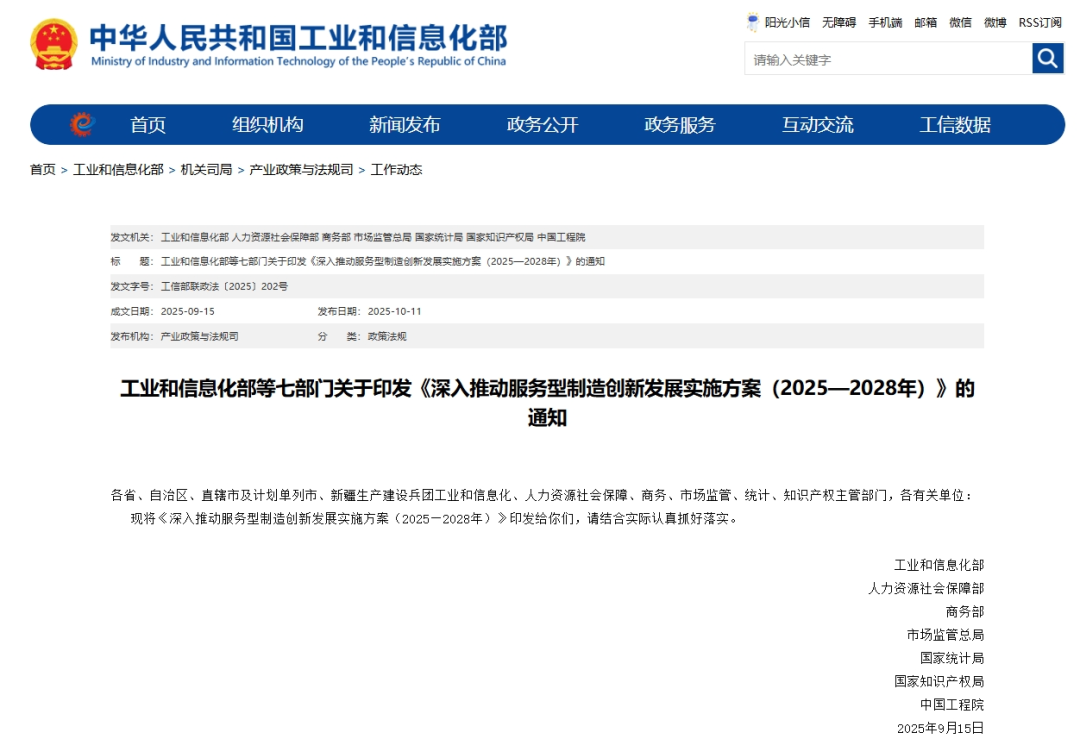
Macro Dynamics - The Ministry of Industry and Information Technology and six other departments issued a notice to enhance the construction of new information infrastructure, emphasizing the integration of computing power with industry applications and the development of high-quality industry data sets [2] Market Data - In September, the retail sales of passenger cars in China reached 2.239 million units, a year-on-year increase of 6%, and a month-on-month increase of 11%. Cumulatively, retail sales for the year reached 17.004 million units, up 9% year-on-year [5] - The wholesale of passenger cars in September was 2.770 million units, a year-on-year increase of 11%, with a cumulative wholesale of 20.812 million units for the year, up 13% year-on-year [5] Company Dynamics - Didi Autonomous Driving announced a D-round financing of 2 billion yuan, with funds aimed at increasing AI research and development and promoting the application of Level 4 autonomous driving [13] - Wahaha Group appointed Xu Simin as General Manager, while the Chairman position remains vacant following the resignation of Zong Fuli [14] - Hongsheng Beverage Group's legal representative, Zhu Lidan, responded to rumors of being taken away for investigation, urging not to believe in rumors [12]


刚刚,全球首个GB300巨兽救场,一年烧光70亿,OpenAI内斗GPU惨烈
3 6 Ke· 2025-10-11 11:27
Core Insights - OpenAI is facing intense internal competition for GPU resources, with a total investment of $7 billion in computing power for 2024, primarily for large model development and inference computing [1][2][12] - Microsoft has launched the world's first GB300 supercomputer, specifically designed for OpenAI, which can significantly reduce the training time for trillion-parameter models from weeks to days [4][6][10] Group 1: Investment and Resource Allocation - OpenAI has spent $5 billion on large model research and $2 billion on inference computing over the past year [1] - The demand for computing power is described as an "endless pit," leading to a critical need for supercomputing expansion and partnerships [2][21] - OpenAI's leadership team has established a clear resource allocation mechanism to manage GPU distribution between research and application teams [15][19] Group 2: Supercomputer Specifications - The GB300 supercomputer features over 4,600 GB300 NVL72 GPUs interconnected via the next-generation InfiniBand network, enabling high data transfer rates and memory capacity [6][8][10] - The system is designed for large-scale AI supercomputing, with a rack-level design that includes 72 GPUs per rack and a total of 37TB of high-speed memory [7][10] - The architecture supports a performance of up to 1,440 PFLOPS using FP4 Tensor Core technology, enhancing the capabilities for AI applications [10] Group 3: Internal Competition and Challenges - OpenAI's internal GPU allocation process is described as a "painful and exhausting" experience, with teams competing fiercely for limited resources [2][12][13] - The allocation of GPUs is critical for productivity, as the number of GPUs directly influences the capabilities of AI applications [19][21] - OpenAI's Chief Product Officer has emphasized the immediate utilization of newly acquired GPUs, highlighting the urgency of resource allocation [21]

OpenAI算力账单曝光:70亿美元支出,大部分钱花在了“看不见的实验”
量子位· 2025-10-11 09:01
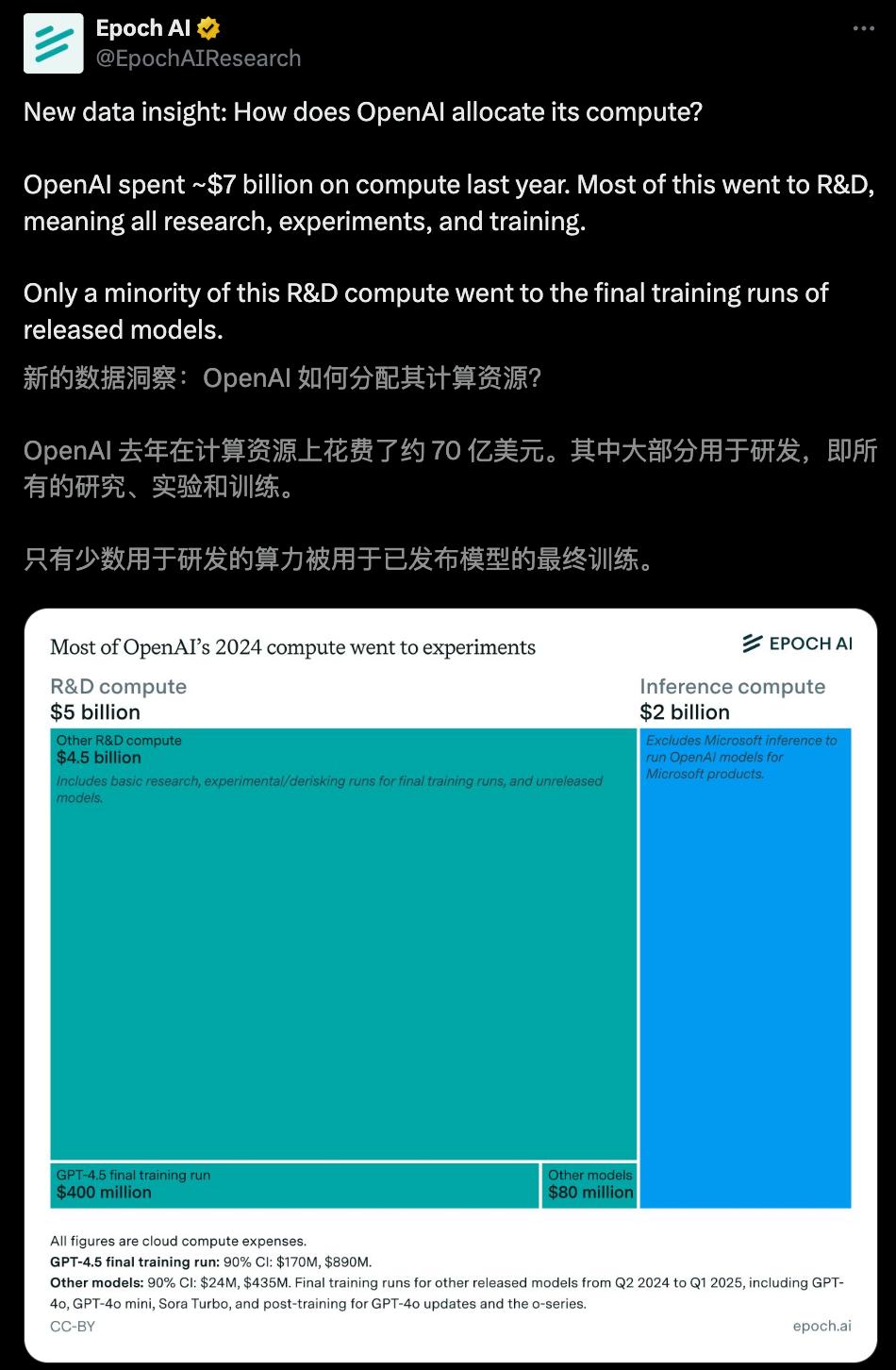
Core Insights - OpenAI's total spending on computing resources reached $7 billion last year, primarily for research and experimental runs rather than final training of popular models [1][3][20] - A significant portion of the $5 billion allocated for R&D compute was not used for the final training of models like GPT-4.5, but rather for behind-the-scenes research and various experimental runs [6][18] Spending Breakdown - Of the $7 billion, approximately $5 billion was dedicated to R&D compute, which includes all training and research activities, while around $2 billion was spent on inference compute for user-facing applications [3][5] - The R&D compute spending includes basic research, experimental runs, and unreleased models, with only a small fraction allocated to the final training of models [5][6] Model Training Costs - Researchers estimated the training costs for significant models expected to be released between Q2 2024 and Q1 2025, focusing solely on the final training runs [11][12] - For GPT-4.5, the estimated training run cost ranged from $135 million to $495 million, depending on cluster size and training duration [15] - Other models like GPT-4o and Sora Turbo were estimated using indirect methods based on floating-point operations (FLOP), with costs varying widely [17] Research Focus - The analysis indicates that a large portion of OpenAI's R&D compute in 2024 will likely be allocated to research and experimental training runs rather than directly producing public-facing products [18] - This focus on experimentation over immediate product output explains the anticipated significant losses for OpenAI in 2024, as the company spent $5 billion on R&D while generating only $3.7 billion in revenue [20][21] Power of Compute - The article emphasizes the critical importance of compute power in the AI industry, stating that whoever controls the compute resources will dominate AI [22][28] - OpenAI has engaged in substantial compute transactions, including building its own data centers to mitigate risks associated with reliance on external cloud services [22][30] - The demand for compute resources in AI development is described as having no upper limit, highlighting the competitive landscape [27][28]

连云区以精准考核引领海洋特色产业高质量发展
Xin Hua Ri Bao· 2025-10-11 06:36
Core Viewpoint - Lianyungang City is focusing on leveraging its unique marine resources to create a competitive advantage in emerging industries such as artificial intelligence, computing power, and new energy vehicles, while avoiding homogeneous competition among regions [1] Group 1: Streamlining Assessment - Lianyungang District is reducing the complexity of performance assessments by consolidating multiple evaluation systems into a single comprehensive framework, resulting in a 28% reduction in assessment indicators for rural areas by 2025 [1] - The district is eliminating irrelevant performance indicators and awards that do not align with local realities, such as "Investment Attraction Award" and "Business Environment Optimization Award" [1] Group 2: Shaping Development Focus - The district has introduced "marine content" as a key metric for evaluating development, including a new indicator for the proportion of marine industry investments in newly signed projects [2] - Specific assessments are tailored to different functional areas to avoid homogeneous competition, with a focus on marine power, modern marine fisheries, and coastal tourism [2] - The marine fisheries sector is projected to achieve an added value of 1.866 billion yuan in 2024, with an annual growth rate of 26.3% [2] Group 3: Motivating Performance - Lianyungang District has established a clear incentive structure that rewards high-performing units and penalizes underperformers, promoting accountability among officials [3] - Since 2025, 23 outstanding officials have been promoted, while 3 underperforming officials have been reassigned, effectively enhancing motivation and performance within the district [3]
Waymo自动驾驶最新探索:世界模型、长尾问题、最重要的东西
自动驾驶之心· 2025-10-10 23:32
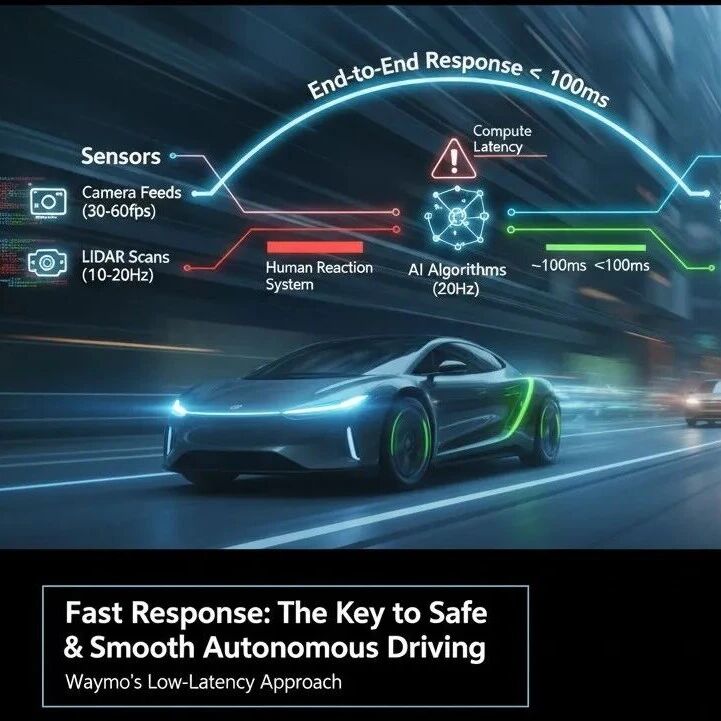
Core Insights - Waymo has developed a large-scale AI model called the Waymo Foundation Model, which supports vehicle perception, behavior prediction, scene simulation, and driving decision-making [5][11] - The model integrates data from multiple sensors to understand the environment, similar to how large language models operate [5][11] - The focus on data quality and selection is crucial for ensuring that the model addresses the right problems effectively [25][30] Group 1: World Model Development - Waymo's world model encodes all sensor data and incorporates world knowledge, enabling it to decode driving-related tasks [11] - The model allows for real-time perception and decision-making on the vehicle while simulating real driving environments in the cloud for testing [7][11] - The long-tail problem in autonomous driving, which includes complex scenarios like adverse weather and construction, remains a significant challenge [11][12] Group 2: Addressing Long-Tail Problems - Weather conditions such as rain and snow present unique challenges for autonomous driving, requiring high precision in judgment [12][14] - Low visibility scenarios necessitate the use of multi-modal sensors to detect objects effectively [15] - Occlusion reasoning is critical for understanding hidden objects and ensuring driving safety [18][21] Group 3: Complex Scene Understanding - Understanding complex scenes like construction zones and dynamic environments requires advanced reasoning capabilities [24] - Real-time responses to dynamic signals, such as traffic officer gestures, are essential for safe navigation [24] - The use of large language models is being explored to enhance scene understanding and decision-making [24] Group 4: Importance of Data, Algorithms, and Computing Power - The three critical components for successful autonomous driving are data, algorithms, and computing power, with a strong emphasis on data quality [25][30] - Efficient data mining from vast video datasets is vital for understanding driving events [30] - Quick decision-making is essential for safety and smooth operation, with a focus on reducing response times across the algorithmic chain [30][31] Group 5: Operational Infrastructure - Waymo's operational facilities, including depots and modification workshops, are crucial for the efficient deployment of Level 4 autonomous vehicles [33] - Vehicles can autonomously navigate to charging stations and begin operations after sensor installation [33] - The engineering challenges of scaling autonomous driving technology require collaboration with traditional automotive engineers [34] Group 6: Sensor and Algorithm Response - The responsiveness of sensors, such as camera frame rates, is critical for effective autonomous driving [36] - Algorithms must process data at high frequencies to ensure timely execution of driving commands [36] - The evolution of vehicle control systems is moving towards higher frequency responses, particularly in electric and electronically controlled systems [36]
为什么 OpenAI 们都要搞 AI 基建?Groq 创始人把背后的逻辑讲透了
Founder Park· 2025-10-10 13:27
Core Insights - OpenAI is actively investing in chip development and collaborating with companies like NVIDIA, AMD, and Oracle to build next-generation AI infrastructure, highlighting the critical role of chips and data centers in AI advancement [2][3] - The growth of AI applications is currently limited by the availability of computing power, indicating that companies with greater access to this resource can serve more users and generate higher revenues [3][23] - A differentiated and efficient supply chain serves as a significant competitive advantage in a market with nearly unlimited demand for AI products [3] Group 1 - The difficulty of chip manufacturing is often underestimated, as it involves complex software ecosystems and continuous engineering optimization [7][15] - Major tech companies are pursuing chip development not just for performance but to gain control over their supply chains and bargaining power [7][30] - The current market for computing power is characterized by scarcity, with many companies still relying on older NVIDIA H100 GPUs, which generate revenue significantly higher than their operational costs [7][47] Group 2 - The investment landscape in AI is robust, with companies like Microsoft deploying large amounts of GPUs for internal use, generating more revenue than renting them out [13][21] - A small number of companies contribute to the majority of AI revenue, indicating a highly concentrated market where supply and demand dynamics play a crucial role [14][36] - The challenges of entering the chip market are significant, with many projects failing despite initial investments, underscoring the complexity of chip design and production [15][28] Group 3 - The return on investment for data centers is longer than for chips, with significant capital expenditures required for infrastructure development [37][39] - Companies are increasingly focused on shortening payback periods and minimizing operational costs to remain competitive in a rapidly evolving market [46][50] - The supply of computing power is a decisive factor in determining market winners, with companies that can secure more capacity gaining a competitive edge [51][52] Group 4 - The AI industry is experiencing a shift where the demand for computing power is expected to grow exponentially, leading to potential shortages [92][94] - The relationship between AI advancements and computing power is unique, as improvements in one area can lead to enhancements in the other, creating a feedback loop [96][97] - The future of AI may lead to significant changes in labor markets, with potential job shortages arising from increased automation and efficiency [97][99]