
光伏产业

Search documents
供应略显宽松,工业硅偏弱震荡
Tong Guan Jin Yuan Qi Huo· 2025-10-13 02:44
Report Summary 1. Report Industry Investment Rating No investment rating information is provided in the report. 2. Core Views of the Report - Macroeconomically, there is a risk of tariff escalation between China and the US, and global market risk - aversion drags down the sentiment of the domestic industrial products market. However, China's economic long - term trend of steady improvement remains unchanged, with the 9 - month manufacturing PMI approaching the boom - bust line, a significant rebound in industrial enterprise profit growth, and continuous support from expansionary fiscal and moderately loose monetary policies. The photovoltaic supply - side reform will be further deepened [3][49]. - On the supply side, the operating rate in Xinjiang has steadily risen to 70%, the output in Sichuan and Yunnan during the wet season is higher than the same period in previous years, and the new capacity investment in Gansu and Inner Mongolia has slowed down. The supply side shows a steady recovery, and social inventory fluctuates at a high level [3][49]. - On the demand side, polysilicon production is increasing, and the production plan for October is still rising month - on - month. Silicon wafer manufacturers' production plans are waiting for the implementation of the component export tax - rebate policy. Battery prices are rising, but new orders are shrinking. Component price increases are stagnant due to the slowdown in photovoltaic installations. Some leading enterprises have pre - arranged for the recycling of retired crystalline silicon components. In traditional industries, the operating rate of silicone has declined due to the incomplete recovery of terminal demand, and the aluminum alloy output has slightly increased due to the rebound in processing fees. Overall, the supply - demand structure of industrial silicon will reach a new balance in October, and the futures price is expected to remain stable and fluctuate [3][49]. 3. Summary by Relevant Catalogs 2025 September Industrial Silicon Market Review - **Industrial silicon futures price fluctuated within a range**: In September 2025, the main 2511 contract of industrial silicon futures fluctuated between 8215 - 9325 yuan/ton, with the price center remaining flat compared to the previous month. The improvement in industrial enterprise profit growth, the implementation of anti - involution policies, and the improvement in the production profit of photovoltaic upstream and mid - stream enterprises supported the price, but the decline in polysilicon prices dragged down market sentiment. By the end of September, the national furnace - opening number increased to 311, with a month - on - month increase of 23. From the demand side, polysilicon enterprises' production cuts were less than expected, silicon wafer price support was limited, photovoltaic battery supply - demand was in a tight balance, and component price increases were stagnant. As of September 30, the main 2511 contract closed at 8640 yuan/ton, with a monthly increase of 2.98% [8]. - **The spot market fluctuated**: In September, the average production cost of industrial silicon was 9095.49 yuan/ton, remaining flat month - on - month. The social inventory was high, and the traditional industries' demand was weak. The anti - involution policy was expected to suppress the medium - term demand for industrial silicon. By the end of September, the prices of mainstream grades such as 553, 441, 421, and 3303 showed different degrees of increase. It is expected that in October, the prices of domestic mainstream grades will mainly fluctuate upwards [9][10][12]. Macroeconomic Analysis - In September, the central bank emphasized moderately loose monetary policy, strengthened counter - cyclical adjustment, and created a suitable monetary and financial environment for economic recovery. The RMB exchange rate was basically stable, and the financial market operated smoothly. China's September official manufacturing PMI rose to 49.8, and the industrial enterprise profit in August increased by 20.4% year - on - year. The equipment manufacturing industry played a significant role in driving profit growth, and some traditional industries turned losses into profits. China's economic long - term trend of steady improvement remained unchanged [14][16]. Fundamental Analysis - **Northern production slowly recovered, and the capacity in Sichuan and Yunnan was strongly released during the wet season**: In September, the operating rate of silicon enterprises in Xinjiang rose to about 70%, and the capacity in the southwest was strongly released due to the decline in electricity prices during the wet season. The new production increments in Inner Mongolia and Gansu were limited. The national industrial silicon output in September was 42.1 tons, with a year - on - year decrease of 7.3%. As of September 26, the national furnace - opening rate rose to 39.1%. Overall, the supply side was relatively loose [18][19][20]. - **Exports maintained stable growth in August**: From January to August, the cumulative export volume of industrial silicon was 49.1 tons, with a year - on - year increase of 18%. The export volume in August was 7.66 tons, with a year - on - year increase of 18%. The export destinations were mainly in Southeast Asia. It is expected that the export volume in October will recover to about 8 tons [24]. - **The social inventory fluctuated at a high level in September**: As of September 30, the national industrial silicon social inventory rose to 54.5 tons, with a month - on - month increase of 0.4 tons. The warehouse receipt inventory at the Guangzhou Futures Exchange continued to rise. It is expected that the social inventory will slightly increase in October [29]. - **Polysilicon production cuts were less than expected, and silicon enterprises' production profit turned losses into profits**: In September, the polysilicon output was 12.5 tons, with a month - on - month increase of 16.7%. The cumulative output from January to September was 81.13 tons, with a year - on - year decrease of 33.2%. The ex - factory price of polysilicon dense material was 51 yuan/kg. In October, the production is expected to increase by 0.3 tons month - on - month. For silicon wafers, the production plan is waiting for the component export tax - rebate policy. For batteries, the price increased, but new orders decreased. For components, the price increase was limited. The recycling of retired photovoltaic components has broad prospects [32]. - **The operating rate of silicone declined, and the DMC spot price slightly increased**: In September, the output of silicone DMC was 20.88 tons, with a month - on - month decrease of 4.9%. The average operating rate of silicone monomer enterprises dropped to 72.84%. The DMC spot price rose to 11050 yuan/ton, with a monthly increase of 13.3%. It is expected that the DMC price will slightly increase in October [35]. - **The aluminum alloy output slightly increased, and the aluminum rod processing fee stabilized and rebounded**: From January to August, the aluminum alloy output was 1232.4 tons, with a year - on - year increase of 15.3%. The output in August was 163.5 tons, with a year - on - year increase of 15.2%. The average processing fee of 6063 aluminum rods in August was 206 yuan/ton. It is expected that the aluminum alloy output will slightly decline in October [36]. Market Outlook - Macroeconomically, China's economic long - term trend of steady improvement remains unchanged. On the supply side, the supply is steadily recovering, and social inventory fluctuates at a high level. On the demand side, the demand structure is being adjusted, and the overall supply - demand will reach a new balance. It is expected that the industrial silicon futures price will remain stable and fluctuate in October, and attention should be paid to the implementation of anti - involution policies [49][51].
德力股份实控人筹划控制权变更
Zhong Guo Ji Jin Bao· 2025-10-09 05:42
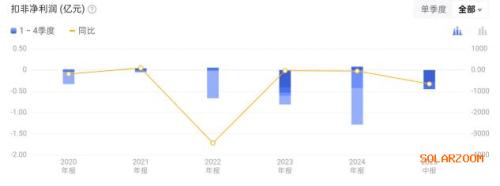
Core Viewpoint - Delixi Co., Ltd. is undergoing a potential change in control, as notified by its controlling shareholder, Shi Weidong, with the specifics of the transaction still under negotiation and subject to formal agreements [1] Group 1: Company Overview - Delixi Co., Ltd. was founded in 1996 and went public in 2011, specializing in the research and manufacturing of various glass products, becoming a leading glassware manufacturer in China and ranking third globally in production capacity [1] - The company ventured into the photovoltaic glass market in November 2020 by establishing a wholly-owned subsidiary, Delixi Solar Energy, and signed a five-year procurement agreement with Longi Green Energy for at least 250 million square meters of photovoltaic glass from 2022 to 2026, with a total contract value of approximately 5.531 billion RMB (excluding tax) [2] Group 2: Financial Performance - Following its entry into the photovoltaic sector, Delixi Co., Ltd. has experienced continuous losses, with a net profit loss of over 31 million RMB in 2020, escalating to a loss of 120 million RMB in 2024, and an additional loss of over 45 million RMB in the first half of 2025 [2] - The company's asset-liability ratio surged from 24% in 2019 to 68% in 2024, indicating increasing financial strain, with cash on hand insufficient to cover short-term interest-bearing debts [2] Group 3: Recent Developments - In 2025, Delixi Co., Ltd. has been selling assets to recover funds, including the sale of its wholly-owned subsidiary, Delixi Mining, for a total price of 135 million RMB, with the transaction amount already received as of September 23 [4] - As of September 30, 2025, the market capitalization of Delixi Co., Ltd. was 3.261 billion RMB [5]


002571拟易主,周四停牌
Shang Hai Zheng Quan Bao· 2025-10-08 12:22
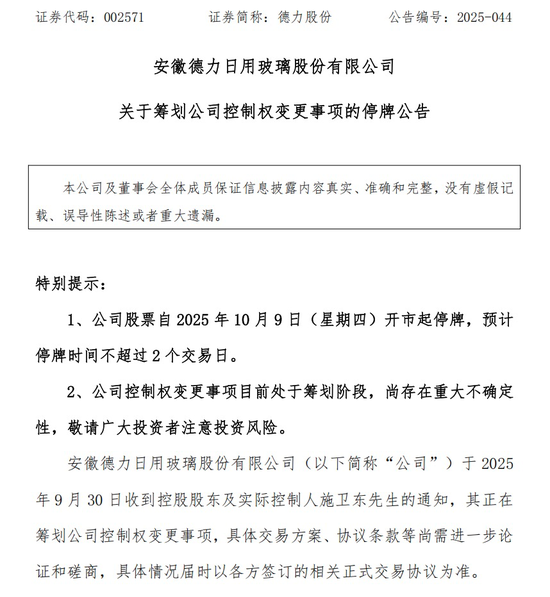
Core Viewpoint - Delixi Co., Ltd. is undergoing a potential change in control, as announced by its major shareholder and actual controller, Shi Weidong, on October 8. The specific transaction plan and agreement terms are still under further verification and negotiation [1]. Company Overview - Delixi Co., Ltd. was founded in 1996 by Shi Weidong and is headquartered in Fengyang, Anhui. The company specializes in the research and manufacturing of various glass products, including household glass, solar glass, packaging glass, optical glass, heat-resistant appliance glass, and crystal glass. It is recognized as the leading manufacturer of glassware in China and the largest household glass factory in the Asia-Pacific region [4]. Financial Performance - The company has faced continuous losses, with net profits attributable to the parent company reported as follows: a loss of 110 million yuan in 2022, 85.5094 million yuan in 2023, and 173 million yuan in 2024. In the first half of 2025, the net profit attributable to the parent company was a loss of 45.3166 million yuan, representing a year-on-year decline of 490.74% [4]. Business Challenges - Delixi Co., Ltd. established a wholly-owned subsidiary, Delixi Solar, in 2020 to enter the promising photovoltaic glass materials sector. In 2021, it signed a five-year procurement agreement for photovoltaic glass with Longi Green Energy. However, the company reported that both photovoltaic glass and daily-use glass faced pressures from insufficient capacity digestion and weak market demand due to global political and economic conditions [5]. - The company experienced significant losses due to fluctuating prices of key raw materials such as sodium antimonate and soda ash, as well as international shipping costs. The decline in photovoltaic glass prices further exacerbated the financial difficulties [5]. - In the 2025 semi-annual report, Delixi Co., Ltd. noted that its subsidiary, Bengbu Solar, achieved production quality comparable to industry leaders. However, the overall downward trend in the photovoltaic industry led to supply-demand imbalances and price declines, impacting profitability. To mitigate cash flow losses, the subsidiary temporarily halted production, affecting the company's overall profitability [6]. - The domestic trade of daily-use glass remained stable, but external trade faced challenges due to fluctuations in shipping costs. The entire industry continues to experience low profitability, with high inventory pressures not yet alleviated, compounded by the effects of international political and economic conditions [6].
碳纤维行业底部复苏,景气回升正当时
DT新材料· 2025-10-08 10:00
Core Viewpoint - The carbon fiber industry is experiencing a recovery phase, marked by significant revenue growth among leading companies and increased investment in production capacity and technology upgrades [4][8]. Industry Performance - The carbon fiber sector has shown a strong performance in 2025, with notable increases in stock prices and revenue for key players. For instance, Zhongjian Technology reported a revenue of 464 million yuan, up 59.46% year-on-year, while Jilin Chemical Fiber's carbon fiber revenue surged by 368.31% to 443 million yuan [4]. - The overall industry is witnessing a recovery in operational rates, with the current operating rate at 61.52%, an increase of 10.02 percentage points since the beginning of the year [5]. Market Dynamics - The demand for carbon fiber is expanding into new applications, particularly in low-altitude economy, automotive, and consumer electronics sectors. Companies like Xiaomi and eVTOL are exploring carbon fiber applications in their products [5]. - The average price of mainstream carbon fiber models in East China has remained stable, with T300-12K priced at 85 yuan/kg as of August [5]. Application Growth - In aerospace, carbon fiber is increasingly utilized, with Boeing 787 using 50% carbon fiber composite materials and the C919 aircraft using approximately 12% [6]. - The automotive sector is projected to see a demand of about 10,000 tons of carbon fiber in 2024, increasing to 14,400 tons by 2025, driven by the rise of new energy vehicles [6]. Wind Power Sector - The wind power industry is also contributing to carbon fiber demand, with an expected global requirement of 44,000 tons in 2024, increasing to 80,000 tons by 2025. China is anticipated to consume about half of this demand [7]. Future Outlook - The carbon fiber industry is transitioning from a recovery phase to a period of steady growth, supported by stable prices, increased operational rates, and a shift in applications towards emerging markets [8].



正泰电器股价涨5.07%,博时基金旗下1只基金重仓,持有9.92万股浮盈赚取14.78万元
Xin Lang Cai Jing· 2025-09-30 05:39
Core Viewpoint - Zhengtai Electric has experienced a significant stock price increase, with a 5.07% rise on September 30, reaching 30.90 CNY per share, and a total market capitalization of 66.403 billion CNY, indicating strong investor interest and performance in the market [1] Company Overview - Zhejiang Zhengtai Electric Co., Ltd. was established on August 5, 1997, and listed on January 21, 2010. The company specializes in low-voltage electrical appliances, electronic instruments, and automation control systems, among other products [1] - The main business revenue composition includes: - Photovoltaic power station engineering contracting: 32.76% - Power station operation: 18.79% - Terminal electrical appliances: 13.01% - Distribution electrical appliances: 11.23% - Control electrical appliances: 6.85% - Instruments and meters: 3.60% - Inverters and energy storage: 3.10% - Building electrical appliances: 3.01% - Metal products: 2.18% - Other: 2.18% - Power electrical appliances: 1.07% - Electronic electrical appliances: 0.43% - Control systems: 0.38% [1] Fund Holdings - According to data, Bosera Fund holds a significant position in Zhengtai Electric, with the Bosera CSI Photovoltaic Industry Index A Fund (015993) increasing its holdings by 12,100 shares in the second quarter, totaling 99,200 shares, which represents 2.7% of the fund's net value [2] - The fund has generated a floating profit of approximately 147,800 CNY today and 197,400 CNY during the five-day rising period [2] Fund Manager Performance - The fund manager of Bosera CSI Photovoltaic Industry Index A is Wang Xiang, who has been in the position for 8 years and 335 days. The fund's total asset size is 56.034 billion CNY, with the best return during his tenure being 191.06% and the worst being -47.82% [3]

光伏ETF(159857)盘中涨超1.7%,创业板ETF天弘(159977) 获实时净申购6200万份,机构:上游光伏加工设备需求或逐渐企稳复苏
2 1 Shi Ji Jing Ji Bao Dao· 2025-09-30 03:45
Group 1 - The photovoltaic ETF (159857) has reached a new annual high, with a 1.75% increase and a trading volume exceeding 89 million yuan, leading in the Shenzhen market [1] - Key component stocks such as GoodWe, Sungrow, JinkoSolar, KSTAR, Canadian Solar, and Jinlang Technology have shown significant gains, with GoodWe rising over 9% [1] - The photovoltaic ETF closely tracks the CSI Photovoltaic Industry Index, which includes representative companies from the photovoltaic industry chain [2] Group 2 - The Wind financial terminal reported a net inflow of over 11 million yuan into the photovoltaic ETF (159857) yesterday [2] - The ChiNext ETF Tianhong (159977) has also seen positive performance, with a trading volume exceeding 110 million yuan and a net inflow of over 150 million yuan in the last 10 trading days [2] - The management fee for the ChiNext ETF Tianhong is 0.15%, and the custody fee is 0.05%, making it one of the lowest in the market [2] Group 3 - Xiangcai Securities indicates that China's new photovoltaic installed capacity is expected to maintain rapid growth this year, supported by stable product prices and corporate profitability [3] - The demand for upstream photovoltaic processing equipment is anticipated to gradually stabilize and recover, driven by ongoing market demand and the application of new technologies such as perovskite [3]

专家分享:纯碱行业现状与展望
2025-09-28 14:57
Summary of the Soda Ash Industry Conference Call Industry Overview - The soda ash industry experienced a total production increase of 1.8% year-on-year to 28.19 million tons in the first three quarters of 2025, but the capacity utilization rate decreased by 100 basis points to nearly 25% [1][2] - Heavy soda ash production decreased by 10.6% year-on-year, while light soda ash production increased by 6%, indicating structural changes in the market [1][2] Key Insights and Arguments - The real estate market downturn significantly impacted flat glass demand, leading to an 18% decrease in photovoltaic glass production in 2025, although light soda ash demand grew by 10% [1][4] - Exports of soda ash surged, with a year-on-year increase of over 100% from January to July, while imports nearly stagnated, resulting in an estimated total import-export volume of about 2 million tons for the year [1][5] - The production methods of ammonia soda and joint soda are facing losses, while natural soda still has profit margins [1][6] - The photovoltaic industry is expected to generate over 700,000 tons of additional soda ash demand annually, with policies likely to prevent raw material price increases [1][7] Supply and Demand Dynamics - The soda ash market is currently under significant supply pressure, despite a reduction in heavy soda ash production and an increase in light soda ash production [3] - The overall demand for flat glass has seen a notable decline, with a 6.6% drop in demand in the first nine months of the year [3][8] - The cumulative glass production in 2025 is expected to decrease by 8%, but monthly production has exceeded the previous year's levels since September, leading to inventory accumulation [8][10] Future Projections - By the end of 2026, new soda ash capacity is projected to reach 6.3 million tons, bringing total capacity to over 47 million tons, indicating significant supply pressure ahead [1][9] - The top five companies in the industry hold a market concentration of 42%, suggesting increased competition [9] Profitability and Cost Structure - Current losses for ammonia soda production are approximately 300 RMB/ton, while joint soda production faces a loss of 100 RMB/ton [6][13] - Natural soda production remains profitable, with a selling price of approximately 900-1,000 RMB/ton against a cost of 700 RMB/ton, yielding a profit of over 200 RMB/ton [6][13] - The production costs for ammonia soda and joint soda differ, with ammonia soda being more cost-effective due to lower raw material prices [13] Inventory and Market Balance - The soda ash market is currently in a state of oversupply, with an excess of 1.39 million tons in 2025, despite an increase in exports to 1.9 million tons [18][28] - The forecast for 2026 indicates a potential supply-demand gap of 4.5 million tons, necessitating production cuts to achieve market balance [19][28] Conclusion - The outlook for the soda ash and glass markets is not optimistic, with a need for supply clearing to restore market balance [20] - The industry faces challenges from high inventory levels and the need for production adjustments to cope with declining demand, particularly from the real estate sector [25][28]
四川甘孜州3.75GW光伏优选:蜀道集团、京东方、甘孜能源发展、宁德时代、华电、大唐、华能、中广核等入围
Xin Lang Cai Jing· 2025-09-24 12:11
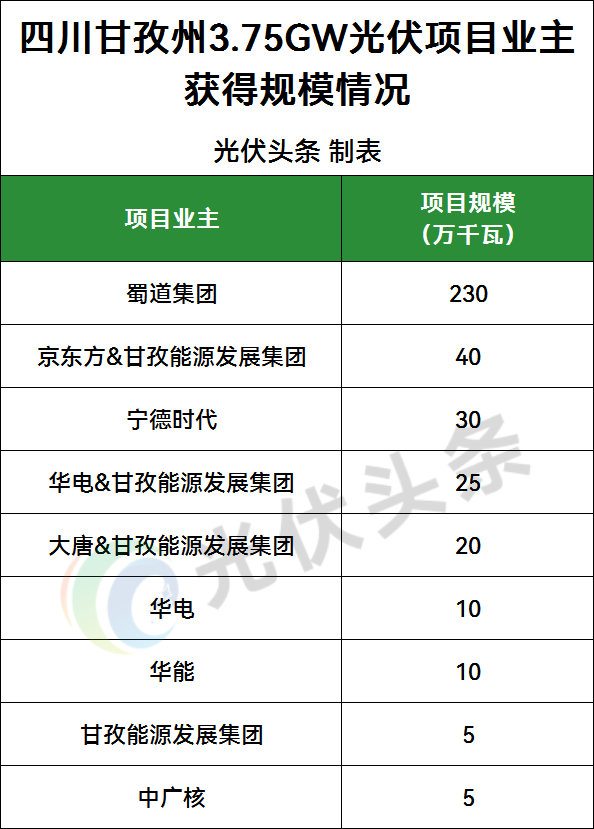
Core Insights - Sichuan Ganzi Prefecture has announced the results of the preferred bidders for 3.75GW of photovoltaic projects, with the largest project awarded to Shudao Group at 2.3GW [1][2] - The projects are part of a broader strategy to enhance local development through innovative construction models, including "light grazing" and "light tourism" [1] Group 1: Project Overview - The total capacity of the announced photovoltaic projects is 3.75GW, with two batches of results published [1] - The first batch includes six projects with a total capacity of 950MW, while the second batch consists of five projects totaling 2.8GW [1][2] - The projects are scheduled to commence construction by the end of 2025 and be completed before 2027 [1] Group 2: Key Bidders and Project Sizes - Shudao Group is the leading bidder with a project size of 2.3GW [1] - Other notable bidders include: - BOE Technology Group & Ganzi Energy Development Group with 400MW [1] - CATL with 300MW [1] - Huadian & Ganzi Energy Development Group with 250MW [1] - Datang & Ganzi Energy Development Group with 200MW [1] - Additional smaller projects include various capacities awarded to other companies such as State Grid and China General Nuclear Power Group [2] Group 3: Project Construction Models - The projects will adopt a "1+N" construction model, emphasizing local adaptation and integration with the environment [1] - The focus is on promoting local economic development through innovative project designs that combine solar energy with agriculture and tourism [1]






涨幅继续扩大,光伏ETF基金(516180)涨超3.7%
Xin Lang Cai Jing· 2025-09-24 06:58
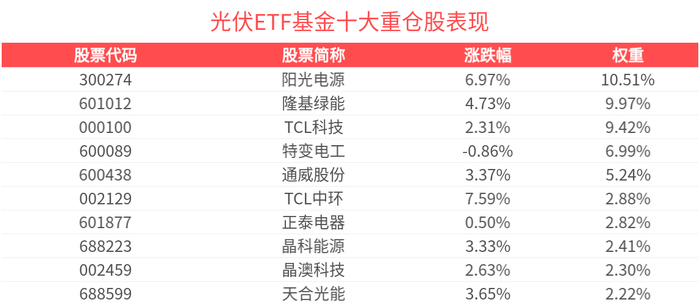
Group 1 - The Zhongzheng Photovoltaic Industry Index (931151) has seen a strong increase of 3.31% as of September 24, 2025, with constituent stocks such as Micro导纳米 (688147) rising by 17.95%, 聚和材料 (688503) by 10.84%, and 奥特维 (688516) by 8.48% [1] - The Photovoltaic ETF Fund (516180) also rose by 3.31%, with the latest price reported at 0.75 yuan, and has accumulated a 9.17% increase over the past month as of September 23, 2025 [1] - The industry is experiencing a steady advancement in anti-involution, with strong policy determination expected in the photovoltaic sector, leading to a strong willingness among companies to change under pressure of profitability and cash flow [1] Group 2 - The top ten weighted stocks in the Zhongzheng Photovoltaic Industry Index (931151) as of August 29, 2025, include 阳光电源 (300274), 隆基绿能 (601012), and TCL科技 (000100), collectively accounting for 56.14% of the index [2]
晶澳科技股价连续4天下跌累计跌幅11.37%,招商基金旗下1只基金持128.79万股,浮亏损失200.91万元
Xin Lang Cai Jing· 2025-09-23 07:18
Core Viewpoint - JinkoSolar Technology Co., Ltd. has experienced a decline in stock price, with a cumulative drop of 11.37% over the past four days, closing at 12.16 CNY per share on September 23, 2023, with a total market capitalization of 40.246 billion CNY [1] Company Overview - JinkoSolar was established on October 20, 2000, and went public on August 10, 2010. The company is primarily engaged in the research, production, and sales of silicon wafers, solar cells, and solar modules, as well as the development, construction, and operation of solar photovoltaic power plants [1] - The revenue composition of JinkoSolar is as follows: photovoltaic modules account for 91.10%, other businesses 5.85%, and photovoltaic power plant operations 3.05% [1] Fund Holdings - According to data, one fund under China Merchants Fund has a significant holding in JinkoSolar. The China Merchants CSI Photovoltaic Industry Index A Fund (011966) increased its holdings by 111,700 shares in the second quarter, bringing the total to 1.2879 million shares, which represents 2.2% of the fund's net value [2] - The fund has incurred a floating loss of approximately 296,200 CNY today, with a total floating loss of 2.0091 million CNY during the four-day decline [2] Fund Manager Performance - The fund manager Wang Ping has a tenure of 15 years and 98 days, with the fund's total asset size at 16.687 billion CNY. The best return during his tenure is 272.34%, while the worst return is -70.61% [3] - Co-manager Xu Rongman has a tenure of 4 years and 184 days, with the fund's total asset size at 27.361 billion CNY. The best return during his tenure is 62.99%, while the worst return is -59.08% [3]
