
电动汽车

Search documents
德铁买中国巴士,德财长“恼火”
Huan Qiu Shi Bao· 2025-12-23 03:56
Group 1 - The core issue revolves around the German railway company, Deutsche Bahn, ordering over 3,300 buses, including approximately 200 electric intercity buses from the Chinese company BYD, which has sparked controversy in Germany [1][2] - German Vice Chancellor and Finance Minister, Christian Lindner, expressed frustration over Deutsche Bahn's decision, advocating for a preference for German and European brands in public procurement [1] - The order from Deutsche Bahn is valued at over 1 billion euros, with delivery scheduled between 2027 and 2032, primarily consisting of hybrid and electric models, with most buses supplied by MAN and a small portion by BYD [1] Group 2 - The announcement of this large order coincides with the EU's relaxation of the "fuel vehicle ban," raising concerns about the competitive position of German automotive manufacturers against Chinese electric vehicle advancements [2] - Lindner acknowledged the significant progress made by China in electric vehicle technology, attributing it to strong government support, and highlighted the challenges faced by German manufacturers in catching up [2] - Experts suggest that the EU's delay in enforcing the "fuel vehicle ban" may provide Chinese companies with more time to enhance their competitive edge in the automotive market [2]

历史罕见,601088,千亿级重大收购!一路狂飙,比黄金还牛,白银再创新高
Zheng Quan Shi Bao· 2025-12-20 10:41
Group 1: Company Acquisition - China Shenhua Energy announced a significant acquisition plan to purchase assets from the State Energy Group for a total price of 133.598 billion yuan [2] - The acquisition includes equity stakes in 12 core enterprises covering coal, coal power, and coal chemical industries, among others [2] - Following the acquisition, China Shenhua's controlling shareholder will remain the State Energy Group, holding 71.48% of the shares [3] Group 2: Market Position and Financial Performance - As of December 19, China Shenhua's market capitalization is nearly 800 billion yuan, making it the leading company in the coal industry [3] - In the first three quarters of the year, the company achieved a net profit of 39.1 billion yuan, ranking first in the industry [3] - The acquisition could position China Shenhua to become the first coal stock in China with a market value exceeding 1 trillion yuan [3] Group 3: Silver Market Dynamics - International silver prices have surged, reaching over 67 USD per ounce, with a year-to-date increase of 132.11%, significantly outpacing gold [4] - The rise in silver prices is attributed to supply-demand imbalances, continuous interest rate cuts by the Federal Reserve, and a surge in global investments [4] - Industrial silver demand has increased by approximately 18% over the past four years, driven by investments in electric vehicles and AI data centers [4][6] Group 4: Silver-Related Stocks Performance - Silver-related stocks have seen an average increase of 79.41% this year, outperforming the Shanghai Composite Index [7] - Notable performers include Xinyi Silver, which has risen by 218.84%, and Shengda Resources, which has increased by 154.18% [8] - Jiangxi Copper has also performed well, with a year-to-date increase of 111.01% and a net profit of 6.023 billion yuan in the first three quarters [8]
国际黄金期货价格19日上涨0.1%
Xin Hua She· 2025-12-20 03:44
Group 1 - International precious metals futures generally rose, with COMEX gold futures up 0.1% to $4368.7 per ounce, marking a weekly increase of 0.93% [1] - Silver prices showed particularly strong performance, nearing historical highs, driven by rising industrial demand and tightening supply [2] - The Bank of Japan raised its benchmark interest rate by 0.25 percentage points to 0.75%, the highest level in 30 years, but the yen weakened due to market disappointment with the central bank's messaging [1] Group 2 - The December consumer confidence index in the U.S. rose to 52.9, up from 51.0 in November, but still significantly lower than the previous year's 74.0, indicating ongoing economic concerns that may support gold prices [1] - COMEX silver futures surged 3.34% to $67.38 per ounce, setting a new historical high with a weekly increase of 8.69% [3] - Analysts predict that silver demand will continue to grow strongly due to renewable energy, electric vehicles, and AI centers, with prices potentially reaching $75 to $100 per ounce by 2026 [2]
【环球财经】纽约金价19日涨0.1%
Xin Hua Cai Jing· 2025-12-20 02:27
尽管12月份消费者信心有所改善,但由于高物价和关税的影响,该指数仍比2024年12月低近30%,利好 金价。 新华财经纽约12月19日电(记者徐静)国际贵金属期货普遍收涨,COMEX黄金期货涨0.1%报4368.7美 元/盎司,周涨0.93%。 黄金、白银价格当日上涨。白银价格表现尤其强劲,距本周历史高点已不远。随着圣诞节假期临近,本 周交易活动趋于平静。 日本央行19日将基准利率上调0.25个百分点至0.75%,为30年来最高水平,并暗示未来可能进一步加 息。然而,由于市场对央行传递的信息不够强硬感到失望,日元当日走软。 俄罗斯总统普京19日在其年终新闻发布会上称,俄罗斯军队已经"完全掌握了战略主动权",并将在年底 前取得更多进展。普京同时表示,莫斯科已准备好和平解决冲突的"根源"。 当天发布的经济数据也支持金价。美国密歇根大学19日发布的调查数据显示,美国12月消费者信心指数 终值上升至 52.9,高于11月的51.0,但低于去年12月的74.0。该数据低于53.5的市场预期。 在工业需求飙升和供应趋紧推动下,纽约商品交易所(Comex)白银期货价格再创新高,达到每盎司 67.38美元,预计到2025年底 ...
联合国贸发会议:2033年人工智能将成最具主导性前沿技术
Yang Shi Xin Wen· 2025-12-19 15:36
Core Insights - The UN Conference on Trade and Development (UNCTAD) reports that the global artificial intelligence (AI) market is expected to reach $4.8 trillion by 2033, significantly increasing its share among frontier technologies and becoming a dominant key technology area [1] - In contrast, the market share changes for technologies such as the Internet of Things, blockchain, electric vehicles, and solar photovoltaics are relatively limited [1] - The report warns that the rapid development of AI is primarily concentrated in a few major economies and large enterprises, which may exacerbate development imbalances between nations and companies [1] - It calls for strategic investments and more inclusive global governance mechanisms to ensure that the benefits of AI development are shared more broadly [1]
Forget Stocks – For 2026 I'm Investing in These Two Metals
Yahoo Finance· 2025-12-19 15:20
Core Viewpoint - Stocks are popular among ordinary investors, but commodities like copper and silver are seen as better investment opportunities for the new year, with both metals experiencing significant price increases in 2025 and potential for further growth in 2026 due to supply and demand dynamics [1][2]. Group 1: Investment Opportunities - Copper can be invested in through the Global X Copper Miners ETF (NYSEMKT: COPX), which is up 80% this year [1]. - Silver can be invested in via the iShares Silver Trust (NYSEMKT: SLV), which has more than doubled this year, up 119% [2]. - Both metals reached new all-time highs in 2025, with expectations for continued price increases in 2026 [2]. Group 2: Demand Factors - Industrial demand is a significant driver for both copper and silver, as they are essential for AI infrastructure, electric vehicles, and renewable energy applications [3]. - The construction of data centers requires substantial amounts of copper and silver, contributing to increased demand [4]. Group 3: Supply Factors - There is a supply shortage of both copper and silver this year, which is bullish for their prices [5]. - The U.S. Department of the Interior has added silver and copper to its list of critical minerals in response to the growing demand for these metals in AI data center construction [5]. Group 4: ETF Details - The Global X Copper Miners ETF has net assets of approximately $3.5 billion and holds 41 stocks, with its largest positions including Lundin Mining (5.6%), KGHM Polska Miedz (5.1%), Boliden AB (5%), Southern Copper (4.7%), and Freeport-McMoRan (4.7%) [8].
博盈特焊:燃煤发电行业存在升级改造需求
Zheng Quan Ri Bao Wang· 2025-12-18 13:16
Core Viewpoint - The company emphasizes that coal-fired power generation remains a crucial source of electricity in China, serving as a pillar industry in the power sector [1] Industry Summary - Recent trends indicate a rapid increase in electricity consumption in China due to global warming, rising summer temperatures, the growth of artificial intelligence data centers, and the demand for electric vehicle charging [1] - Coal power is recognized for its stability, peak regulation capabilities, and reliability, making it a fundamental support for the stable operation of China's power system [1] - There is a growing demand for upgrades and renovations in the coal-fired power generation industry, particularly for low-nitrogen combustion modifications, which necessitate improvements in boiler corrosion and wear resistance [1] - This upgrade demand is expected to drive the development of the industrial corrosion and wear resistance sector [1]
马斯克点评福特收缩电动汽车战略:没救了,他们坚持“去死”
Sou Hu Cai Jing· 2025-12-18 09:31
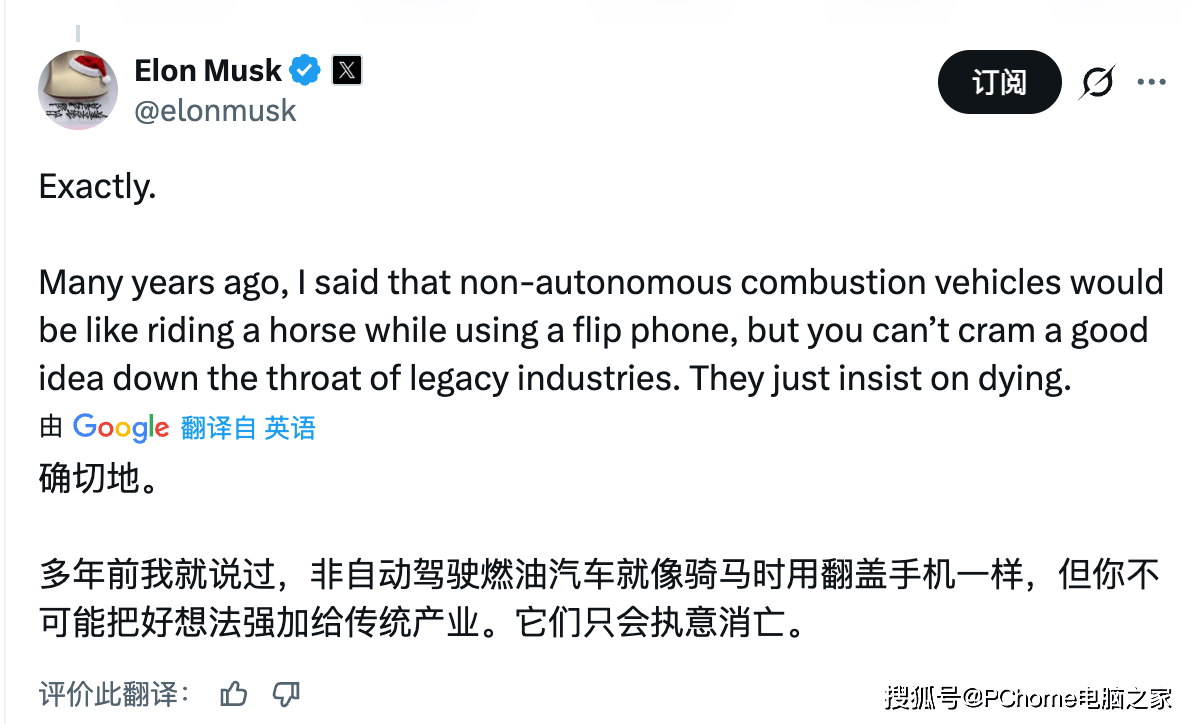
近日,特斯拉CEO埃隆·马斯克社交媒体平台就"福特收缩电动汽车战略"的相关消息公开发声,言辞一如既往地尖锐。 事情的导火索,源于一位网友对福特电动化逻辑的评论。该网友指出,福特等传统车企仍将"减少碳排放"视作发展电动汽车的核心动因,本身就暴露出其对 产业变革理解的滞后。在其看来,减排只是电动汽车的"副作用",真正的本质在于——电动汽车是更优的自动驾驶与智能化平台。继续围绕内燃机体系修修 补补,就像在电灯普及之后还执意投资捕鲸船,方向性错误难以挽回。 马斯克对此表示"完全正确",并进一步抛出了极具冲击力的类比:非自动驾驶的内燃机汽车,就像"骑着马、用着翻盖手机","你不可能把一个好主意硬塞 给传统行业,他们只是坚持去死。" 据悉,2025年12月,福特宣布重大收缩电动汽车战略,计提约195亿美元资产减记,聚焦盈利与性价比。核心举措包括停产纯电皮卡F-150 Lightning,下一 代转为增程版并移至密歇根组装;取消下一代电动厢式货车等大型纯电项目,暂停激进纯电扩张。同时,将资源转向混动、增程与低成本纯电,计划2027年 推出约3万美元中型电动皮卡,盘活电池产能发展储能业务,以应对成本高、盈利难与市场需求不及预 ...


中国汽车迅速走红,“英国人已经意识到,这并非低端品牌”
Guan Cha Zhe Wang· 2025-12-18 03:02
Core Insights - Chinese automotive brands, including BYD and Chery, are gaining significant traction in the UK market, with a notable increase in consumer acceptance and sales [1][3][4] Market Trends - In the past month, Chinese manufacturers accounted for 13% of new car registrations in the UK, doubling their market share from the previous year [3] - The growth rate of Chinese brands in the UK is unprecedented, with their market share increasing five to six times faster than that of Tesla and Kia during their respective market entries [3] Competitive Landscape - The UK automotive market is characterized by a lack of absolute brand loyalty, with over 70 brands registered since 2019, and annual sales of approximately 2 million new cars [4][5] - BYD's market share in the UK is slightly over 2%, comparable to Tesla, while MG, another Chinese brand, holds over 4% [4] Consumer Perception - Initial skepticism towards Chinese brands has shifted as consumers recognize the quality and features of vehicles like the BYD Seal, which offers competitive pricing and performance [1][5] - Sales personnel emphasize the advanced features of BYD vehicles, helping to reshape consumer perceptions of the brand as not being low-end or cheap [5][7] Business Expansion - A UK dealer, Doug Keith, has expanded his operations to include multiple BYD showrooms, reflecting the growing demand for Chinese vehicles [1][8] - Keith anticipates a revenue increase of over 50% in 2024, projecting sales to reach approximately £500 million, driven by the rising interest in Chinese automotive brands [7][8]

大众汽车在德启动自有电池生产
Zhong Guo Xin Wen Wang· 2025-12-18 00:24
Core Insights - Volkswagen Group has officially launched battery cell production at its subsidiary PowerCo in Salzgitter, Germany, marking a significant milestone for both the company and the European battery industry [1][2] - The Salzgitter factory represents the first full-process layout of battery cell production in Europe, enhancing the company's technological sovereignty and autonomy [1] - Volkswagen aims to reduce electric vehicle manufacturing costs and improve its competitiveness in the global electrification market through this initiative [1] Investment and Production Details - The Salzgitter factory project has seen an investment exceeding €1 billion since its construction began in July 2022 [1] - Initial production capacity is limited to several hundred battery cells per day, with plans to gradually increase to 60,000 to 70,000 cells per day, targeting an annual capacity of 20 GWh, sufficient for approximately 250,000 electric vehicles [1] - The self-produced battery cells are expected to be used in new small electric vehicles like the Volkswagen ID. Polo and Cupra Raval starting in 2026 [1] Strategic Importance - CEO Oliver Blume stated that the Salzgitter factory sends a strong technological signal for Europe and is a crucial part of the group's overall strategy [2] - As the first European automaker to achieve in-house battery cell development and production, Volkswagen strengthens its position and independence in global competition [2]