药品集采

Search documents
科伦药业:第十一轮集采涉及公司约14个产品
Zheng Quan Ri Bao Wang· 2025-09-01 07:43
Core Viewpoint - Kelun Pharmaceutical (002422) announced on September 1 that the 11th round of centralized procurement involves approximately 14 products, most of which are newly approved products, resulting in minimal impact on existing products [1] Group 1: Business Performance - Over the past three years, the revenue and profit of the generic drug segment have shown stable growth, attributed to the company's position as a leading supplier in centralized procurement and the rapid market release of new products [1] - The company has consistently implemented a cost leadership strategy, leading to a year-on-year decrease in the unit production cost of generic drugs [1] Group 2: Current Challenges - In the first half of this year, the generic drug segment faced pressure mainly due to the 10th round of centralized procurement and price declines of some renewed products, while new winning products have not yet contributed to incremental growth [1] Group 3: Future Outlook - Despite the intense competition in the centralized procurement environment and limited profitability per product, the company continues to invest steadily in the research and development pipeline for generic drugs and has adjusted its R&D strategy to focus on advantageous products and pipelines, maintaining a positive outlook for the future [1]

京新药业(002020):2025年半年报点评:研发管线有序推进,核心产品地达西尼商业化取得阶段性成效
EBSCN· 2025-09-01 06:13
Investment Rating - The report maintains a "Buy" rating for the company [4] Core Insights - The commercialization of the core innovative drug, Dazisini, has achieved significant progress, with over 1,500 hospitals covered and a revenue of 55 million yuan in H1 2025 [2][4] - The company has seen a decline in revenue due to price reductions from centralized procurement policies, leading to a downward adjustment in net profit forecasts for 2025-2027 [4] Financial Performance Summary - In H1 2025, the company reported total revenue of 2.017 billion yuan, a decrease of 6.20% year-on-year, with finished drug revenue at 1.175 billion yuan, down 9.68% [1] - The net profit attributable to the parent company was 388 million yuan, a decline of 3.54% year-on-year, while the non-recurring net profit increased by 7.78% to 360 million yuan [1] - The operating cash flow was 393 million yuan, down 17.48% year-on-year, with an EPS of 0.46 yuan [1] Revenue and Profit Forecast - The revenue forecast for 2025 is adjusted to 4.1 billion yuan, with net profit estimates revised to 788 million yuan, reflecting a decrease of 13% from previous estimates [4] - The company is expected to see a gradual recovery in revenue growth, with projections of 4.58 billion yuan in 2026 and 5.068 billion yuan in 2027 [10] R&D Pipeline Progress - The company is advancing its R&D pipeline in the fields of mental health, cardiovascular, and digestive diseases, with several products in various stages of clinical trials [3][9]

方盛制药(603998) - 方盛制药2025年半年度经营数据公告
2025-08-28 10:37
湖南方盛制药股份有限公司 HUNANFANGSHENG PHARMACEUTICAL CO., LTD. 湖南方盛制药股份有限公司 HUNANFANGSHENG PHARMACEUTICAL CO., LTD. 说明: 1、主营业务分行业情况中,"医疗业务及其他"为子公司永州方盛天鸿肿瘤医院 有限公司医疗服务业务收入、子公司重庆筱熊猫药业股份有限公司和湖南方盛锐新药业 有限公司(分别于 2024 年 4 月、6 月后不再纳入合并范围)医药销售业务收入、子公司 广东暨大基因药物工程研究中心有限公司的医药技术服务收入、子公司云南芙雅生物科 技有限公司植物提取产品收入; 证券代码:603998 证券简称:方盛制药 公告编号:2025-077 湖南方盛制药股份有限公司 2025年半年度经营数据公告 本公司董事会及全体董事保证本公告内容不存在任何虚假记载、误导性陈述 或者重大遗漏,并对其内容的真实性、准确性和完整性承担法律责任。 根据《上市公司行业信息披露指引第六号——医药制造》的 相关规定,湖南方盛制药股份有限公司(以下简称"公司")现 将 2025 年上半年度主要经营数据披露如下(单位:元,人民币): | | | ...

出售和睦家剩余权益等资产增厚业绩,复星医药上半年增利不增收
Bei Ke Cai Jing· 2025-08-28 05:16
Core Viewpoint - Fosun Pharma reported a decline in revenue but an increase in net profit for the first half of 2025, indicating a mixed performance influenced by various factors [1][2]. Financial Performance - In the first half of 2025, Fosun Pharma achieved operating revenue of approximately 19.514 billion yuan, a year-on-year decrease of 4.63% [1]. - The net profit attributable to shareholders was about 1.702 billion yuan, reflecting a year-on-year increase of 38.96% [1]. - The net profit attributable to shareholders after deducting non-recurring gains and losses was approximately 0.961 billion yuan, showing a year-on-year decrease of 23.39% [1]. Asset and Liability Management - As of June 30, 2025, Fosun Pharma's asset-liability ratio was 49.24%, slightly up from 48.98% at the end of 2024 [2]. - The decrease in operating revenue was primarily due to the impact of centralized drug procurement policies, although revenue from innovative drugs showed steady growth [2]. Operational Insights - The company reported a net cash flow from operating activities of 2.134 billion yuan, an increase of 11.90% year-on-year [2]. - Fosun Pharma has signed agreements to dispose of non-core assets totaling over 2 billion yuan since the beginning of 2025 [2]. Business Segments - Fosun Pharma's core business includes pharmaceuticals, medical devices, and health services, with a focus on innovative drugs, mature products, and vaccines [3]. - In the first half of 2025, the company received approvals for 5 indications of 4 innovative drugs and 57 generic drug varieties [3]. - Research and development expenditures totaled 2.584 billion yuan, with 1.717 billion yuan specifically allocated for R&D [3]. Industry Context - The pharmaceutical industry is undergoing significant changes due to the normalization of drug procurement and ongoing support for innovative drug policies [4]. - The company faces risks from policy adjustments, market competition, and potential mismatches between drug development and clinical needs [4]. Strategic Responses - Fosun Pharma aims to track industry and policy trends, enhance R&D efficiency, and optimize product structure [5]. - The company plans to improve operational efficiency and expand market coverage through increased marketing efforts [5].
仙琚制药(002332):国内制剂集采+原料药降价拖累业绩
Xin Lang Cai Jing· 2025-08-28 02:36
Core Viewpoint - The company reported a decline in revenue and net profit for the first half of 2025, primarily due to reduced income from Xianyao Trading and price drops in self-operated raw materials and certain products included in national procurement [1] Group 1: Financial Performance - In 1H25, the company achieved revenue of 1.869 billion yuan, a year-over-year decrease of 12.6%, and a net profit attributable to shareholders of 308 million yuan, down 9.3% year-over-year [1] - In Q2 2025, revenue was 861 million yuan, reflecting a year-over-year decline of 21.7%, while net profit was 164 million yuan, down 12.9% year-over-year [1] - The decline in revenue and profit is attributed to decreased income from Xianyao Trading, price reductions in self-operated raw materials, and price drops of products like Sugammadex and Dexamethasone due to inclusion in national procurement [1] Group 2: Raw Material Sector - The raw material segment generated revenue of 730 million yuan in 1H25, a decrease of 20% year-over-year [2] - Self-operated raw materials accounted for 423 million yuan in revenue, down 13.6% year-over-year, with expectations of slight revenue decline for 2025 due to price pressure in the non-standard market [2] - The Italian subsidiary reported revenue of 305 million yuan, an increase of 2.7% year-over-year, with expectations of single-digit growth for 2025 due to anticipated economic recovery overseas [2] - Xianyao Trading's revenue plummeted to 1.78 million yuan, a staggering decline of 98% year-over-year [2] Group 3: Formulation Sector - The formulation segment reported revenue of 1.127 billion yuan in 1H25, down 7.2% year-over-year, with expectations of over 10% revenue growth in 2024 [3] - Gynecology products generated 207 million yuan in revenue, down 11% year-over-year, primarily due to regional procurement impacts on progesterone capsules [3] - The anesthesia segment maintained revenue at 60 million yuan, while the respiratory segment saw a 13% year-over-year increase, achieving 446 million yuan in revenue [3] Group 4: R&D Pipeline - The company is approaching a period of intensive product launches, with several exclusive or first-generic products expected to hit the market soon [4] - Key upcoming products include: - Gonanes (exclusive, long-acting contraceptive, peak sales ~1.5 billion yuan) - Drospirenone (first-generic, short-acting contraceptive, approved in April 2023, peak sales 500-1,000 million yuan) - Estradiol Valerate (first-generic, approved in July 2024, peak sales 500-1,000 million yuan) [4] - New drugs in the anesthesia and respiratory categories are also in various stages of clinical trials, with significant peak sales potential [4] Group 5: Profit Forecast and Valuation - Due to price pressure in the non-standard raw material market, the company has revised its net profit forecasts for 2025-2027 to 575 million, 629 million, and 752 million yuan, representing decreases of 10.7%, 15.6%, and 15.2% respectively [5] - Based on a sum-of-the-parts valuation, the company is valued at 13.871 billion yuan, with a target price of 14.02 yuan, slightly up from the previous 13.86 yuan, primarily due to an increase in comparable company PE [5]

南新制药为何要下血本买已被集采的药?
Xin Lang Cai Jing· 2025-08-27 13:10
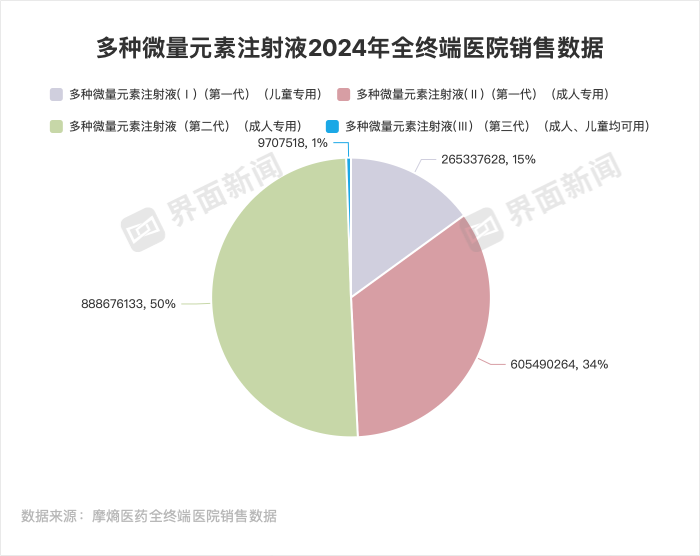
Core Viewpoint - Nanjing Pharmaceutical plans to acquire assets from Future Pharmaceutical for up to 480 million yuan, which includes both listed and in-development products related to microelement injection solutions [1][2]. Group 1: Acquisition Details - The acquisition involves cash payment not exceeding 480 million yuan for a set of assets, including "Microelement Injection (I)", "Microelement Injection (II)", and the in-development "Microelement Injection (III)" [1]. - The transaction is expected to constitute a significant asset restructuring as per regulations, but it is still in the planning stage and subject to further negotiations and approvals [1][2]. Group 2: Financial Implications - As of March 2025, Nanjing Pharmaceutical's cash reserves were only 550 million yuan, meaning the acquisition would leave them with just 70 million yuan post-transaction [2]. - The projected sales for the microelement injections in 2024 are approximately 1.769 billion yuan, with Future Pharmaceutical's products contributing around 522 million yuan, accounting for about 29.5% of the total sales [3]. Group 3: Market Dynamics - The key variable affecting the acquisition's value is the success of the in-development "Microelement Injection (III)" and its market performance post-launch [3]. - "Microelement Injection (I)" is specifically for children and has been included in the national medical insurance directory since 2009, while "Microelement Injection (II)" serves adults and is also part of the insurance directory [6][9]. - The adult market for microelement injections is larger but faces intense competition, particularly from second-generation products that have been optimized for better efficacy [9][14].


誉衡药业(002437) - 002437誉衡药业投资者关系管理信息20250827
2025-08-27 12:32
Financial Performance - In the first half of 2025, the company's operating revenue was 11.00 billion CNY, a year-on-year decrease of 9.97% [2] - Net profit attributable to shareholders was 1.34 billion CNY, an increase of 7.56% year-on-year [2] - The net profit after deducting non-recurring gains and losses increased by 13.28% [2] - Operating cash flow was 1.55 billion CNY, with a weighted average return on equity of 6.78% [2] Sales Growth Drivers - Sales of the main product, An Nao Wan/Pian, increased by over 30% year-on-year [3] - Revenue from potassium chloride sustained-release tablets also grew by over 30% [3] - The sales of the drug Siglitin Metformin sustained-release tablets have expanded to over 600 terminals, with expected continued growth [3] Cost Management - Sales expenses decreased by 31.28% to 294 million CNY [3] - Management expenses fell by 21.58% to 56.75 million CNY [3] - Financial expenses reduced from 60.13 million CNY to 48.03 million CNY [3] Future Strategies - Focus on existing product growth, particularly for Luguapeptide injection and multi-vitamin injections [3] - Accelerate the sales channel expansion for Siglitin Metformin sustained-release tablets and explore new markets for Meloxicam tablets [3] - New product Pema Bet tablets expected to launch in September, with high market expectations [3] - The company aims to maintain low levels of financial, management, and sales expenses [3] Market Expectations - Pema Bet tablets projected to enter the national catalog in Q4 2025, with significant market potential [4] - Siglitin Metformin sustained-release tablets expected to achieve sales of approximately 100 million CNY by year-end [4] - An Nao Wan/Pian expected to exceed 10 million boxes in sales, with a target of over 1 billion CNY in the next five years [6] International Expansion - The company has accumulated experience in international cooperation over the past decade and plans to continue exploring new opportunities [7] - Sodium creatine phosphate sales in Central Asia generated 2.46 million CNY in revenue in the first half of 2025 [7] Cost Efficiency - Sales expense ratio has decreased to 26.76% due to refined management and drug procurement policies [8] - Management expense ratio is among the lowest in the industry, with potential for further reduction [8] E-commerce Development - The company has established a professional e-commerce team, expecting online sales to contribute approximately 20% of product revenue [8]

双鹭药业2025年中报简析:净利润同比增长309.08%,三费占比上升明显
Zheng Quan Zhi Xing· 2025-08-26 23:09
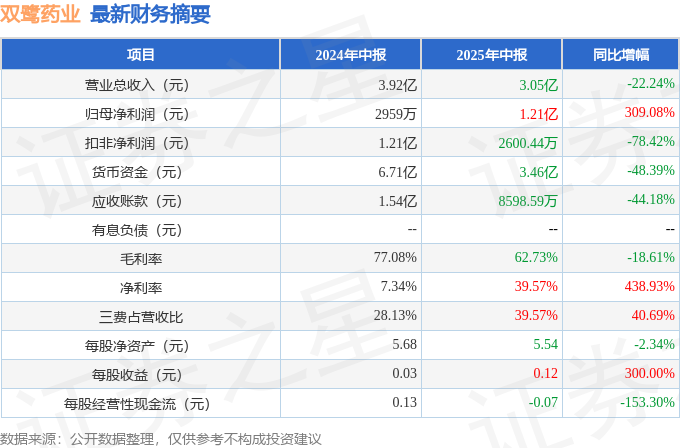
Core Viewpoint - Double Deer Pharmaceutical (002038) reported a decline in total revenue for the first half of 2025, while net profit saw a significant increase, indicating a mixed financial performance amid industry challenges [1][2]. Financial Performance Summary - Total revenue for the first half of 2025 was 305 million yuan, a decrease of 22.24% compared to the same period in 2024 [1]. - Net profit attributable to shareholders reached 121 million yuan, an increase of 309.08% year-on-year [1]. - The gross profit margin was 62.73%, down 18.61% year-on-year, while the net profit margin increased to 39.57%, up 438.93% [1]. - The total of selling, administrative, and financial expenses (three expenses) accounted for 39.57% of total revenue, an increase of 40.69% year-on-year [1]. - Earnings per share rose to 0.12 yuan, a 300% increase compared to the previous year [1]. Revenue and Cost Analysis - The decline in revenue was attributed to price reductions from drug procurement, intensified industry competition, and decreased demand for certain drugs due to disease prevalence [1]. - Operating costs increased by 26.41%, driven by expanded production scale and rising raw material and labor costs [1][2]. Cash Flow and Investment - Net cash flow from operating activities decreased by 153.3%, primarily due to increased cash payments for purchased goods [2]. - Net cash flow from investing activities increased by 94.24%, attributed to higher cash receipts from investment recoveries [3]. - The net increase in cash and cash equivalents saw a significant decline of 167.93% due to the drop in operating cash flow [3]. Business Evaluation - The company's historical return on invested capital (ROIC) has been moderate, with a median of 8.77% over the past decade, and a notably poor ROIC of -1.47% in 2024 [4]. - The company has maintained a relatively stable financial history, with only one loss year since its listing [4]. - Recent discussions highlighted the company's focus on R&D progress and the impact of procurement changes on its operations [4].

盐酸氨溴索原研药沐舒坦将重返中国市场
Bei Ke Cai Jing· 2025-08-26 10:55
Core Viewpoint - The return of the original brand Mucosolvan (Ambroxol Hydrochloride) to the Chinese market is anticipated in December 2025, following its exit due to registration expiration and increased competition from generic drugs [1][2]. Group 1: Company Background - Mucosolvan was originally developed by Boehringer Ingelheim and launched in Germany in 1978, entering the Chinese market in 1991 [2]. - The product achieved peak sales exceeding 8 billion yuan in China, making it a highly competitive product in the market [2]. - The original manufacturer, Boehringer Ingelheim, ceased the product's registration in China in 2020, leading to its market exit [3]. Group 2: Market Competition - The return of Mucosolvan will face competition from 367 similar drug approvals in China, including significant price competition from generics [6]. - In the 2021 centralized procurement, Boehringer Ingelheim's bid was only a 0.3% price reduction, while competitors like Yunnan Longhai offered a 93.3% reduction [4]. - The market for expectorants is crowded, with other active ingredients available, such as bromhexine and acetylcysteine, which may affect Mucosolvan's market share [6]. Group 3: Future Outlook - The product's return is now under the management of Opella, a company that became independent from Sanofi in May 2025, which retains a 48.2% stake in Opella [4]. - The ability of Mucosolvan to regain consumer trust and willingness to pay a premium in a low-price environment remains uncertain [6]. - The performance of Mucosolvan post-return will be closely monitored, especially regarding its positioning in the OTC market [6].
新天药业(002873) - 002873新天药业调研活动信息20250826
2025-08-26 10:38
R&D Pipeline and Innovations - The company has three ongoing 1.1 class clinical phase III projects and has made breakthroughs in other important therapeutic areas, including oncology, cardiovascular, gynecology, and urology [2][3]. - In the oncology field, a modified new drug for auxiliary treatment has been submitted for IND approval in July 2025 [2]. - The company is advancing a 1.1 class innovative drug for treating benign prostatic hyperplasia and related symptoms [2]. Product Development and Clinical Research - The company has achieved significant results in the secondary development of existing products, such as Kun Tai capsules, which have shown efficacy in alleviating perimenopausal syndrome and improving reproductive health [3]. - The company’s product Kushi Gel has been rated as A-level clinical value, demonstrating its effectiveness in maintaining vaginal microecological balance [3]. - The company is conducting a multi-center, randomized, double-blind clinical trial for Ning Mi Tai capsules, approved by the National Medical Products Administration [3]. Investment in Subsidiaries - The company has increased its investment in Huilun Pharmaceutical, recognizing its innovative capabilities and complete commercialization experience [4][5]. - Huilun Pharmaceutical has nearly 20 small molecule drug innovation projects, with over ten expected to enter clinical phases by the end of 2025 [4]. Market Strategy and Challenges - The company’s main products are currently not affected by centralized procurement policies due to their unique patent status [7]. - The company plans to enhance its OTC market presence and brand building to mitigate the impact of market fluctuations [7]. - Rising raw material costs and industry policy changes have led to a temporary decline in revenue, prompting the company to adjust its marketing strategies and strengthen cost control [8][9]. Future Outlook and R&D Focus - The company emphasizes the importance of traditional Chinese medicine (TCM) innovation, aligning with national policy support and market demand for chronic disease treatment [10]. - A balanced approach to short-term and long-term R&D investments is crucial for sustainable growth and shareholder returns [11].