
创新药研发

Search documents
吖啶片获批在即|金马药业集团携手北京大兴区共谋发展新篇
Xin Lang Cai Jing· 2026-02-05 13:06
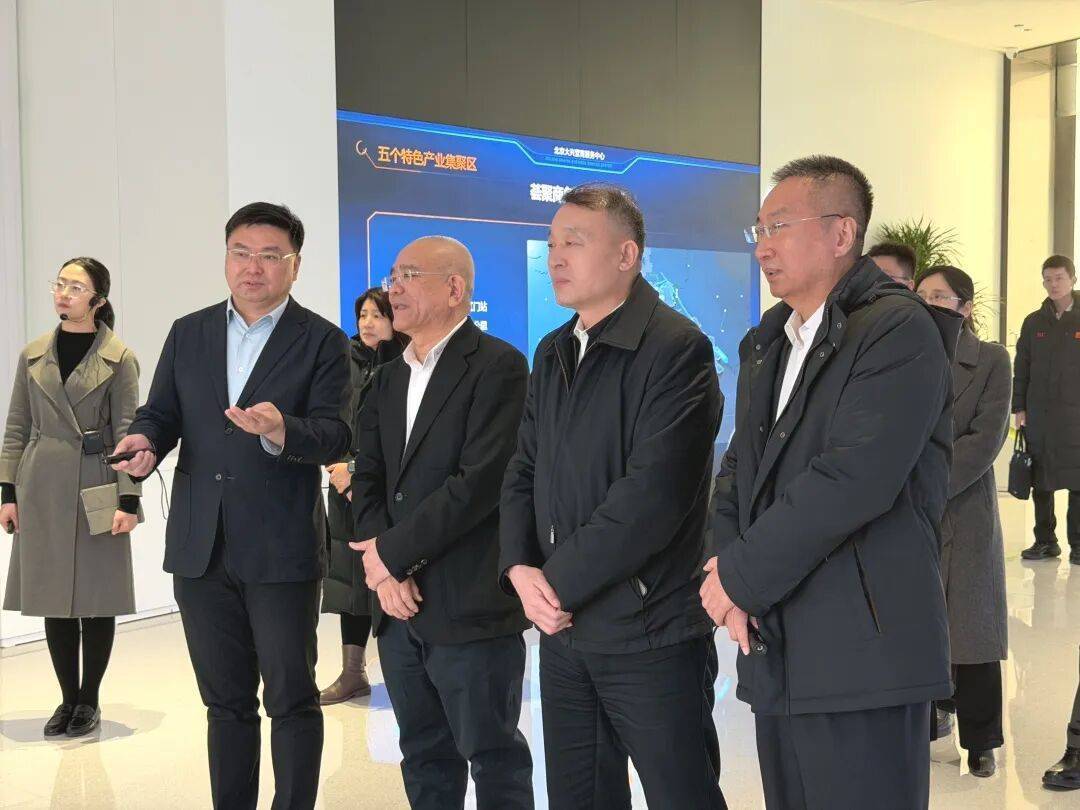
春回大地,万象启新!2026年2月4日,恰逢立春时节。在国家1类新药琥珀八氢氨吖啶片获批进入倒计时的关键节点,为深化推进集团创新转型,加速集 团北京总部暨北京科创中心的战略落地,大兴区委书记初军威、区长刘洋、副区长安学军等区领导隆重会见金马药业集团董事长张玉富先生一行。 区委书记初军威介绍大兴区产业布局,区长刘洋,副区长安学军陪同参观 双方以春为约,围绕创新药获批后的总部建设、科创中心落地、新药生产及商业化推广、神经领域创新药持续投入和研发、智能医疗生态构建等核心议题 深度磋商,达成全方位共识,为金马药业扎根"中国药谷"、赋能首都医药健康产业高质量发展注入磅礴动能,让合作共赢的信心与春天的朝气一同升腾! 集团医疗板块总裁、建设板块总裁,研发副总裁、金融副总裁、IT总监陪同调研。 参观北京市大兴区营商服务中心 行程伊始,在区委书记初军威、区长刘洋、副区长安学军等区领导的全程陪同下,集团项目工作组走进大兴区营商服务中心。 初军威书记亲自推介区域发展优势:大兴区立足首都都市圈核心枢纽定位,坐拥临空经济区、自贸区、综保区"三区叠加"的独特政策红利,联动京津冀协 同发展的战略价值凸显。全区锚定生命健康、临空产业、先进制 ...

国产创新药,正在破局
3 6 Ke· 2026-02-05 11:26
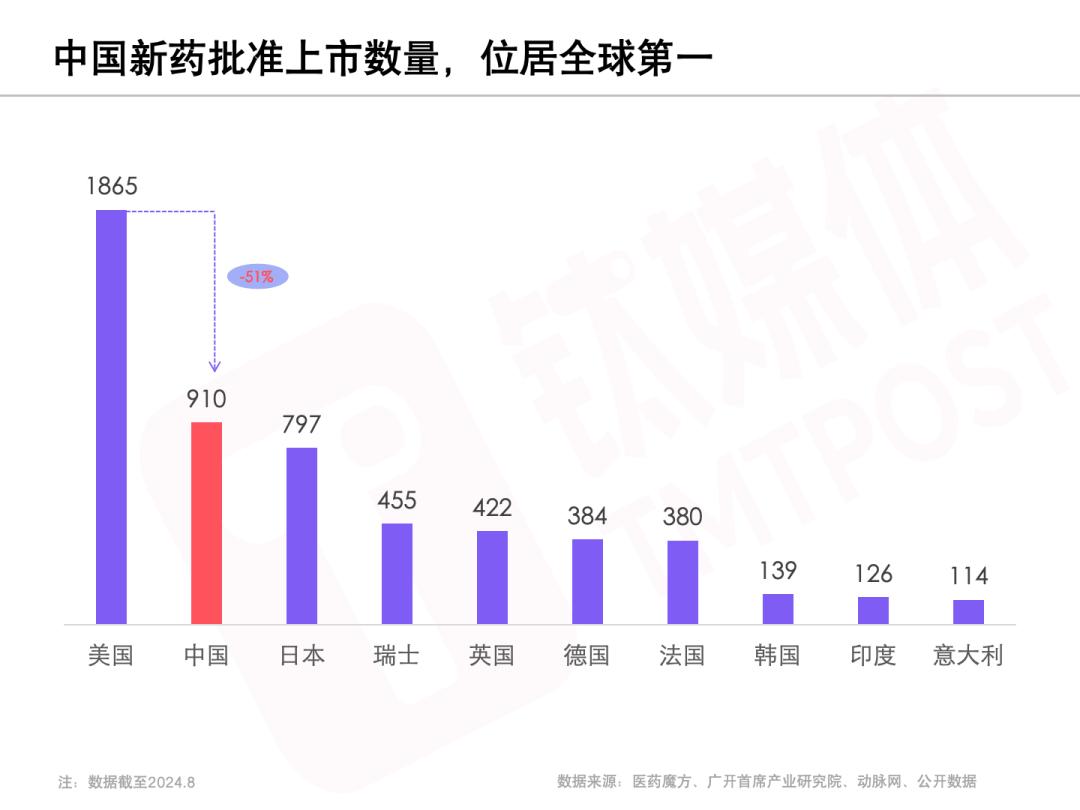
Core Viewpoint - The article discusses the significant progress in China's innovative drug development, highlighting the increase in the number of new drugs approved and the growing competitiveness of Chinese pharmaceutical companies in both domestic and international markets [4][16]. Group 1: Growth of Innovative Drugs - In 2024, the number of domestically developed Class 1 new drugs in China reached 40, a substantial increase from just 9 in 2018 [2][3][4]. - Since the beginning of the 14th Five-Year Plan, 113 innovative drugs have been approved, which is 2.8 times the number approved during the 13th Five-Year Plan [4]. - As of August 2024, there are 910 new drugs available in China, indicating a robust growth in the pharmaceutical market [6]. Group 2: Clinical Trials and Breakthroughs - In a head-to-head clinical trial, the drug Ivoris (依沃西单抗) developed by Kangfang Biopharma outperformed the global best-selling cancer drug, Pembrolizumab (K drug), marking a significant achievement for Chinese innovation [7][9]. - The global sales of Pembrolizumab reached $29.482 billion in 2024, underscoring the competitive landscape [8]. Group 3: Market Dynamics and International Expansion - Chinese innovative drugs are not only performing well domestically but are also gaining traction in international markets, with products like Sidakio (西达基奥仑赛) achieving $1.596 billion in cumulative sales since its launch [12][13]. - The total transaction scale of technology licensing by Chinese pharmaceutical companies exceeded $34 billion in 2024, indicating a shift towards international collaboration [14][15]. Group 4: R&D Landscape and Challenges - As of August 2024, there are 5,380 new drug candidates in development in China, accounting for over one-third of the global pipeline [18]. - The average cost of developing an innovative drug is around $1 billion, with a typical development timeline of 10 years [20][21]. - The efficiency of drug development in China is improving, with preclinical phases taking 12-20 months compared to 24-36 months internationally [23]. Group 5: Policy Support and Ecosystem - The Chinese government has implemented various policies since 2008 to support innovative drug development, including expedited approval processes and financial incentives [28][29]. - The combination of government support, industry collaboration, and technological advancements is creating a conducive environment for innovation in the pharmaceutical sector [41]. Group 6: Future Outlook - The article emphasizes that the development of innovative drugs in China has made significant strides over the past decade, transitioning from imitation to innovation [42]. - The government's continued support for innovative drugs is expected to enhance the industry's growth and provide hope for patients [42].




翰思艾泰HX111完成首例患者给药 创新实力凸显估值洼地价值
Ge Long Hui· 2026-02-05 09:45
Core Insights - The announcement of the first patient enrollment in the Phase I clinical trial of HX111, a novel OX40-targeted antibody-drug conjugate (ADC), marks a significant milestone for the company and highlights its innovative capabilities in the ADC space [1][2] - The company has developed a dual-antibody pipeline in cell immunotherapy, showcasing its comprehensive R&D strength and high-value product matrix [1][4] ADC Development - HX111 is the first OX40-targeted ADC to enter clinical trials globally, addressing a significant technical gap in the field [2] - The drug utilizes a monoclonal antibody targeting OX40 and a potent microtubule inhibitor MMAE, specifically binding to OX40 molecules overexpressed on tumor cells, leading to effective apoptosis in resistant tumors [2] Dual-Antibody Pipeline - The company has developed two key dual-antibody candidates, HX009 and HX044, targeting CD47, which is crucial for overcoming blood toxicity issues associated with first-generation therapies [3] - HX009 employs a strategy of strong PD-1 binding and weak CD47 binding to enhance T cell activity against tumors, while HX044 is the first CTLA-4×CD47 dual antibody in clinical trials, targeting Treg cells in the tumor microenvironment [3] R&D Team and Innovation - The company's R&D strength is supported by a top-tier team with deep academic and industry experience, covering all critical aspects of the drug development process [4] - The innovative achievements stem from a thorough understanding of biological mechanisms and continuous iteration of core technologies, creating significant barriers to entry and first-mover advantages [4] Market Potential - The market for HX111, targeting relapsed/refractory tumors, presents a substantial unmet need, while the dual-antibody candidates focus on immune therapy resistance and multi-cancer treatment, representing a market potential worth hundreds of billions [4] - As clinical trials progress and commercialization expectations rise, the company's performance growth is expected to be robust [4] Future Outlook - The ongoing clinical trials for HX111, HX009, and HX044 are anticipated to further highlight the company's multi-technology synergy, leading to increased market recognition of its core value [5] - The company's commitment to innovation is setting a benchmark for Chinese biotech firms and establishing a foundation for long-term, high-quality growth [5]
复星医药(600196.SH):控股子公司药品芦沃美替尼片注册申请获受理
Ge Long Hui A P P· 2026-02-05 08:39
该药品为本集团(即本公司及控股子公司/单位,下同)自主研发的创新型小分子化学药物,为MEK1/2 选择性抑制剂。 格隆汇2月5日丨复星医药(600196.SH)公布,公司控股子公司上海复星医药产业发展有限公司(称"复星 医药产业")自主研发的复迈宁®(通用名:芦沃美替尼片;称"该药品")用于治疗伴有症状、无法手 术的丛状神经纤维瘤(PN)的Ⅰ型神经纤维瘤病(NF1)成人患者(称"新增适应症")的药品上市申请 获国家药品监督管理局受理并已获纳入优先审评程序。 ...
国金证券:维持先声药业(02096)“买入”评级 SIM0500获里程碑付款
智通财经网· 2026-02-05 08:08
Core Viewpoint - The company is undergoing a continuous innovation transformation, with multiple innovative pipelines being launched internationally, leading to an upward revision of revenue and profit forecasts for 2026 while maintaining profit forecasts for 2025 and 2027 [1] Group 1: Financial Analysis - The revenue projections for 2025, 2026, and 2027 are adjusted to 76.3 billion, 100.3 billion, and 110.4 billion respectively, up from previous estimates of 76.3 billion, 91.0 billion, and 110.4 billion [1] - The net profit attributable to the parent company for 2025, 2026, and 2027 is revised to 11.5 billion, 16.5 billion, and 16.6 billion respectively, compared to earlier estimates of 11.5 billion, 13.8 billion, and 16.6 billion [1] - The corresponding EPS for 2025, 2026, and 2027 is adjusted to 0.44, 0.64, and 0.64 respectively, up from previous estimates of 0.44, 0.53, and 0.64 [1] Group 2: Product Development - The company received a milestone payment of 40 million USD from AbbVie for SIM0500 on February 3, 2026, following a licensing agreement signed in January 2025 [1] - SIM0500 is a humanized TCE tri-antibody targeting two tumor-associated antigens, showing strong T-cell cytotoxic effects against multiple myeloma cells [2] - The FDA granted SIM0500 a fast track designation for use in patients with multiple myeloma who have received at least three prior lines of therapy and are resistant or intolerant to standard treatments [2] Group 3: Strategic Partnerships - Since 2025, the company has successfully licensed four pipelines internationally, including agreements with AbbVie, NextCure, Ipsen, and Boehringer Ingelheim, with potential total payments reaching up to 10.6 billion USD and 10.16 billion EUR [3] - The partnerships with major multinational corporations (MNCs) validate the company's enhanced innovation capabilities and suggest ongoing opportunities for new business development in the future [3]

联邦制药涨近3% 自研1类创新药UBT251注射液OSA适应症获临床试验默示许可
Zhi Tong Cai Jing· 2026-02-05 03:03
Core Viewpoint - Federal Pharmaceutical (03933) shares increased by nearly 3%, currently up 2.7% at HKD 12.17, with a trading volume of HKD 54.12 million [1] Group 1: Company Developments - Federal Pharmaceutical announced that its wholly-owned subsidiary, Federal Biotech (Zhuhai Hengqin) Co., Ltd., received implied approval from the National Medical Products Administration of China for clinical trials of its self-developed innovative drug UBT251 injection for the indication of moderate to severe obstructive sleep apnea (OSA) [1] - UBT251 is the first chemical-synthesized GLP-1/GIP/GCG tri-target receptor agonist new drug in China, positioning the company significantly in the research field of this type of medication [1] - The company aims to continue focusing on new product development, enhancing its competitiveness and creativity in the biopharmaceutical industry, which is expected to generate greater returns for the company and its shareholders [1]
港股异动 | 联邦制药(03933)涨近3% 自研1类创新药UBT251注射液OSA适应症获临床试验默示许可
智通财经网· 2026-02-05 02:59
Core Viewpoint - Federal Pharmaceutical (03933) shares increased by nearly 3%, currently trading at HKD 12.17 with a transaction volume of HKD 54.12 million, following the announcement of a significant regulatory milestone for its innovative drug UBT251 [1] Group 1: Company Developments - Federal Pharmaceutical announced that its wholly-owned subsidiary, Federal Biotech (Zhuhai Hengqin) Co., Ltd., received implied clinical trial approval from the National Medical Products Administration of China for UBT251 injection, targeting moderate to severe obstructive sleep apnea (OSA) associated with obesity, effective February 2, 2026 [1] - UBT251 is recognized as China's first chemically synthesized GLP-1/GIP/GCG tri-target receptor agonist new drug, positioning the company prominently in the research field of this category of drugs [1] - The company aims to continue its focus on new product development, enhancing its competitiveness and creativity in the biopharmaceutical industry, which is expected to generate greater returns for the company and its shareholders [1]
福建广生堂药业股份有限公司关于乙肝治疗一类创新药奈瑞可韦GST-HG141完成III期临床试验受试者入组的公告
Zhong Guo Zheng Quan Bao - Zhong Zheng Wang· 2026-02-04 22:50
登录新浪财经APP 搜索【信披】查看更多考评等级 本公司及董事会全体成员保证信息披露的内容真实、准确、完整,没有虚假记载、误导性陈述或重大遗 漏。 福建广生堂药业股份有限公司(以下简称"公司")创新药控股子公司福建广生中霖生物科技有限公司的 在研乙肝治疗一类创新药奈瑞可韦GST-HG141的III期临床试验,已于近日完成全部受试者入组,合计 入组578例。 GST-HG141用于慢性乙型肝炎(CHB)抗病毒药物应答不佳患者联合治疗(add-on)的随机、双盲、安 慰剂对照、多中心III期临床试验,主要目的是在经过抗病毒药物治疗的CHB应答不佳患者中评估GST- HG141治疗的有效性和安全性,联合组长单位为树兰(杭州)医院和北京大学第一医院。2026年1月, GST-HG141的III期临床及拓展研究入选新发突发与重大传染病防控国家科技重大专项"慢性乙型肝炎临 床治愈联合治疗新方案研究"项目课题三,后期拓展研究将进一步评价GST-HG141长期用药后对于 cccDNA的潜在耗竭作用,并续贯联合口服表面抗原抑制剂 GST-HG131等的临床治愈有效性,是凸显重 要临床价值的前瞻性研究。 奈瑞可韦GST-HG14 ...

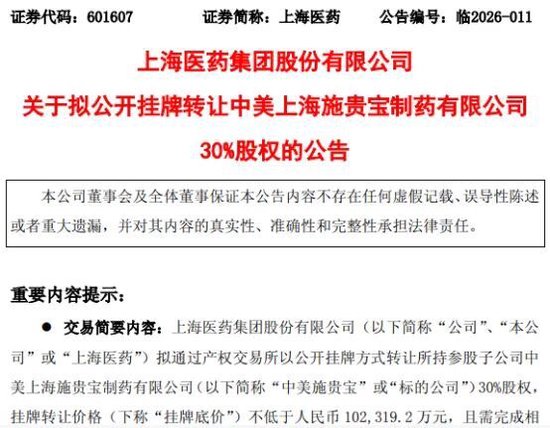
上海医药拟清仓中美上海施贵宝股权
Xin Lang Cai Jing· 2026-02-04 14:31
Core Viewpoint - Shanghai Pharmaceuticals is experiencing a situation of revenue growth without profit increase, prompting a structural optimization strategy [1][8]. Group 1: Company Actions - On February 4, Shanghai Pharmaceuticals announced plans to publicly transfer 30% of its stake in China-America Shanghai Bristol-Myers Squibb Co., with a minimum listing price of 1.023 billion yuan [1][8]. - The company is focusing on innovation, with a new drug pipeline consisting of 56 projects, including 44 innovative drugs [6][14]. Group 2: Shareholder Changes - In October 2025, Shanghai Pharmaceuticals' major shareholder, Shanghai Pharmaceuticals Holding Group, increased its stake from 23.303% to 38.487%, enhancing the stability of the shareholding structure [6][13]. - The second largest shareholder is Yunnan Baiyao, holding 17.95% [6][13]. Group 3: Financial Performance - For the first three quarters of 2025, Shanghai Pharmaceuticals reported revenue of 215.072 billion yuan, a year-on-year increase of 2.60%, while net profit attributable to shareholders was 5.147 billion yuan, up 26.96% [15]. - However, the company's net profit excluding non-recurring items decreased by 26.79%, and operating cash flow fell by 15.56% [15].
广生堂乙肝治疗一类创新药奈瑞可韦GST-HG141完成III期临床试验受试者入组
Bei Jing Shang Bao· 2026-02-04 12:00
北京商报讯(记者 丁宁)2月4日晚间,广生堂(300436)发布公告称,公司创新药控股子公司福建广 生中霖生物科技有限公司的在研乙肝治疗一类创新药奈瑞可韦GST-HG141的III期临床试验,已于近日 完成全部受试者入组,合计入组578例。 公告显示,奈瑞可韦GST-HG141是新型乙肝核心蛋白/核衣壳调节剂,属于全新机制的在研抗乙肝病毒 的一类创新药。迄今为止,全球范围内尚无同类产品上市,属潜在FIC(First in class)项目。 ...