
资金流向

Search documents
石油石化行业资金流入榜:中国海油等5股净流入资金超亿元
Zheng Quan Shi Bao Wang· 2026-01-13 08:54
Market Overview - The Shanghai Composite Index fell by 0.64% on January 13, with six industries experiencing gains, led by the oil and petrochemical sector, which rose by 1.62% [1] - The pharmaceutical and biological industry also saw an increase of 1.21% [1] - The defense and military industry and electronics sector faced the largest declines, with drops of 5.50% and 3.30% respectively [1] Capital Flow - The net outflow of capital from the two markets reached 162.743 billion yuan for the day [1] - Four industries experienced net inflows, with the pharmaceutical and biological sector leading at a net inflow of 4.348 billion yuan [1] - The oil and petrochemical industry followed with a net inflow of 586 million yuan [1] Oil and Petrochemical Sector - The oil and petrochemical industry rose by 1.62%, with a total net inflow of 586 million yuan [2] - Out of 47 stocks in this sector, 28 saw gains, including two that hit the daily limit [2] - The top stocks with significant net inflows included China National Offshore Oil Corporation (1.86 billion yuan), Sinopec (1.26 billion yuan), and Bohai Chemical (1.22 billion yuan) [2] Individual Stock Performance - The top performers in the oil and petrochemical sector included: - China National Offshore Oil Corporation: +3.57% with a turnover rate of 2.63% and a net inflow of 186.43 million yuan [2] - Sinopec: 0.00% change with a turnover rate of 0.26% and a net inflow of 125.57 million yuan [2] - Bohai Chemical: +10.14% with a turnover rate of 10.92% and a net inflow of 121.55 million yuan [2] - Conversely, the stocks with the largest net outflows included: - Intercontinental Oil and Gas: -0.56% with a net outflow of 1.6717 billion yuan [3] - China National Petroleum Corporation: +2.23% with a net outflow of 537.68 million yuan [3] - Zhongman Petroleum: +3.64% with a net outflow of 359.65 million yuan [3]



1月第1周立体投资策略周报:“十六连阳”背后是哪些资金在买-20260112
Guoxin Securities· 2026-01-12 15:25
Group 1 - In the first week of January, a total net inflow of funds into the market reached 721 billion, reversing a previous outflow of 104 billion [1][8] - The financing balance increased by 858 billion, public fund issuance rose by 70 billion, and estimated net inflow from northbound funds was 96 billion [1][8] - The short-term sentiment indicator is at a high level since 2005, with the recent weekly turnover rate (annualized) at 564%, placing it in the 87th percentile historically [1][12] Group 2 - The long-term sentiment indicator is at a medium-low level since 2005, with the recent A-share risk premium at 2.43%, which is in the 46th percentile historically [2][14] - The recent dividend yield of the CSI 300 index (excluding financials) compared to the ten-year government bond yield is 1.17, placing it in the 7th percentile historically [2][14] - The highest turnover rates among industries in the past week were in defense and military (100%), media (98%), and automotive (97%), while the lowest were in liquor (18%), utilities (56%), and beauty care (59%) [2][14] Group 3 - The highest financing transaction ratios were in power equipment (95%), beauty care (95%), and machinery (94%), while the lowest were in coal (32%), food and beverage (36%), and construction decoration (44%) [2][14] - The total market capitalization of A-shares is 101.25 trillion, with a circulating market value of 93.05 trillion [3]
全球资产配置资金流向月报(2026年1月)-20260112
Shenwan Hongyuan Securities· 2026-01-12 14:42
Group 1: Seasonal Capital Inflows - In January, significant seasonal inflows of global capital into Chinese equity markets (including A-shares, H-shares, and Chinese concept stocks) are expected, with a historical probability of 76% for the Hang Seng Index to have a positive annual return if inflows are positive[12] - Since 2000, global capital typically experiences a significant inflow into Hong Kong local stocks in January after marginal outflows in December[10] - In December 2025, the inflow into the Chinese equity market reached $177.6 billion, while the inflow into the emerging market bond market was $177.7 billion[26] Group 2: Global Asset Flow Overview - As of December 31, 2025, the relative inflow ratio for Chinese fixed-income funds reached 11.2%, leading other markets, while equity funds saw a 1.3% inflow, also leading other major markets[23] - In December, the U.S. equity market saw inflows of $778.8 billion, while emerging markets experienced inflows of $339.5 billion[19] - The inflow into the U.S. fixed-income market was substantial, with $391.3 billion in December, indicating a preference for U.S. assets[19] Group 3: Fund Type Analysis - In December, passive equity funds accounted for a significant portion of inflows into emerging markets, with $347 billion, although this was a decrease from $424 billion in November[60] - Active equity funds saw outflows of $7 billion in emerging markets, with China experiencing a $5 billion outflow in December[60] - The inflow into Chinese fixed-income markets was $178 billion in December, representing 68% of the total inflow into emerging market bonds[57]
股票行情快报:兰州银行(001227)1月12日主力资金净卖出642.76万元
Sou Hu Cai Jing· 2026-01-12 12:21
Core Viewpoint - Lanzhou Bank (001227) reported a stable stock price at 2.34 yuan with a slight increase of 0.0% as of January 12, 2026, indicating a steady market position despite recent fluctuations in fund flows [1]. Financial Performance - For the first three quarters of 2025, Lanzhou Bank's main revenue was 5.923 billion yuan, a year-on-year decrease of 2.14% [2]. - The net profit attributable to shareholders was 1.504 billion yuan, reflecting a year-on-year increase of 0.65% [2]. - The net profit after deducting non-recurring items was 1.425 billion yuan, showing a year-on-year increase of 2.39% [2]. - In Q3 2025, the bank's single-quarter main revenue was 2.003 billion yuan, down 2.67% year-on-year [2]. - The single-quarter net profit attributable to shareholders was 553 million yuan, up 0.28% year-on-year [2]. - The single-quarter net profit after deducting non-recurring items was 529 million yuan, with a significant year-on-year increase of 29.71% [2]. - The bank's liability ratio stood at 92.2%, with investment income reported at 1.351 billion yuan [2]. Capital Flow Analysis - On January 12, 2026, the net outflow of main funds was 6.4276 million yuan, accounting for 4.62% of the total transaction amount [1]. - The net outflow of speculative funds was 3.6484 million yuan, representing 2.62% of the total transaction amount [1]. - Retail investors contributed a net inflow of 10.076 million yuan, which was 7.24% of the total transaction amount [1].


股票行情快报:中银证券(601696)1月12日主力资金净卖出6825.52万元
Sou Hu Cai Jing· 2026-01-12 11:45
Group 1 - The core viewpoint of the news is that Bank of China Securities (601696) has shown positive financial performance in the third quarter of 2025, with significant year-on-year growth in revenue and net profit [2] - As of January 12, 2026, the stock price of Bank of China Securities closed at 14.99 yuan, reflecting a 0.94% increase, with a trading volume of 986,700 hands and a total transaction amount of 1.473 billion yuan [1] - The company reported a total revenue of 2.438 billion yuan for the first three quarters of 2025, representing a year-on-year increase of 26.95%, and a net profit attributable to shareholders of 854 million yuan, up 29.28% year-on-year [2] Group 2 - In the third quarter of 2025, the company achieved a single-quarter revenue of 933 million yuan, which is a 38.33% increase compared to the same quarter last year, and a net profit of 289 million yuan, up 22.37% year-on-year [2] - The company has a debt ratio of 79.44% and reported investment income of 276 million yuan [2] - The business segments of Bank of China Securities include investment banking, securities brokerage, asset management, proprietary trading, private equity investment, futures, and other businesses [2]

煤炭行业1月12日资金流向日报
Zheng Quan Shi Bao Wang· 2026-01-12 09:25
Market Overview - The Shanghai Composite Index rose by 1.09% on January 12, with 28 out of the 31 sectors experiencing gains, led by the media and computer sectors, which increased by 7.80% and 7.26% respectively [1] - The sectors that saw declines included oil and petrochemicals, coal, and real estate, with decreases of 1.00%, 0.47%, and 0.29% respectively [1] Capital Flow Analysis - The main capital outflow from the two markets totaled 27.468 billion yuan, with 11 sectors experiencing net inflows [1] - The computer sector had the highest net inflow of capital, amounting to 15.774 billion yuan, while the media sector followed with a net inflow of 5.391 billion yuan [1] Coal Industry Performance - The coal industry saw a decline of 0.47% with a net capital outflow of 20 million yuan, comprising 37 stocks, of which 15 rose and 18 fell [2] - Among the stocks in the coal sector, 17 experienced net capital inflows, with six stocks exceeding 10 million yuan in net inflow, led by Xinjie Energy with 33.428 million yuan [2] - The stocks with the highest net capital outflows included Yongtai Energy, Huayang Shares, and Yanzhou Coal, with outflows of 72.047 million yuan, 39.750 million yuan, and 33.726 million yuan respectively [2] Individual Stock Performance in Coal Sector - Notable stocks in the coal sector included: - Xinjie Energy: 0.00% change, net inflow of 33.428 million yuan [3] - Shaanxi Coal: 0.00% change, net inflow of 29.965 million yuan [3] - China Shenhua: -1.39% change, net outflow of 25.616 million yuan [2][3]
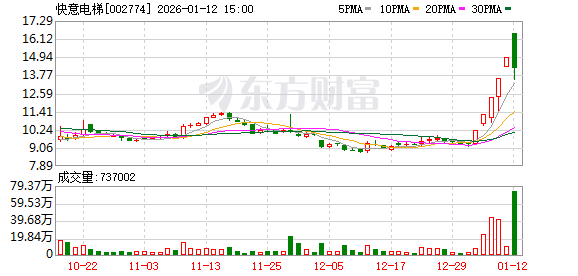
快意电梯跌5.08%,龙虎榜上机构买入1276.74万元,卖出255.35万元
Zheng Quan Shi Bao Wang· 2026-01-12 09:24
Group 1 - The stock of Kuaiji Elevator experienced a decline of 5.08% with a turnover rate of 26.16% and a trading volume of 1.021 billion yuan, showing a volatility of 22.21% [2][2][2] - Institutional investors net bought 10.21 million yuan, while brokerage seats collectively net sold 118 million yuan [2][2][2] - The stock was listed on the Shenzhen Stock Exchange due to a daily volatility of 22.21% and a daily decline deviation of -7.13% [2][2][2] Group 2 - The top five trading departments accounted for a total transaction of 247 million yuan, with a buying amount of 70.06 million yuan and a selling amount of 177 million yuan, resulting in a net sell of 107 million yuan [2][2][2] - Among the trading departments, one institutional seat was present, net buying 10.21 million yuan with a buying amount of 12.77 million yuan and a selling amount of 2.55 million yuan [2][2][2] - The stock saw a net outflow of 57.97 million yuan in main funds today, with large orders experiencing a net outflow of 6.59 million yuan and big orders a net outflow of 51.39 million yuan [2][2][2]

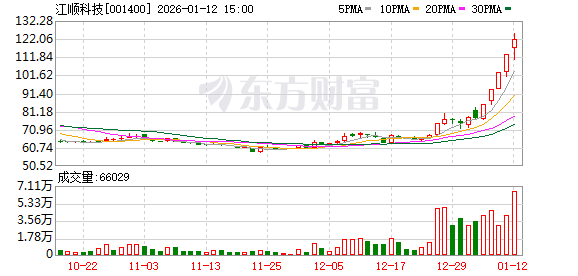
江顺科技龙虎榜数据(1月12日)
Zheng Quan Shi Bao Wang· 2026-01-12 09:20
Core Viewpoint - Jiangshun Technology's stock price increased by 7.14% with a turnover rate of 44.02%, indicating significant trading activity and interest from institutional investors [2] Group 1: Trading Activity - The stock had a total trading volume of 783 million yuan, with a price fluctuation of 13.61% throughout the day [2] - Institutional investors net bought 51.59 million yuan, while brokerage seats collectively net sold 7.32 million yuan [2] - The stock has appeared on the "Dragon and Tiger List" six times in the past six months, with an average price drop of 0.80% the day after being listed and an average increase of 3.96% in the following five days [3] Group 2: Capital Flow - The stock saw a net inflow of 29.10 million yuan from major funds today, with a significant net inflow of 43.43 million yuan from large orders, while large orders experienced a net outflow of 14.32 million yuan [3] - The latest margin trading balance as of January 9 was 130 million yuan, with a financing balance of 129 million yuan and a securities lending balance of 454,400 yuan [3] - Over the past five days, the financing balance increased by 787,800 yuan, representing a growth of 0.61%, while the securities lending balance rose by 158,900 yuan, showing a significant increase of 53.77% [3]
中泰证券:季节性资金流向权益市场 超长政府债发行惯性仍令债市承压
Xin Lang Cai Jing· 2026-01-12 01:19
Group 1 - The report from Zhongtai Securities indicates that a true bull-bear transition in China's bond market requires two key policy signals: the Ministry of Finance must clearly shorten the issuance period of local special bonds or special government bonds, and the central bank must announce or implement a debt purchase plan significantly exceeding the current scale [1] - The report highlights that seasonal funds that should flow into the bond market have been "taken away" by the equity market, which is a significant source of the recent "spring fever" in the stock market, further intensifying the outflow pressure in the bond market [1] - It is projected that approximately 67 trillion yuan and 75 trillion yuan of household time deposits will mature in 2025 and 2026, respectively. Even if 10% of these funds "move," the scale will reach several trillion yuan [1] Group 2 - The report identifies two main product categories where these funds are likely to flow: "fixed income +" wealth management products, which typically allocate 3%-5% of equity assets to enhance returns, and dividend-type insurance, which aims to achieve expected returns above 3.4%, with a more aggressive allocation in the stock market [1]

资金出现哪些新信号?
Hu Xiu· 2026-01-11 10:40
Group 1 - The A-share market saw a significant surge with the Shanghai Composite Index breaking the 4100-point mark, indicating a strong market momentum [3] - The trading volume exceeded 3.1 trillion yuan, which is a critical threshold that may attract more follow-up capital into the market [3] - Financing balances have rapidly increased, with some brokerage firms reporting that their margin trading quotas have been fully utilized, indicating strong demand for leveraged investments [3] Group 2 - A substantial amount of capital, approximately 30 trillion yuan, is expected to be "unlocked" in 2026 as funds currently held in fixed deposits mature, which could lead to increased investments in the stock market [3] - The potential inflow of funds into the A-share market is likely to rise, as the stock market currently outperforms other asset classes [3] - The adjustment of export tax rebates for solar and battery sectors may impact the grid sector, although specific effects are yet to be fully assessed [5]