新能源转型

Search documents
潍柴动力:公司正加快新能源转型
Zheng Quan Ri Bao Wang· 2026-01-14 13:13
Core Viewpoint - Weichai Power (000338) is accelerating its transformation towards new energy and actively promoting the commercialization of integrated driving assistance technology [1] Group 1 - The company is focusing on new energy transformation [1] - Weichai Power is pushing for the commercial application of integrated driving assistance technology [1]
车企2025产销快报解析:四大板块齐头并进
Xin Lang Cai Jing· 2026-01-14 06:06
Core Insights - The Chinese passenger car market is projected to retail 23.78 million units in 2025, reflecting a 4% year-on-year growth, supported by policies like "trade-in" [20][21] - Major domestic automakers such as BYD, Geely, Changan, and Leap Motor have achieved significant breakthroughs, while several joint ventures are showing signs of recovery in China [20][21] Domestic Automakers Performance - BYD set a new annual sales record with 4.60 million units sold in 2025, a 7.73% increase, with pure electric vehicle sales reaching 2.25 million units, up 27.85% [21][22] - SAIC Group sold 4.51 million vehicles in 2025, marking a 12.3% increase, with its new energy vehicle sales growing by 33.1% to 1.64 million units [3][21] - China FAW achieved total vehicle sales of 3.30 million units, a 3.2% increase, with its new energy vehicle sales soaring by 71% to 366,000 units [3][22] - Geely exceeded its sales target with 3.02 million units sold, a 39% increase, and its new energy vehicle sales reached 1.69 million units, up 90% [4][22] - Changan's sales reached 2.91 million units, an 8.5% increase, with new energy vehicle sales growing by 51% to 1.11 million units [4][23] - Chery Group achieved a record high of 2.81 million units sold, with new energy vehicle sales increasing by 54.9% to 903,800 units [5][23] Joint Ventures Performance - Joint ventures are under pressure but some have found ways to adapt, with FAW-Volkswagen selling 1.59 million vehicles, maintaining its position as the top joint venture [26][27] - SAIC Volkswagen achieved sales of 1.06 million units, successfully surpassing the million mark [27] - Toyota's joint ventures in China reported positive growth, with FAW Toyota selling 805,500 units, marking three consecutive years of growth [27][28] New Energy Vehicle Market - The new energy vehicle segment is a common highlight across major automakers, with significant growth reported [21][22] - Leap Motor achieved a remarkable 103% year-on-year growth, delivering 596,600 units in 2025 [29] - Xpeng Motors delivered 429,400 units, a 126% increase, while NIO delivered 326,000 units, up 46.9% [30][31] Export Growth - China's automobile exports are expected to exceed 7 million units in 2025, marking a historic high [16][34] - Chery led the export of Chinese passenger cars with 1.34 million units, a 17.4% increase [34][35] - BYD's overseas sales surpassed 1 million units for the first time, reaching 1.05 million units, a 145% increase [35][36] Globalization Strategies - SAIC Group updated its overseas strategy, achieving 1.07 million units in overseas sales, a 3.1% increase [35][36] - Changan's overseas sales reached 637,000 units, an 18.9% increase, while Geely's overseas sales totaled 420,000 units [36][37] - New energy vehicle startups are also targeting international markets, with Leap Motor and Xpeng making significant strides in overseas deliveries [36][37]






韩系车居然增长:是反弹,还是“缓刑”?
虎嗅APP· 2026-01-13 10:11
Core Viewpoint - Hyundai Motor Group remains optimistic about its resurgence in the Chinese market, especially if the recent South Korea-China leadership talks lead to improved bilateral relations [2][3]. Group 1: Market Performance - Hyundai and Kia have shown signs of stabilization in the Chinese market over the past couple of years, with sales expected to improve by 14.8% for Beijing Hyundai to approximately 210,000 units in 2025, and 254,000 units for Yueda Kia [5]. - The overall Chinese passenger car market is projected to see wholesale sales of 29.55 million units in 2025, a year-on-year increase of 8.8% [5]. Group 2: Survival Strategies - The growth in export business has been a significant factor for Hyundai's short-term improvement, with exports now accounting for a higher percentage of their operations [7]. - Hyundai's sales network in China has not collapsed, and there remains a market for fuel-efficient vehicles among price-sensitive consumers in lower-tier cities [7][8]. Group 3: Future Outlook - The warming of South Korea-China relations is seen as a potential external benefit, which could enhance cooperation with local suppliers [11]. - Despite recent stabilization, Hyundai still faces structural pressures, with its performance in China lagging behind the global average [13]. - The success of future models, particularly in the electric and smart vehicle segments, will be crucial for Hyundai's long-term recovery in the Chinese market [14][18].

2026全场景产品力持续提升!上汽跃进或将成城配用户“首选” | 头条
第一商用车网· 2026-01-13 06:18
Core Insights - The article highlights that SAIC Yuejin aims to double its sales by 2025, targeting 56,000 units in 2026, focusing on product strength to enhance user wealth creation [1] - The domestic light truck market is expected to see slight growth, with a projected total scale of 1.03 million units in 2026, a 3% year-on-year increase, and a significant rise in demand for new energy light trucks [1] Market Performance - SAIC Yuejin has outperformed the market, achieving a sales increase from 17,000 to 40,000 units in 2025, representing a 127% year-on-year growth; in the new energy sector, retail sales reached 22,573 units, up 217% [3] - The market share in the wholesale sector increased from 2.0% to 4.0%, a rise of 2.1 percentage points [3] Competitive Positioning - In 2025, SAIC Yuejin secured five industry-leading positions: highest sales growth rate, fastest growth in new energy logistics vehicles, leading market share in specialized new energy chassis, and top sales among major B-end enterprises [5] - Despite challenges from new energy alternatives, traditional energy light trucks maintained a stable market share, with 22 out of 31 regions showing growth [5] Strategic Initiatives - SAIC Yuejin plans to invest billions to support channel expansion and build a stable, win-win ecosystem, shifting strategies from broad outreach to precise targeting and from volume-focused incentives to multi-dimensional collaboration [5] - The company will enhance service management and training, aiming for a 12-hour closure rate monitoring and improved service station layouts [5] Product Development - In 2026, SAIC Yuejin aims to launch 32 development projects, with 24 set to be produced that year, including new models on a seventh-generation platform [7] - The new energy vehicle lineup will include models with rapid battery swapping capabilities, supporting flexible purchasing options [9] Technological Advancements - New energy models will feature advanced intelligent driving assistance systems, enhancing safety and efficiency for users [11] - Collaboration with CATL will advance battery swapping network construction, aiming to create a comprehensive ecosystem for electric light trucks [11]
调研速递|中国重汽接受中金银海等4家机构调研 新能源重卡销量同比增190% 出口覆盖150余国
Xin Lang Zheng Quan· 2026-01-12 10:42
Group 1 - The company hosted an institutional research meeting on January 12, 2026, with participation from four investment institutions, discussing operations, new energy business, export situation, and dividend plans [1] - The overall operation of the company shows growth, with a sufficient backlog of orders. In 2025, the total sales volume of heavy trucks in China reached 1.137 million units, a year-on-year increase of approximately 26% [1][2] - The new energy heavy truck sector is experiencing rapid growth, with a significant increase in market penetration. In 2025, the cumulative sales of new energy heavy trucks in China reached 195,600 units, a year-on-year increase of 190% [1][2] Group 2 - The company has achieved rapid breakthroughs in the new energy sector, with sales growth surpassing the industry average. It will continue to focus on technological evolution and market trends for stable business development [2] - The company has maintained the industry’s leading position in exports for 21 consecutive years, covering over 150 countries and regions, with strong growth in emerging markets [2] - The company emphasizes shareholder returns, having consistently increased the dividend payout ratio over the past five years, and plans to further raise cash dividend ratios when conditions allow [2]

盐湖提锂关键技术重大突破,回收率提升成本大降
Jin Rong Jie· 2026-01-12 00:44
Group 1 - The research team from the Qinghai Salt Lake Research Institute has achieved a significant technological breakthrough in the efficient separation of lithium, sodium, and potassium ions from lithium brine, addressing key technical challenges in the lithium extraction process [1] - A demonstration line for extracting lithium from lithium brine with a capacity of 10,000 tons of battery-grade lithium carbonate has been established in Qinghai Province, generating an additional output value of over 600 million yuan [1] - The newly developed green and efficient lithium extraction technology improves the overall lithium ion recovery rate by 15% to 20% and reduces costs by 30%, with water and energy consumption below industry standards by over 30% [1] Group 2 - By 2026, domestic sales of new energy vehicles in China are expected to reach 19.42 million units, a year-on-year increase of 18%, while global sales are projected to be 24.18 million units, up 15% [2] - The global demand for energy storage cells is anticipated to grow significantly, with an expected increase of 220 GWh in 2026, leading to a total production of 764 GWh and a growth rate exceeding 40% [2] - The Chinese salt lake lithium extraction industry is transitioning from a "cost advantage" to "technology leadership," enabling a full industrial chain upgrade from resource development to high-value utilization, thus providing stable supply for the new energy industry [2]
亚普股份(603013):公司动态研究报告:油箱龙头海外布局成效显著,开拓航空航天与机器人新赛道
Huaxin Securities· 2026-01-11 14:48
Investment Rating - The report assigns a "Buy" rating for the company, marking it as the first investment recommendation [1]. Core Insights - The company, a global leader in fuel systems, is actively transitioning towards new energy sectors, including aerospace and robotics, with significant overseas expansion [4][11]. - The company is the third largest global manufacturer of fuel systems and has established a strong presence with 27 production bases and 7 engineering centers across 11 countries [4][10]. - The revenue forecast for the company shows a steady growth trajectory, with expected revenues of 90.7 billion, 100.0 billion, and 108.2 billion yuan for 2025, 2026, and 2027 respectively [13]. Summary by Sections Company Overview - Established in 1988, the company specializes in automotive energy storage and thermal management systems, holding a leading position in the domestic market and ranking third globally in fuel systems [4]. - Major clients include over 60 brands such as Volkswagen, Ford, and Toyota, with fuel tank revenue projected to be 75.2 billion yuan in 2024, accounting for 93.1% of total revenue [4]. Product Development - The company is advancing in hybrid high-pressure fuel systems, with orders for these systems surpassing traditional fuel systems for the first time in 2024 [4]. - Development of automotive thermal management systems and battery pack housings is ongoing, with successful trials and new project acquisitions [5]. - The company is also focusing on fuel cell hydrogen storage systems, achieving significant advancements in product certification and market readiness [6][7]. Market Performance - The company’s performance is bolstered by the rising sales of hybrid vehicles, with PHEV sales expected to reach 3.697 million units in 2025, a year-on-year increase of 8.8% [8]. - The export of passenger vehicles is projected to grow significantly, providing structural growth opportunities for the company’s fuel systems business [8]. International Expansion - The company has a well-established overseas production capacity, with significant growth in revenue from international markets, which accounted for 42.6% of total revenue in the first half of 2025 [10]. - The company’s overseas subsidiaries have shown double-digit growth in supply performance, particularly in North America [10]. Acquisition and New Ventures - The acquisition of Winshang Technology, a leader in rotary transformers, for 5.78 billion yuan, aims to expand into aerospace and robotics sectors [11]. - Winshang Technology is recognized for its high-precision rotary transformers, with a projected market growth rate of 15.3% from 2025 to 2031 [11]. Financial Projections - Revenue and net profit forecasts indicate a positive growth outlook, with net profits expected to reach 5.8 billion, 6.5 billion, and 7.2 billion yuan from 2025 to 2027 [13]. - The company maintains a stable gross margin, with slight fluctuations projected over the coming years [9].

不只是稀土!中国把白银升级管控,扼住美国高科技产业“咽喉”
Sou Hu Cai Jing· 2026-01-11 09:12
Core Insights - Silver has transitioned from being merely a decorative metal to a critical component in high-tech industries, significantly contributing to its price surge in 2025, which saw a 146% increase compared to gold's 60% rise [1][3]. Demand Drivers - The explosive growth in demand for silver is primarily driven by three high-growth sectors: the photovoltaic industry, electric vehicles, and artificial intelligence [3][13]. - The photovoltaic industry, essential for solar panels, is projected to require 450 million ounces of silver by 2030, significantly boosting demand [8]. - The electric vehicle sector, which uses several times more silver than traditional vehicles, is growing at a compound annual growth rate (CAGR) of 13% [7][8]. - The AI industry relies heavily on high-performance chips that require silver for internal connections and packaging, enhancing the metal's strategic value [9][11]. Supply Constraints - The global silver market has faced a supply-demand imbalance for five consecutive years, with a projected shortfall of 3,660 tons in 2025 [15][17]. - Major silver-producing countries like Mexico and Peru are experiencing declining production due to aging mines and rising extraction costs [19]. - China's silver production is limited, with annual output of over 3,400 tons against a consumption of 9,400 tons, leading to a reliance on imports [25][21]. Export Control Policies - In early 2026, China implemented new export controls on silver, elevating it to a strategic resource level similar to rare earths, which will significantly impact global supply [27][29]. - The stringent conditions for obtaining export licenses aim to prioritize domestic industrial needs, particularly in high-tech sectors [29][31]. Global Market Impact - The new export policies are expected to reduce global silver supply by 4,500 to 5,000 tons annually, exacerbating existing shortages [33]. - Countries worldwide are beginning to recognize silver's strategic importance, leading to a global race to stockpile the metal [35][42]. - Financial market speculation is intensifying the demand for silver, with a significant disparity between physical inventory and paper contracts on exchanges like COMEX [38]. Future Outlook - The ongoing trends in the photovoltaic, electric vehicle, and AI sectors will continue to drive silver demand, maintaining upward pressure on prices [40][42]. - Experts predict that silver prices could reach $100 per ounce by the second half of 2026, reflecting its revalued strategic importance in global technology and resource competition [44].

不许买俄油!特朗普祭出3招,连续点名中国,是时候该算总账了
Sou Hu Cai Jing· 2026-01-11 03:30
Group 1 - The core viewpoint of the article is that Trump's administration is implementing aggressive measures to control global oil markets, particularly targeting Russia and its major clients, China and India, to undermine Russia's economy and redirect oil trade to the U.S. [1][3] - Trump has approved a bill to impose sanctions on countries purchasing Russian oil, with China and India being the primary targets, as they account for nearly 90% of Russia's oil exports [1][3] - The U.S. aims to cut off Russia's economic lifeline by pressuring its clients, thereby reducing funding for Russia's military actions and benefiting U.S. interests in the global oil market [3][5] Group 2 - The U.S. is also pressuring Venezuela to sever economic ties with Russia and China, effectively making its oil exports reliant on U.S. cooperation, thus allowing the U.S. to control the production and revenue from Venezuelan oil [5][7] - The U.S. has seized multiple oil tankers involved in trade with Venezuela, asserting control over oil shipments and demanding that Venezuela redirect its oil sales to the U.S. [5][7] - The ultimate goal of these strategies is to establish systemic control over global oil resources and wealth distribution, reinforcing U.S. dominance in the energy sector [7][12] Group 3 - China has responded firmly against U.S. sanctions, emphasizing its commitment to normal economic cooperation with Russia and Venezuela, and asserting its rights to protect its interests [7][10] - China holds significant leverage as the largest energy importer, which could challenge U.S. attempts to dictate oil trade dynamics [10][12] - Additionally, China possesses critical resources and technologies, particularly in rare earth elements, which are essential for high-end manufacturing and defense technologies, providing it with a strategic advantage in the energy sector [10][12]

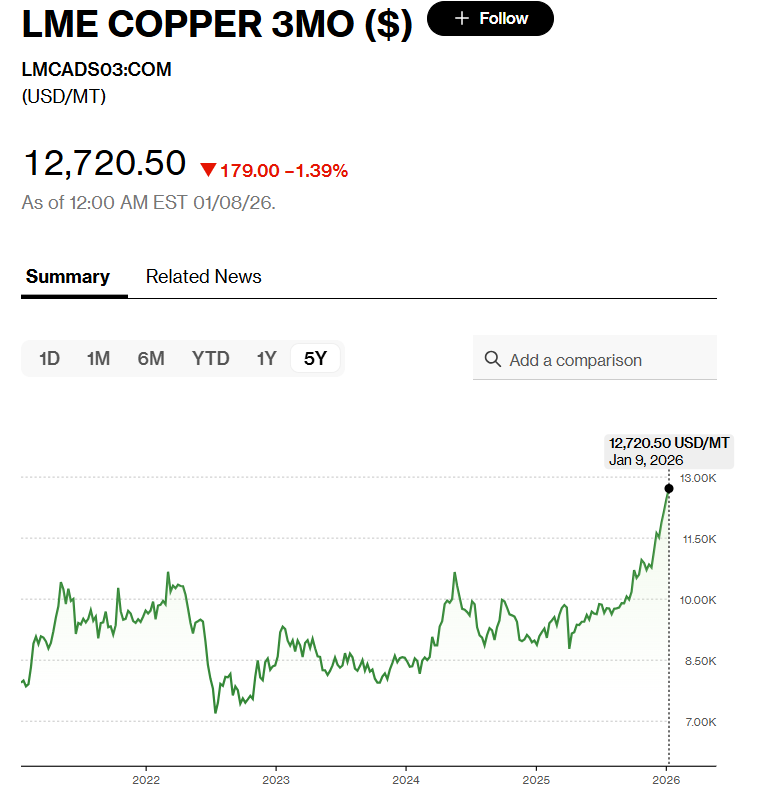
铜“牛市叙事”即将崩塌? 特朗普铜关税信号或成“牛转熊”最锋利拐点
智通财经网· 2026-01-09 10:08
Core Viewpoint - Goldman Sachs presents a mixed outlook on copper prices, acknowledging short-term bullish factors driven by scarcity and demand from the energy transition and AI infrastructure, while cautioning about a potential mid-term correction due to fundamental market conditions and U.S. tariff policies [1][5][9]. Group 1: Price Predictions - Goldman Sachs has raised its copper price forecast for the first half of 2026 from $11,525 per ton to $12,750 per ton, citing a "scarcity premium" and insufficient inventory outside the U.S. as key drivers [1][7]. - The firm maintains a cautious outlook for the fourth quarter of 2026, predicting a price of $11,200 per ton, indicating that prices above $13,000 per ton are unlikely to be sustainable in the long term [1][7]. Group 2: Market Dynamics - The recent surge in copper prices is attributed to two main factors: U.S. tariff expectations causing a "cross-regional depletion" effect and strong demand driven by AI-related investments [5][6]. - The U.S. copper market is experiencing a structural mismatch, with rising Comex copper inventories and declining LME copper stocks, leading to increased scarcity premiums [5][6]. Group 3: Tariff Implications - The uncertainty surrounding U.S. tariffs on refined copper products is a critical factor influencing market behavior, with potential announcements expected in the second quarter of 2026 [9][10]. - Goldman Sachs outlines various scenarios regarding tariff implementation, with a baseline scenario suggesting a 15% tariff announcement in mid-2026, while a delay could lead to significant downward pressure on copper prices [10][11]. Group 4: Speculative Positioning - The copper futures market is currently characterized by a crowded speculative long position, which may lead to increased volatility and sensitivity to market catalysts [11][12]. - A shift in the narrative from scarcity to potential oversupply could trigger a rapid price decline if the "hoarding logic" weakens [11][12].