
生成式AI

Search documents
多家港股上市企业AI收入增幅显著,迈向商业化深水区
Sou Hu Cai Jing· 2025-09-02 17:24
Core Insights - The article highlights the significant growth of AI-related revenues among several Hong Kong-listed companies in their 2025 semi-annual reports, indicating a shift from AI as a concept to its deep application and value realization in the business sector [3]. Group 1: Alibaba Cloud - Alibaba Cloud reported a remarkable 26% year-on-year increase in external commercial revenue, reaching 33.398 billion yuan, marking the highest growth rate in nearly three years [4] - AI revenue now constitutes over 20% of external commercial revenue, with related product revenue maintaining triple-digit year-on-year growth for eight consecutive quarters, driving the growth of cloud business [4] - To meet the rising global demand for cloud and AI, Alibaba Cloud has launched eight new data centers this year and plans to invest 380 billion yuan in cloud and AI hardware infrastructure over the next three years [4] Group 2: SenseTime - SenseTime achieved a revenue of 2.358 billion yuan in the first half of 2025, reflecting a year-on-year growth of 35.6%, with adjusted net losses narrowing by 50% to 1.162 billion yuan [5] - The rapid growth of the generative AI business, which generated 1.816 billion yuan in revenue (up 72.7% year-on-year), has significantly contributed to the company's performance recovery, increasing its share of total revenue to 77% [5][6] - SenseTime's strategic focus on a "computing power infrastructure - large model research - large model application" framework has created a positive business cycle, despite some restructuring challenges [6] Group 3: CloudWalk Technology - CloudWalk Technology reported a revenue of 405 million yuan in the first half of 2025, a 20.2% increase year-on-year, with explosive growth in large model revenue, which surged 457% to nearly 100 million yuan [7] - The sales revenue from solutions reached 283 million yuan, up 22.6% year-on-year, while AI chip shipments totaled 16.5 million units, a 0.7% increase from the previous year [7] Group 4: Baiwang Technology - Baiwang Technology achieved a revenue of 347.6 million yuan in the first half of 2025, a 23.5% year-on-year increase, with AI-related business revenue surpassing 60.86 million yuan, accounting for 17.5% of total revenue [8] - The company launched an enterprise-level intelligent agent matrix and collaborated with China COSCO Shipping Technology to introduce a global tax compliance intelligent machine, showcasing its strategic positioning in the AI sector [8] Industry Trends - The AI sector is transitioning from speculative hype to sustainable commercial value realization, as evidenced by the strong performance of multiple Hong Kong-listed companies in their semi-annual reports [8] - AI technology has made significant advancements and demonstrated robust monetization capabilities, helping companies explore new growth trajectories and driving the industry towards a new development phase [8]


马斯克追杀“内鬼”,OpenAI躺枪
Hu Xiu· 2025-09-02 13:12
Core Points - Elon Musk revealed that the entire codebase of his AI startup xAI was stolen by a former core engineer, Xuechen Li [1][6] - xAI filed a lawsuit against Li for multiple charges including theft of trade secrets and violation of confidentiality agreements [2][4] - The stolen codebase is valued at "billions of dollars" and is considered superior to competitors like ChatGPT [7][23] Group 1: Incident Details - Li, who graduated from Stanford and was one of the first engineers at xAI, had access to the entire technology stack and confidential files [11][12] - Prior to his resignation, Li sold his xAI shares for nearly $7 million [5][12] - On July 25, Li copied a significant amount of confidential information to personal storage systems before resigning on July 28 [13][14] Group 2: Legal Actions - xAI's security team discovered data leaks on August 11, leading to Li being identified as the suspect [16] - Li attempted to cover up his actions by changing passwords and denying access to stolen data [17][20] - xAI is seeking a temporary injunction to prevent Li from working in any AI-related role at OpenAI or other competitors until the stolen information is recovered [26] Group 3: Implications for Competition - The stolen trade secrets could provide OpenAI and other competitors with significant advantages, potentially saving billions in R&D costs [24] - The ongoing legal battle may escalate tensions between Musk and OpenAI, which has been a point of contention for some time [29][30]
一文看懂AI竞赛:王座更替,谁家的AI更招财
3 6 Ke· 2025-09-02 11:59
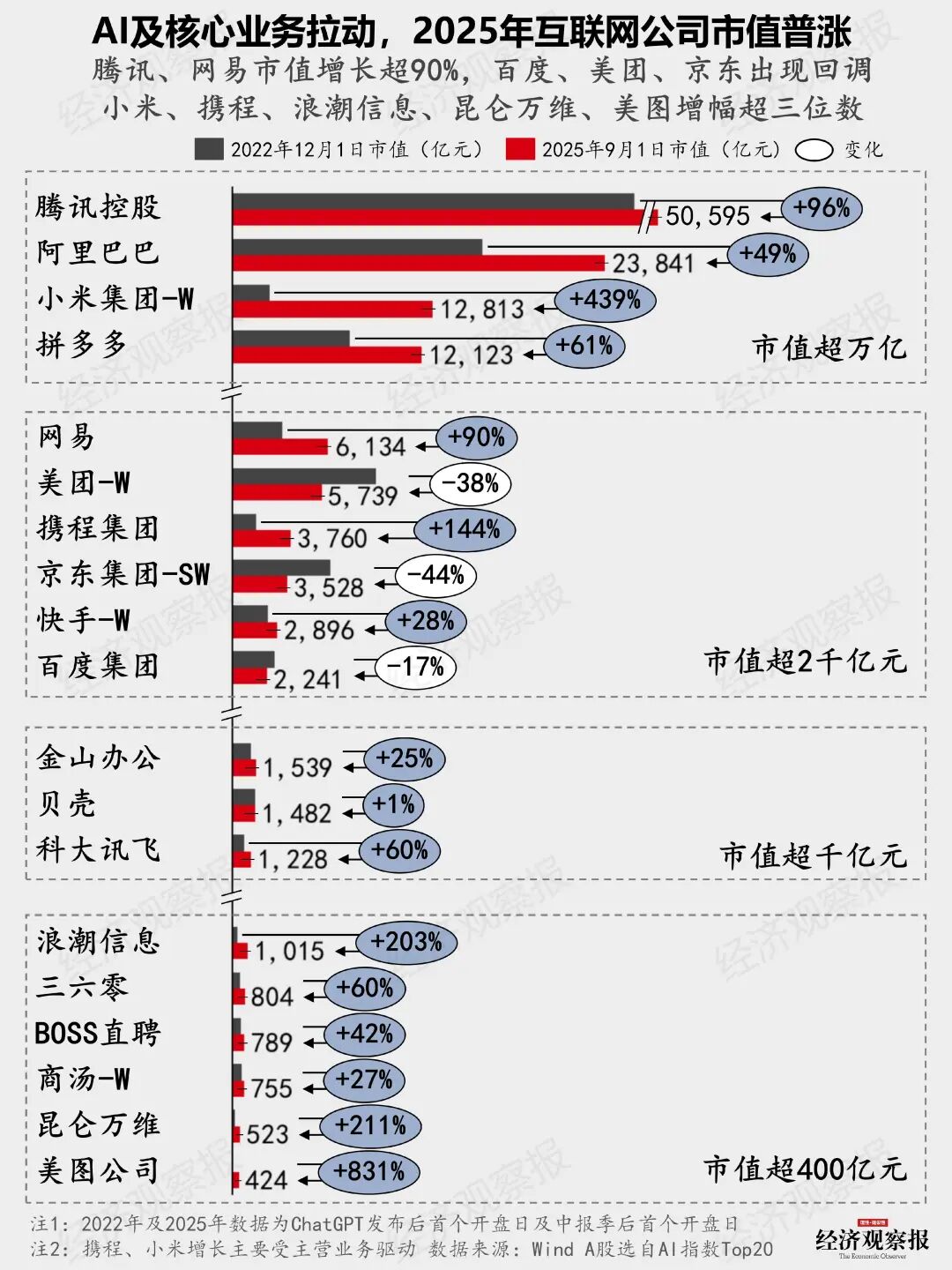
Group 1 - AI remains a capital-intensive sector, with model performance relying on parameters, data, and computing power, making capital expenditure a key indicator of AI strategy strength [1][7] - The fastest monetization applications of AI are in image and video generation, particularly in advertising and content creation, covering three main types of advertisers [1][11] - By the mid-2025 reporting season, nearly all internet companies with a market capitalization over 100 billion mentioned AI in their financial reports [1][2] Group 2 - Since the launch of ChatGPT, AI has transitioned from a technical slogan to real business applications, penetrating various revenue and cost segments such as advertising, video, subscriptions, and office services [2] - From December 1, 2022, to September 1, 2025, Tencent's market value increased by approximately 90% to 5 trillion yuan, while Alibaba returned to a market cap of 2 trillion yuan, and Xiaomi's market value surged by 439% to enter the "2 trillion club" [2] - The valuation changes are not solely driven by AI but also influenced by fundamentals, economic expectations, and policy impacts, with macroeconomic recovery and AI-related policies supporting valuation reassessment [3] Group 3 - Capital expenditures for Alibaba and Tencent in Q2 reached 38 billion yuan and 19.1 billion yuan, respectively, with year-on-year growth of 220% and 119% [7] - Alibaba's strategy includes a significant investment of 380 billion yuan over three years to build AI infrastructure, while its Q2 revenue was 247.6 billion yuan, showing a 2% year-on-year increase [7] - Baidu emphasized its "AI-first" strategy, with non-advertising core revenue exceeding 10 billion yuan, growing 34% year-on-year, but faced cash flow pressures with a negative cash flow of 4.7 billion yuan in Q2 [8] Group 4 - Image and video generation has become the fastest monetization track for AI, with companies like Baidu, Alibaba, Tencent, and others launching video generation models [11] - Kuaishou reported over 250 million yuan in revenue from its AI video generation model "Keling" in Q2, with expectations to double its annual revenue forecast [11] - The education sector is also emerging as a significant AI application area, with companies like NetEase's Youdao showing a clear "education-first" path and achieving 800 million yuan in AI-related revenue, a 30% year-on-year increase [12] Group 5 - Mid-sized internet companies are focusing on vertical scenarios and increasing R&D investment to find more certain AI commercialization paths, with R&D investment typically exceeding 20% of revenue [14] - Kingsoft Office reported a revenue of 2.657 billion yuan, with a 62% year-on-year growth in its WPS 365 business, and R&D investment accounting for 36% of revenue [15] - Companies like Kunlun Wanwei and 37 Interactive Entertainment are embedding AI into their business processes, with significant revenue growth and application in various sectors [15]




一文看懂AI竞赛:王座更替 谁家的AI更招财
Jing Ji Guan Cha Bao· 2025-09-02 11:04
Core Insights - In the AI era, major internet companies have integrated AI into various business segments, leading to significant changes in market valuations and company rankings [2][4] - The capital expenditure on AI has surged, with Alibaba and Tencent leading the investment race, indicating a shift towards long-term AI-driven narratives in the capital markets [5][7] Company Performance - Tencent remains the top company with a market value increase of approximately 90% to 5 trillion yuan, while Alibaba has regained a market value of over 2 trillion yuan [2] - Xiaomi's market value skyrocketed by 439% due to new business ventures, placing it in the "2 trillion club" [2] - Kuaishou reported a revenue of over 250 million yuan from its AI video generation model, reflecting its strategic importance [8][9] AI Investment Strategies - Alibaba's capital expenditure reached 38 billion yuan, a 220% increase year-on-year, while Tencent's was 19.1 billion yuan, up 119% [5] - Baidu's non-advertising core revenue surpassed 10 billion yuan, growing 34% year-on-year, but faced cash flow challenges due to heavy AI investments [6][10] Market Trends - The fastest monetization of AI applications is seen in image and video generation, particularly in advertising and content creation [8] - Companies like Kuaishou and Baidu are actively developing AI tools for video generation and search integration, indicating a competitive landscape [8][10] Emerging Companies - Mid-sized companies are focusing on vertical markets and increasing R&D investments, with many allocating over 20% of revenue to R&D [11][12] - Companies like Kingsoft Office and Kunlun Wanwei are successfully integrating AI into their core business models, showing promising growth [11][12]
LeCun今后发论文得亚历山大王批准!Meta搞出大无语操作
量子位· 2025-09-02 10:45
Core Viewpoint - Meta has announced a significant internal policy change requiring that all papers from its AI research division, FAIR, must be reviewed by the TBD lab before publication, indicating a shift in control and oversight within the company's AI research structure [1][7][10]. Group 1: Internal Policy Changes - The new policy mandates that any paper from FAIR must undergo evaluation by TBD, which is led by Meta's Chief AI Officer, Alexandr Wang [1][7][16]. - If TBD assesses a paper as valuable, it can be withheld from publication, and the authors will be required to apply the proposed technologies in Meta's products before returning to their regular work at FAIR [8][10][11]. - This move has caused unrest within FAIR, with some employees reportedly leaving for other AI startups due to dissatisfaction with the new regulations [12][26]. Group 2: Organizational Structure and Leadership - Following a recent reorganization, Meta's AI department is divided into four main divisions, with TBD and FAIR being parallel rather than hierarchical [15][16][18]. - Alexandr Wang, who oversees TBD, is perceived to have been given a higher position within the company, as he announced the reorganization under his name rather than Mark Zuckerberg's [22][42]. - The leadership of FAIR is currently held by Rob Fergus, who co-founded the division and returned to Meta after a stint at Google DeepMind [19][20]. Group 3: Implications for Research and Development - The new policy represents a significant shift in how research is conducted within Meta, as it imposes external oversight on what was previously an independent research environment [38][39]. - The idealistic vision of open research at Meta is being compromised, as the focus shifts towards immediate application and results-driven outcomes [38][40]. - The aggressive approach taken by Wang mirrors Zuckerberg's earlier strategies, suggesting a continuation of a results-oriented culture within Meta's AI initiatives [27][42].


75家机器人上市公司2025半年报总结:营收5821亿,盈利301亿,传统巨头与AI新锐谁能最终胜出?
机器人圈· 2025-09-02 10:32
Core Viewpoint - The Chinese robotics and artificial intelligence industry is experiencing a bifurcation, with leading companies like Cambricon and Orbbec achieving explosive growth driven by generative AI and 3D vision, while traditional firms like Geling Deep Vision and Jiangsu Beiren face significant losses [2][4]. Market Performance Overview - The overall industry is in a high prosperity phase, with 75 listed companies reporting total revenue of 582.994 billion yuan and a combined net profit of 30.097 billion yuan. 53 companies achieved year-on-year revenue growth, and 53 companies reported an increase in net profit [4][5]. Revenue and Profit Rankings - The top revenue-generating company, Industrial Fulian, reported 360.76 billion yuan, significantly outpacing the other nine companies combined. Other notable companies include Hikvision, Huichuan Technology, and Sanhua Intelligent, which not only have substantial net profits but also impressive growth rates of 36%-60% [9][11]. Losses and Challenges - Companies like SenseTime, Black Sesame Intelligence, and Unibot are showing trends of revenue growth and narrowing losses, indicating potential for value reassessment with technological breakthroughs. However, companies like Efort and Xinsong are facing dual declines, reflecting intense market competition and rapid technological changes [12][13]. Performance Growth Leaders - The top performers in terms of growth include companies like Cambricon, which reported a staggering revenue growth rate of 4347.82%, and a profit growth rate of 295.85%, highlighting the significant impact of global investments in AI technologies [11][13].






想找到21岁的乔布斯,跟他说:Hi
虎嗅APP· 2025-09-02 10:27
Core Viewpoint - The article emphasizes the emergence of a new generation of AI entrepreneurs under 30, highlighting their potential to redefine technology and business models in the AI landscape, similar to past tech pioneers like Steve Jobs and Bill Gates [5][19]. Group 1: AI Entrepreneurs and Their Impact - The article discusses how young entrepreneurs are leveraging generative AI technologies, with examples of startups like Mercor, Cognition AI, and Anyshpere, showcasing their rapid growth and innovative products [6][9]. - It notes that the age of 30 serves as a symbolic milestone, but the true measure of these entrepreneurs lies in their AI-native thinking and capabilities [7][8]. Group 2: Selection Criteria for AI Leaders - The "Top 20 AI Leaders Under 30" list is being created to identify promising young leaders who are either co-founders of startups or chief scientists in major AI firms, with a focus on those whose products are fundamentally AI-driven [10][19]. - The selection process will prioritize long-term value over superficial metrics, evaluating aspects such as financing, market potential, technology, product performance, and business viability [11][16]. Group 3: Participation and Timeline - The recruitment phase for the list began in September, inviting eligible AI entrepreneurs to self-nominate or be nominated by others, with specific information required for submission [13][17]. - Key dates include the application period from now until October 20, evaluation from October 21 to 29, and the announcement of the list between November 3 and 20 [17][22]. Group 4: Evaluation Dimensions - The evaluation will consider various dimensions, including technical strength, product effectiveness, commercial prospects, growth metrics, and financing capabilities [21]. - Specific criteria include R&D investment, core team qualifications, user growth, market space, and revenue growth rates [16][21]. Group 5: Collaboration and Expert Involvement - The initiative is supported by several investment firms and organizations, indicating a collaborative effort to identify and promote emerging AI talent [14][28]. - A panel of industry experts will be involved in the evaluation process, ensuring a comprehensive assessment of candidates [28].

Gartner《2025中国AI趋势》的十大关键趋势
Sou Hu Cai Jing· 2025-09-02 09:29
Core Insights - The report emphasizes that generative AI is profoundly transforming Chinese enterprises, significantly enhancing employee capabilities and creating numerous cross-departmental applications while raising AI governance to unprecedented levels [2] - A major challenge identified is the uncertainty regarding the return on investment (ROI) from AI, with only 13% of respondents expressing high confidence in calculating AI's ROI, and 36% showing low confidence [2] Key Trends - **Open Generative AI Models**: The focus is on ecological control, compliance, and industrial safety, with the launch of open-source models like DeepSeek marking a significant shift in the market landscape [2][3] - **Build Strategy**: Chinese enterprises prefer to develop their own solutions to achieve customized innovation and protect data sovereignty, particularly in government and large state-owned enterprises [3] - **Agent-based AI**: This approach emphasizes intelligent agents capable of task perception, execution, and feedback, moving beyond simple text generation to more complex task execution [4][5] - **Frugal AI**: Companies are focusing on cost-effectiveness rather than maximum performance, emphasizing lightweight deployment and local inference, which is particularly important for SMEs [6] - **Engineering Capability**: The engineering strength of Chinese enterprises is crucial for accelerating the transition of AI from concept to implementation, with a notable increase in the production landing rate of generative AI from 8% in 2024 to 43% in 2025 [6] - **Collaborative AI Security**: The rise of generative AI has led to increased security concerns, necessitating a collaborative governance framework across IT, legal, and business departments [6] - **AI Talent Pool**: China has a rich talent pool in AI, with a significant increase in the proportion of Chinese authors in top AI conferences, and a growing need for business-savvy talent as generative AI becomes more accessible [7] - **Ubiquitous AI**: AI applications are expanding beyond traditional office settings, thriving in B2C scenarios and leveraging China's strengths in 5G and digital ecosystems [8][9] - **Inclusive AI Ecosystem**: Chinese companies are shifting towards a one-stop service model that integrates models, platforms, tools, and services, enhancing customer choice and deployment speed [10][11] - **Data as a Core Barrier**: Unique data has become a critical asset for leveraging AI successfully, forming a closed-loop evolution between data management and AI capabilities [12] Conclusion - The ten trends identified are interconnected and collectively empower Chinese enterprises to innovate, achieve business transformation with controllable costs, and drive a B2C-oriented AI ecosystem, positioning them for significant global impact [12]

xAI工程师“叛逃”OpenAI:套现700万美元 盗走“价值数十亿美元”代码库
Mei Ri Jing Ji Xin Wen· 2025-09-02 08:40
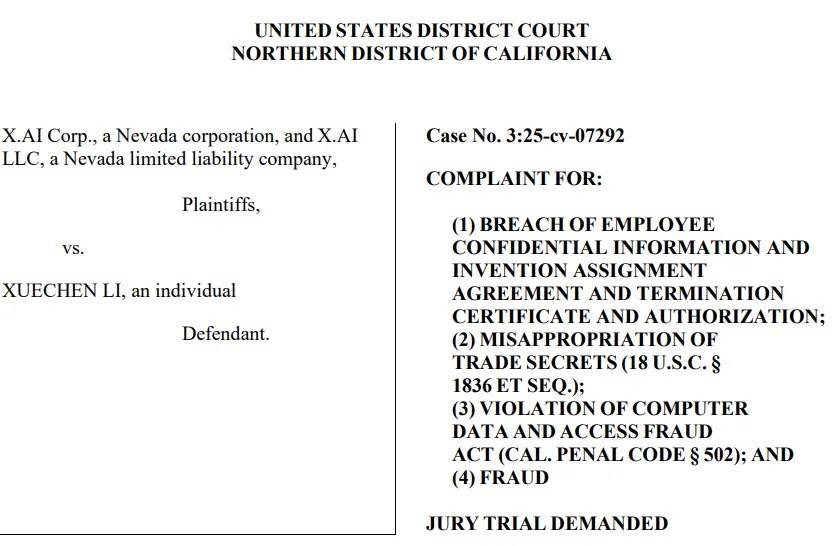
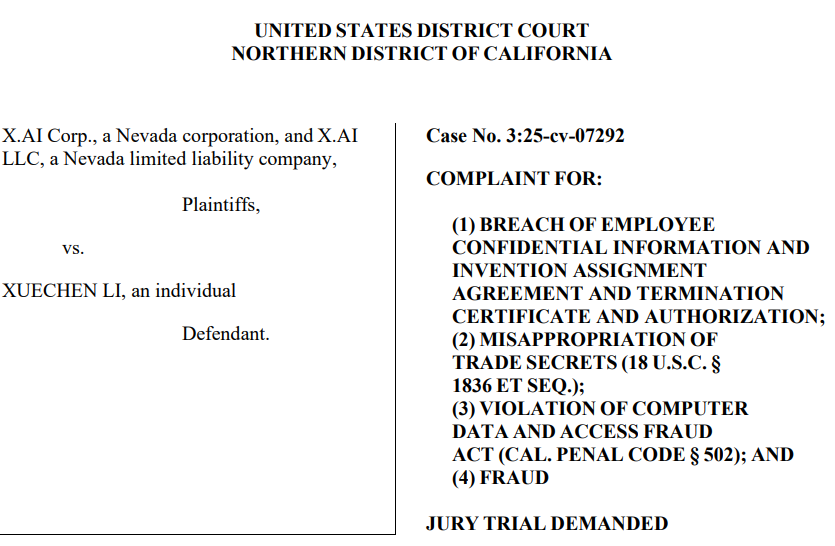
近日,埃隆·马斯克亲口爆料,其旗下人工智能初创公司xAI的整个代码库被盗了。涉案的主角并非外部人员,而是xAI 早期的核心工程师之一——Xuechen Li(以下简称"Li")。 8月28日,xAI以窃取商业机密的名义将Li告上加州北区联邦法院。起诉书显示,xAI对Li进行了四项指控,分别是违反 《员工保密信息与发明转让协议》和《离职证明与授权书》、盗取商业机密、违反《计算机数据与访问欺诈法》和欺 诈。 图片来源:xAI起诉书截图 根据xAI的指控,Li在离职前夕,精心策划并执行了一场"代码库大迁徙",随后还计划无缝跳槽至马斯克的"死对头"—— OpenAI。 而在窃密事件发生前,Li刚刚将手中的xAI股权套现,累计获利近700万美元。 尽管OpenAI并不是这次案件的被告,但这事儿一出来,马斯克与OpenAI之间本就剑拔弩张的关系,无疑将更紧张了。 价值"数十亿美元"的代码库失窃 要讲清楚这起代码盗窃案,还得从xAI和Li的渊源说起。 2024年,Li从斯坦福大学毕业,并取得计算机博士学位。他在学术期刊上发表过不少AI相关文章。同年2月,他加入了 刚刚起步的xAI,成为公司的首批20名工程师之一,深度参与x ...
AI模型终于能翻译“拼多多砍一刀”了
3 6 Ke· 2025-09-02 08:25
Core Insights - Tencent's Hunyuan-MT series translation models, Hunyuan-MT-7B and Hunyuan-MT-Chimera-7B, have been released as open-source, providing advanced machine translation capabilities across 33 languages, including minority languages and dialects [1][7][18] - The models have demonstrated superior performance in various translation benchmarks, outperforming established systems like Google Translate and other models with significantly larger parameters [2][26] - Hunyuan-MT-7B achieved first place in 30 out of 31 language pairs at the WMT 2025 competition, showcasing its effectiveness in both resource-rich and resource-scarce languages [4][22] Model Performance - Hunyuan-MT-7B excels in translating internet slang and gaming terminology, accurately interpreting phrases like "小红薯" as "REDnote" and "砍一刀" as Pinduoduo's pricing mechanism, while Google Translate fails to capture the context [8][10] - The model's understanding of cultural nuances and idiomatic expressions allows it to produce translations that are more natural and contextually appropriate compared to traditional systems [12][13] - In professional translation tests, Hunyuan-MT-7B showed strong capabilities in translating specialized terms, although it still faced challenges in maintaining fluency in sentence structure [15][18] Technical Advancements - The models utilize a "weak-to-strong" reinforcement learning approach, integrating multiple candidate translations to enhance output quality beyond single candidates [5][24] - Hunyuan-MT-7B has been optimized for performance, achieving a 30% improvement in inference speed through FP8 quantization [7][26] - The training data for these models includes a vast dataset of 1.3 trillion tokens from over 112 languages, ensuring a diverse and high-quality training foundation [19][21] Future Implications - The advancements in machine translation technology, particularly through the use of generative AI, are expected to significantly enhance cross-border business operations for companies like Tencent, ByteDance, and Alibaba [28] - The ongoing development of translation models indicates a trend towards more sophisticated and efficient solutions in the field of computational linguistics, potentially leading to broader applications in various industries [28]
