
绿色消费

Search documents
中汽协预计2026年汽车总销量达3475万辆
Di Yi Cai Jing· 2026-01-14 09:39
Core Insights - The Chinese automotive industry is projected to achieve a total production and sales volume of 34.53 million and 34.40 million vehicles respectively in 2025, marking a year-on-year growth of 10.4% and 9.4% [1] - The sales of new energy vehicles (NEVs) are expected to exceed 16 million units in 2025, with domestic new car sales accounting for over 50% of the market, solidifying their position as a dominant force [1] - The automotive export volume is anticipated to surpass 7 million units, reaching 7.098 million, with NEV exports doubling to 2.615 million units [1] Industry Performance - The automotive industry in China has demonstrated resilience against external pressures such as trade protectionism and global supply chain restructuring, achieving both scale and quality improvements [1] - During the "14th Five-Year Plan" period, the industry maintained a production and sales volume exceeding 30 million units for three consecutive years, with revenue surpassing 1 trillion yuan [2] Sales Forecast - Total vehicle sales are projected to reach 34.75 million units in 2026, with NEV sales expected to hit 19 million units, reflecting a growth rate of 15.2% [3] - The breakdown for 2025 includes 30.10 million passenger vehicles and 4.30 million commercial vehicles, with respective growth rates of 9.2% and 10.9% [3]

十四五收官年战报:重卡超114万!商用车销430万辆 新能源渗透率多少?| 头条
第一商用车网· 2026-01-14 09:32
Core Viewpoint - In 2025, the commercial vehicle market in China experienced growth in both domestic demand and exports, driven by strong policy support for new energy vehicles, leading to a structural recovery and growth in the market [1][24]. Production and Sales Data - In December 2025, China's automobile production and sales reached 3.296 million and 3.272 million units, respectively, with a month-on-month decline of 6.7% and 4.6%, and a year-on-year decline of 2.1% and 6.2% [1]. - For the entire year of 2025, automobile production and sales totaled 34.531 million and 34.400 million units, marking a year-on-year increase of 10.4% and 9.4%, with production and sales remaining above 30 million units for three consecutive years [1][24]. Commercial Vehicle Performance - In December 2025, commercial vehicle production and sales were 416,000 and 425,000 units, respectively, with month-on-month increases of 7.4% and 8.5%, and year-on-year increases of 15.5% and 15.3% [1][3]. - For the entire year, commercial vehicle production and sales reached 4.261 million and 4.296 million units, reflecting year-on-year growth of 12% and 10.9% [3]. Truck Segment Insights - In December 2025, truck production and sales were 357,000 and 361,000 units, with month-on-month increases of 7.2% and 6.7%, and year-on-year increases of 17.6% and 17.2% [5]. - Heavy-duty truck sales reached 1.145 million units for the year, showing a significant year-on-year increase of 27% [7]. Bus Segment Insights - In December 2025, bus production and sales were 59,000 and 64,000 units, with month-on-month increases of 8.6% and 20.1%, and year-on-year increases of 3.9% and 5.5% [8]. - For the entire year, bus production and sales totaled 568,000 and 574,000 units, with year-on-year growth of 11.8% and 12.3% [11]. Pickup Truck Performance - In 2025, pickup truck production and sales reached 591,000 and 609,000 units, with year-on-year increases of 12.6% and 11.1% [10]. Export Performance - In December 2025, commercial vehicle exports reached 112,000 units, with a month-on-month increase of 7.3% and a year-on-year increase of 42.4% [17][18]. - For the entire year, commercial vehicle exports totaled 1.06 million units, reflecting a year-on-year growth of 17.2% [20]. New Energy Vehicle Insights - In December 2025, domestic sales of new energy commercial vehicles reached 120,000 units, with a month-on-month increase of 23.2% and a year-on-year increase of 72%, accounting for 38.3% of total commercial vehicle sales [20]. - For the entire year, domestic sales of new energy commercial vehicles reached 871,000 units, with a year-on-year growth of 63.7%, representing 26.9% of total commercial vehicle sales [20].

2025年我国汽车产销量再创历史新高,连续17年稳居全球第一
Yang Shi Xin Wen· 2026-01-14 09:04
中国汽车工业协会副秘书长 陈士华:"十四五"期间,我国汽车行业取得多方面突破,产销量连续三年 保持3000万辆以上规模,营业收入突破10万亿元,出口跻身世界第一,电动化与智能化、网联化加速融 合,形成产业领先优势。 中国汽车工业协会今天(14日)发布的最新数据显示,2025年,我国汽车行业继续展现出强大的发展韧 性和活力,多项经济指标再创新高。 2025年,汽车产销量分别为3453.1万辆和3440万辆,同比分别增长10.4%和9.4%,产销量再创历史新 高,连续17年稳居全球第一。新动能加快释放,新能源汽车产销量超1600万辆,其中国内新车销量占比 超50%,成为我国汽车市场主导力量。在对外贸易方面,呈现出较强韧性,汽车出口超700万辆,出口 规模再上新台阶。其中,新能源汽车出口261.5万辆,同比增长1倍。 中国汽车工业协会副秘书长 陈士华:2026年,"两新"政策平稳有序衔接。包括9部门联合印发的《关于 实施绿色消费推进行动的通知》,将加快发展方式和消费模式绿色转型,这将稳定市场预期,提振汽车 消费。2026年,中国汽车产业将持续推进高质量发展,整体市场保持稳健运行。 来源:央视新闻 中国汽车工业协会相 ...
1%! 中汽协发布2026年汽车销量预测
Zhong Guo Jing Ying Bao· 2026-01-14 08:37
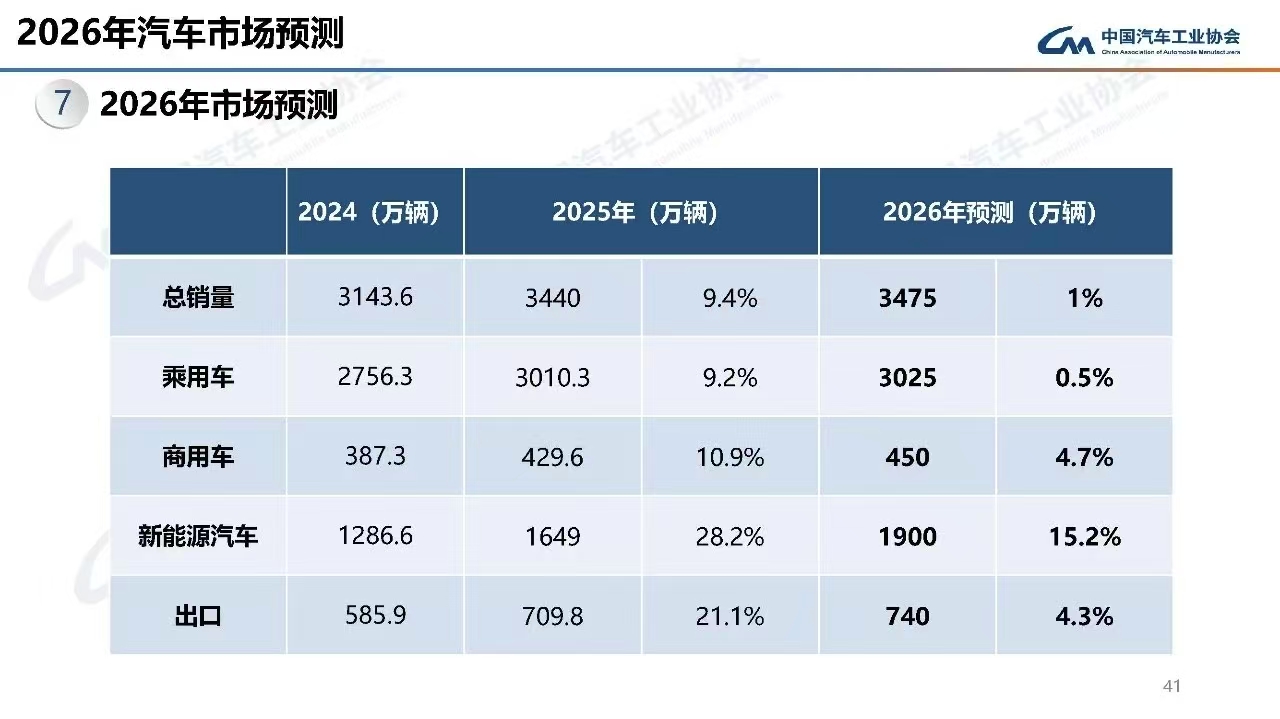
2026年,我国经济工作坚持稳中求进,提质增效,坚持内需主导。国家有关部委聚焦中央经济工作会议 部署的重点任务,紧抓时间窗口,主动靠前发力,"两新"政策已于2025年年底发布,政策平稳有序衔 接。 近日,商务部、工业和信息化部等9部门联合印发《关于实施绿色消费推进行动的通知》,加快发展方 式和消费模式绿色转型,"十五五"时期培育绿色消费新增长点。随着系列政策落地实施,将有利于坚定 发展信心,稳定市场预期,提振汽车消费。2026年,中国汽车产业将持续推进高质量发展,整体市场保 持稳健运行。 (文章来源:中国经营报) 2026年1月14日,中国汽车工业协会发布了2025年全年我国汽车产销数据及经济运行情况,并对2026年 汽车市场进行了预测。 《中国经营报》记者了解到2026年,预计我国汽车总销量将达到3475万辆,微增1%。其中,乘用车预 计为3025万辆,微增0.5%;商用车预计为450万辆,小幅增长4.7%;新能源汽车预计为1900万辆,增长 15.2%;汽车出口量预计为740万辆,小幅增长4.3%。 ...
均突破3400万辆!2025年我国汽车产销量再创历史新高
中国基金报· 2026-01-14 07:18
来源:新闻联播 中国汽车工业协会今天( 1 4日)发布的最新数据显示, 2 025年,我国 汽车行业继续展现出 强大的发展韧性和活力,多项经济指标再创新高。 2025年,汽车产销量分别为3453.1万辆和3440万辆,同比分别增长10.4%和9.4%,产销量再 创历史新高,连续17年稳居全球第一 。其中,新动能加快释放,新能源汽车产销量超1600万 辆,其中国内新车销量占比超50%,成为我国汽车市场主导力量。在对外贸易方面,呈现出较强 韧性,汽车出口超700万辆,出口规模再上新台阶。其中, 新能源汽车出口261.5 万辆,同比 增长 1倍 。 中国汽车工业协会副秘书长 陈士华介绍,"十四五"期间,我国汽车行业取得多方面突破,产销 量连续三年保持3000万辆以上规模, 营业收入突破10万亿元,出口跻身世界第一 ,电动化与 智能化、网联化加速融合,形成产业领先优势。 2025年,我国"两新"政策加力扩围,企业新品密集上市,汽车市场终端需求持续释放,2 025 年汽车产销量实现超预期增长。值得注意的是, 2 025年, 中国品牌乘用车销量占比接近 70%,较去年同期上升4.3个百分点。2025年,在政策利好、供给丰 ...
中汽协:2025年汽车产销累计完成3453.1万辆和3440万辆 产销量再创历史新高
智通财经网· 2026-01-14 07:09
Group 1 - The core viewpoint of the article highlights that China's automotive industry is expected to achieve record production and sales figures in 2025, maintaining its position as the world's largest automotive market for 17 consecutive years [10][1] - In 2025, total automotive production and sales are projected to reach 34.53 million and 34.40 million units, respectively, representing year-on-year growth of 10.4% and 9.4% [10][1] - The passenger vehicle market is expected to show steady growth, while the commercial vehicle market is recovering with over 10% growth, surpassing 4 million units [10][1] Group 2 - The new energy vehicle (NEV) sector is anticipated to see production and sales exceeding 16 million units, with NEVs accounting for over 50% of new car sales in China [10][1] - Exports of automobiles are projected to exceed 7 million units, with NEV exports reaching 2.615 million units, marking a significant increase [10][1] - The overall automotive market is expected to maintain stable operations, supported by government policies aimed at boosting domestic demand and promoting green consumption [6][2] Group 3 - In 2025, domestic sales of passenger vehicles are expected to reach 27.302 million units, reflecting a year-on-year increase of 6.7% [17][1] - Traditional fuel vehicle sales are projected to decline by 4%, while NEV sales are expected to grow significantly [17][1] - The market share of Chinese brand passenger vehicles is anticipated to approach 70%, with a notable increase in sales volume [29][1] Group 4 - The commercial vehicle market is expected to see production and sales of 4.261 million and 4.296 million units, respectively, with year-on-year growth of 12% and 10.9% [51][1] - The heavy-duty truck segment is projected to grow by 27%, while light-duty trucks are expected to see a 6.5% increase in sales [52][1] - The market for commercial vehicles is benefiting from both domestic demand and export growth, supported by favorable government policies [51][1] Group 5 - The NEV sector is projected to achieve production and sales of 16.626 million and 16.49 million units, respectively, with year-on-year growth of 29% and 28.2% [70][1] - NEV domestic sales are expected to account for 50.8% of total domestic vehicle sales, with significant growth in both passenger and commercial NEVs [84][1] - The export of NEVs is anticipated to reach 2.615 million units, doubling from the previous year, with strong growth in both passenger and commercial segments [85][1]
中国汽车,连续17年全球第一
财联社· 2026-01-14 06:23
Group 1 - The core viewpoint of the article highlights that by 2025, China's automotive production and sales are projected to reach 34.53 million and 34.40 million units respectively, marking a year-on-year growth of 10.4% and 9.4%, thus achieving a historical high and maintaining the position as the world's largest automotive market for 17 consecutive years [1] - New energy vehicles (NEVs) are expected to exceed 16 million units in production and sales, with domestic new car sales accounting for over 50%, establishing themselves as the dominant force in China's automotive market [1] - The export of automobiles is showing strong resilience, with over 7 million units exported, and NEV exports reaching 2.615 million units, which is a 100% year-on-year increase [1] Group 2 - During the 14th Five-Year Plan period, China's automotive industry has achieved significant breakthroughs, maintaining production and sales above 30 million units for three consecutive years, with revenue surpassing 10 trillion yuan, and becoming the world's largest exporter [1] - By 2025, the market share of domestic passenger vehicles is expected to approach 70%, an increase of 4.3 percentage points compared to the previous year, driven by favorable policies, abundant supply, and continuous improvement in infrastructure [1] - The "Two New" policies are expected to accelerate and expand, leading to a continuous release of terminal demand in the automotive market, resulting in an anticipated growth in production and sales that exceeds expectations [1]
产业运行 | 2025年12月汽车工业产销情况
中汽协会数据· 2026-01-14 06:22
Core Viewpoint - The Chinese automotive industry is projected to achieve record production and sales in 2025, with a total of 34.53 million vehicles produced and 34.40 million sold, marking a year-on-year growth of 10.4% and 9.4% respectively, maintaining its position as the world's largest automotive market for 17 consecutive years [12][18]. Group 1: Overall Production and Sales - In 2025, the automotive industry will produce and sell 34.53 million and 34.40 million vehicles respectively, achieving a historical high and surpassing 30 million units for three consecutive years [12][18]. - The passenger vehicle market is expected to grow steadily, contributing significantly to overall market growth, while commercial vehicles are projected to recover with over 10% growth, exceeding 4 million units [12][18]. - The export of automobiles is anticipated to exceed 7 million units, with new energy vehicle exports reaching 2.615 million units, showcasing strong resilience in foreign trade [12][18]. Group 2: Passenger Vehicle Market - In 2025, passenger vehicle production and sales will surpass 30 million units, with total production at 30.27 million and sales at 30.10 million, reflecting year-on-year growth of 10.2% and 9.2% respectively [29]. - The market share of Chinese brand passenger vehicles is close to 70%, with sales reaching 20.936 million units, a year-on-year increase of 16.5% [31]. - New energy passenger vehicles are expected to outperform traditional fuel vehicles, with significant growth across various price segments [32][41]. Group 3: Commercial Vehicle Market - The commercial vehicle market is projected to show a recovery, with production and sales reaching 4.261 million and 4.296 million units respectively, reflecting year-on-year growth of 12% and 10.9% [53]. - The sales of heavy-duty trucks are expected to grow by 27%, while light-duty trucks will see a 6.5% increase [54]. - The market for commercial vehicles will benefit from both domestic demand and export growth, with a notable increase in new energy commercial vehicle penetration [53]. Group 4: New Energy Vehicles - In 2025, new energy vehicle production and sales will exceed 16 million units, with production at 16.626 million and sales at 16.490 million, marking year-on-year growth of 29% and 28.2% respectively [72][74]. - The domestic sales of new energy vehicles are projected to reach 13.875 million units, with a year-on-year increase of 19.8% [77]. - New energy vehicles will account for over 50% of total vehicle sales, with significant contributions from both passenger and commercial segments [86]. Group 5: Key Enterprises and Export Situation - The top fifteen automotive groups in China will account for 92.3% of total vehicle sales, with a combined sales volume of 31.741 million units, reflecting a year-on-year growth of 9.1% [94]. - In 2025, the export of commercial vehicles is expected to exceed 1 million units for the first time, with a total of 1.06 million units exported, marking a year-on-year increase of 17.2% [67]. - The export of new energy vehicles is projected to reach 2.615 million units, doubling from the previous year, indicating a strong international competitive position [87].
解码2026“国补”新政
Jing Ji Wang· 2026-01-14 02:24
Group 1: National Subsidy Policy - The new "National Subsidy" policy, with an initial funding of 62.5 billion yuan, aims to boost consumption upgrades and improve livelihoods by focusing on large-scale equipment updates and trade-in programs for consumer goods [2][4] - The 2026 subsidy rules have been optimized compared to 2025, with specific adjustments for automobiles and home appliances, including a 15% subsidy for energy-efficient products and a cap of 1,500 yuan per item [2][7] - The inclusion of smart glasses in the subsidy program reflects the government's support for the smart wearable industry and aligns with the trend of consumption upgrades [3][4] Group 2: Smart Glasses Market - Smart glasses are transitioning from niche products to practical tools for various scenarios, including education, workplace efficiency, and fitness monitoring, which is attracting attention from major tech companies [5][6] - The domestic retail market for smart glasses is expected to recover significantly this year, with companies like VITURE expanding their presence in key urban areas [3][6] - The smart glasses segment is projected to experience substantial growth, with the global AI glasses market expected to reach 6.653 billion yuan in 2025 and 18.209 billion yuan in 2026 [5] Group 3: Home Appliances and Environmental Focus - The 2026 subsidy policy emphasizes energy-efficient home appliances, with a focus on products meeting level 1 energy or water efficiency standards, which is expected to enhance the market share of green products [7][8] - The policy changes are anticipated to accelerate the elimination of outdated production capacities and drive companies to invest more in R&D for high-end, eco-friendly products [7][8] - The shift towards level 1 energy-efficient products is expected to significantly reduce carbon emissions, reinforcing the social value of green consumption [8] Group 4: Market Dynamics and Consumer Behavior - The adjustment in subsidy policies is likely to lead to a decline in sales for lower-efficiency products while promoting higher-efficiency alternatives, thus influencing consumer purchasing behavior [9][10] - The smart consumer electronics sector is experiencing high growth, with online retail sales of smart wearables increasing by 23.1% from January to October 2025, indicating a strong demand for intelligent and experiential products [10]

发布28条政策促进消费和服务业联动发展 上海:优化汽车贷款流程 放宽申请条件
Zhong Guo Zheng Quan Bao· 2026-01-13 21:03
Group 1 - The core viewpoint of the article is the introduction of 28 policy measures by the Shanghai Municipal Government to enhance service quality and boost consumption across six key sectors: finance, information services, transportation, cultural and entertainment services, life services, and inspection and certification [1][3] Group 2 - In the financial sector, the measures encourage innovation in financial products tailored to new consumption trends, such as holiday, night, nostalgic, and anime economies, and include personal consumption loan interest subsidies and optimized auto loan processes [1][2] - In transportation services, the government supports airlines in launching new international routes and developing luxury tourism trains, as well as enhancing airport commercial layouts to create composite consumption scenarios [2] - In the cultural and entertainment sector, there is a focus on promoting the gaming and esports industry, supporting the development of original IP games, and incentivizing quality micro-short film content creation [2] Group 3 - The next steps involve ensuring the effective implementation of the measures by coordinating service supply with consumer demand, promoting digital, green, and intelligent consumption, and enhancing service quality [3] - The government aims to create a favorable environment for sustained consumption growth by implementing fiscal and financial support policies and improving service quality management and brand building [3]