
生成式AI

Search documents
商汤-W(00020):利润与现金流改善,生成式AI持续高增
SINOLINK SECURITIES· 2025-08-29 02:48
Investment Rating - The report maintains a "Buy" rating for the company [4] Core Views - The company reported a revenue of 2.36 billion RMB for the first half of 2025, representing a year-on-year growth of 35.6%. The gross profit was 910 million RMB, up 18.4% year-on-year, while the net loss narrowed to 1.49 billion RMB, a reduction of 39.9% compared to the previous year [2] - The company's cash flow from operating activities showed a net outflow of 640 million RMB, which is an improvement of 81.9% compared to the same period last year [2] - The generative AI segment generated 1.82 billion RMB in revenue, marking a significant year-on-year increase of 72.7%. The company has optimized its GPU chip mix, achieving a 20% improvement in computing efficiency compared to the previous year [3] - The visual AI segment's revenue was 440 million RMB, down 14.8% year-on-year, but there was a notable increase in overseas opportunities and orders [3] - The company reduced its workforce by 31.4% during the reporting period, leading to a 72.5% year-on-year increase in revenue per employee, which reached 261,000 RMB [3] - The company expects revenues for 2025 to reach 5.04 billion RMB, with projected growth rates of 33.7%, 27.1%, and 23.8% for the years 2025, 2026, and 2027 respectively [4] Summary by Sections Performance Review - In the first half of 2025, the company achieved a revenue of 2.36 billion RMB, with a gross profit of 910 million RMB and a net loss of 1.49 billion RMB [2] Business Analysis - The generative AI revenue was 1.82 billion RMB, growing 72.7% year-on-year, while the visual AI segment saw a revenue decline to 440 million RMB [3] - The company improved its operational efficiency, resulting in a significant reduction in workforce and an increase in revenue per employee [3] Profit Forecast, Valuation, and Rating - Revenue projections for 2025, 2026, and 2027 are 5.04 billion RMB, 6.41 billion RMB, and 7.94 billion RMB respectively, with corresponding net losses expected to narrow over the years [4]
商汤科技发布半年报:生成式AI业务爆发性增长
Jing Ji Guan Cha Wang· 2025-08-29 02:29
Core Insights - SenseTime reported a total revenue of 2.358 billion yuan for the first half of 2025, marking a year-on-year increase of 35.6%, primarily driven by explosive growth in its generative AI business [1] - The company's net loss narrowed to 1.489 billion yuan, a nearly 40% decrease year-on-year, reflecting the success of its strategy to focus on core operations and improve efficiency [1] - The gross margin decreased from 44.1% in the same period last year to 38.5%, attributed to rising hardware costs and operational expenses of AI data centers [1] Revenue Breakdown - The generative AI business generated 1.815 billion yuan in revenue, a year-on-year increase of 72.7%, and accounted for 77.0% of total revenue, up from 60.4% in the previous year [1] - Traditional visual AI business revenue was 436 million yuan, down 14.8% year-on-year, due to a shift in collaboration model with a major client [2] - The "X Innovation Business," which includes smart driving and healthcare, reported revenue of 107 million yuan, a decline of approximately 39.6% year-on-year, primarily due to a drop in smart driving revenue [2] R&D and Strategic Developments - R&D expenditure for the first half of 2025 was 2.1185 billion yuan, an increase of 12.0% compared to 1.8922 billion yuan in the same period of 2024, driven by investments in foundational model training and generative AI applications [2] - The company has restructured its revenue reporting categories, now classifying its business into generative AI, visual AI, and X innovation, with AI GPU chip companies excluded from consolidated financial statements [1] - SenseTime's "1+X" strategy has made substantial progress, with generative AI further solidifying its position in revenue, and the company has established a specialized leadership structure to enhance the operational vitality of its X innovation business [3]
科技行情火热,半导体设备ETF(561980)昨日涨超8%,短期急涨之后,后市会如何走?
2 1 Shi Ji Jing Ji Bao Dao· 2025-08-29 02:19
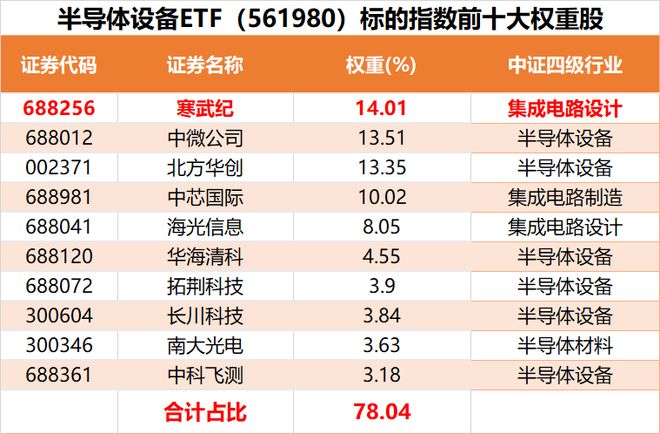
Core Viewpoint - The A-share technology market is experiencing a strong rally, particularly in the semiconductor and chip sectors, with significant gains in stocks like Cambrian Technology, which surged by 15.73% to reach a record price of 1595 yuan, surpassing Kweichow Moutai and becoming the new stock king of A-shares [1] Group 1: Market Performance - The semiconductor equipment ETF (561980) saw a daily increase of 8.40%, with a net inflow of 39.35 million yuan, bringing its total scale to over 1 billion yuan [1] - The A-share market has shown steady growth, with the Shanghai Composite Index surpassing 3800 points, marking a ten-year high, and trading volume and margin financing balances continuing to rise [4] Group 2: Index Composition - As of August 28, Cambrian Technology accounts for 14.01% of the semiconductor equipment ETF (561980), making it the largest weighted stock in the index [2][3] - The top five weighted stocks in the index collectively account for nearly 59%, while the top ten account for over 78%, indicating a high concentration in the index [2][3] Group 3: Financial Performance - Cambrian Technology reported a revenue of 2.881 billion yuan for the first half of the year, a staggering year-on-year growth of 4348%, with a net profit of 1.038 billion yuan [6] - Another leading company, SMIC, achieved a net profit of 2.301 billion yuan in the first half of the year, reflecting a year-on-year increase of 39.76% [7] Group 4: Industry Trends - The semiconductor industry is seeing significant net inflows, with 44 billion yuan over the past five days and 80.425 billion yuan over the past 20 days [5] - The global semiconductor revenue is expected to nearly double from 2024 to 2030, exceeding 1 trillion USD, driven by the infrastructure needs of generative AI [9] - Domestic chip suppliers are anticipated to increase their market share in AI servers, with local suppliers expected to rise from 37% in 2024 to 40% by 2025 [9][10]


哈佛学生靠医疗“ChatGPT”,成了亿万富翁
Hu Xiu· 2025-08-29 02:00
Core Insights - OpenEvidence is a rapidly growing AI-driven clinical decision support platform that has gained significant traction among U.S. physicians, with over 100,000 daily users, up from a few thousand just a year ago [2][4] - The platform addresses the challenge of rapidly evolving medical knowledge, allowing doctors to quickly access the latest evidence-based information [2][6] - OpenEvidence's unique business model bypasses traditional healthcare software sales, offering free access to individual doctors and monetizing through targeted advertising [19][20] Company Overview - OpenEvidence was founded by Daniel Nadler and Zachary Ziegler, both Harvard alumni, with Nadler previously selling his financial AI company Kensho for approximately $550 million [22][25] - The platform has achieved a valuation of $3.5 billion within three years of its inception, with significant funding from top venture capital firms [25][28] - OpenEvidence's mission is to organize and expand global medical knowledge, providing verified physicians with quick access to relevant clinical information [6][10] User Engagement - The platform has registered over 430,000 doctors, covering over 40% of practicing physicians in the U.S., with a monthly user growth rate of 65,000 [4][5] - OpenEvidence processes approximately 850,000 clinical inquiries monthly, showcasing its high usage frequency among healthcare professionals [5][10] - The platform's core functionality includes intelligent search and instant Q&A, providing precise answers with authoritative citations in just 5-10 seconds [9][10] Technological Innovation - OpenEvidence utilizes a specialized AI model that avoids the common pitfalls of hallucination by relying on authoritative sources such as FDA and CDC data [12][13] - The platform has integrated advanced features like the DeepConsult AI agent, which can autonomously analyze hundreds of studies and generate comprehensive reports for physicians [10][15] - OpenEvidence is the first AI system to achieve a perfect score on the U.S. Medical Licensing Examination (USMLE), highlighting its advanced capabilities [14] Market Strategy - The company employs a "freemium + advertising" model, similar to early Google, to build a large user base before monetizing through targeted ads [19][20] - OpenEvidence's advertising strategy is designed to maintain trust among users by clearly distinguishing between organic results and advertisements [20] - The platform's approach has created a strong network effect, establishing itself as a standard within the medical community [19][20] Competitive Landscape - OpenEvidence operates in a competitive environment, with emerging startups like DynaMed and Hippocratic AI also focusing on clinical decision support tools [28][29] - The failure of IBM's Watson Health serves as a cautionary tale, emphasizing the importance of practical application and user trust in the success of medical AI solutions [28]

AI落地的“十大问题”
Tai Mei Ti A P P· 2025-08-29 00:23
Core Insights - 2025 is recognized as the year when enterprise-level AI applications will take off, shifting focus from technology and tools to applications and value [1] - Many companies have begun to invest in enterprise-level AI, but results are underwhelming, with only 27.2% of Chinese companies moving towards large-scale AI applications [1][2] - The upcoming ITValue Summit aims to discuss the challenges and truths surrounding the implementation of enterprise-level AI [1][4] Group 1: Key Challenges in AI Implementation - Consensus is crucial for transitioning from pilot projects to strategic restructuring, with 64% of CEOs reporting project stagnation due to unclear goals [5] - Data quality remains a significant pain point, with issues like data silos and compliance hindering AI application [6] - Choosing the right application scenarios for generative AI is complex, often leading companies to prioritize technology over business needs [7] Group 2: Model and Industry-Specific Considerations - Selecting the appropriate model is essential for cost-effectiveness, with trade-offs between pre-trained models and open-source options [8] - Industry-specific models require a deep understanding of unique demands, making their implementation a complex process involving multiple dimensions [9] - Ensuring AI reliability and interpretability is critical, as issues like "AI hallucinations" can hinder deployment in high-accuracy scenarios [9][10] Group 3: Knowledge Management and Collaboration - Building a dynamic knowledge base is vital for AI models to thrive, requiring continuous updates and integration into daily operations [11][12] - The evolution of AI from a task executor to a collaborative partner necessitates a redefinition of human-machine interaction and governance [13] - Safety and compliance remain paramount, with AI's integration into core business systems raising strategic risks related to algorithm bias and privacy [14] Group 4: Talent and Organizational Structure - The successful deployment of AI is heavily reliant on the availability of talent capable of integrating AI with business needs, with 53% of executives citing talent shortages as a primary barrier [15] - Organizational structures and decision-making processes often fail to support the scaling and iterative optimization of AI projects [15] - The summit will address these prominent issues and more, aiming to dissect the complexities of AI implementation [16]

商汤生成式AI收入增73%,亏损收窄但传统业务迎挑战
Nan Fang Du Shi Bao· 2025-08-28 22:14
Core Insights - Generative AI is becoming a cornerstone and growth engine for SenseTime, with a significant revenue increase reported in the mid-year financial results for 2025 [2] - The company's revenue for the first half of the year reached 2.358 billion yuan, marking a year-on-year growth of 35.6%, while the adjusted net loss narrowed significantly by 50% to 1.162 billion yuan [2] Generative AI Business Performance - The generative AI segment generated revenue of 1.816 billion yuan, reflecting a year-on-year increase of 72.7%, and now accounts for 77% of the total revenue [2] - The growth is attributed to the successful implementation of the "computing power infrastructure - large model research - large model application" strategy [2][3] Infrastructure and Model Development - As of August this year, the total computing power of SenseCore has reached approximately 25,000 PetaFLOPS [3] - The "Riri New" multimodal large model has been iteratively improved, with the latest version V6.5 matching the capabilities of leading international models [3] Application and User Engagement - The "Raccoon" product family for enterprise users has surpassed 3 million users, processing around 10 billion data analysis tokens daily [3] - The "Kapi" series for consumer users has exceeded 10 million users, with a year-to-date growth of 400% in daily active users [3] Strategic Restructuring and Challenges - The "1+X" strategy has redefined the business structure, categorizing core operations under "1" (generative AI and visual AI) and innovative incubations under "X" [4] - The visual AI segment, once a key revenue driver, reported a revenue decline of 14.8% to 436 million yuan due to a shift in collaboration with a major client [4] - The "X" innovation segment generated 107 million yuan, down from 177 million yuan year-on-year, primarily due to challenges in the smart driving "Jueying" business [4] Profitability and Cost Challenges - Despite a significant reduction in overall losses, the company's gross margin fell to 38.5% from 44.1% year-on-year, attributed to increased costs related to hardware and AIDC operations [5]

2025年上半年归母净利润增长约四成 中芯国际市值能否突破万亿元大关
Mei Ri Jing Ji Xin Wen· 2025-08-28 17:21
Core Viewpoint - Semiconductor industry is experiencing a "stronger gets stronger" effect, with SMIC positioned as the second-largest pure foundry globally, following TSMC [1][2] Financial Performance - In the first half of 2025, SMIC reported revenue of 32.348 billion RMB, a year-on-year increase of 23.1% [1] - The net profit attributable to shareholders was 2.301 billion RMB, reflecting a year-on-year growth of 39.8% [1] - EBITDA (Earnings Before Interest, Taxes, Depreciation, and Amortization) for the same period reached 17.418 billion RMB, up 26.5% year-on-year [1][2] Market Dynamics - SMIC's wafer sales volume increased by 19.9%, from 3.907 million wafers in the previous year to 4.682 million wafers [1] - The average selling price of wafers rose to 6,482 RMB, compared to 6,171 RMB in the same period last year [1] - The global semiconductor industry is witnessing a continuous rise in output value, driven by diverse downstream application scenarios [3] Capacity and Innovation - SMIC has added nearly 20,000 pieces of 12-inch standard logic monthly capacity in the first half of 2025, maintaining a leading overall capacity utilization rate [3] - The company is actively collaborating with supply chain partners and educational institutions to enhance talent development and innovation [3] Future Outlook - For the second half of 2025, SMIC aims to focus on annual performance growth, new application development, and deep cooperation in research and education [4][5] - The company anticipates challenges from U.S. tariff policies and geopolitical uncertainties, but remains committed to achieving performance targets above industry averages [5]

格隆汇公告精选(港股)︱中兴通讯(00763.HK)上半年净利润50.58亿元 同比减少11.77%
Ge Long Hui A P P· 2025-08-28 16:37
Core Viewpoint - ZTE Corporation (00763.HK) reported a net profit of 5.058 billion yuan for the first half of 2025, a year-on-year decrease of 11.77%, while revenue increased by 14.51% to 71.553 billion yuan, indicating a strategic shift towards "connection + computing power" amidst the rapid development of artificial intelligence [1] Financial Performance - ZTE Corporation achieved a revenue of 71.553 billion yuan, reflecting a year-on-year growth of 14.51% [1] - The net profit attributable to ordinary shareholders was 5.058 billion yuan, down 11.77% year-on-year [1] - The net profit after deducting non-recurring gains and losses was 4.104 billion yuan, a decrease of 17.32% year-on-year [1] Major Events - Several companies reported significant financial results, including: - Ideal Automotive-W (02015.HK) with a net profit of 1.1 billion yuan for Q2, up 69.6% quarter-on-quarter [1] - SenseTime-W (00020.HK) with revenue of 2.358 billion yuan for the first half, a 72.7% year-on-year increase in generative AI revenue [1] - China Pacific Insurance (02601.HK) reported a net profit of 27.885 billion yuan, up 11.0% year-on-year [1] - New China Life Insurance (01336.HK) with a net profit of 14.799 billion yuan, a 33.5% increase year-on-year [1] - SF Express (09699.HK) reported a significant adjusted net profit growth of 139.0% [1]

腾讯研究院AI速递 20250829
腾讯研究院· 2025-08-28 16:01
Group 1 - OpenAI and Anthropic have collaborated to evaluate each other's large models, with Claude showing a lower hallucination rate by rejecting 70% of uncertain queries, while OpenAI's model has a higher hallucination rate despite a lower rejection rate [1] - Google's Gemini team has developed the "Nano-Banana" model, which allows for high-quality image generation and editing in just 13 seconds, utilizing a native multimodal architecture [2] - Tencent has released and open-sourced the HunyuanVideo-Foley model, which generates movie-quality sound effects for videos based on input video and text, achieving industry-leading performance in generalization and audio fidelity [3] Group 2 - ByteDance has launched the OmniHuman-1.5 model, which features dual audio-driven capabilities for simultaneous character interactions, enhancing the realism of digital avatars [4][5] - The workflow automation tool n8n has seen a fourfold revenue increase in eight months, reaching a valuation of $2.3 billion, and is evolving into an AI application orchestration layer [6] - A research team from the University of Washington has utilized AI to reduce climate simulation time from months to 12 hours, enabling the simulation of 1,000 years of climate data [7] Group 3 - The latest AI Top 100 list indicates a reshaping of the industry landscape, with ChatGPT losing its top position for the first time, and several Chinese models entering the top 20, reflecting increased competition [8] - Geoffrey Hinton has warned about the potential emergence of superintelligent AI within the next decade, suggesting that humanity may need to adopt a "baby" role under AI's guidance to ensure survival [9][10] - Anthropic's CEO has highlighted the "unordered risks" associated with AI systems and is advocating for a new safety framework to ensure AI reliability and comprehensibility [11]

全球科技业绩快报:商汤1H25
Haitong Securities International· 2025-08-28 15:25
Investment Rating - The report assigns an "Outperform" rating for the company, indicating an expected relative return exceeding 10% over the next 12-18 months [26]. Core Insights - The company achieved a revenue of RMB 2.358 billion in H1 2025, a year-over-year increase of 35.6%, driven primarily by its Generative AI business, which saw a revenue increase of 72.7% to RMB 1.816 billion, contributing 77% to total revenue [10][14]. - The gross profit rose by 18.4% to RMB 908 million, with a gross margin of 38.5%. Adjusted net losses narrowed by 50% to RMB 1.162 billion, and adjusted EBITDA losses decreased by 72.5% to RMB 521 million, indicating significant improvement in profitability quality [10][14]. - The company's cash reserves at the end of the period stood at RMB 13.158 billion, reflecting strong financial health [10]. Summary by Sections Performance Overview - In the first half of 2025, the company reported a revenue of RMB 2.358 billion, a 35.6% increase year-over-year, exceeding market expectations. The Generative AI segment's revenue reached RMB 1.816 billion, marking a 72.7% increase and accounting for 77% of total revenue [10][14]. - Gross profit increased by 18.4% to RMB 908 million, with a gross margin of 38.5%. Adjusted net loss decreased by 50% to RMB 1.162 billion, and adjusted EBITDA loss reduced by 72.5% to RMB 521 million, showcasing improved loss management [10][14]. Strategic Infrastructure - The company has developed a "Compute-Model-Application" framework, achieving a total computing power of approximately 25,000 PetaFLOPS. The SenseCore 2.0 platform has been upgraded and certified at the highest level for large model inference capabilities [11]. - The domestic chip heterogeneous cluster operates at a scale of 5,000 cards with an 80% utilization rate and 95% training efficiency, positioning the company among the top three in China for platform strength [11]. Large Models and Applications - The company launched the "Rì Rì Xīn V6.0" model in April and upgraded to V6.5 in July, achieving significant advancements in multi-modal technologies. The user base for its "Little Raccoon" data analysis products surpassed 3 million, with a 510% increase in multi-modal interaction duration [12]. - The model's cost-effectiveness improved by approximately three times, and the application penetration in sectors like government and finance accelerated significantly [12]. Visual AI and Innovative Business - The Visual AI segment focuses on high-quality clients, with the "Ark" platform now serving nearly 200 cities and over 30,000 locations, achieving over 100 million daily API calls. The company maintains a leading position in the smart cabin sector [13]. - The X Innovative Business segment has launched various products, including a co-branded home robot with Disney and healthcare solutions in Singapore, enhancing its market presence [13]. Future Outlook - Management anticipates that Generative AI will continue to be the core growth driver, with a focus on replicable solutions for high-value industries. Key areas to watch include the large-scale deployment of the V6.5 model and advancements in computing infrastructure [14][15].