
创新药

Search documents
放弃教师铁饭碗,她用30年干成中国女首富:财富1410亿,涨幅83%
Sou Hu Cai Jing· 2025-10-31 12:38
Core Viewpoint - The Hu Run Research Institute released the "2025 Hu Run Women Entrepreneurs List," highlighting that Zhong Huijuan and her daughter Sun Yuan topped the list as China's richest women with a wealth of 141 billion yuan, marking an increase of 64 billion yuan or 83% from the previous year. This is the first time a woman from the life and health sector has achieved this status [1][3]. Company Overview - Zhong Huijuan, 64, is from Lianyungang, Jiangsu, and is married to Sun Piaoyang, the founder of Heng Rui Medicine. Together, they are known as "China's most powerful pharmaceutical couple," each leading companies with market values exceeding 100 billion yuan [3]. - Over the past year, Hansoh Pharmaceutical's market value doubled, driven by the launch of innovative drugs and international collaborations. Since 2025, the company's stock price has increased by over 115%, reaching 35.78 HKD per share, with a market capitalization of 216.65 billion HKD [3][4]. Business Transformation - Hansoh Pharmaceutical transitioned from a generic drug manufacturer to a leader in innovative drugs, reflecting the evolution of China's pharmaceutical industry over the past three decades. As of the first half of 2025, innovative drug revenue accounted for 82.7% of total revenue, with frequent overseas licensing deals [3][7]. - The company faced significant challenges due to the implementation of centralized drug procurement policies, which drastically reduced profits from generic drugs. In response, the company shifted its focus to innovative drug development, increasing R&D investments and establishing multiple research centers [7][10]. Financial Performance - In 2024, Hansoh Pharmaceutical reported total revenue of 12.261 billion yuan, a year-on-year increase of 21.3%, with a net profit of 4.372 billion yuan, up 33.4%. Innovative drug and collaboration product sales reached 9.477 billion yuan, a 38.1% increase, making up 77.3% of total revenue [8][10]. - For the first half of 2025, the company achieved revenue of 7.434 billion yuan, a 14.3% increase, and a net profit of 3.135 billion yuan, up 15%. Innovative drug sales further increased to 6.145 billion yuan, representing 82.7% of total revenue [8][10]. R&D Investment - Hansoh Pharmaceutical's commitment to R&D is evident, with R&D expenditures of approximately 2.702 billion yuan in 2024, a 28.8% increase, accounting for over 20% of total revenue. In the first half of 2025, R&D spending was about 1.441 billion yuan, up 20.4% [10]. - The company has over 1,800 R&D professionals and is advancing more than 70 innovative drug clinical trials across various therapeutic areas, including oncology and autoimmune diseases [10][11]. Licensing and Collaborations - International pharmaceutical giants have increasingly sought partnerships with Hansoh Pharmaceutical, leading to significant licensing agreements. Notable deals include a $1.85 billion upfront payment from GSK for ADC drug HS-20093 and a $1.12 billion upfront payment from Merck for GLP-1 receptor agonist HS-10535 [11]. - The company has established a "R&D-licensing-reinvestment" cycle, ensuring stable revenue growth while funding further research initiatives [11][12]. Market Position - The wealth increase of Zhong Huijuan and her daughter is largely attributed to the rise in Hansoh Pharmaceutical's stock price, which has surged over 115% since 2025. However, compared to other major domestic pharmaceutical companies, Hansoh remains relatively under the radar, focusing on R&D rather than media attention [12].



钟慧娟的首富路:一手握鲜花,一手拿罚单
凤凰网财经· 2025-10-31 12:34
Core Viewpoint - The article highlights the rise of Zhong Huijuan, the chairwoman of Hansoh Pharmaceutical, who has become China's richest woman with a wealth of 141 billion yuan, surpassing previous titleholder Zong Fuli of Wahaha Group. This wealth surge is attributed to the significant increase in Hansoh Pharmaceutical's market value, which has more than doubled within the year, reflecting the company's strategic shift towards innovative drugs and the overall boom in the innovative pharmaceutical sector [1][2][5]. Group 1: Wealth and Company Growth - Zhong Huijuan's wealth has increased by over 60 billion yuan this year, driven by Hansoh Pharmaceutical's market capitalization rising from approximately 90 billion HKD to over 200 billion HKD, marking a year-to-date increase of over 100% [2][12]. - The salary structure within the company shows that in 2024, Zhong Huijuan's salary is 11.93 million yuan, while her daughter Sun Yuan, an executive director, earns 19.04 million yuan, significantly higher than her husband Sun Piaoyang, who earns only 1.65 million yuan [6][7]. Group 2: Strategic Shift to Innovative Drugs - Hansoh Pharmaceutical has transitioned from a focus on generic drugs to innovative drugs, with the number of innovative drugs increasing from 1 in 2019 to 7 in 2022, and innovative drug revenue surpassing generic drug revenue for the first time, reaching 50.6% [12]. - The company has also engaged in strategic overseas licensing agreements, with a notable deal involving a targeted antibody-drug conjugate (ADC) that includes an upfront payment of 80 million USD and potential milestone payments totaling 1.45 billion USD [12]. Group 3: Compliance and Regulatory Challenges - Despite its success, Hansoh Pharmaceutical has faced scrutiny over compliance issues, including a significant fine of 25.54 million yuan for improper competition practices related to "kickback sales" [22][23]. - The company's sales and distribution expenses have consistently exceeded 3 billion yuan annually for seven years, raising concerns about its marketing practices and business model [19][20]. - Historical allegations of bribery and improper conduct have also surfaced, with past incidents involving the company's sales managers engaging in corrupt practices to secure business advantages [24].

微芯生物拟1000万元至1500万元回购股份,公司股价年内涨66.15%
Xin Lang Zheng Quan· 2025-10-31 12:27
Core Viewpoint - Microchip Biotech announced a share buyback plan with a total amount between 10 million and 15 million yuan, with a maximum buyback price of 47.46 yuan per share, which is 53.74% higher than the current price of 30.87 yuan [1] Group 1: Company Overview - Microchip Biotech, established on March 21, 2001, and listed on August 12, 2019, is located in Shenzhen, Guangdong Province [1] - The company focuses on providing affordable, urgently needed innovative molecular entity drugs for patients, with main business revenue composition: 97.80% from product sales, 1.81% from other (supplementary), 0.27% from technology licensing, and 0.13% from other sources [1] - The company belongs to the pharmaceutical and biotechnology industry, specifically in chemical pharmaceuticals and formulations, and is involved in concepts such as AI medicine, anti-cancer drugs, biopharmaceuticals, and innovative drugs [1] Group 2: Financial Performance - As of September 30, 2025, Microchip Biotech achieved operating revenue of 674 million yuan, a year-on-year increase of 40.12%, and a net profit attributable to shareholders of 70.77 million yuan, a year-on-year increase of 238.53% [2] - The number of shareholders increased to 24,400, a rise of 25.25%, while the average circulating shares per person decreased by 20.16% to 16,681 shares [2] - As of September 30, 2025, Hong Kong Central Clearing Limited became the sixth largest circulating shareholder, holding 10.2021 million shares as a new shareholder [2]

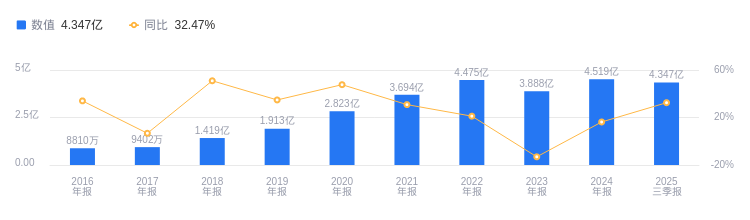
昊帆生物的前世今生:2025年Q3营收4.35亿排行业24,净利润9923.83万排16,扩张新产能突破瓶颈
Xin Lang Cai Jing· 2025-10-31 12:16
Core Viewpoint - Haofan Bio, a leading company in the peptide synthesis reagent sector, was established in December 2003 and went public on July 12, 2023, in Shenzhen, with its headquarters in Suzhou, Jiangsu Province [1] Group 1: Business Overview - Haofan Bio specializes in the research and sales of peptide synthesis reagents, protein crosslinkers, and molecular building blocks, with a focus on peptide drugs, innovative drugs, and biopharmaceuticals [1] - The company has a differentiated advantage in technology and customer resources [1] Group 2: Financial Performance - In Q3 2025, Haofan Bio reported revenue of 435 million yuan, ranking 24th among 34 companies in the industry, while the industry leader, Changchun High-tech, had revenue of 9.807 billion yuan [2] - The net profit for the same period was approximately 99.24 million yuan, placing the company 16th in the industry, with the top performer, Tonghua Dongbao, reporting a net profit of 1.188 billion yuan [2] Group 3: Financial Ratios - As of Q3 2025, Haofan Bio's debt-to-asset ratio was 7.86%, significantly lower than the industry average of 26.88%, indicating strong solvency [3] - The company's gross profit margin was 38.75%, which is below the industry average of 70.17%, suggesting room for improvement in profitability [3] Group 4: Shareholder Information - As of September 30, 2025, the number of A-share shareholders decreased by 12.14% to 10,000, while the average number of circulating A-shares held per shareholder increased by 19.09% to 4,200.4 [5] - The fifth largest circulating shareholder, Huatai-PB Health Mixed Fund, increased its holdings by 26,430 shares [5] Group 5: Future Outlook - The company is expected to maintain steady growth, with projected net profits of 166 million, 208 million, and 268 million yuan for 2025 to 2027, respectively, and corresponding EPS of 1.54, 1.93, and 2.48 yuan [5] - Haofan Bio has established a presence in over 1,900 pharmaceutical-related enterprises globally and is actively expanding into the European market [5] - The company is enhancing its production capacity through self-built facilities and acquisitions, with ongoing projects in Anhui and Huai'an expected to resolve capacity issues by mid-2026 [5]
医药板块迎大涨,恒生创新药ETF(159316)、医药ETF(512010)等产品受资金关注
Mei Ri Jing Ji Xin Wen· 2025-10-31 12:04
Core Viewpoint - The pharmaceutical sector has experienced a significant rally, particularly in the innovative drug concept, leading to a substantial recovery of the week's gap. The China Innovation Drug Industry Index rose by 1.5%, while the Hang Seng Hong Kong Stock Connect Innovative Drug Index increased by 1.0% this week [1] Group 1: Market Performance - The China Biotechnology Theme Index increased by 0.6%, while the China Hong Kong Stock Connect Medical and Health Comprehensive Index remained nearly flat. Conversely, the CSI 300 Medical and Health Index declined by 1.1% [1] - The Hang Seng Innovative Drug ETF (159316) attracted a total of 440 million yuan in net inflows over the first four trading days of the week, with an additional 5 million shares subscribed today. The Medical ETF (512010) also saw over 600 million yuan in net inflows during the same period [1] Group 2: Industry Developments - Recent positive developments in the innovative drug industry include a significant partnership between Innovent Biologics and Takeda, involving an initial payment of 1.2 billion USD, highlighting global market recognition of the value of Chinese innovative drugs [1] - On a macroeconomic level, the Federal Reserve's interest rate cut cycle is generally favorable for financing and valuation expansion of innovative drug companies, as historical data shows that pharmaceutical and biotech assets have performed well during such periods [1] Group 3: Index Information - The Hang Seng Hong Kong Stock Connect Innovative Drug Index focuses on leading innovative drug companies listed in Hong Kong, comprising no more than 40 stocks involved in research, development, and production of innovative drugs [3] - The CSI Innovation Drug Industry Index includes no more than 50 companies primarily engaged in innovative drug research and development, while the CSI Biotechnology Theme Index focuses on companies involved in gene diagnostics, biopharmaceuticals, and blood products [3][4]

久违了,“喝酒吃药”行情!港股通创新药ETF暴力反弹近5%,食品ETF连续吸金!软科技崛起,硬科技调整
Xin Lang Ji Jin· 2025-10-31 11:45
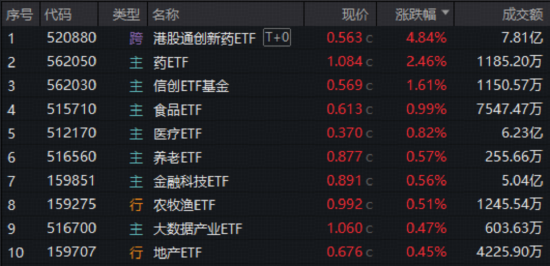
Group 1: Market Overview - A-shares and Hong Kong stocks experienced fluctuations, with the ChiNext Index dropping over 2% and the Hang Seng Index falling more than 1% [1] - The "drinking and eating" market saw a resurgence, with innovative drug sectors in A-shares and Hong Kong stocks performing well against the market trend [1][5] - The technology sector showed mixed performance, with hard tech like semiconductors and optical modules weakening, while domestic software gained traction [1] Group 2: Innovative Drug Sector - The Hong Kong Stock Connect Innovative Drug ETF (520880) surged by 4.84%, with over 260 million yuan added in the last 10 days [1][5] - The innovative drug sector is expected to benefit from the introduction of a "commercial insurance innovative drug directory" mechanism in the national medical insurance negotiations [5][7] - The ETF focuses on 100% innovative drug research and has a significant allocation to large-cap innovative drug leaders, showing a year-to-date increase of 108.14% [8][9] Group 3: Food and Beverage Sector - The Food ETF (515710) rose by 0.99%, attracting over 155 million yuan in the last five trading days, indicating a rebound in the food and beverage sector [1][10] - Key stocks in the food sector, including liquor brands, saw significant gains, with Guangzhou Restaurant and Gujing Gongjiu both rising over 6% [10][12] - The food and beverage industry is expected to recover as fiscal and monetary policies work together to improve consumer sentiment [12][13] Group 4: Technology Sector - The optical module sector faced declines, with the leading companies in this space experiencing significant drops post-earnings [2][14] - The AI application sector showed resilience, with companies like Deepin Technology rising over 13% despite the overall downturn in the technology sector [14][16] - The market is anticipated to remain volatile, but there are opportunities for investment in the AI and technology sectors as they are seen as key growth areas [16][17]
科创创新药ETF大涨7.27%点评
Mei Ri Jing Ji Xin Wen· 2025-10-31 11:37
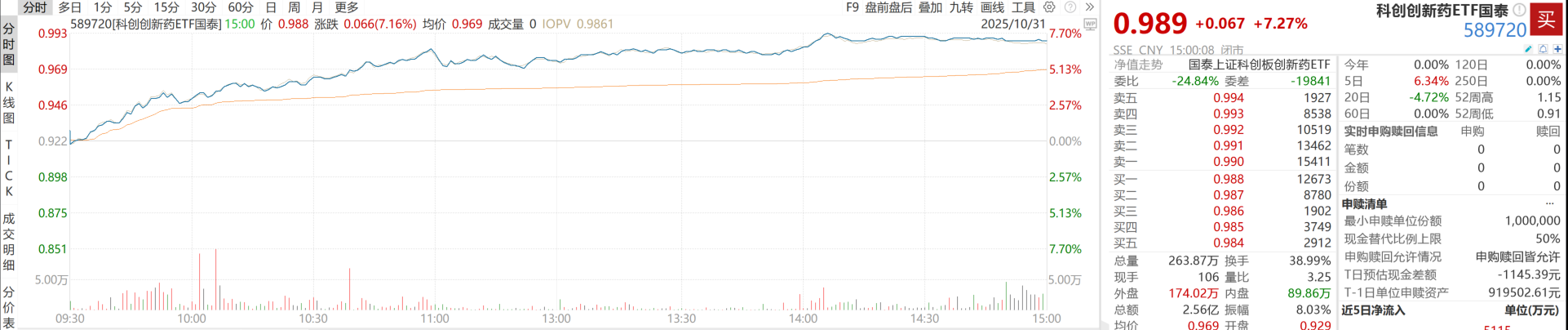
Core Viewpoint - The A-share market experienced a decline on October 31, with technology stocks pulling back while small-cap stocks rebounded, indicating a shift in market dynamics [1] Group 1: Market Performance - The Shanghai Composite Index fell by 0.81% to 3954.79 points, while the Shenzhen Component dropped by 1.14% and the ChiNext Index decreased by 2.31% [1] - The total trading volume in the A-share market was 2.35 trillion yuan, down from 2.46 trillion yuan the previous day [1] Group 2: Innovation Drug Sector Developments - Pfizer has initiated two global Phase III clinical trials for the PD-1/VEGF dual antibody (code: 707) developed by 3SBio, targeting first-line treatment for non-small cell lung cancer and colorectal cancer, marking a significant advancement in China's innovative drug export model [3] - Takeda's recent quarterly report provided an optimistic market potential assessment for the PD-1/IL-2α bispecific antibody (IBI363), predicting peak sales of approximately $40 billion across multiple indications, indicating a potential cornerstone drug in global oncology treatment [3] - The National Medical Insurance Directory negotiations have begun, aiming to complement basic medical insurance and facilitate the entry of high-priced innovative drugs into the market [3] Group 3: Investment Logic Shift - The investment logic in the innovative drug sector is evolving from speculative trading based on business development (BD) expectations to a focus on validating the actual value of collaborations, as evidenced by Pfizer's rapid advancement of clinical trials and Takeda's quantification of market potential [4] - The market is increasingly favoring leading innovative drug companies that have established deep partnerships with top multinational corporations (MNCs), as these collaborations are seen as endorsements of their innovation capabilities [4] Group 4: Future Market Outlook - Short-term expectations may recover as more MNCs disclose their investments and plans for collaborative pipelines, with attention returning to fundamentals [6] - Key upcoming milestones include data readouts from products entering late-stage global clinical trials, which could serve as catalysts for valuation increases [6] - Long-term, companies with sustainable first-in-class (FIC) or best-in-class (BIC) product platforms are expected to receive valuation premiums, reflecting a re-evaluation of their long-term value [6] Group 5: Investment Opportunities - The Innovation Drug ETF (517110) tracks the China-Hong Kong-Shenzhen innovative drug industry index, covering quality innovative drug companies across various stages, which may help mitigate risks associated with single technology failures [6] - The Science and Technology Innovation Drug ETF (589723) focuses on leading innovative drug companies in the STAR Market, showing stronger rebound potential compared to broader market indices [7]
新晋女首富诞生,1400亿
盐财经· 2025-10-31 11:10
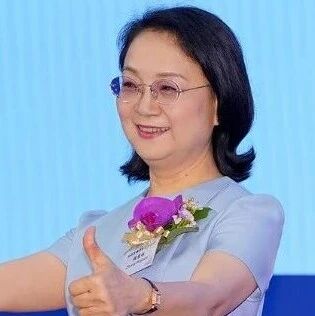
Core Insights - The article highlights the rise of Zhong Huijuan as the new female billionaire in China, with a wealth of 141 billion yuan, surpassing her predecessor Zong Fuli [4][8]. - Zhong Huijuan is the founder and CEO of Hansoh Pharmaceutical, which has seen its market value increase from 90 billion to over 200 billion HKD this year, reflecting the booming biopharmaceutical sector [4][8]. Company Overview - Zhong Huijuan transitioned from being a chemistry teacher to the pharmaceutical industry, joining Hansoh Pharmaceutical in its early days [7]. - The company initially focused on generic drugs but has shifted towards innovative drug development, particularly in oncology and other critical disease areas [7][8]. - Hansoh Pharmaceutical went public in June 2019 on the Hong Kong Stock Exchange [7]. Financial Performance - Hansoh Pharmaceutical's market capitalization has more than doubled this year, with a stock price increase of over 100% [8]. - Zhong Huijuan's wealth increased by over 60 billion yuan compared to the previous year, marking a significant financial milestone [8]. Strategic Developments - Recently, Hansoh Pharmaceutical entered a major licensing agreement with Roche for a targeted antibody-drug conjugate, which includes an upfront payment of 80 million USD and potential milestone payments of up to 1.45 billion USD [8]. - This deal exemplifies the lucrative opportunities within the biopharmaceutical sector, contributing to the company's substantial revenue potential [8]. Industry Trends - The article notes a broader trend of wealth accumulation among pharmaceutical entrepreneurs, particularly in the innovative drug sector, with several companies experiencing significant stock price increases [15][16]. - The biopharmaceutical industry in China is witnessing a surge in business development (BD) transactions, with a total of 63.55 billion USD in BD deals in the first half of the year, surpassing the total for 2024 [16][17]. - The market has seen a wave of new listings, with 14 pharmaceutical companies announcing plans to go public in Hong Kong in September alone [17]. Market Adjustments - Despite the growth, there are signs of market adjustments, with some leading innovative drug companies experiencing stock price corrections [18]. - Hansoh Pharmaceutical's stock performance following the Roche deal did not meet expectations, indicating potential volatility in the sector [18].
【财闻联播】理想召回11411辆汽车!因赛集团:终止重大资产重组事项
券商中国· 2025-10-31 11:03
Macro Dynamics - In September, the bond market issued a total of 81,027.8 billion yuan in various bonds, including 14,904.9 billion yuan in government bonds, 8,519.1 billion yuan in local government bonds, 11,741.0 billion yuan in financial bonds, 13,407.3 billion yuan in corporate credit bonds, 365.7 billion yuan in credit asset-backed securities, and 31,627.8 billion yuan in interbank certificates of deposit [2] - In September, China's foreign exchange market had a total transaction volume of 26.87 trillion yuan (approximately 3.78 trillion USD), with the interbank market accounting for 22.44 trillion yuan (approximately 3.16 trillion USD) [3] - In the first three quarters, the revenue of large-scale internet and related service enterprises in China reached 14,420 billion yuan, showing a year-on-year growth of 2.8% [4][5] Financial Institutions - China Taiping announced the sale of minority stakes in four companies for a total consideration of 6.5 billion yuan [8] - Hangzhou Bank received approval to issue capital instruments not exceeding 40 billion yuan [9] Market Data - On October 31, A-shares saw a collective decline, with the Shanghai Composite Index down 0.81%, the Shenzhen Component down 1.14%, and the ChiNext Index down 2.31% [11] - The financing balance in the two markets decreased by 7.392 billion yuan, with the Shanghai Stock Exchange reporting a balance of 12,535.78 billion yuan and the Shenzhen Stock Exchange reporting 12,196.92 billion yuan [12] Company Dynamics - China National Petroleum Corporation announced the resignation of Zhou Song as the chairman of the supervisory board [14] - InSai Group decided to terminate a major asset restructuring plan due to changes in the external environment [15] - Tianqi Co., Ltd. signed a strategic cooperation framework agreement with Foxconn Automotive to deploy at least 2,000 embodied intelligent robots over the next five years [17] - Li Auto announced a recall of 11,411 units of the MEGA 2024 electric vehicle due to potential safety hazards [18] - Qingyue Technology is under investigation by the China Securities Regulatory Commission for suspected false financial reporting [19]



创新药行情爆发,三生国健、舒泰神斩获“20cm”涨停
Huan Qiu Lao Hu Cai Jing· 2025-10-31 10:17
Core Insights - The innovative drug sector experienced a significant surge in stock prices, driven by news of the national medical insurance negotiation, with companies like Sanofi and Sihuan Pharmaceutical seeing their stocks hit the daily limit increase [1] - The introduction of the "Commercial Insurance Innovative Drug Directory" mechanism is expected to enhance the market for innovative drugs, allowing for better pricing and payment structures [1] Group 1: National Medical Insurance Negotiation - The 2025 National Medical Insurance negotiation commenced on October 30, introducing the "Commercial Insurance Innovative Drug Directory" for the first time [1] - This directory will include innovative drugs that are not yet part of the basic medical insurance but have high clinical value and significant patient benefits [1] - The development of commercial insurance is deemed essential, with the directory providing guidance for market pricing and optimizing drug price formation mechanisms [1] Group 2: Company-Specific Developments - On October 30, Pfizer registered two global Phase III clinical trials for the PD-1/VEGF bispecific antibody SSGJ-707, developed by Sihuan Pharmaceutical and Sanofi [2] - Pfizer will pay an upfront fee of $1.25 billion and up to $4.8 billion in milestone payments for the global development, production, and commercialization rights of SSGJ-707 [2] - Sanofi holds a 30% stake in the SSGJ-707 project, while Sihuan Pharmaceutical holds 70%, indicating potential future revenue from milestone payments for Sanofi [2] Group 3: Financial Performance - In Q3, Sanofi reported a revenue of 474 million yuan, a year-on-year increase of 38.27%, and a net profit of 209 million yuan, up 101.41% [3] - For the first three quarters, the company achieved a revenue of 1.116 billion yuan, reflecting an 18.80% year-on-year growth, and a net profit of 399 million yuan, a 71.15% increase [3] - The growth in revenue is attributed to licensing income from collaboration projects and an increase in CDMO business, alongside improved management efficiency and reduced expense ratios [3]
