
绿色金融

Search documents
盛树资产管理公司落地海南,打造链接全球资本与中国制度优势的双向枢纽
Sou Hu Wang· 2025-10-26 08:25
Core Viewpoint - Shengshu Asset Management Company plans to establish its China headquarters, Shengshu Investment (Hainan) Co., Ltd., in Sanya, Hainan, on December 28, 2025, reflecting confidence in China's long-term economic development and the increasing attractiveness of the Hainan Free Trade Port system [1][3] Group 1: Company Strategy and Operations - Shengshu Asset Management, headquartered in Singapore, focuses on international capital markets and serves high-net-worth clients, sovereign wealth funds, insurance groups, and large family offices [3] - The company is shifting its strategic focus from traditional mature markets to emerging economies, particularly those with clear policy benefits and institutional innovation, with Hainan being a prime example [3][4] - The establishment of the Hainan headquarters is part of Shengshu's global strategy to deepen its presence in China and radiate across Asia, with multiple functions including asset allocation, fund operation, market research, investor services, risk control, compliance supervision, and digital platform development [4][9] Group 2: Investment Plans and Financial Commitments - Shengshu plans to invest $1 billion in a diversified structured investment portfolio, with $400 million allocated to core industries in the free trade port, including cross-border asset management, international shipping settlement services, digital trade infrastructure, healthcare digital upgrades, and fintech projects [4][5] - An additional $300 million will target high-growth sectors such as green energy, carbon asset trading platforms, duty-free retail chains, cultural tourism innovation, and ESG-driven enterprise incubators [5][7] - The company will also allocate $200 million for quality infrastructure REITs assets, focusing on long-term stable cash flow [7] Group 3: Governance and Compliance - Shengshu plans to initiate a "全民持股计划" (Employee Stock Ownership Plan), aiming to release over 40% of company equity to core employees, individual investors, external strategic partners, and potential public investors [8] - The company has partnered with King & Wood Mallesons and PwC for comprehensive strategic cooperation to ensure compliance and regulatory alignment in the Chinese market [8][9] Group 4: Government Support and Future Outlook - The Hainan provincial government and Sanya municipal government have shown strong support for Shengshu's headquarters establishment, initiating a "green approval channel" for various operational needs [9][10] - By 2027, Shengshu aims to establish a local professional team of no less than 300 people in Hainan, covering key functions such as investment research, legal, compliance, market, data, and system development [9][10] - The company views the establishment of its headquarters as a validation of institutional pathways and an expression of capital trust in China, with Hainan expected to become a central node connecting global resources and Chinese industries [11]


前三季度我省主要金融指标平稳较快增长
Hai Nan Ri Bao· 2025-10-26 00:24
Financial Indicators - The total balance of various loans in Hainan reached 14,106 billion yuan by the end of September, showing a year-on-year growth of 11.9%, which is 4.5 percentage points higher than the same period last year [1] - The total balance of various deposits in Hainan was 15,384 billion yuan by the end of September, with a year-on-year growth of 8.9%, an increase of 2.0 percentage points compared to the same period last year [1] Inclusive Finance - The balance of inclusive small and micro loans in Hainan reached 1,305 billion yuan by the end of September, reflecting a year-on-year increase of 12.4% [1] Technology Finance - The balance of technology loans in Hainan was 1,588 billion yuan by the end of August, with a year-on-year growth of 12.7% [2] - Hainan Natural Rubber Industry Group issued 350 million yuan in the interbank bond market, marking the first nationwide agricultural science and technology bond [2] Green Finance - The balance of green loans in Hainan reached 1,668 billion yuan by the end of September, with an increase of 274 billion yuan since the beginning of the year [2] Pension and Consumer Finance - The balance of personal consumer loans (excluding personal housing loans) grew by 9.6% year-on-year by the end of September [2] - The balance of loans for the pension industry saw a significant increase of 163.5% year-on-year by the end of August [2]
书写金融强国建设北京篇章 ——写在2025金融街论坛年会开幕前夕
Jing Ji Ri Bao· 2025-10-25 22:10
Core Insights - The 2025 Financial Street Forum Annual Conference will be held in Beijing, focusing on "Innovation, Transformation, and Reshaping Global Financial Development" [1] - Beijing Financial Street is revitalizing its role in the new era, aiming to become a highland for asset management and contributing to the construction of a financial powerhouse [1][2] Group 1: Financial Street's Role and Contributions - Beijing Financial Street is a key area for financial institutions and talent, managing over 20 trillion yuan in assets, accounting for about half of the city's total and one-eighth of the national total [2] - The financial sector in Beijing achieved an added value of 670 billion yuan in the first three quarters of this year, representing a 9% year-on-year growth, with Financial Street making a significant contribution [2] - Financial Street is home to over 260 asset management institutions, forming a comprehensive asset management system across banking, securities, and insurance sectors [2] Group 2: Future Development Plans - Financial Street aims to build a more resilient, dynamic, and international financial system, enhancing its ability to attract global financial resources and foreign institutions [3] - The area is focused on improving capital market functions and supporting the listing and market value management of quality enterprises, particularly benefiting small and innovative businesses [3] Group 3: Open and Global Engagement - Financial Street has established a framework for institutional, business, and market openness, contributing nearly 70% of Beijing's financial tax revenue and about 35% of its financial added value [4] - The 2025 Financial Street Forum will host over 400 important guests from more than 30 countries and regions, with innovative overseas sub-forums set up in cities like Hong Kong and New York [4][5] - This initiative reflects Financial Street's expanding global network and commitment to high-level financial openness [5] Group 4: Financial Development Strategies - Financial Street is actively pursuing the "Five Major Articles" of financial development, focusing on high-quality growth paths [7] - The area is developing a technology finance hub, with an average annual growth rate of 15% in loans to technology enterprises during the 14th Five-Year Plan period [7] - Efforts are being made to enhance green finance services, with the district leading in various green development indicators [7]

全国首笔“VEP花木贷”花在哪里
Xin Hua Ri Bao· 2025-10-25 20:18
Core Insights - The introduction of the "VEP (Specific Regional Unit Ecological Product Value) Flower Loan" has successfully addressed the financing challenges in the flower industry of Shuyang County, with a loan amount of 5 million yuan based on an ecological value assessment of 61.1883 million yuan [1][2] - The transformation from "selling products" to "selling landscapes" reflects a strategic shift in the flower industry, focusing on enhancing the overall aesthetic and value of the products [2][3] - The financial innovation has catalyzed a broader industry transformation, integrating talent development, brand building, and platform construction to drive high-quality growth in the flower industry [4] Financial Innovation and Impact - The "VEP Flower Loan" has been utilized for upgrading the garden park, turning it into a national 3A-level tourist attraction, demonstrating a reinvestment in enhancing product appeal [2] - The loan's ripple effect has encouraged other enterprises to invest in artistic re-creation of seedlings, leading to significant profit margins from miniature garden sales [2][3] - Shuyang County aims to increase the proportion of cultural tourism revenue to 15% of the total flower production value within three years, indicating a clear strategic direction for industry growth [2] Talent Development and Industry Ecosystem - The establishment of master studios for bonsai artists has become a breeding ground for cultivating local craftsmanship, enhancing the quality and marketability of Shuyang's flower products [3] - A systematic talent cultivation plan is in place, aiming to increase the number of senior professionals and elevate local experts to the level of "Chinese Bonsai Art Masters" [3] - The county's efforts to create a comprehensive industrial platform have attracted businesses from established flower production areas, highlighting the competitive advantages of Shuyang's integrated resources [3] Digital Transformation and Efficiency - Shuyang County is building a data-driven industrial network that integrates logistics, e-commerce, and financial services, enhancing operational efficiency and sales conversion rates [3] - The establishment of a "Flower Big Data Element Application Center" and a video live-streaming center aims to leverage digital tools for better industry performance [3]
国家开发银行做好“五篇大文章” 奋力书写金融高质量发展新篇章
Zheng Quan Ri Bao· 2025-10-25 16:44
Core Viewpoint - The China Development Bank (CDB) is committed to serving the real economy by enhancing its financial services across five key areas: technology finance, green finance, inclusive finance, pension finance, and digital finance, thereby contributing to the construction of a strong financial nation [1] Group 1: Technology Finance - CDB actively promotes financial services for technological innovation, providing comprehensive financial support for major national technology tasks and tech enterprises, facilitating the development of new productive forces [2][3] - CDB has issued its first batch of three "Technology Innovation Bonds" totaling 20 billion yuan, aimed at supporting technology innovation demonstration enterprises and high-tech manufacturing industries [3] Group 2: Green Finance - CDB focuses on financing for green upgrades in infrastructure, low-carbon technology innovation, and energy transitions, supporting major ecological projects and initiatives [4][5] - Since the 14th Five-Year Plan, CDB has issued 157 billion yuan in green financial bonds to support national strategies related to ecological protection and high-quality development [6] Group 3: Inclusive Finance - CDB has played a significant role in providing student loans, disbursing 246 billion yuan to support over 23 million students, accounting for over 80% of the national total [6] - The bank has supported over 1.5 million small and micro enterprises, enhancing financial services in key sectors such as technology innovation and green development [6] Group 4: Pension Finance - CDB has supported the construction of over 190,000 inclusive pension beds during the 14th Five-Year Plan, addressing the needs of the aging population [8][9] - The bank has developed personalized financing solutions to revitalize and integrate idle elderly care resources, enhancing the availability of diverse elderly care services [9] Group 5: Digital Finance - CDB is advancing digital transformation by supporting the construction of foundational networks and AI infrastructure, aiming to enhance the efficiency of financial services [10][11] - The bank is implementing innovative loan models using AI and mobile applications to improve the student loan process and overall service experience [11]
绿色债券周度数据跟踪-20251025
Soochow Securities· 2025-10-25 09:47
证券研究报告·固定收益·固收点评 固收点评 20251025 绿色债券周度数据跟踪 (20251020-20251024) [Table_Tag] [Table_Summary] 观点 ◼ 一级市场发行情况: 本周(20251020-20251024)银行间市场及交易所市场共新发行绿色债券 30 只,合计发行规模约 55.01 亿元,较上周减少 49.41 亿元。发行年限 多为 3 年;发行人性质为地方国有企业、央企子公司、大型民企、其他 企业;主体评级多为 AAA、AA+级;发行人地域为宁夏回族自治区、山 东省、湖北省、吉林省、北京市、广东省、天津市、浙江省、江苏省; 发行债券种类为中期票据、私募公司债、企业 ABS、交易商协会 ABN、 超短期融资券、一般公司债。 ◼ 二级市场成交情况: 本周(20251020-20251024)绿色债券周成交额合计 665 亿元,较上周增 加 52 亿元。分债券种类来看,成交量前三为非金公司信用债、金融机 构债和利率债,分别为 335 亿元、255 亿元和 49 亿元;分发行期限来 看,3Y 以下绿色债券成交量最高,占比约 79.62%,市场热度持续;分 发行主体行业来 ...
中信证券发布三季度报 资产规模首次超两万亿
Sou Hu Cai Jing· 2025-10-25 09:47
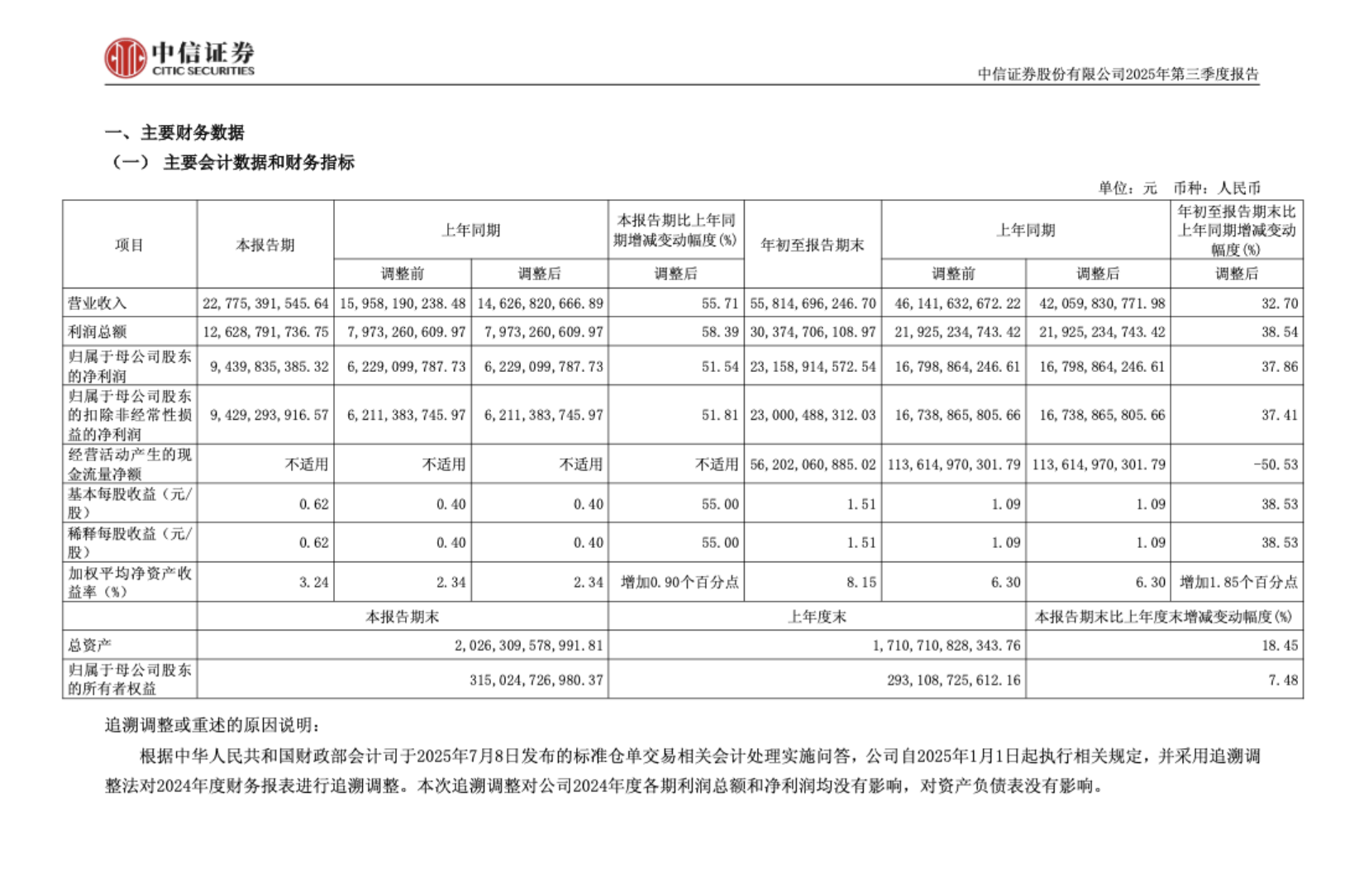
Core Points - CITIC Securities has become the first brokerage in China to exceed total assets of 2 trillion yuan, reaching 2.03 trillion yuan as of September 30, 2025 [1] - The company reported a significant increase in operating income and net profit for the third quarter of 2025, with operating income of 55.81 billion yuan, a year-on-year increase of 32.70%, and net profit attributable to shareholders of 23.16 billion yuan, a year-on-year increase of 37.86% [4] - The return on equity (ROE) reached 8.15%, an increase of 1.85 percentage points compared to the previous year [4] Financial Performance - Total assets as of the end of the reporting period were 2,026.31 billion yuan, with net assets attributable to shareholders reaching 315 billion yuan [2][4] - The basic and diluted earnings per share were both 0.62 yuan, reflecting a 55% increase compared to the same period last year [2] - The net cash flow from operating activities for the year-to-date was 56.20 billion yuan, indicating strong operational cash generation [2] Sector Contributions - In the technology finance sector, CITIC Securities completed equity underwriting of 112.3 billion yuan for the Sci-Tech Innovation Board, Growth Enterprise Market, and Beijing Stock Exchange from 2023 to the third quarter of 2025 [4] - The company assisted BYD in completing a $5.6 billion H-share placement, setting a record in the global automotive industry and Hong Kong market [4] - In green finance, CITIC Securities completed green bond underwriting amounting to 181 billion yuan from 2023 to the third quarter of 2025 [5] Other Initiatives - The company has developed a comprehensive green service system and has engaged in rural revitalization bonds totaling 1.55 billion yuan [5] - CITIC Securities has over 4.7 trillion yuan in asset management scale as of September 30, 2025, and has launched initiatives to enhance awareness of retirement planning among the youth [5] - The company is advancing its digital transformation with the development of AI digital employees, having launched 18 digital staff and 118 AI application scenarios [5]

江苏银行荣膺第十届“融城杯金融科技创新十佳案例”
Xin Lang Cai Jing· 2025-10-25 07:39
Core Insights - Jiangsu Bank's "Su Yin Green Finance Intelligent Service Platform" was recognized as one of the "Top Ten Financial Technology Innovation Cases" at the 10th "Rongcheng Cup" awards, highlighting the industry's acknowledgment of the bank's technological innovation capabilities [1][2] Group 1: Event Overview - The "Rongcheng Cup" financial technology case evaluation was co-hosted by the New Financial Alliance (NFA) and Financial City, with academic support from the China Financial Forty Forum (CF40) and Peking University's Digital Finance Research Center [2] - The evaluation process began on June 19 and included a rigorous selection and review, resulting in ten exemplary cases across various important fields such as inclusive finance, green finance, consumer protection, supply chain finance, and risk management [2] Group 2: Platform Development - Jiangsu Bank has been committed to the concept of green development and has integrated "greening" with "digitalization" as a key path for high-quality transformation in green finance [3] - The "Su Yin Green Finance Intelligent Service Platform" was developed over five years, employing a gradual development strategy to create a comprehensive decision management platform that integrates technological breakthroughs, model innovation, and ecological construction [3] Group 3: Core Functions - The platform addresses industry challenges such as the identification of diverse green business, analysis of vast green asset data, ESG risk management, and high-standard environmental information disclosure [4] - It features five core functions: green business identification, ESG risk management, environmental information disclosure, specialty product management, and green asset management, with several functions being industry firsts [4] Group 4: Technological Empowerment - The platform utilizes three core technologies to enhance its functionalities, including a large language model based on the DeepSeek architecture for building a green industry knowledge base, machine learning algorithms for optimizing important green finance models, and a domestic distributed big data platform for secure data integration [5] Group 5: Achievements and Impact - As of now, Jiangsu Bank has managed a green financing scale exceeding 750 billion yuan, achieving a reduction of 5.62 million tons of carbon dioxide emissions, saving 2 million tons of standard coal, and conserving 4.09 million tons of water [6] - The bank's achievements in the digitalization of green finance have received high praise from regulatory bodies and internal user groups, demonstrating a leading role in providing replicable and promotable advanced experiences for the integration of "greening" and "digitalization" in the financial industry [6]

全球瞭望|英国经济学家:英国应持续加强对华经贸合作
Xin Hua She· 2025-10-25 07:17
Core Viewpoint - The article emphasizes the importance of strengthening economic and trade cooperation between the UK and China across various sectors, including trade, investment, finance, and green development [1][2]. Group 1: Economic Cooperation - China is recognized as the world's second-largest economy and has been a major contributor to global economic growth over the past 25 years [1]. - The UK is urged to enhance its economic ties with China in light of rising protectionism and geopolitical tensions, which necessitate collaboration with other major economies [1]. Group 2: Green Development - China's achievements in green development, particularly in renewable energy, are highlighted as significant, presenting opportunities for collaboration in green finance between the UK and China [1]. Group 3: Trade Relations - China is currently the UK's fifth-largest trading partner, indicating substantial room for growth in goods, services, and investment [1]. - Recent activities aimed at promoting connectivity include the 11th UK-China Economic and Financial Dialogue held in Beijing and the first meeting of the UK-China Economic and Trade Joint Committee in seven years [1]. Group 4: Policy Recommendations - Continuous strengthening of UK-China economic cooperation is deemed necessary, with a call for coherent policies from the UK government [2]. - The UK is encouraged to leverage its strengths in financial and professional services, high-end manufacturing, life sciences, clean energy, and creative industries to seek more collaborative opportunities [2].
央行:前三季度绿色贷款新增6.47万亿 科技企业获贷率三连升
2 1 Shi Ji Jing Ji Bao Dao· 2025-10-25 00:52
Core Insights - The People's Bank of China reported a 6.6% year-on-year increase in the total balance of RMB loans, reaching 270.39 trillion yuan by the end of Q3 2025, with a total increase of 14.75 trillion yuan in the first three quarters [1] - The loan structure has been optimized, with significant support for green, inclusive, and technological innovation sectors [1][2] Loan Growth and Structure - The balance of corporate and institutional loans reached 184.3 trillion yuan, growing by 8.2% year-on-year [1] - Short-term loans and bill financing increased by 9.3% to 62.77 trillion yuan, while medium to long-term loans grew by 7.8% to 117.89 trillion yuan [1] - Fixed asset loans amounted to 77.55 trillion yuan, up 7.0%, and operational loans reached 75.63 trillion yuan, increasing by 9.0% [1] Sector-Specific Loan Performance - Industrial medium to long-term loans stood at 26.59 trillion yuan, growing by 9.7%, while service sector loans reached 72.36 trillion yuan, up 6.8% [2] - Inclusive small and micro loans grew by 12.2% to 36.09 trillion yuan, significantly outpacing overall loan growth [2] - Green loans reached 43.51 trillion yuan, with a 17.5% increase, accounting for 43.9% of total loan increments in the first three quarters [2][3] Support for Innovation and Agriculture - Loans for technology-based SMEs grew by 22.3% to 3.56 trillion yuan, reflecting strong policy support [3][4] - The loan approval rate for high-tech enterprises increased to 57.6%, with a total loan balance of 18.84 trillion yuan [4] - Agricultural loans reached 53.4 trillion yuan, growing by 6.8%, indicating solid financial support for rural revitalization [4] Real Estate and Consumer Loans - Real estate loans showed stability, with a slight year-on-year decrease of 0.1%, while personal housing loans decreased by 0.3% [4] - Household loans totaled 83.94 trillion yuan, growing by 2.3%, with operational loans increasing by 4.8% [4][5] - Short-term consumer loans demonstrated resilience, supported by effective interest subsidy policies and expanding credit in service consumption [5]